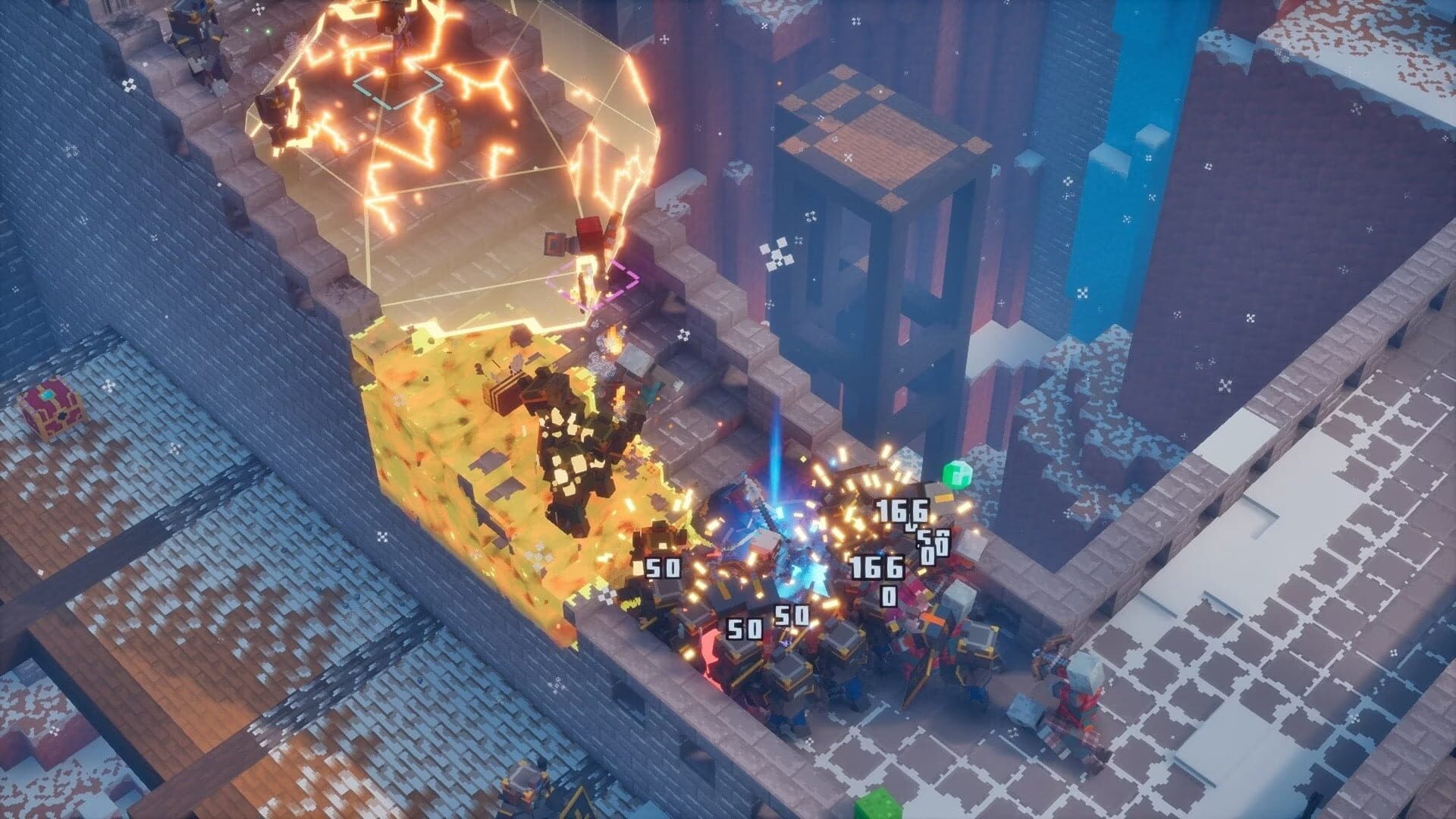
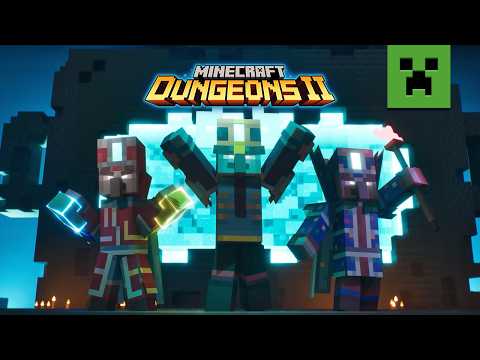
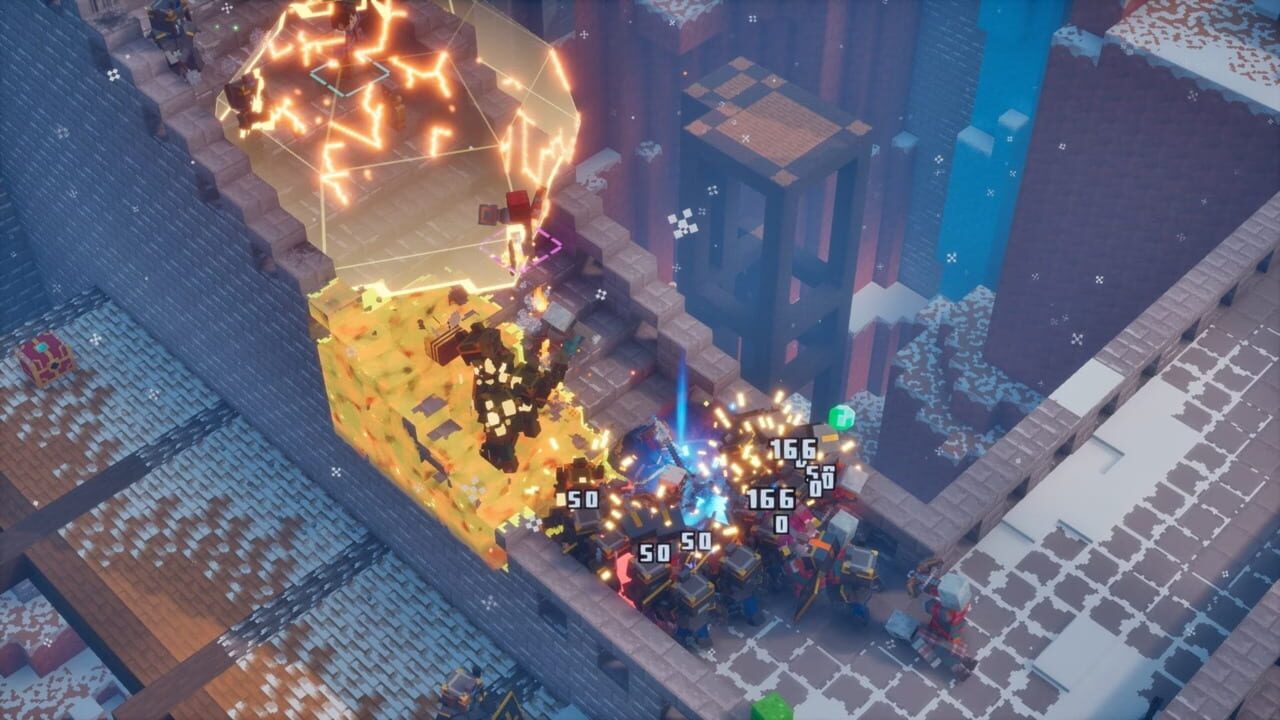
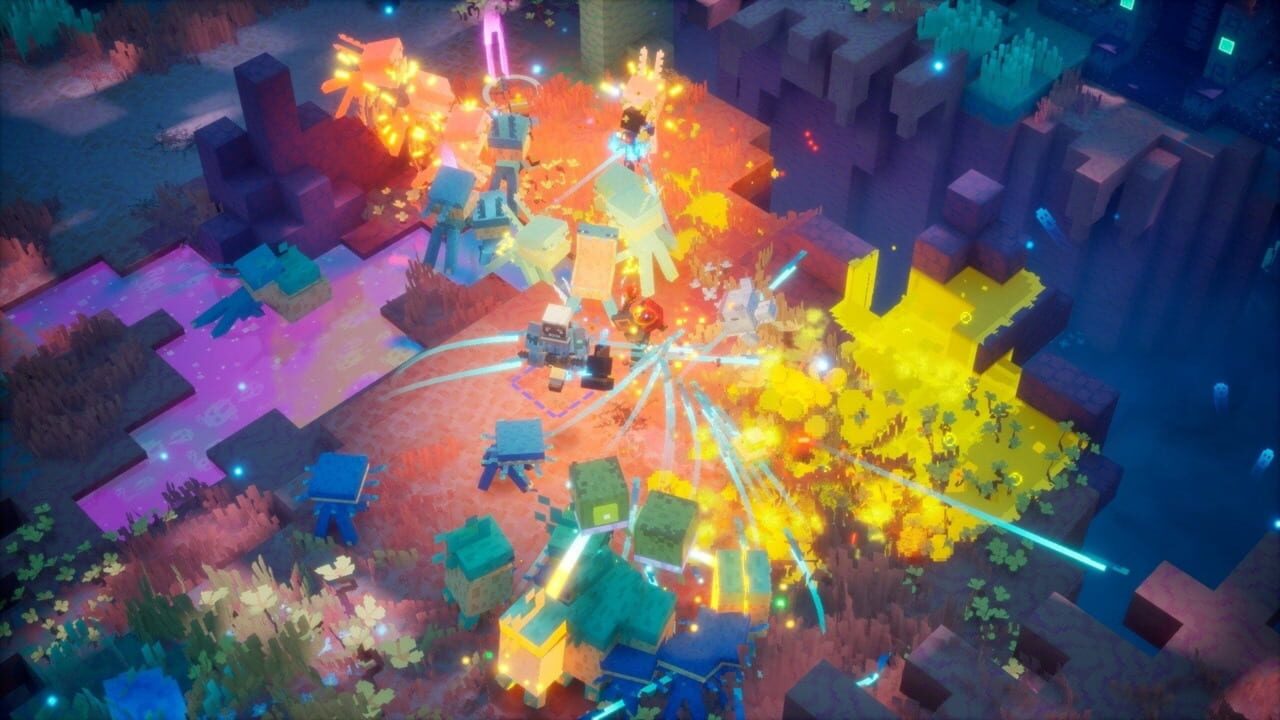
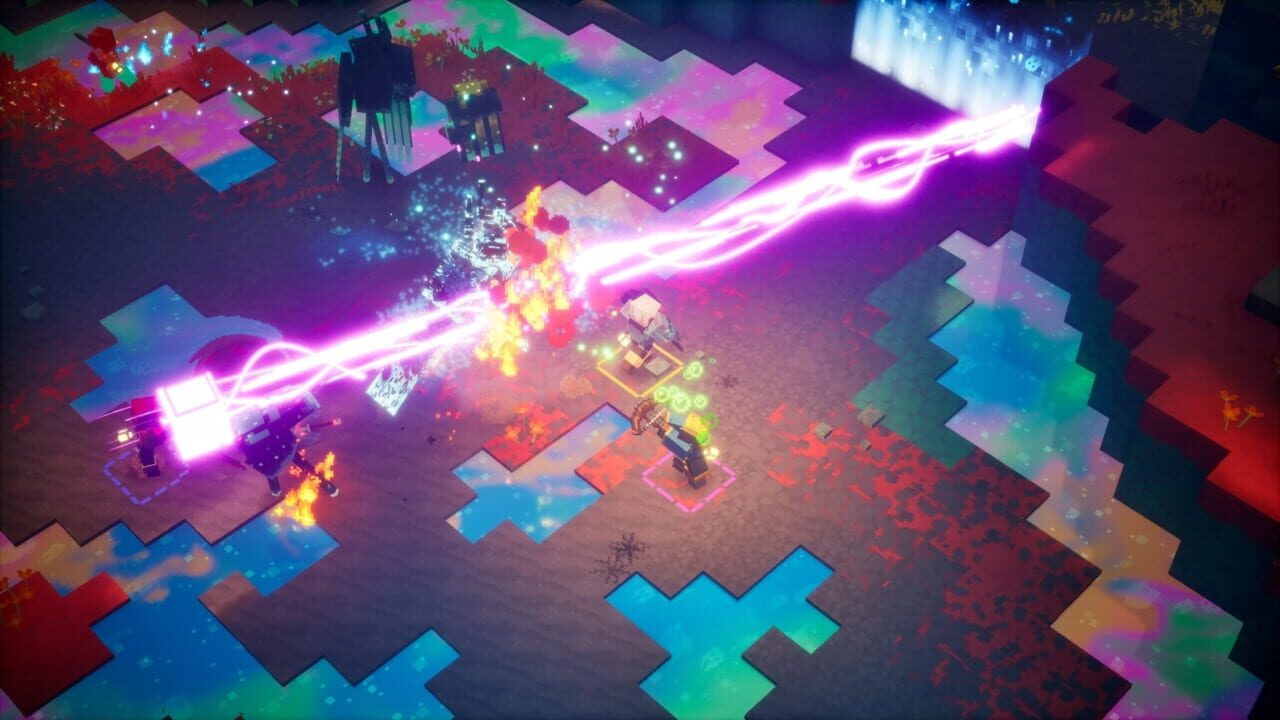
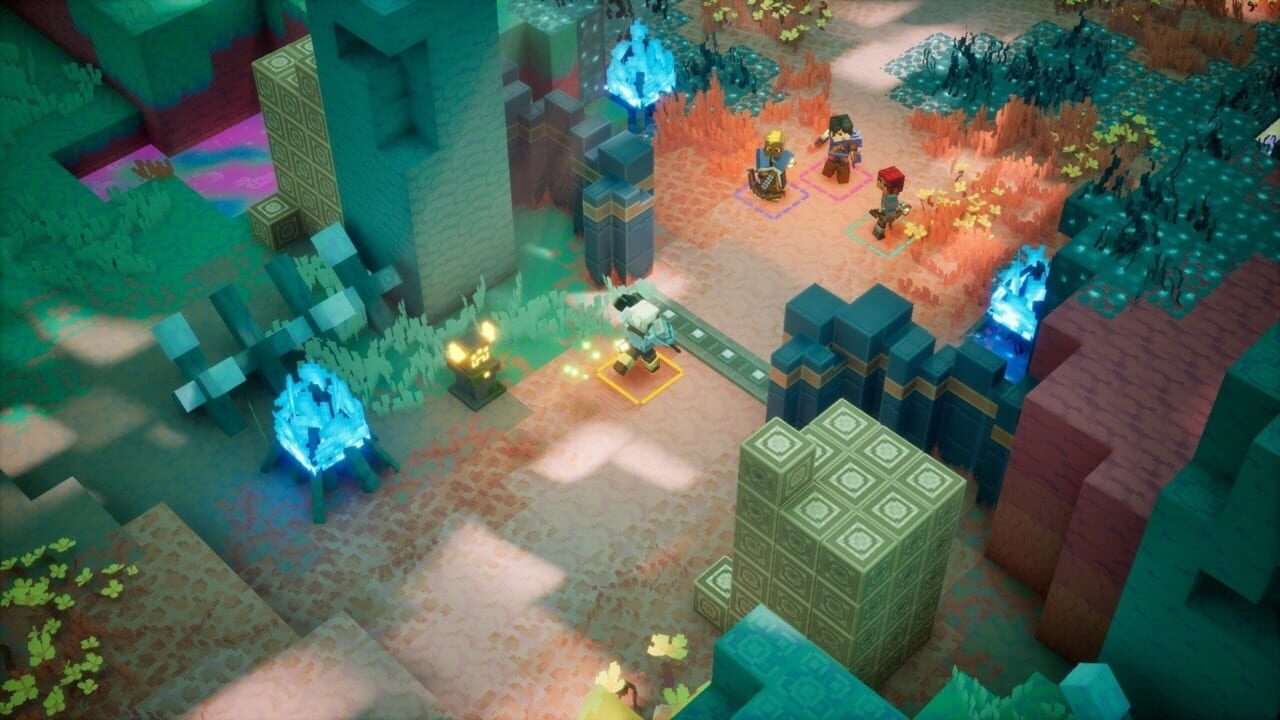
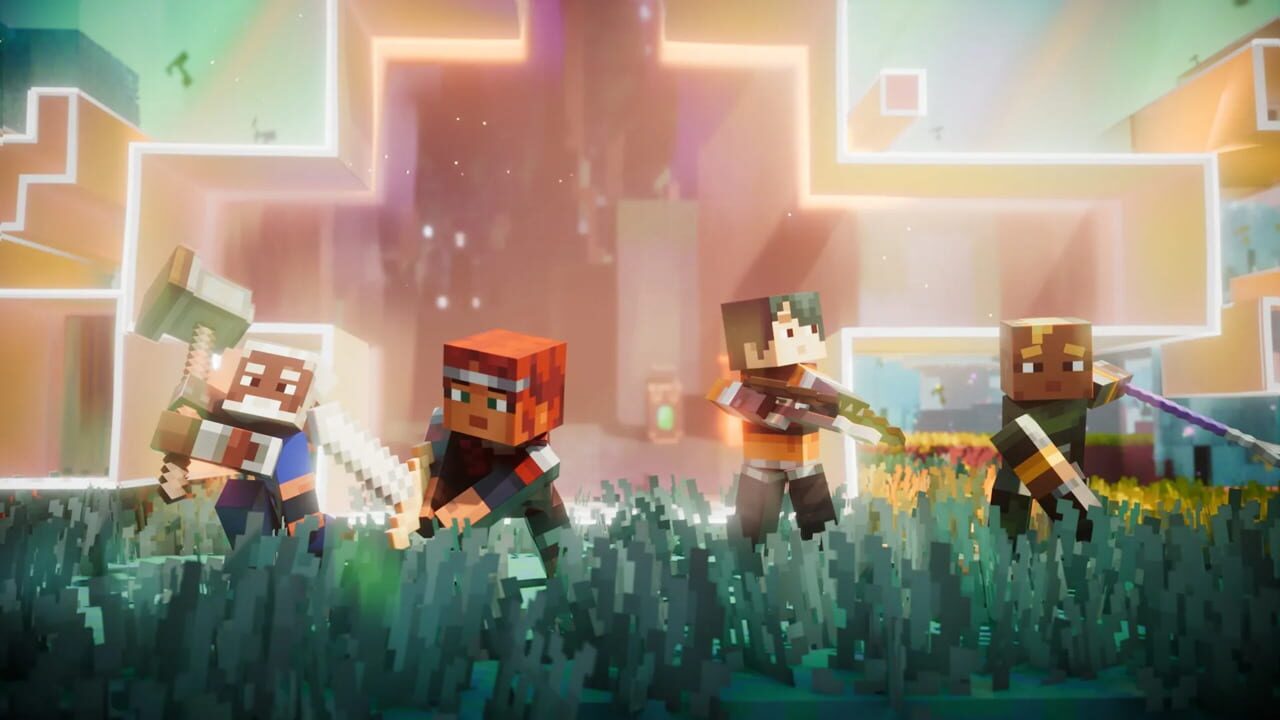


A boy of about eight is standing in front of a television with a controller held in both hands, thumbs already sore, and a sword has just fallen out of a skeleton onto the floor of a dungeon rendered in the same blocky geometry as the world he has spent four hundred hours terraforming on his own save file. The sword is yellow. Yellow is good. He does not know yet how good, because the number on it has not resolved into meaning, but the color has already told him everything the color is designed to tell him, and he is reaching for the pickup prompt before the game has finished animating the drop. Somewhere upstream of this moment, a designer decided that yellow would mean this and blue would mean something lesser and orange would mean something rarer still, and that decision is doing exactly what it was built to do, on exactly the nervous system it was built to do it to. This is a Form & Systems reading, and the form in question is not new. It is the loot table, the chassis under every action role-playing game since Diablo taught the genre in 1996 that a player will click on a corpse forever if the corpse sometimes contains something good. What is new, in Minecraft Dungeons II, is the age of the hand doing the clicking. Mojang's sequel, arriving this fall as a four-player co-op dungeon crawler built on top of the Minecraft license, inherits the loot loop wholesale and points it at a player base that skews, by any reasonable estimate of who plays Minecraft, considerably younger than the one Diablo or Path of Exile or Destiny were built for. The original Minecraft Dungeons was described on release, accurately, as Diablo for kids. The sequel is the same claim made twice. The easy essay here writes itself in one sentence: games are slot machines, and now they are slot machines for children, and that is a scandal. It is not the essay this piece is going to write, because the sentence is both too easy and not quite true. What Dungeons II actually does, by simplifying the action-RPG loop down to something an eight-year-old can operate without a wiki open on a second screen, is not disguise the machine better. It strips the disguise off. Genres accumulate complexity precisely because complexity is where the compulsion architecture hides from the player experiencing it, and a game built to be legible to a child cannot afford that complexity. What is left, once the talent trees and stat sheets and crafting economies are gone, is the mechanism in something close to its bare form: press a button, kill a thing, see a color, want the next color. Looking at that bare mechanism clearly is more useful, not less, for understanding what every game in the genre has been doing to adults for three decades. The mechanism has a name, and the name predates video games by seventy years. B. F. Skinner's operant-conditioning chambers, running through the 1940s and 1950s at Harvard and then Indiana, established that reinforcement delivered on a variable ratio, an unpredictable number of responses required before a reward arrives, produces the highest and steadiest response rate of any schedule Skinner tested, and the most resistance to extinction once reward stops. A pigeon on a fixed schedule, one peck equals one pellet every tenth peck, learns the pattern and paces itself. A pigeon on a variable schedule, reward arriving after three pecks sometimes and thirty pecks other times with no way to predict which, pecks continuously, because the next peck might be the one. Skinner wrote in Science and Human Behavior that a gambling establishment achieves its effect not by refusing to pay out but by paying out unpredictably, and that the unpredictability is the entire mechanism. He also ran an experiment, in 1948, in which pigeons fed on a fixed time interval regardless of behavior developed elaborate repeated motions anyway, head-bobbing, turning in circles, because whatever they happened to be doing when the food arrived got reinforced into ritual. The pigeon does not need to understand the schedule to be shaped by it. This is the part that matters for a game aimed at children: neither does an eight-year-old. The loot table itself has a specific origin, and the origin matters because it shows the schedule was never accidental. Diablo's design team at Blizzard North built the randomized item drop as a deliberate answer to a specific problem: a hack-and-slash game with fixed, predictable rewards runs out of reasons to keep playing once the story ends. David Brevik, the game's lead designer, has described the randomization as the mechanism that let a short campaign support hundreds of hours of replay, because no two runs through the same dungeon would offer the same incentive to keep going. That is a real design achievement, and it is also, described plainly, an engineering decision to substitute unpredictable reward for finite content. The genre that followed, Torchlight, Path of Exile, Borderlands, the endless loot-shooters of the 2010s, all inherited the same substitution and refined it, mostly by adding more categories of item, more visible rarity tiers, more numbers on the tooltip, so that the underlying schedule had more surface to hide behind. Minecraft Dungeons II inherits the substitution too, four items of quality tier, a handful of enchantment slots, nothing an adult player would call deep, and in stripping the surface back down to something a child can parse, it makes the original substitution visible again: reward randomized in place of reward guaranteed, because randomized reward keeps the loop running longer. A loot table is a variable-ratio schedule wearing a skeleton costume. Kill a mob, and a roll happens against a table of possible drops weighted by rarity, invisible to the player, resolving instantly into an item that is common, rare, unique, or nothing at all. The player cannot see the roll. The player experiences only the outcome, and the outcome is unpredictable in exactly the way Skinner's reinforcement schedule requires: sometimes the very next kill drops the good sword, sometimes forty kills pass with nothing worth equipping, and there is no way to know in advance which forty kills those will be. Minecraft Dungeons II does not need to dress this in the language of a casino to run it. It only needs enemies, a kill button, and an item that occasionally looks better than the one currently equipped. The genre's habitual scaffolding, class builds, gear synergies, damage-type triangles, exists mostly to give adult players something to reason about on top of the schedule. Strip the scaffolding for an audience too young to hold it, as Dungeons II does by design, and the schedule is what remains, running at full strength, uncamouflaged. The counter-argument deserves to be taken seriously rather than waved off, because it is not wrong on its own terms. Anticipation is not inherently a pathology. A great deal of what makes any skill-based activity absorbing, fishing, a jump-shot practiced until it lands, a boss fight learned through repeated failure, is exactly the gap between action and uncertain outcome that Skinner's chamber isolates in the lab. Mihaly Csikszentmihalyi's flow research, built on interviews with rock climbers, chess players, and surgeons through the 1970s and 1980s, found that sustained engagement peaks not when outcomes are guaranteed but when a person's skill is closely matched to a challenge whose result is genuinely in question. A child getting better at dodging a zombie's swing, learning the tell before the hit lands, timing a roll correctly for the first time, is exercising something real: developing motor prediction, pattern recognition, hand-eye coordination under mild stress. None of that is manufactured compulsion. It is closer to what play has always been for. Csikszentmihalyi's own case studies are worth sitting with here, because they were never drawn from casinos. They were drawn from surgeons losing track of time mid-operation, from a composer describing the hours a symphony took to write as feeling like minutes, from a fourteen-year-old chess player who could not explain what he found absorbing about the game except that the board seemed to think along with him. The common structural feature across all of them was a channel narrow enough that the person's full attention fit inside it, with clear goals and immediate feedback on whether the current action was working. A child three hours into a Dungeons II session, learning which enemy telegraphs a charge and which one telegraphs a ranged attack, adjusting a dodge timing session over session until the dodge becomes automatic, is inside a channel of exactly that kind. The game is teaching a skill, and the skill is real, transferable in miniature to the next action game the child plays and arguably to any task that rewards sustained attention and rapid feedback. Denying that this is happening, in the interest of making the loot-table argument land harder, would be its own kind of dishonesty, the mirror image of the industry's habit of calling every reward system a form of engagement without asking what kind. The honest distinction is not between games that create anticipation and games that do not. Every game worth finishing does that. The distinction is between anticipation that resolves through the player's own growing competence and anticipation that resolves through a die roll the player's competence cannot touch. Landing the dodge is flow. The color of the sword that drops afterward is not flow; the player's skill had no bearing on whether the drop table rolled yellow or nothing at all. Dungeons II, like every loot-driven action-RPG before it, braids these two things so tightly that a child playing it has no reason to separate them, and arguably no ability to. The genre's entire pleasure depends on the braid holding. This essay is not arguing the braid should be cut. It is arguing that naming which strand is which is the useful thing a reader can carry out of a children's dungeon crawler and into every other loot game they or their kids will ever play. Where the argument that Dungeons II is simply a scandal actually fails is on the question of monetization, and it fails on evidence rather than intuition. The mechanism King and Delfabbro identified in their 2018 study of loot-box design, and the one Zendle and Cairns found correlated with problem-gambling symptoms in their large-scale 2018 survey, is not the variable-ratio schedule alone. It is the variable-ratio schedule wired to a real-money purchase point, so that the unpredictable reward can be bought directly rather than only earned through play, and a subsequent systematic review by Spicer and colleagues in 2022 found the correlation between loot-box spending and gambling-adjacent behavior held specifically where money changed hands for chance. That is the structure that makes "loot boxes are like slot machines" more than a metaphor: a slot machine, notably, also requires a coin. The original Minecraft Dungeons shipped in 2020 with no microtransactions and Mojang stated it would not add them, monetizing instead through conventional paid DLC that added new levels, story content, and a wider gear pool, purchased once, playable indefinitely, with no chance element attached to the purchase itself. Nothing in the announce trailer for Dungeons II, built around the Deep Dark and a new antagonist called the Twisted Warden, suggests a departure from that model. A child chasing a yellow sword in Dungeons II is chasing a schedule, but not a bill. That is a real and defensible difference from the mobile gacha games and loot-crate shooters the "games are casinos" argument was actually built to describe, and an essay that erases the difference to make its point stronger is making a weaker argument by making a wider one. What the monetization question leaves standing is narrower and more interesting than a scandal: a design decision to run the compulsion architecture on a child's nervous system for its own sake, not for revenue, because the architecture is judged to be good clean fun once the cash register is removed from it. That judgment is not obviously wrong. It is also not obviously examined, by the discourse around games like this one, with anything like the scrutiny the loot-box-and-money version receives. A reward schedule engineered to produce steady, high-frequency responding is still a reward schedule engineered to produce steady, high-frequency responding whether or not a wallet is involved, and Skinner's pigeons were not being sold anything either. The interesting question Dungeons II poses is not "is this predatory," which it structurally is not, but "what does it mean to build the purest available version of a compulsion loop and hand it to the age group with the least capacity to notice it operating." The answer this essay wants to offer is: it means the loop was never really about money to begin with. Money was one especially profitable place to attach it. Dungeons II shows the loop can run just as cleanly attached to nothing but the drop table itself. There is a second argument the game makes, sitting directly next to the first, and it belongs to the same lens because it is also a question about what the form actually delivers against what it promises. Minecraft's central and only truly novel contribution to games, when it arrived in 2011, was not its aesthetic. Voxel graphics existed before it. The contribution was a verb: place block. Every other thing Minecraft became, the survival loop, the redstone engineering, the servers with entire reconstructed cities, is downstream of that one verb being handed to the player with no restriction on where or when to use it. A 2024 study published in the Journal of Environmental Psychology, running a cluster-randomized trial across primary schools using Minecraft Education, found measurable gains in spatial reasoning tied specifically to the building and modification tasks the intervention assigned, not to combat or exploration modes. The placing is where the documented cognitive work happens. It is the verb doing the work Minecraft is actually known for. Minecraft Dungeons II borrows every surface of that world, the blocky biomes, the pig and the creeper, the crafting-table iconography repurposed into an enchanting interface, and gives the player none of the verb that made the surface mean something. There is no placing block in a dungeon crawler built for corridors and combat arenas; the level exists before the player arrives and is unchanged by the time they leave it, aside from the corpses. What Dungeons II sells the child holding the controller is Minecraft's whole visual grammar of buildability, the promise every block-shaped surface in that game has always made, that this world is made of discrete, liftable, placeable units and therefore is yours to rearrange, without ever cashing the promise in. The blocks are there to be recognized, not touched. A child who has spent real hours in the original game learning that a block means an object waiting to be picked up is handed, in the sequel-in-name-only, a world built entirely out of blocks that behave like scenery. This is not a flaw exactly, because the genre Dungeons II is actually working in, the isometric loot-crawler, has never needed a building verb and does not miss one in its native context. It becomes a flaw specifically at the intersection with the Minecraft license, where the aesthetic has spent fifteen years training an audience, much of it literally children, to read blockiness as an invitation. Dungeons II accepts the association and declines the invitation. Put the two observations together and the shape of what the game is doing comes into focus. It takes an aesthetic whose entire cultural meaning is built around a verb, agency, the world as raw material, and pairs it with a system whose entire mechanical meaning is built around the absence of agency in the one place that matters most, the moment the reward resolves. The child gets the look of a world they can shape and the feel of a machine that shapes them instead, on a schedule they cannot see and would not, at eight, have the conceptual tools to name even if it were shown to them. None of this makes Dungeons II a bad game for children, and nothing in the loot-table research says a child playing it will come to harm the way a person feeding coins into a fixed-odds terminal might. The schedule without the wager is a different animal, quieter, and the flow research suggests some real portion of what a child feels while playing is honest skill-acquisition pleasure rather than manufactured craving. But the schedule is still the schedule. It still produces the head-bob, the reach for the next kill before the last drop has finished animating, the difficulty later in life of walking away from any system built the same way. That is the frame worth carrying out of a children's dungeon crawler and into the rest of the genre. The next loot-driven game, adult-rated, elaborately statted, wrapped in seasons and battle passes and skill trees deep enough to obscure the mechanism under an afternoon of theorycrafting, is running the same reinforcement schedule Dungeons II runs in the open. The complexity is not incidental to the disguise. It is the disguise. A player who has watched an eight-year-old reach for a yellow sword before the drop animation finishes has seen the whole apparatus stripped down to its moving parts, and can recognize those parts the next time they show up wearing a stat sheet instead of a crayon-bright color code. Yellow is good. The boy already knows this, the way Skinner's pigeons knew which peck came before the pellet, without either of them needing the word for what they had learned.
Tuesday analysis
The Loot Loop, Built for Eight-Year-Olds
- Writer
- J. A. Marsh
- Lens
- Form & Systems
- Published
- MAR 27, 2026
- Length
- 2,957 words / 13 min
- Notes
- 9 sources
A player who has watched an eight-year-old reach for a yellow sword before the drop animation finishes has seen the whole apparatus stripped down to its moving parts.