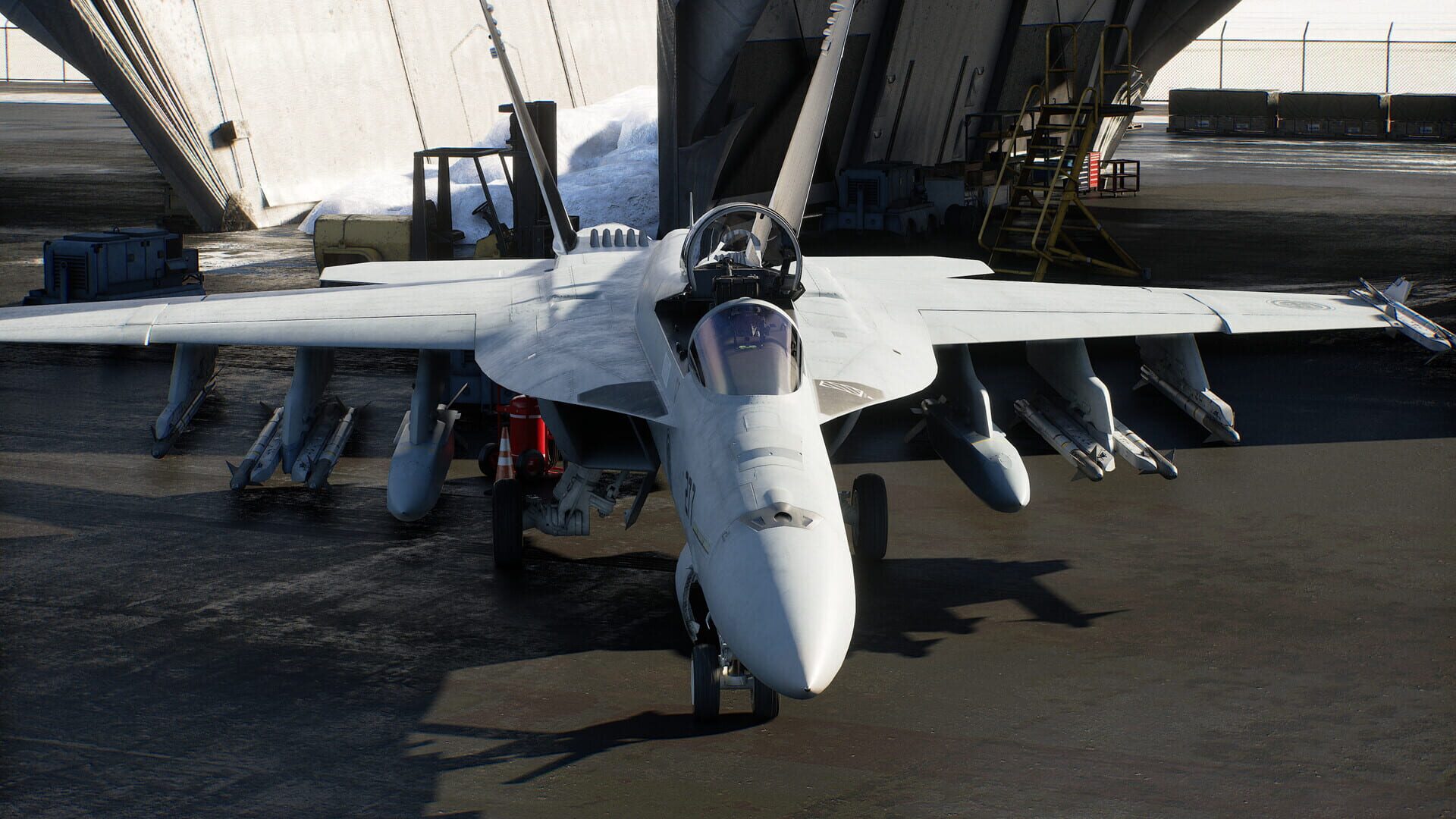
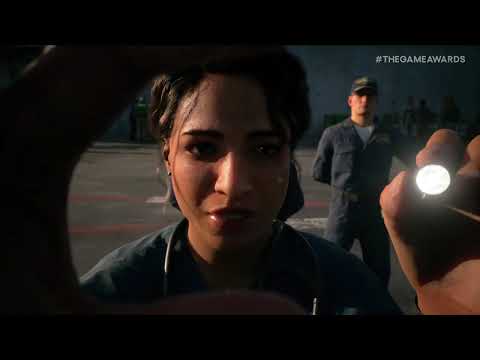

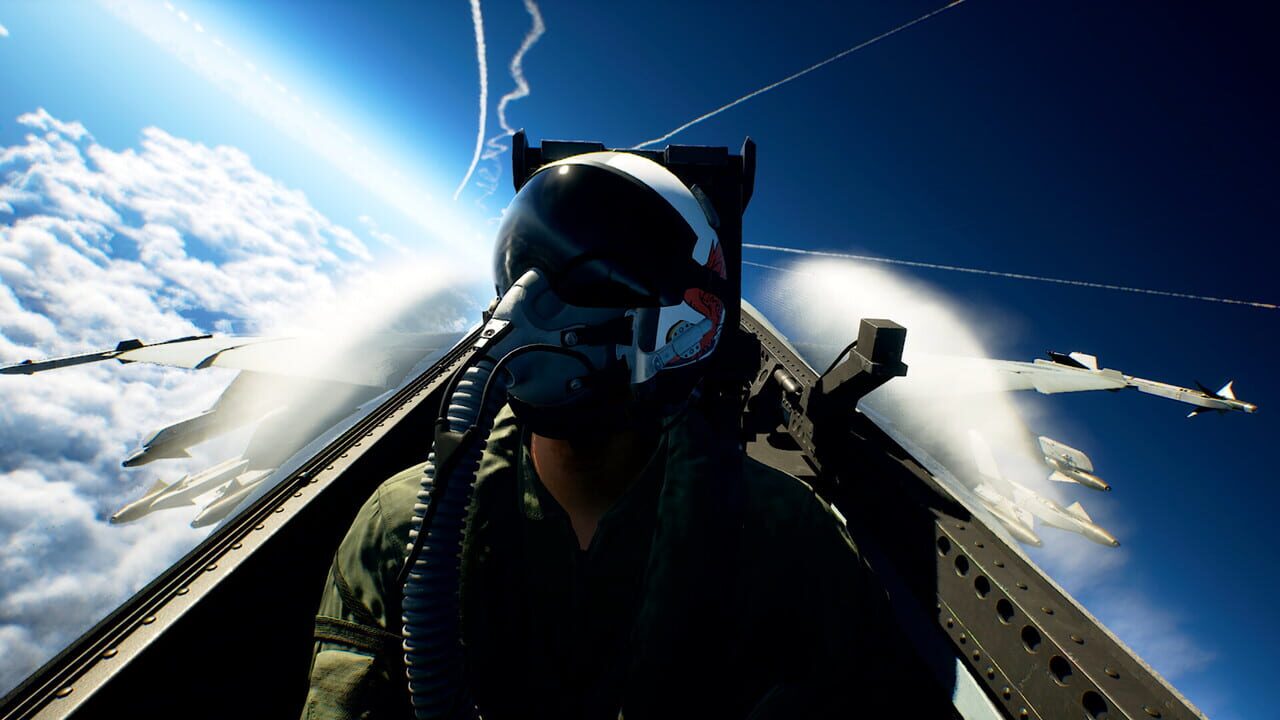


Three seconds of dead air, then a voice, compressed almost to a rasp, cutting through the static: "Blaze, this is Chopper. I'm hit. I'm hit bad." No face attached to it. No cockpit shown. Just the voice, thinned by a radio filter that clips its low end and squashes its dynamic range into a narrow, buzzing band, arriving at the exact volume of every other voice on the channel, friend and stranger alike. In Ace Combat 5: The Unsung War, released in 2004, the player has flown alongside Chopper for perhaps forty minutes of missions. They have never seen him. They will, in the next ten seconds, listen to him die, and it will land harder than almost anything a cutscene in the same series has managed with an actual character model on screen. This is the essay's subject and its method both: an image-and-sound reading of a series that has spent a quarter century building its emotional architecture almost entirely out of a channel most action games treat as decoration. Ace Combat 8: Wings of Theve, releasing this September from Bandai Namco Aces, continues a design lineage in which the wingmen the player fights beside are rarely modeled, rarely lit, rarely given a face the camera lingers on. They are radio chatter: compressed, interrupted, sometimes overlapping, occasionally garbled past comprehension. The series has consistently produced stronger attachment through that thin, noisy channel than most contemporary games manage with fully rendered faces, motion-captured performances, and cutscenes budgeted like small films. The claim of this essay is not that voice-only characterization is a clever workaround for a flight game's inability to show cockpit intimacy. It is that the absence of the face is doing structural work, and that the specific vocabulary of radio, its distortion, its overlap, its refusal to let the listener see who is speaking, is the mechanism by which that work gets done. Ace Combat 8 has not shipped. This essay does not describe playing it, and it makes no claim about specific scenes, specific lines, or specific character beats in a game not yet public. What is public: the setting is the Federation of Central Usea in July 2029, a nation overrun in a lightning invasion by the Republic of Sotoa, its military scattered, its capital of Theve reduced to a symbol the player's callsign is named for. What is also public, and more durable than any single plot detail, is the design tradition Wings of Theve inherits. Every mainline Ace Combat game since at least Ace Combat 4 in 2001 has built its cast primarily through radio, and the series' producer, Kazutoki Kono, has described the fictional setting of Strangereal, the alternate Earth every mainline game takes place on, as deliberately "accommodating": realistic enough to carry weight, fictional enough to let the writers do what a documentary treatment of real air combat could not. One of the things that accommodation has always paid for is a communications channel that never has to justify why the player cannot see the people talking. In a Strangereal cockpit, nobody can. The visor is down, the HUD is up, and the only other pilots the player will ever meet are voices. Start with what the acousmatic voice is, because the word is going to do real work in this essay and it deserves a plain-language account before it does any. Acousmatic, revived by the radio engineer and composer Pierre Schaeffer in the 1950s to describe the specific experience of hearing music on the radio without seeing the instruments that produced it, names a simple but consequential fact: a sound heard without its source visible behaves differently in the mind than the same sound heard with the source in view. Schaeffer was interested in this mostly as a compositional tool, a way of getting listeners to hear a sound as pure sound rather than as an assumption about its cause. The film theorist Michel Chion picked the term up decades later and pushed it toward drama. Chion's specific contribution, laid out across The Voice in Cinema, is the idea of the acousmêtre, a character defined by a voice the audience hears repeatedly before, or instead of, ever seeing a body attached to it. Chion's examples are the Wizard of Oz's disembodied bellow, the killer's voice on the phone in horror thrillers, the ghost in a haunted-house story who speaks from the next room. His argument is that the acousmêtre accumulates a specific kind of power that an on-screen character cannot: because the listener has not been given a face to file the voice under, the voice becomes free to feel bigger, closer, and more urgent than any face could make it, right up until the moment it is finally attached to a body, at which point some of that power visibly drains away. Chion calls this "de-acousmatization," and treats it, correctly, as almost always a diminishment. A wingman on an Ace Combat radio channel is a mundane, repeated, everyday version of the acousmêtre, doing the same trick at a much smaller and much more frequent scale, mission after mission, for thirty or forty hours of play. The player never sees Chopper's face. They never see Nagase's face, or Blaze's, in any of the moments where the character is actually speaking to them in the cockpit, because the cockpit view keeps the player's own aircraft's canopy in frame and every other plane is a distant, banking silhouette against cloud. What the player gets instead is a voice, and only a voice, arriving through a filter that narrows its frequency range and compresses its dynamics the way real VHF aircraft radio does, clipping the warmth out of the low end and pushing everything toward a thin, present, slightly abrasive midrange. That filtering is not incidental production polish. It is the acousmatic condition made audible: a voice stripped of the visual and even much of the acoustic information that would normally let a listener place a body, an expression, an age, a size behind it, replaced with a signal that the listener's mind has to do more work to interpret, and therefore invests more of itself in. There is a second, more concrete piece of engineering doing work here, and it deserves to be named for what it is rather than waved at as atmosphere. Squelch is a real circuit function in analog and early digital radio, designed to suppress a receiver's output in the absence of a signal strong enough to be real speech rather than noise. Its audible signature, familiar to anyone who has used a walkie-talkie or a CB radio, is the sharp gate at the start and end of a transmission: a beat of near-silence, then a faint hiss as the circuit opens, then the voice, then a hard cutoff back to silence when the speaker releases the key. Ace Combat's sound design has, across its console-era entries, consistently reproduced this gating behavior rather than smoothing it into a clean broadcast-quality voice track. The effect is that every line of wingman dialogue arrives with its own tiny ritual of appearing and vanishing: a small door opening, a voice stepping through it, the door closing again. Radio drama scholarship has a name for the broader phenomenon this belongs to. Neil Verma, in Theater of the Mind, his study of American radio drama from the Depression through the Cold War, documents how radio dramatists of the 1930s and 1940s developed what he calls an "intimate" style specifically to exploit the fact that a voice arriving alone, without picture, forces the listener's imagination to supply the missing image, and that supplying it is a more active, more binding act of attention than simply watching a face do the same emotional work on a screen. The squelch gate is a percussive, mechanical version of the same principle: it marks the boundary of each utterance sharply enough that the listener's attention snaps to it, every time, the way attention snaps to a doorbell more reliably than to background music. None of this would matter if the content of the chatter were merely functional, callouts and confirmations with no emotional freight. It rarely is, and the series has understood since at least Ace Combat 5 that a wingman's voice earns attachment the way any character earns it in fiction with no visual channel at all, which is to say through repetition, specificity, and small consistent behavioral tells carried entirely in vocal performance: a particular way of swearing under pressure, a particular cadence when calling a kill, a particular hesitation before a risky maneuver. Chopper's death in Ace Combat 5 works because the player has, by that point in the campaign, heard his voice do a dozen small, specific things: joke nervously before a mission, call out a target with slightly too much enthusiasm, needle another squadmate over the radio in a way that reads, without any image attached to it, as a particular kind of person. When his voice breaks and cuts out, the player is not losing a character model. They are losing the only version of Chopper that ever existed for them, the sound of him, and the loss is total in a way that a wounded character clutching their chest on screen rarely manages, because the screen version leaves the player something to look at after the moment has passed. The radio version leaves nothing. The channel goes quiet, and the quiet is the whole of the grief the game is asking for. The overlapping-transmission problem is worth its own treatment, because it is the mechanism by which Ace Combat's radio chatter builds something a single acousmatic voice cannot: the impression of a world larger than the mission the player is flying. A single wingman speaking to the player one line at a time produces intimacy. Multiple voices, some addressed to the player and some clearly not, layered over each other on the same channel or on adjacent ones the player catches only fragments of, produces scale. Ace Combat's mission audio has long included chatter that is not, strictly, for the player: enemy squadrons coordinating with each other in dialogue the player intercepts rather than receives, allied ground units calling in status updates that have nothing to do with the player's own objective, command-level traffic discussing the broader campaign in terms the player's own briefing never fully explained. None of it is fully legible in the moment, because combat audio is busy and the player's attention is mostly on the sky. A world rendered entirely in dialogue addressed to the player would feel like a stage set built for an audience of one. A world in which the player periodically overhears voices that are not talking to them, doing things the mission briefing did not mention, feels like a world that would keep going if the player's plane were shot down and the mission ended early. Verma's account of the "kaleidosonic" radio drama style, the other pole from the intimate style he documents in the same period, describes exactly this effect: sound designed to suggest a wide, moving, only partially graspable field of activity, rather than a single voice speaking directly into the listener's ear. Ace Combat's mission audio typically runs both registers at once, intimate wingman chatter close and clear, kaleidosonic background traffic distant and half-comprehensible, and the two together produce something neither could alone: a battlefield that has weather in it, other squadrons in it, a command structure in it, none of which the game had to render as a single additional polygon. The technique has a history inside the series worth tracing briefly, because it did not arrive fully formed. Ace Combat 4: Shattered Skies, released in 2001 and the first entry to build a Strangereal campaign with real narrative ambition, introduced the device that later games leaned on harder: mission briefings and radio traffic voiced not by a single narrator but by a rotating cast of unseen squadron members, ground crew, and enemy pilots, each identifiable by voice alone across a campaign with almost no character art beyond static portrait icons. That game's most quoted line, an enemy ace's radio taunt delivered entirely as audio over a black loading screen, has outlived nearly every rendered cutscene image the PlayStation 2 era of the series produced, which is itself a small piece of evidence for the argument: the image faded from memory in a way engineered nowhere near as durably as the audio. Ace Combat 5 took the device further by attaching it to squad dynamics rather than single rival pilots, giving the player an entire flight of named wingmen, Chopper among them, whose voices had to be distinguishable from each other in real time during missions where four or five people were talking at once. That is a harder design problem than a single acousmêtre, because it requires the sound team to make voice alone carry not just character but also legibility: the player has to know, instantly and without looking at a subtitle, which of five unseen pilots just called out a bandit at their six. The series solved this the way radio drama solved the same problem a half century earlier, through consistent vocal casting, consistent register, and consistent verbal tics, the same tools Verma documents 1930s and 1940s radio writers using to keep a listener oriented among characters who existed only as voices on a single shared channel. Ace Combat 7, in 2019, added the wrinkle of enemy transmissions bleeding into the player's own channel through jamming and interference effects, voices arriving already half-destroyed, which pushes Chion's acousmatic account somewhere he did not fully anticipate: not a voice without a body, but a voice actively fighting to remain a voice at all against a channel trying to erase it. Wings of Theve, built for a hardware generation with far more headroom for spatial audio and per-source processing than any previous entry, inherits all three techniques, rotating cast, layered simultaneity, degrading signal, as a mature toolkit rather than an experiment. What the marketing has not needed to say, because it is baked into the genre rather than pitched as a feature, is that the player's attachment to this cast will again be built almost entirely through their ears. It is worth pausing on the obvious counter-reading, because it is a fair one. A skeptic could argue that Ace Combat's reliance on radio-only characterization is not an aesthetic choice at all, but a budget one: rendering thirty distinct, motion-captured wingman faces across a campaign is expensive, and a voice track is comparatively cheap. There is truth in this. Arcade flight combat has never had AAA-tier character-animation budgets, and the series has made a virtue of a constraint it did not fully choose. But the constraint argument does not survive contact with how deliberately the games use the tool once they have it. Ace Combat 7: Skies Unknown, released in 2019 with a budget that did stretch to fully rendered cutscene faces for its handful of named human characters, still runs the vast majority of its wingman and enemy-ace dialogue as pure radio chatter, unseen, even in missions where showing a face would have cost nothing additional. The choice persists past the point where it can be explained by cost alone, which suggests the team understands what this essay is arguing: that the unseen voice is doing something the seen face cannot, not merely something cheaper than the face. There is a related design fact that sharpens the point. Ace Combat's aces, the game's recurring rival pilots, the Yellow Squadron of Ace Combat 5, the Belkan holdouts of Ace Combat Zero, are almost never given faces either, even in games with the budget to spare. Their signature is a callsign, a distinctive aircraft livery, and a voice performance the player learns to recognize across an entire campaign the way a person learns to recognize a specific radio host's voice without ever having seen a photograph of them. Ace Combat Zero's Belkan War, released in 2006 as a prequel to Ace Combat 5, builds its most acclaimed rival character, the mercenary ace Cipher fights across the campaign, entirely on this principle: a callsign, a livery, and a voice whose specific menace comes from the player never being able to attach a face to it and file the threat away as merely another enemy plane. The design team could have shown that face in a cutscene at any point across two decades of re-releases and did not. Chion's account of de-acousmatization as diminishment explains why: showing the face would have cashed in something the games have deliberately kept in reserve. None of this is unique to Ace Combat in the abstract. Games have used radio-only characters before, and other media discovered the acousmatic voice's power long before video games existed to borrow it. What is specific to Ace Combat is the density and duration of the technique: dozens of hours across nearly two decades of mainline entries, in a genre, arcade flight combat, whose core moment-to-moment gameplay physically cannot show the player another pilot's face even if the writers wanted to, because the cockpit view is fixed forward and the enemy planes are, correctly, rendered as small and distant. The series did not invent the acousmatic voice. It found a genre in which the acousmatic voice was structurally mandatory, and then, rather than fighting that constraint with cutscenes and character models, built its entire emotional architecture inside it. Wings of Theve inherits a design problem that every mainline entry before it has already solved in roughly this way: how do you make a player love a person they will never see. The answer the series keeps arriving at is that you do not need to solve the seeing at all. You need the voice to be specific, the radio to be loud with other lives the player is only half-hearing, and the gate to snap shut, hard, the moment the transmission ends. The frame carries past the cockpit. Any game, any medium, that relies on voice-only characters, a dispatcher in a delivery-driving game, an unseen commander in a strategy title, a narrator who is never shown a body, is drawing on the same acousmatic mechanism Ace Combat has spent twenty years refining by accident of genre. The voice on the radio never blinks, never flinches, never looks away to check its phone. It has nothing to do but talk to you, and the not-seeing is what lets the talking do that much work. The next time an unseen voice on a headset says it is hit, hit bad, and then says nothing else, it is worth noticing that the silence that follows is doing more than any face could have, precisely because there was never a face to begin with.
Tuesday analysis
You Fall in Love With a Voice on the Radio
- Writer
- J. A. Marsh
- Lens
- Image & Sound
- Published
- MAR 6, 2026
- Length
- 3,129 words / 14 min
- Notes
- 8 sources
The voice on the radio never blinks, never flinches, never looks away to check its phone. It has nothing to do but talk to you, and the not-seeing is what lets the talking do that much work.