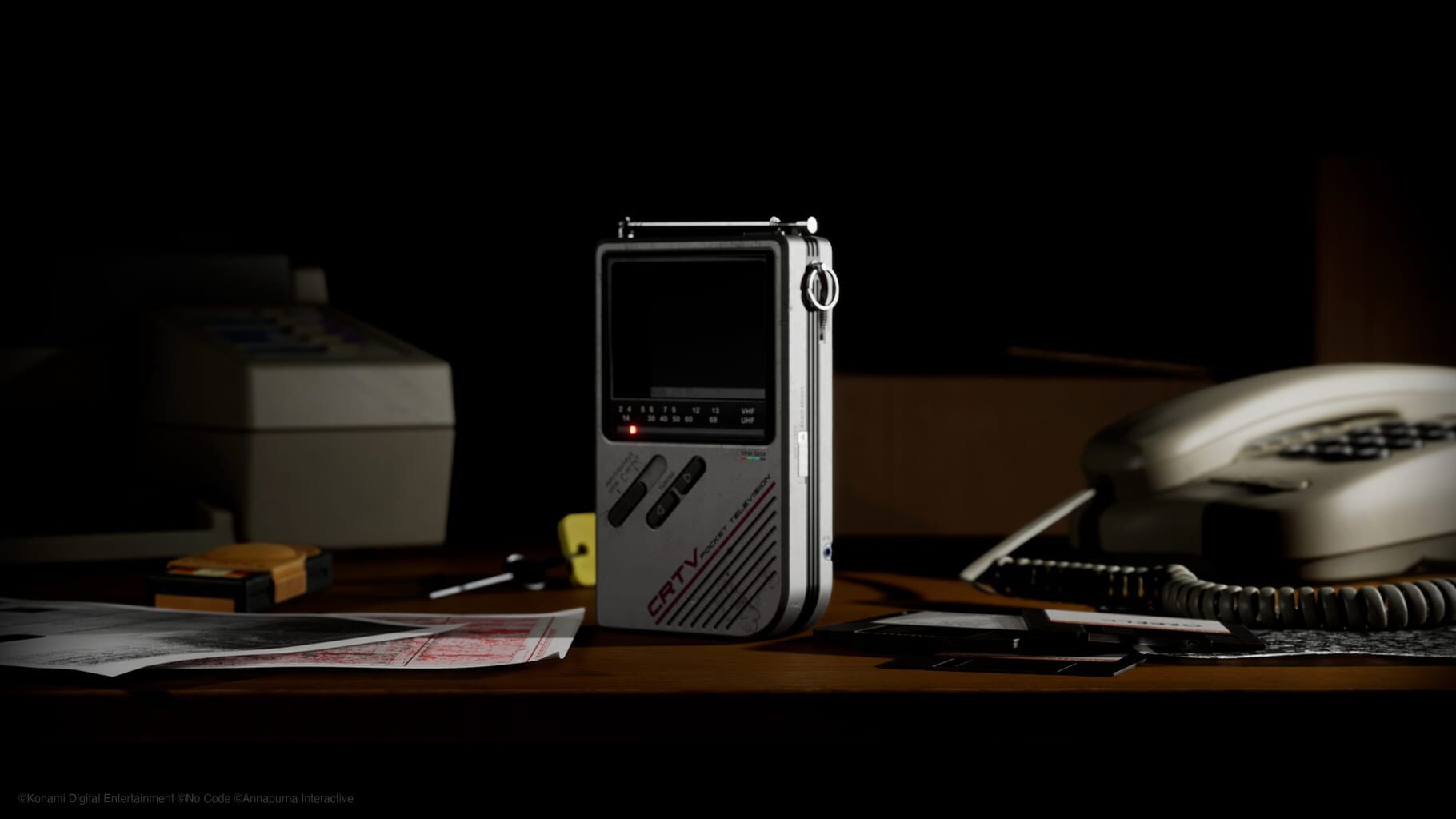


Somewhere on the PlayStation development kit at Konami, in 1998 or early 1999, an engineer opened a level of a game called Silent Hill and watched the world stop rendering thirteen and a half meters from the camera. Past that line there was nothing. Not black, not distance haze in the sense a modern engine means it, just an absence where geometry should have continued and did not, because the console did not have the triangles to spare. New pieces of the town loaded in in real time as the player advanced, close enough that a faster walk would have caught the seams. The fix that shipped was fog: a dense, moving, grey-white wall pushed close enough to the player's eye that the edge of the world was never visible, because the edge of the world was hidden inside it. That is the origin the corpus of Silent Hill scholarship has more or less settled on, confirmed by the development team itself in interviews from the game's original press run. Director Keiichiro Toyama has said the atmosphere he wanted was "closer to what we experience when sleeping, in dreams and nightmares," and that the player was meant to gather "fragments" and reconstruct them, the way a dream reconstructs a day. Sound director Akira Yamaoka built the score out of industrial noise rather than melody, on the theory that Silent Hill needed to sound like a place that existed rather than a place that was scored. Neither man has ever claimed the fog was a purely artistic decision arrived at before the hardware forced the question. The fog was a solution to a rendering problem that a design team recognized, quickly, as more than a solution. This is a piece of image-and-sound criticism, not a piece of studio history, so the origin matters here for one reason: it tells us what fog does before anyone decided what fog meant. Silent Hill: Townfall, from the Glasgow studio Screen Burn Interactive, formerly No Code, arrives in September 2026 with none of that constraint. It runs on hardware that will draw geometry to the horizon without blinking, on an engine built by people who have never had to hide a seam. Screen Burn's fog is a choice made by artists with full information, rendered by a machine with no limit to confess. The question a reader might expect a piece like this to ask is whether the choice still works when it is no longer forced. That question turns out to be the wrong one, or at least the smaller one. The better question, and the one this essay wants to sit with, is what it means to render occlusion on purpose. Not to hide the seam because you have to, but to build the seam because you have learned exactly what the seam does to a human visual system, and to install it anyway. Vision is not a camera. This is the least controversial claim in contemporary perceptual science and the most consistently under-applied one in conversations about horror games, which still tend to talk about fog and darkness as if they were curtains pulled across a stage, hiding a set that exists in full behind them. The predictive-processing account of perception, laid out with particular clarity in neuroscientist Anil Seth's Being You, argues the opposite direction of travel. The brain does not passively receive a complete image and then interpret it. The brain generates a running prediction about what is out there, checks that prediction against the thin, noisy trickle of signal actually arriving from the eye, and only revises the prediction where the signal insists on a correction. Seth's phrase for ordinary seeing is "controlled hallucination": hallucination because the picture is a construction the brain is building, controlled because the world outside keeps correcting the construction's mistakes. Take away the correction and the construction does not stop. It runs on prediction alone, faster and looser, filling every gap with whatever the predicting system finds most plausible given everything it already fears. Fog is a machine for cutting the correction signal while leaving the prediction running. This is the whole trick, and it is worth being precise about why it is not the same as darkness, which horror games also use constantly and which works by a related but distinct mechanism. Total darkness removes the visual signal wholesale; the mind has nothing to correct against and has to invent from memory and anxiety alone, which is powerful but also, past a certain point, exhausting, because there is no scene to read at all, only black. Fog is crueler because it is partial. It gives the visual system just enough: a shape at the edge of resolution, a suggestion of vertical mass forty feet ahead, a paler patch that might be a streetlamp or might be a face turned toward the player. The predictive system cannot switch off and wait, the way it might in full dark. It has real data, degraded just enough to be useless for identification and just specific enough to demand interpretation. It has to guess, continuously, with a live signal that keeps almost resolving and never does. That is a much more expensive cognitive state to sustain than blindness, and it is the state original Silent Hill kept its players in for the length of an entire game. The film theorist's version of this argument predates the neuroscience by decades and arrived at the same conclusion by watching audiences rather than scanning brains. Val Lewton, the RKO horror producer whose 1940s pictures set the template for suggestion-based horror across the rest of the century, is reported to have put it almost exactly the way a vision scientist would: if you make the screen dark enough, he said, the mind's eye will read anything into it you want. Cat People, produced by Lewton and directed by Jacques Tourneur in 1942, never shows its cursed protagonist transform. It shows a shadow, a sound, a swimming pool lit from below with something moving at the edge of the light, and lets every viewer in the theater build a different monster out of the same eleven seconds of film. Lewton's reasoning, according to people who worked with him, was partly economic. RKO would not fund a convincing transformation effect. But Lewton also understood, correctly, that a convincing transformation effect would have been a worse choice even with an unlimited budget, because any monster the studio built would be less frightening than the one each audience member assembled out of their own private catalogue of what frightens them specifically. Noël Carroll, writing the foundational modern philosophy of the horror genre in 1990, calls this the imaginative work art-horror asks of its audience: the genre's pleasure depends on the audience doing real cognitive labor to complete what the artwork withholds, and a monster fully depicted has already done the audience's work for them, which is a kind of theft. Team Silent's engineers arrived at Lewton's insight from the opposite direction, forced there by triangle counts instead of chosen there by a producer's taste, but the destination is the same room. Withheld information is not information you fail to give the viewer. It is information you hand the viewer's own predictive machinery to generate on your behalf, for free, tailored automatically to whatever that particular viewer finds most unbearable. No art department, however large, can build a monster customized to every player's specific fear. Fog can, because fog does not build the monster. Fog builds the conditions under which the player's own visual cortex builds it. This raises the real problem facing a studio making a Silent Hill game on 2026 hardware, and it is worth stating the problem cleanly before crediting Screen Burn's answer to it. A modern engine can render Toyama's fog exactly, pixel for pixel, at any resolution and frame rate the studio wants, with volumetric lighting the original PlayStation could not have dreamed of. What it cannot render is the accident. The 1999 fog worked partly because it was legible as a compromise even to players who had never heard the word "polygon budget." It read as a real property of a real, badly maintained American town: the fog was there because the world was rotting, and the rot happened to also solve a rendering problem, and the coincidence was invisible and total. A studio in 2026 choosing fog is choosing an aesthetic quotation of a hardware limitation that no longer exists, and quotations of constraint have a specific failure mode. They can read as nostalgia, a costume worn by a machine that has nothing left to hide. The February reveal offered Screen Burn's own answer to that problem, in the form of an object rather than a statement of intent: the CRTV, a hand-held device that protagonist Simon Ordell carries through St. Amelia, which shows him and the player story-critical information through what the reveal footage presented as a degraded, uncertain video signal rather than a clean readout. That is one answer to the accident problem: if the modern hardware cannot accidentally fail the way a PlayStation failed, build a diegetic object inside the fiction that fails on purpose, and let the player's information about the world arrive through that failing object rather than through the raw fidelity the engine is otherwise capable of. The limitation migrates from the console to a prop the character is holding. It is still a limitation. It has just moved inside the story, where a limitation has to earn its keep by meaning something, because it is no longer free. The setting migrates too, and this is where the perceptual argument stops being sufficient on its own and needs the historical one beside it. Silent Hill's American town has never been merely an assortment of fog and industrial grime; it has a specific cultural referent, confirmed by the writer of the 2006 film adaptation, Roger Avary, who has said openly that the town's mine fire and its endless subterranean burn were drawn from Centralia, Pennsylvania, an actual borough whose underground coal seam ignited in 1962 and has not stopped burning since. Centralia's population fell from just under a thousand in 1981 to five residents by 2020. The town is not a metaphor built by a screenwriter looking for spooky texture. It is a real place, a specific casualty of an American economic and industrial arrangement that consumed the town's reason for existing and then left the physical shell standing, cracked, venting smoke, legally condemned and functionally abandoned. Silent Hill's fog, read against that referent, hides a very particular kind of absence: the town that outlived its economy, kept its houses and its street signs and its church, and lost everything that had once organized a reason for a person to be there. American gothic horror has mined this vein since well before Silent Hill: the company town, the mill town, the coal town, hollowed from the inside while the architecture remains standing as a kind of accusation. Move that structure to St. Amelia, the fictional island Screen Burn has built for Townfall, and the fog is no longer hiding the same kind of absence, because it is not hiding the same kind of economy. The studio has said publicly that St. Amelia draws on real Scottish coastal villages the Screen Burn team knows firsthand, chiefly St Monans in the East Neuk of Fife, a genuine fishing village whose harbour was, at the end of the nineteenth century, one of the busiest working ports on that stretch of coast. The East Neuk's herring fleets thinned across the entire twentieth century, a slower and less cinematic collapse than a mine fire: St Monans went from dozens of working boats before the First World War to a fraction of that by mid-century, as herring stocks fell and the industrial fishing fleets elsewhere in Britain and Europe out-competed the small East Neuk harbours. The detail that lands closest to 1996, the year Townfall is set, is the closure of James N. Miller and Sons, a boatyard that had built fishing vessels, pilot boats and small yachts continuously since the 1770s and that shut down in St Monans in the final years of that decade, the last of a line of Fife boatbuilders that the herring economy had once supported in numbers. By 1996 the East Neuk villages Screen Burn is drawing on were not ruins. They were something harder to render as horror at a glance: villages that had converted, imperfectly and not by choice, from working harbours into places tourists came to look at working harbours that no longer quite worked. The economy had not caught fire and vanished the way Centralia's did. It had been reassigned, from fishing to the memory of fishing, while the stone houses and the harbour walls stayed exactly where they had always been. That is a different thing for fog to hide, and a Townfall built with any care for its own premise has to know it. American rural collapse, the Centralia referent, is horror of total abandonment: nobody left, nothing left, the town preserved by catastrophe rather than by choice. Post-industrial Scottish coastal decline, at least in the mid-1990s register Townfall is reaching for, is horror of persistence without purpose: the harbour is still there, the boats still go out, somebody still paints the harbour wall white every few years, and none of it is quite for the reason it used to be for. A fog that conceals a Pennsylvania mine fire is concealing a wound. A fog that conceals a Fife fishing village in 1996 is concealing a town that has learned to keep functioning as a town after the thing that made it a town stopped mattering, which is a quieter and in some ways a more contemporary kind of dread, closer to the sensation of walking through a shopping street where half the units are empty and the other half sell things nobody who lives there actually needs. The predictive-processing argument from earlier in this essay explains why fog is frightening in general. The setting explains what, specifically, a St. Amelia player's mind is being invited to fill the fog with, and it will not be the same monster an American player assembled in 1999, because it is not drawing on the same available cultural material. There is a genuine risk in this relocation that the essay should name rather than skip past, because both-sidesing it would be worse than taking a position and being wrong about it. Fog that hides a specific historical wound only works if the player has some cultural material to draw on when the predictive machinery starts filling gaps; strip the referent away entirely and fog becomes decoration, atmosphere without a cause, which is the failure mode critics have occasionally accused later Silent Hill entries of falling into once the games stopped being clearly about anything beyond their own house style. Screen Burn's choice to root St. Amelia in real, named, specific East Neuk texture, rather than in a generic foggy-Britain mood board, is the decision that determines whether Townfall's fog does the work Team Silent's fog did by accident or whether it is simply the Silent Hill logo rendered at higher resolution. The studio's own account of the choice, that Scotland is where its developers grew up and the place they know how to depict with texture rather than tourism, at least states the right ambition. Whether the finished game delivers on it is a claim this essay cannot verify before release, and it would be dishonest to write as though the game were already played. What can be said now, from the perceptual argument and the historical one together, is what a deliberately rendered occlusion is actually for, on hardware that owes it nothing. It is not nostalgia for a rendering budget nobody misses. It is not, at its best, empty atmosphere borrowed from a franchise's back catalogue because the franchise's back catalogue is known to work. Fog rendered on purpose, by a studio that could show the player everything and has chosen not to, is a bet that withheld information will still be completed by something worse than the artist could have drawn, provided the withholding is aimed at a real absence the player's own mind has material to fill. Team Silent found this out by accident, solving a triangle budget and discovering they had solved a much older problem in horror storytelling, the one Val Lewton solved on purpose forty years earlier with a swimming pool and a shadow and no money for a monster suit. Screen Burn cannot have the accident. It can have the aim. A 1996 St. Amelia dock, fog pushed close to the lens the way Toyama once pushed it out of necessity, asks a player raised on unlimited draw distance to do the oldest work vision has ever done under uncertainty: to look at the grey wall thirteen meters out, register that something is standing in it, and build the thing that's standing there out of whatever they, personally, are most afraid actually lives at the edge of what they can see. That machinery is older than any console. The fog just has to know what it's for.
Tuesday analysis
The Fog Was a Hardware Limit
- Writer
- J. A. Marsh
- Lens
- Image & Sound
- Published
- MAR 13, 2026
- Length
- 2,875 words / 13 min
- Notes
- 10 sources
Fog does not hide a monster. Fog hires the viewer to build one, out of whatever the viewer is most afraid actually lives at the edge of visibility.