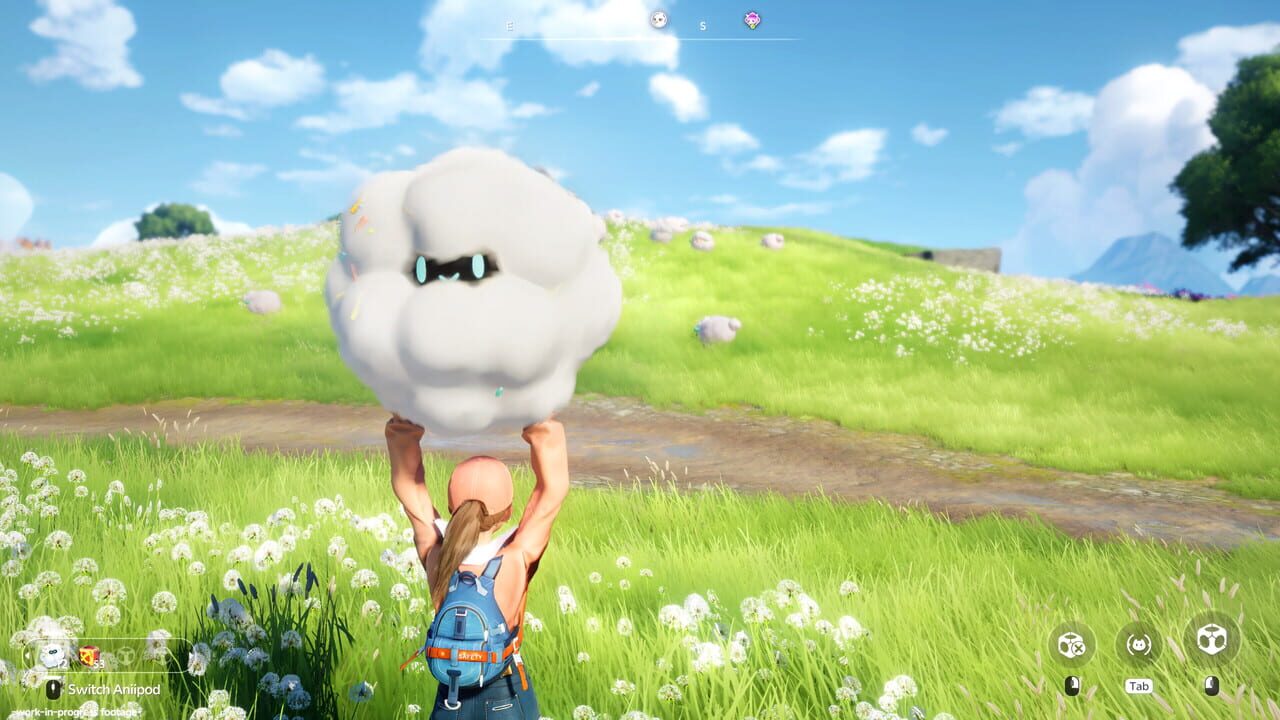

Aniimo's executive producer, Jovi Zhang, was explaining in an interview this summer why Pawprint Studio had ruled out a gacha system for its free-to-play creature-collecting role-playing game, and the sentence she reached for as reassurance was not really about monetization at all. "This is a world that belongs to the Aniimo," she said. Every Aniimo in it, in her own description, is already there, simply waiting to be found. The claim rewards reading slowly, because it does more work than a fairness pledge usually does. It does not say the world contains many creatures, or most of them. It says every one of them is already there, in a fixed and finished arrangement, before a single player logs in, and that the player's task is not to build a collection so much as to locate one that already exists in full. Aniimo, arriving September 16 on PlayStation 5, Xbox, and PC, with a mobile release a week behind, sends its Pathfinders across the continent of Idyll to catch, "Twine" with, and eventually move through the world as a growing roster of creatures called Aniimo, before graduating to a metropolis floating above the continent where those Pathfinders compare what they have found. The game is Pawprint Studio's first release, built in Hangzhou and financed by FunPlus under a new publishing label, Kingsglory, set up largely to carry it to market. Aniimo was revealed at the Xbox Games Showcase in June 2025, ran a closed beta the following year, and arrives with the kind of launch-week press push, pre-order tiers included, that a debut studio's only project tends to get when a much larger parent company is underwriting it. None of that is unusual for the genre. What Zhang's sentence names, more precisely than most marketing copy manages to, is the specific thing the genre has been selling for thirty years, and the specific thing a live, monetized version of that genre finds unusually hard to actually deliver.
That difficulty is a question about nervous systems more than about markets, which makes it a question about brains and bodies even though the vocabulary a marketing team reaches for tends to sound like real estate. Zhang's sentence is aimed at a specific discomfort, the sense, familiar to anyone who has opened a checklist app, a fitness tracker, or a childhood sticker album, that an incomplete set makes a small, continuous claim on attention until it stops being incomplete. Very little else in an ordinary adult week is built this way. A job has no cartridge that reads one hundred percent complete, and the people furthest along in most careers usually describe the work as having gotten less bounded with seniority, not more. A load of laundry, finished, produces another load by Thursday. An inbox reads zero for perhaps ninety seconds before it does not. The sensation of a task visibly nearing its own end, once common to apprenticeships, harvests, and mortgages paid to a final installment, has grown rare enough in ordinary life that a game promising it outright, in an executive producer's own words, is offering something most of the rest of a day cannot match.
The explanation this genre has usually received is almost entirely commercial, and it is not wrong so much as incomplete. Pokemon, the format's founding case, shipped in Japan in 1996 as two separate versions, Red and Green, each stocked with creatures the other lacked, so that completing either game's internal registry required trading with a second owner over a link cable, a design decision that also, not incidentally, sold two cartridges per friendship. Gotta catch 'em all, the tagline that came with it, reads less like a boast than a fairly blunt appeal to sociability: no single copy could keep that promise alone, then or in any of the sequels that kept the same version-exclusive split for three decades afterward, through every clone and descendant the format produced. The genre's later monetized variants, gacha pulls weighted against the buyer, seasonal creatures available for one month only, trading systems dressed up as social features, have mostly been read as refinements of that same commercial insight: scarcity and artificial incompleteness keep a customer paying, trading, or simply logged in. That account explains why a studio might want a collection kept incomplete. It does not explain why an incomplete collection is something a mind minds in the first place, and that second, older question is the more interesting one, because the discomfort long precedes the commerce that eventually learned to price it.
The relevant research is a full seven decades older than the genre. In 1927, working in Kurt Lewin's laboratory in Berlin, a psychology student named Bluma Zeigarnik ran a study built around an observation Lewin had reportedly made in a cafe: a waiter could recite a large, unpaid table's entire order from memory in precise detail, then lose the whole thing the moment the bill was settled, as though paying had closed a file the mind no longer needed open. Zeigarnik gave adult subjects eighteen to twenty-two short tasks, simple arithmetic, puzzles, building shapes out of clay or beads, letting roughly half run to completion and interrupting the rest partway through, then asked her subjects afterward to list whatever tasks they could remember. The interrupted tasks were recalled at nearly twice the rate of the finished ones, a result published that year in the journal Psychologische Forschung and known ever since as the Zeigarnik effect. The intuitive gloss, that the mind holds an open loop in a kind of active suspension until it closes, is the version of the finding that made its way into a century of productivity advice, cliffhanger endings, and, more recently, the small satisfying chime a checklist app plays when a box is finally ticked.
It is also, by the standard this publication tries to hold itself to, a finding that needs a caveat rather than a retelling on faith. Later attempts to reproduce Zeigarnik's ratio were inconsistent for decades, and a 2025 meta-analysis by Ghibellini and Meier, pooling the modern literature on the effect, found that once Zeigarnik's own original numbers were set aside, the recall advantage for interrupted tasks nearly disappeared, landing close to an even split rather than her reported near-doubling. What the same body of research keeps finding, more reliably than the memory effect itself, is narrower and, for the purposes of a game about collecting things, more useful: people retain a marked pull to return to and finish an interrupted task, an action tendency a colleague in Lewin's own Berlin group identified in a companion study around the same period, even in the many cases where they turn out to be no better than anyone else at simply recalling that the task exists at all. The itch, in other words, is real and repeatedly documented. It is a pull toward resumption rather than a superior memory for what was left undone, and a creature-collecting game does not actually need its players to remember their gaps with any special clarity. It needs them to feel the pull to close one, which is the part of Zeigarnik's century-old finding that has held up best under a hundred years of other people's replication attempts.
That pull explains why an open slot in a grid produces a specific, low-grade discomfort. It does not explain why so much of adult life's spare attention gets spent closing that particular kind of gap, a grid of creatures, stamps, or vinyl records, rather than any of the dozens of other unfinished tasks a week generates, and the better account of that choice belongs to consumer research rather than cognitive psychology. The marketing scholar Russell Belk, in Collecting in a Consumer Society, defined collecting precisely, as the process of "actively, selectively, and passionately acquiring and possessing things removed from ordinary use and perceived as part of a set of non-identical objects or experiences." Two clauses in that definition matter more than they first appear to. Removed from ordinary use means a collected object stops being a tool and becomes a specimen, valued for its place in an arrangement rather than for what it does. A set of non-identical objects means the arrangement has a shape, a known or knowable total, against which any given collection can be measured as more or less complete. Fieldwork Belk conducted with Melanie Wallendorf, John Sherry, and other collaborators split collectors into two rough temperaments: one chasing a defined series toward its own completion, cataloguing a childhood stamp album or a set of commemorative coins until every slot has something in it, the other assembling and refining a collection with no terminal state in mind at all, judging it by ongoing improvement rather than distance from a final square. The first temperament is the one a creature-collecting game is built, deliberately, to recruit.
Belk's more widely cited claim, from a 1988 paper in the Journal of Consumer Research, is that possessions function as an extension of the self: the objects a person keeps, arranges, and can produce on request are experienced as part of identity rather than simple ownership, a way of making an interior fact externally legible to other people and to the collector's own sense of who they are. A collection intensifies this considerably, because a collection is not one possession but an argument made out of many, a visible claim about attention, taste, and persistence that a single object cannot make on its own. Two people who each own one baseball card own a card. A person who owns four hundred, arranged and nearly complete, owns a fact about themselves that can be shown to someone else without a word of explanation attached. The gaps in the grid are the parts of that claim not yet made, which is a strange kind of pressure for a set of small plastic-feeling animals to be under, and also exactly the pressure the genre has always applied on purpose.
Put the two accounts together and a more specific claim becomes available than either supplies alone. A bounded collection is one of a genuinely small number of progress signals left in ordinary adult life that is legible and completable on its own terms, and creature-collecting games have spent three decades occupying the room that the rest of adult life vacated. A career does not have a percentage counter, because a promotion opens onto another rung rather than a finish line, and most professions redefine what counts as skilled every few years specifically so that nobody gets to call the learning finished. A body does not finish being maintained. Health, in particular, has been restructured over the past generation from a state a person could reach into a subscription a person renews, tracked in rings and streaks that reset at midnight rather than accumulating toward a final number. Culture has drifted the same direction: a newspaper used to end, with a back page, and could be folded and set down; a feed does not end, by design, and the folding-down gesture has nowhere left to happen. Education used to end in a comparable way, a diploma conferred once and framed on a wall, and has spent the last two decades being rebuilt around continuing credits, recertification cycles, and the polite but constant expectation that a finished degree is only ever a base layer. Even the domains that once offered the finished feeling, a completed apprenticeship marked with a guild rank, a mortgage paid to its last installment and stamped as such in a physical ledger, a matched shelf of a book series bought volume by volume until the set was whole, have grown rarer or been folded into renewals and refinancings that never quite conclude. What a creature-collecting game offers instead is almost absurdly literal by comparison: a fixed roster, a screen that fills in as it is walked, a number with a visible ceiling it can actually reach. The genre's real innovation was never the creatures. It was building, out of a few spare hours a week, one of the last rooms in an adult life where done is a state a person can reach and see.
Aniimo sharpens this further than most of its predecessors, because of the one mechanic the game is actually organized around. Twining, in Zhang's own description, lets a Pathfinder "swap to the creature's first-person perspective, borrowing its abilities to interact with the environment," which means the usual creature-collecting arrangement, a trainer standing at a polite distance issuing commands to an owned animal, is not how most of Aniimo is meant to be played. The player becomes the burrowing thing in order to burrow, the gliding thing in order to glide, seeing Idyll through a captured creature's own eyes rather than over its shoulder from a fixed camera, catching new Aniimo along the way with a thrown Aniipod timed against the target's movement, in a world where particular creatures surface only in particular weather, at particular hours, or during unannounced phenomena, which turns the roster itself into something closer to a long-running weather log than a simple tally. Outside battle, the same collection does quieter work: a Homeland campsite lets a Pathfinder park a customizable camper, plant crops, and decorate a small patch of the continent that never stops accepting more decoration, while a three-player mode called Egg Heist sends Pathfinders into direct competition over eggs in a scramble that, like any ranked ladder, has no version of finished built into it at all. Belk's extended self is usually a metaphor: a possession stands in for identity, arranged where others can see it. Twining collapses the metaphor into a mechanic. Zhang has described the studio's own relationship to the roster in similarly intimate terms, saying the team thinks of each Aniimo they design as something closer to their own child than to a product asset, which is a strange thing for an executive producer to say about a monetized inventory item and also, read against Twining specifically, a fairly precise description of what the mechanic then hands the player: not a pet acquired but a self briefly become. The collected object is not displayed as an extension of the player so much as occupied as one, its abilities worn rather than issued as commands, which makes the roster screen back at camp less like a trophy case and more like a wardrobe of prior selves, each one available to be stepped back into. A grid built on that logic asks to be filled for a slightly more intimate reason than the usual dex screen does. An empty slot is less an animal not yet caught than a perspective the player has not yet been allowed to try on.
The difficulty is that Aniimo is not a cartridge, and the promise it is making cannot be kept the way a cartridge keeps it. A 1996 copy of Pokemon Red has a fixed maximum, set in the game's code and unchangeable by anyone, the studio included, once it has left the factory. Aniimo is a live, free-to-play service that Pawprint and Kingsglory will need to keep profitable for years past launch, backed by a parent company, FunPlus, whose other long-running mobile titles have made it one of the more experienced operators of exactly this kind of long-tail monetization anywhere in games. The tools available for doing that without a gacha system, cosmetics for players and their creatures, seasonal content, a pre-order tier that already bundles a battle pass called the Companion Handbook alongside launch-week rewards, an ever-renewing Homeland to decorate, an Egg Heist ladder with no top, all share one structural feature a boxed cartridge never had to worry about. They require the game to keep producing new things to want, on a schedule, indefinitely. Even the closed beta showed the shape of this before launch: independent trackers cataloguing the test roster arrived at different totals from one phase to the next, not through sloppy counting but because the roster itself kept changing under them while Pawprint was still finishing the game, which is a small preview of what a launched, live Idyll will keep doing on purpose. Zhang's other public promise, that "the core system is always going to provide a free way for people to make their ideal Aniimo," is specific and there is no reason on the public record to doubt it will be honored. But it is a promise about fairness on the way to an outcome, not a promise that the outcome, once reached, will be left alone. A live-service collection has to keep its grid open, because a grid that closed, that let every Pathfinder's log fill in and simply stay full, would remove the one reason a paying or simply attentive audience has to come back next season. The bounded set is what recruits the player. The unbounded set is what keeps the business alive afterward, and no monetization model, gacha, cosmetics, or a battle pass, changes which side of that tension a live-service format sits on.
The obvious objection is that plenty of players have been living inside exactly this arrangement for years, in games considerably less careful about the promise than Aniimo is being, and do not describe it as a broken promise at all. Players who have spent a decade collecting mounts in World of Warcraft, with no expectation the list will ever close and no apparent sense of grievance about that, are proof enough that indefinite collecting is not automatically experienced as betrayal. Belk's own distinction supplies the reason why, more precisely than a general appeal to differing taste would. The collector chasing a defined series toward completion was not the only kind his fieldwork found. The other temperament was never oriented toward a finish line at all, measuring a collection by its ongoing refinement and the pleasure of the accumulating practice rather than by distance from a final square, and for that player an ever-lengthening roster, new seasons, new cosmetics, new corners of a Homeland campsite to plant, is not a broken promise but simply more of what was actually wanted. Nothing about that player's enjoyment is confused or needs correcting. What Zhang's own sentence does, though, the one this essay opened with, is address the other temperament specifically, the one counting toward a total, and promise that collector a totality, every Aniimo, already waiting, inside a game built by commercial necessity never to let that count stop moving. The promise and the player it is aimed at are both real. So is the format's structural inability to close the file that particular player is actually trying to close.
Every creature-collecting game since 1996 has shipped some version of the same screen: a grid of small portraits, filled in where a creature has been met, reduced to a flat grey outline where it has not, the outline holding the exact shape of the thing it withholds. On a cartridge that screen is genuinely temporary, a countdown toward a fixed number that trading, trying, or simply playing longer will eventually reach. Idyll will have its own version within days of the sixteenth, some Pathfinder's grid already mostly full, a handful of grey shapes left in the corners where a creature tied to a particular weather pattern or hour has not yet lined up with the hours a working adult actually has free to spend on it. New shapes, sized for creatures that do not exist yet, will be added to those corners on the studio's own schedule, most likely faster than the old ones get filled in. The screen will look, at every point along the way, exactly like a countdown. Nothing in its design requires it to ever reach zero, and a live game, built to be played past any single season, would rather it did not.