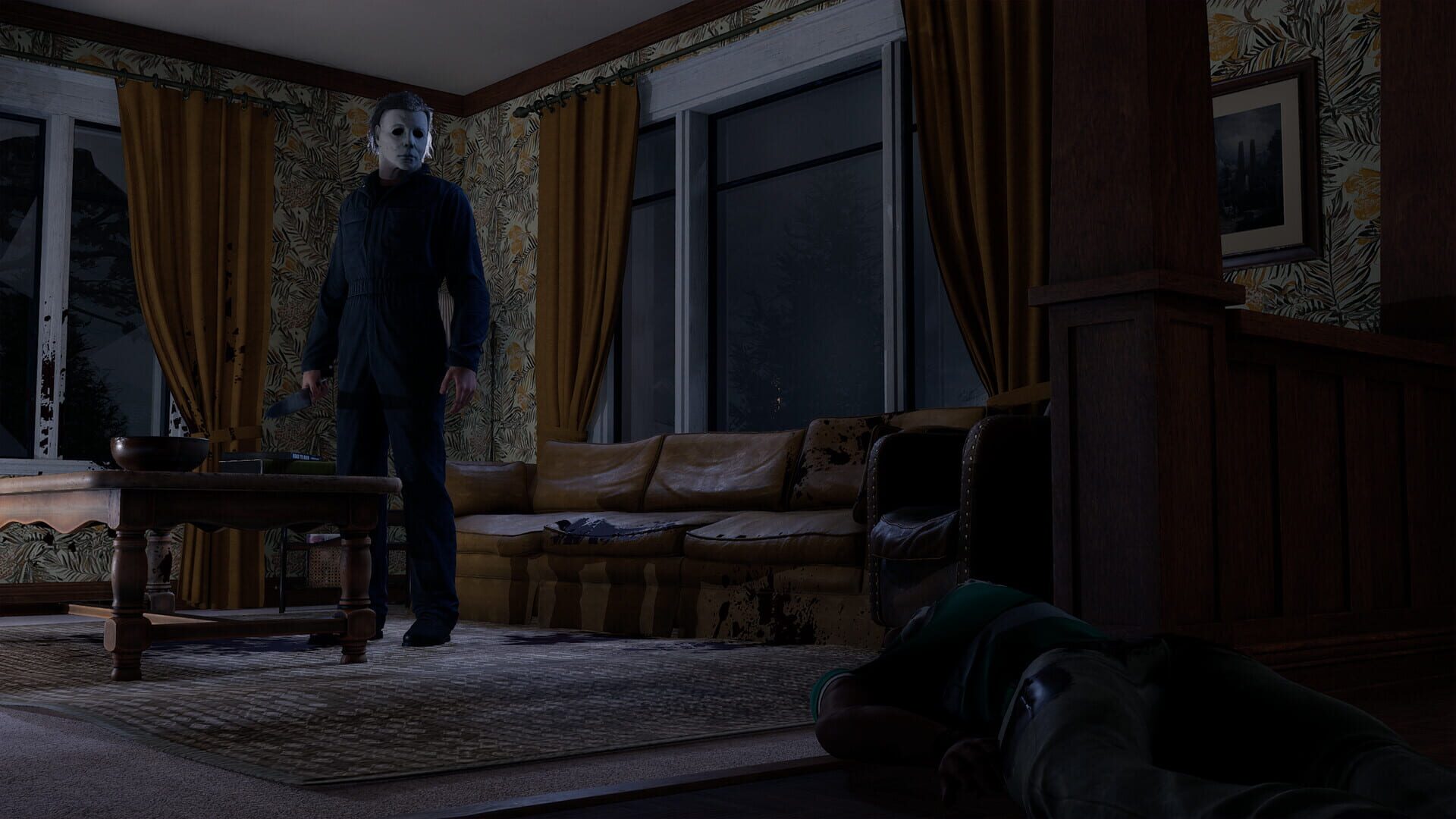



At PAX East this year, five strangers sat down in front of a demo cabinet to play a game that had not yet decided whether it was scared of them or the other way around. Four of them picked up controllers mapped to teenagers in Haddonfield, Illinois, on the night of October 31, 1978: kids with flashlights, half a tank of gas, and a phone that may or may not still have a dial tone by the time they need it. The fifth picked up the controller mapped to Michael Myers. He did not run anywhere. He walked. The four teenagers ran, because that is what a person does when a man in a boiler suit and a rubber mask is visible across a cornfield, closing the gap at a pace that never changes and never has to. Illfonic's Halloween: The Game, arriving this September, asks one player in every match of its asymmetric mode to be the person who does not run. This is a psychology and physiology question before it is a game-design question, and it is worth taking it seriously as one. What does it do to a person to be handed, for forty minutes, the role of the thing that cannot be reasoned with, that has no plan and needs none, and that wins by being patient rather than by being fast. That is a Brain and Body question. It asks what a specific in-game role does to the nervous system and the felt experience of the person holding the controller, on both sides of the asymmetry, and it draws on the physiology of threat response rather than on the game's plot or its place in slasher-film history. The lens matters here because the obvious frame, the film-studies frame, has already been worked over exhaustively since 1978. The interesting question left standing is what happens inside a body, a specific body sitting on a specific couch, when it is assigned the job of walking calmly toward other people who are running for their lives. Illfonic did not invent this design problem. The studio has spent a decade living inside it. Friday the 13th: The Game, released in 2017, put one player behind Jason Voorhees and seven behind camp counselors, and it became, for a period, one of the more interesting failures in modern multiplayer design: adored by the people who got to play Jason, resented by a meaningful share of the counselors, and eventually undone by a licensing lawsuit before Illfonic could finish balancing it. Predator: Hunting Grounds, in 2020, repeated the shape with a four-person fireteam against one Predator, and the reviews that followed drew the same line in almost the same place: the Predator side, praised as "surprisingly spot-on," against a human fireteam experience reviewers found comparatively thin. Two games, two different licensed monsters, one recurring result. The killer role kept working. The prey role kept needing more work to feel worth playing. That is not a coincidence a studio gets to have twice by accident, and Illfonic's own designers talk about Halloween explicitly as the third attempt at solving it. Producer Jordan Matthewson has said the new game is about "bringing together everything we've learned" from the studio's earlier asymmetric titles, "what worked, what didn't, and what needs a bit more." Start with the walk, because the walk is the design decision that makes this game a different psychological object than most things in its genre. Every other stalking figure in commercial horror runs. Jason Voorhees runs, in most of his cinematic and interactive incarnations. Pyramid Head runs. Nemesis, in Resident Evil 3, runs fast enough to close distance across an open street in seconds. Speed is the default because speed produces a legible, well-studied fear response: an approaching threat that is gaining on you triggers what the visual-neuroscience literature calls a looming response. A 2013 study by Chi-Ying Yilmaz and Markus Meister at Caltech showed that mice presented with a rapidly expanding dark disk, a stimulus that mimics an object closing distance fast, reliably froze or fled within a fraction of a second, with almost no learning required. The response is old. It runs through the superior colliculus and into the amygdala with minimal cortical involvement, which is a technical way of saying the body decides before the mind is consulted. Games that make their monster run are reaching, deliberately or not, for this exact circuit. A fast threat produces a fast, legible fear: the spike, the sprint, the door slammed shut behind you. John Carpenter refused this in 1978, and the refusal was the whole point. The Shape, as Michael Myers is credited in the original film, does not run in the scenes that made the character famous. He appears at the edge of a frame, standing, and by the time the frame cuts away and back he has either closed distance without seeming to move quickly or vanished. Carpenter has said the deliberateness of the movement was intentional, describing the character's uncanny stillness in a way that made the scenes around a kill as unsettling as the kill itself. Nick Castle, who played the adult Myers in most of the film, moves with an unhurried, almost graceful economy that has become the character's most imitated and least successfully copied trait. The 2018 legacy sequel and its two follow-ups all tried to recapture it; most of the discourse around those films agrees they only partly succeeded. The walk is harder to make scary than the run. It is also, when it works, scarier. The predator-imminence research explains why. Threat-response studies in animals distinguish between a proximal threat, close and closing, and a distal one, present but not yet closing distance. Work using looming and "sweeping" stimuli with newly hatched chicks found the two produce genuinely different behaviors: a fast, expanding threat drives an immediate escape response, while a slower, more distant threat produces something closer to a change in vigilance, a decrease in movement meant to avoid drawing attention, rather than a sprint. The chick facing the slow threat does not know when the threat becomes proximal. That is the entire problem. A fast predator announces its intentions by definition; the moment it is closing distance, it is already attacking, and the body's job is simple: run now. A slow predator that is always closing distance, at a fixed unhurried rate, never announces the transition. It is always both approaching and not yet arriving. The prey animal, and the survivor player, is left holding a threat assessment that never resolves, which is a more taxing thing to carry than a sprint you can at least outrun or lose. This is close to what Walter Cannon was describing when he coined the language of fight, flight, and the visceral arousal that accompanies acute fear, in his 1915 study of the bodily changes produced by pain, hunger, fear, and rage. Cannon's framework was built around a threat with a clear onset and a clear resolution: the body mobilizes, the crisis passes, the mobilization stands down. Michael Myers, by design, denies both endpoints. He is not a crisis with an onset. He is present, at a distance, for as long as the level requires, and there is no equivalent moment where the player's body gets to conclude the threat has passed, because the threat's approach rate never changes to signal one. Illfonic's own designers describe the character in these terms without using the physiology vocabulary. Jared Gerritzen, one of the game's lead developers, has drawn the contrast to the studio's earlier killer directly: "Michael is more like a coiled cobra that is waiting to attack, while Jason is this raging bull that runs through." A coiled cobra is a threat defined by its patience. A raging bull is a threat defined by its speed. The two produce different nervous systems in the person on the other end of the controller, and Illfonic seems to have understood, going in, that they were building the cobra rather than a second bull. The game gives Michael one power that reinforces the same logic rather than working against it. Gerritzen has described a "Shape Jump" ability that lets Michael relocate across the map, provided no one has a direct line of sight on the space he is moving into and no light is falling on it. "The ability has brought a horrifying element of being stalked by Michael and never knowing where he will pop up," Gerritzen has said. Notice what the ability does not do. It does not make Michael faster in a straight line. It makes his location unknowable between the moments a survivor can see him. Combined with the walk, this produces a killer whose entire threat profile is built from denial of information rather than raw speed: you do not know exactly where he is, and even when you do, he is not accelerating toward you in a way that gives you a countdown. The player controlling the survivor is not managing a closing gap. They are managing an absence of a closing gap, which the body, per the looming-versus-distal research, treats as a different and in some ways more demanding kind of vigilance. Turn now to the other half of the controller, the half that gets less written about because it is less immediately relatable: what does it feel like to be the walk. Barbara Ehrenreich's 1997 study Blood Rites argued that a great deal of human ritual, myth, and religious structure descends from a much older fact: for most of the deep evolutionary history of the genus, humans were prey, not predators. Large cats, packs of dogs, and other carnivores hunted early hominids on the African savannah for a very long stretch of time before humans became reliably dangerous hunters themselves, and Ehrenreich's argument is that the psychological residue of having been prey animals never fully cleared. Instead, a wide range of human societies built initiation rites, war rituals, and religious structures around the deliberate, controlled reenactment of the predator role: the young man who kills the lion, the warrior who wears the skin of the animal that used to hunt his ancestors, the god who is himself part-predator. Taking on the predator's identity, in other words, is not a neutral role reversal in human ritual history. It has historically been treated as something that requires ceremony, because it is a psychologically loaded thing to do: stepping into the position of the thing that used to eat you. A multiplayer horror game does not carry that weight consciously, and nobody sits down to a Halloween match thinking about Pleistocene predation. But the structure Ehrenreich describes, prey becoming predator by deliberate, bounded reenactment rather than by accident, maps onto what the killer role in this genre actually asks a player to do more precisely than the marketing language around these games usually admits. The survivor role is legible without explanation. Anyone who has ever been frightened understands what it is to run from something. The killer role is the one that requires the player to inhabit an unfamiliar position: not fear, but the absence of fear, expressed as patience. The killer's fun, when the design works, is not the same emotion as the survivor's fun scaled up. It is a different emotion assigned to the same shared clock. This is the balance problem that sank Friday the 13th and dogged Predator: Hunting Grounds, and it is worth being precise about what the problem actually is, because "balance" undersells it. A shooter is unbalanced when one side wins too often. An asymmetric horror game can be perfectly balanced in the win-rate sense, fifty percent killer wins, fifty percent survivor escapes, and still be broken, because the two sides are not competing for the same feeling. The killer's satisfaction is built from control, patience, and the slow, confirmed success of a plan closing on a target. The survivor's satisfaction is built from tension, improvisation, and the relief of a plan that barely worked. Robbie Hobbs and Randy Greenback, who worked on Friday the 13th's design, described in a 2017 interview the effort that went into making Jason's various forms and the counselors both feel distinct while staying within a playable balance, and the game shipped with a widely noted asymmetry in how much power Jason held relative to the counselors, thrilling for the one player and, for several of the seven, closer to spectatorship. A game analysis of Dead by Daylight, the genre's most commercially durable entry, put the underlying design tension plainly: "one of the hardest parts is trying to make each side feel fun without weakening them too much." The two fun states pull in opposite directions by construction. Give the killer more control and the survivors' agency thins; give the survivors more agency and the killer's patience starts to look like helplessness. Illfonic's Jordan Matthewson has framed the studio's answer to this problem as an attempt to stop leaving so much of the tension up to the players themselves: "we want to have that natural balance in the game," he has said, "because you can't always rely on the players to always set those experiences up nicely." That is a striking admission from a studio with a decade in this specific genre. It concedes that the earlier games depended on a kind of unscripted social contract, seven strangers agreeing, tacitly, to play their part in someone else's fear, and that the contract broke often enough to be worth engineering around directly. What Illfonic seems to be building instead is a set of mechanical guarantees, the walking pace, the Shape Jump's dependence on darkness and unwatched space, the map design around Haddonfield's houses and hedgerows, that produce the coiled-cobra experience regardless of whether the four survivor players cooperate well. Design the physiology into the system rather than hoping the room supplies it. There is a second physiological register worth naming here, because it is the one the survivor side of the roster actually lives in more often than the classic sprint. The threat-imminence literature that distinguishes a fast, closing predator from a slow, present one also documents a third response beyond fight and flight: freezing, sometimes called tonic immobility, in which the animal facing an ambiguous or inescapable threat stops moving altogether rather than committing to a direction. Mice presented with a slow, distal threat in the habituation studies out of the predator-imminence research showed increased stillness rather than escape, a strategy that makes sense only against a threat that has not yet decided to close the distance: movement is what gives the position away. A killer who runs forces a decision immediately, fight or flee, and the decision, once made, resolves the arousal one way or another. A killer who walks extends the window in which freezing is the rational choice, because running might be the thing that turns a present threat into a closing one. A survivor player who chooses to crouch in a closet rather than sprint for a car, even when the car is the better option on paper, is not making a mistake the game needs to punish. That instinct is the correct output of a nervous system reading Michael's pace correctly, and a killer designed around patience rather than speed will keep producing it match after match. The killer side of that same exchange is where the genre's asymmetric-pleasure problem gets sharpest, and it is worth separating two things that get collapsed under the single word "power." A design analysis of Dead by Daylight, the commercially dominant title in this specific subgenre, has argued that a meaningful share of that game's killer-side design is organized around a mechanic of humiliation rather than competition in the ordinary multiplayer sense: hooks that make an eliminated survivor visible to their teammates while they wait to die, taunts and mori animations that linger on the moment of a kill rather than cutting away from it. The critique is not incidental to the genre; it is close to definitional. A killer who merely outscores the other team is playing a shooter with a scary skin. A killer whose satisfaction depends on being watched, on the kill mattering to people who are still alive to see it, is playing something closer to a ritualized display, and displays require an audience that cannot look away. Halloween's survivors, per the previews, can find and briefly rally other townsfolk in Haddonfield rather than facing Michael entirely alone, which changes who the display is for without removing the display. The kill still needs witnesses. The witnesses just have more reason, now, to run rather than hide, which returns the whole system to the same walking pace it started with. There is a reason this genre keeps returning to licensed slasher monsters rather than inventing new ones, and it is not simply brand recognition. Michael Myers arrives pre-loaded with forty-eight years of cultural agreement about what his threat feels like, which means Illfonic does not have to teach players what the walk means. Every survivor sitting down to the game already knows, from the films or from cultural osmosis, that the man in the mask is not going to hurry, and that the not-hurrying is the frightening part. The design's job is narrower than inventing a new fear. It is translating an already-understood fear into a system four other human beings can meaningfully resist, badly, sometimes, on purpose, without the resistance collapsing the fear that got them to sit down in the first place. None of this requires having played the finished game, which does not yet exist in a form the public has been shown beyond preview builds and demo cabinets, and any claim about how the September release actually feels in full would be invented rather than reported. What is available, and verifiable, is the design language the studio has used to describe its own intentions, the fact pattern of two prior asymmetric horror titles from the same studio and the specific way both were received, and the physiological literature on how differently a body responds to a fast threat and a slow one. Put those together and a frame emerges that travels well past this specific game. Any asymmetric multiplayer system, horror or otherwise, is really building two products inside one ruleset, and the harder design problem is never whether one side wins too much. It is whether the emotion assigned to each side is one an actual person will volunteer to feel again next week. Somebody has to walk. The whole design lives in what walking, instead of running, does to the four people who have to decide, over and over, whether to look behind them. Forty seconds before the demo ended, one of the three teenagers at that PAX East cabinet stopped moving. He had seen Michael standing at the far end of the cornfield, not advancing, just present, and he made the mistake every survivor player eventually makes: he waited to see what the walk would do next. It did the only thing it was ever going to do. It kept coming.
Tuesday analysis
Someone Has to Volunteer to Be the Boogeyman
- Writer
- J. A. Marsh
- Lens
- Brain & Body
- Published
- APR 3, 2026
- Length
- 3,180 words / 14 min
- Notes
- 12 sources
The killer is not chasing the survivors so much as arriving at them, on a schedule only he controls, and control of the schedule is the entire horror.