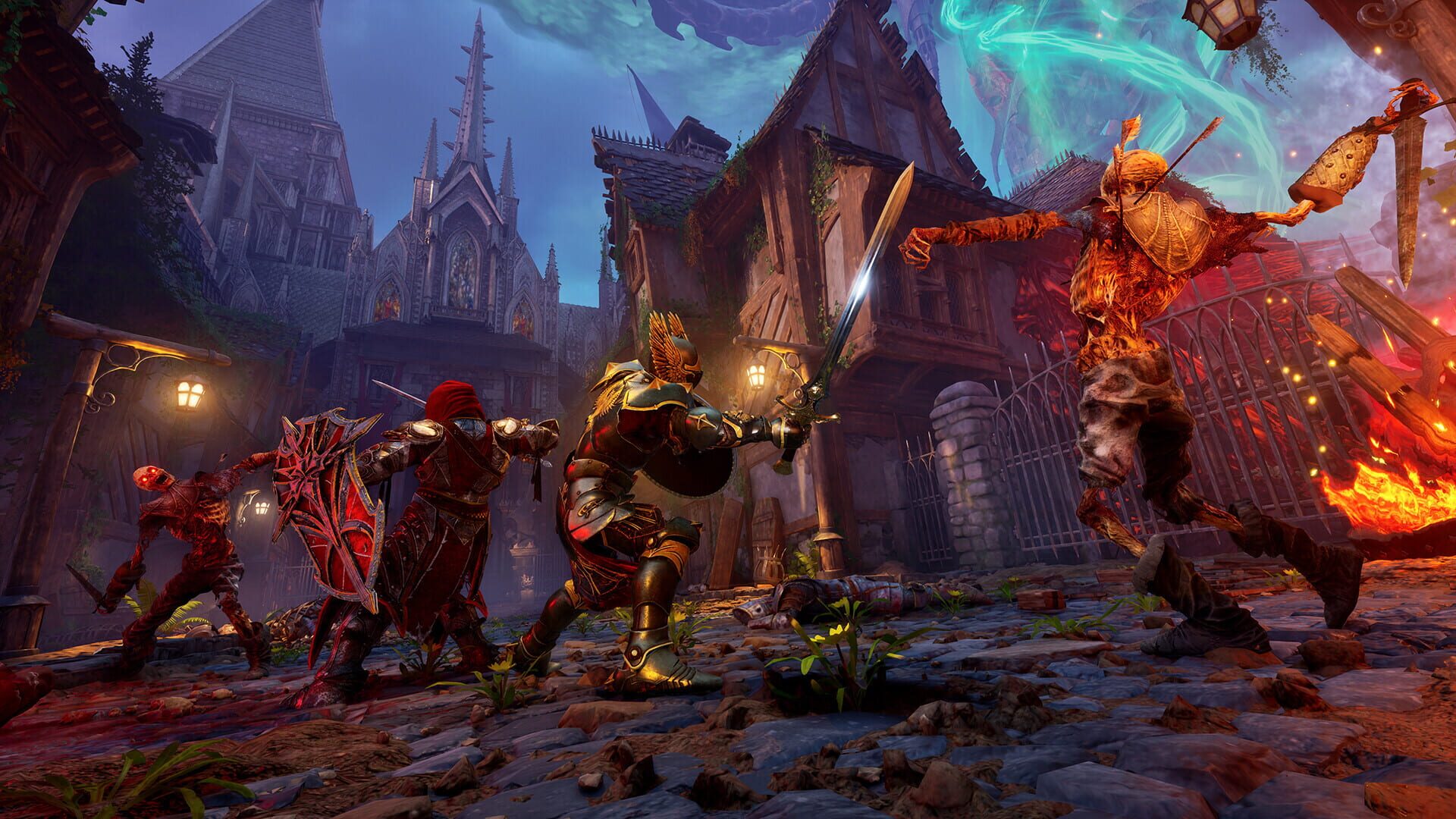
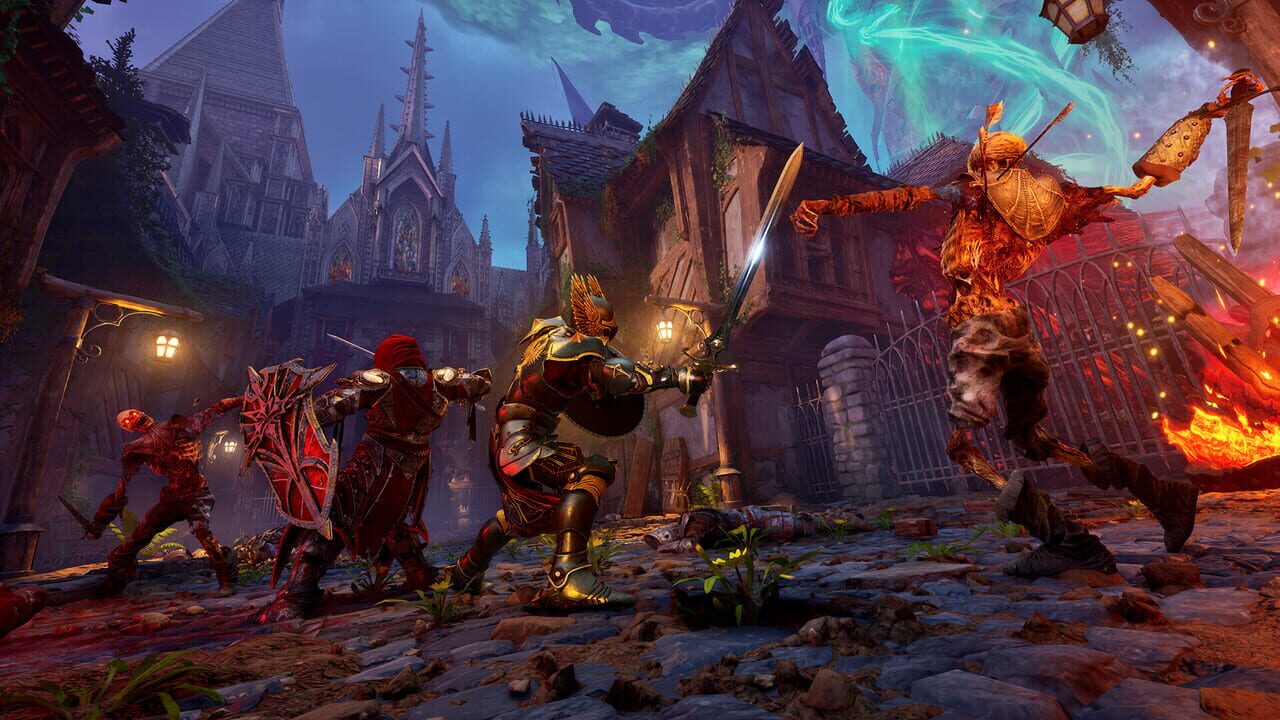
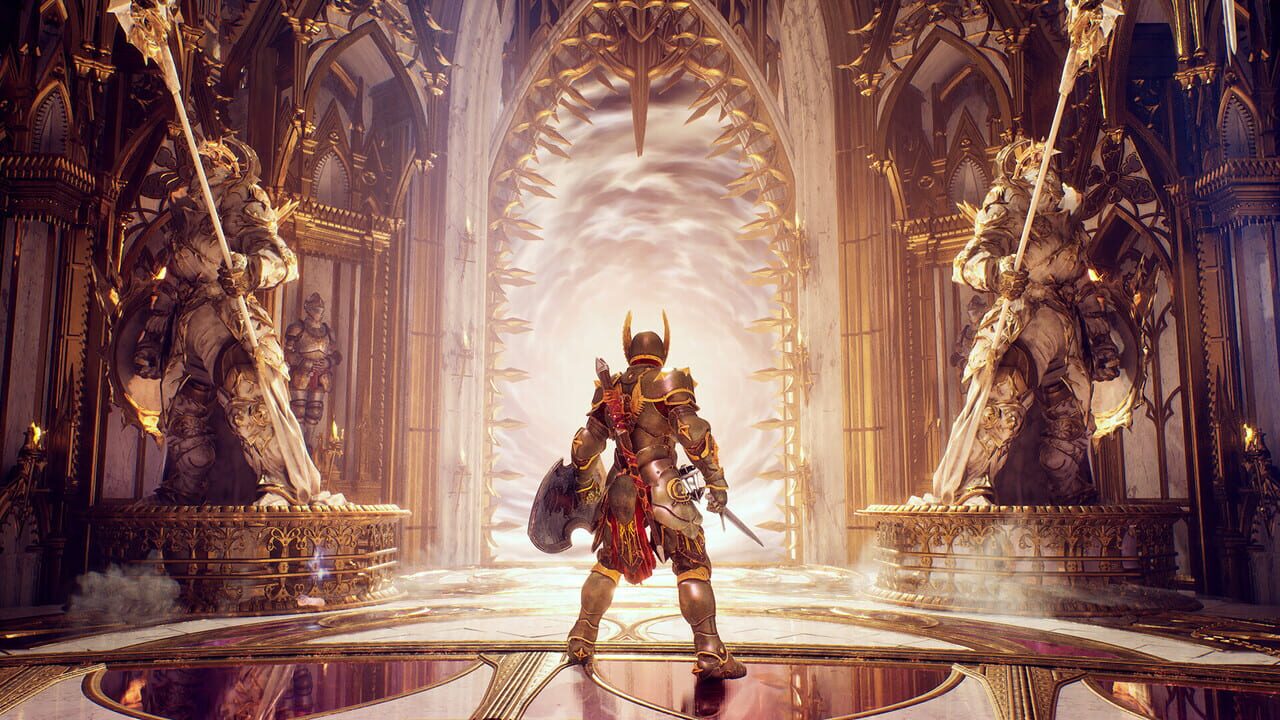
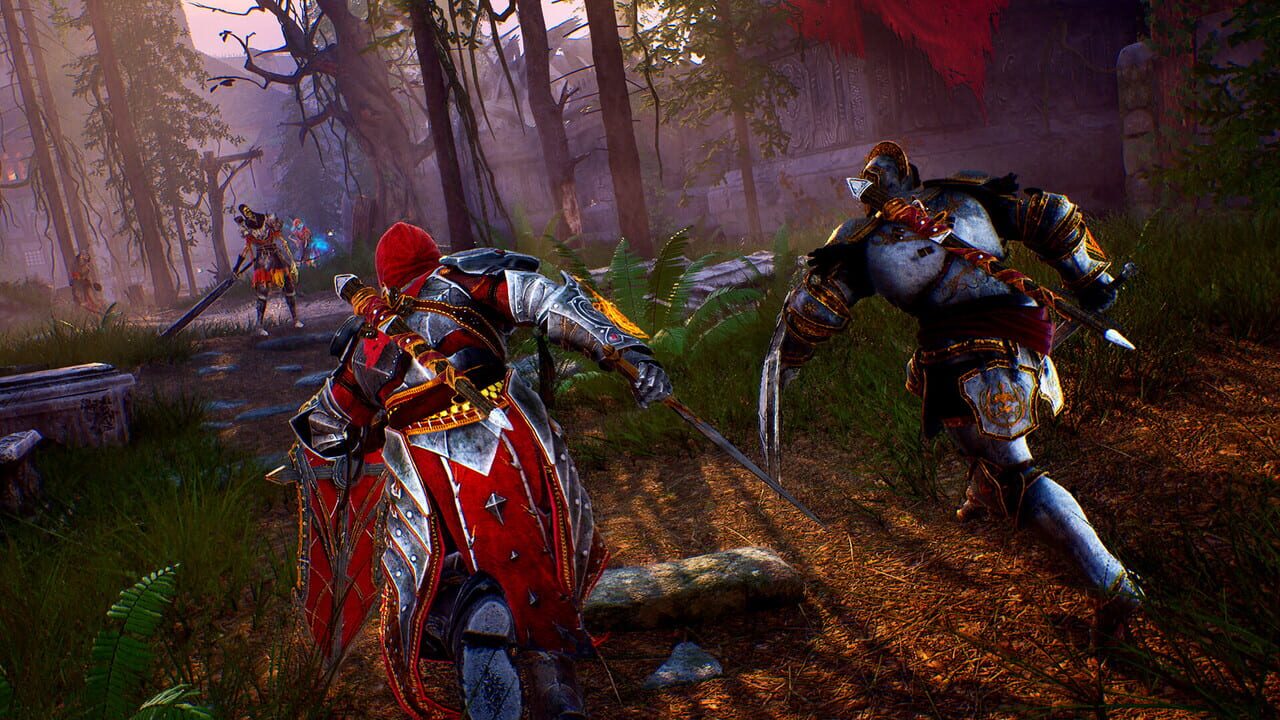
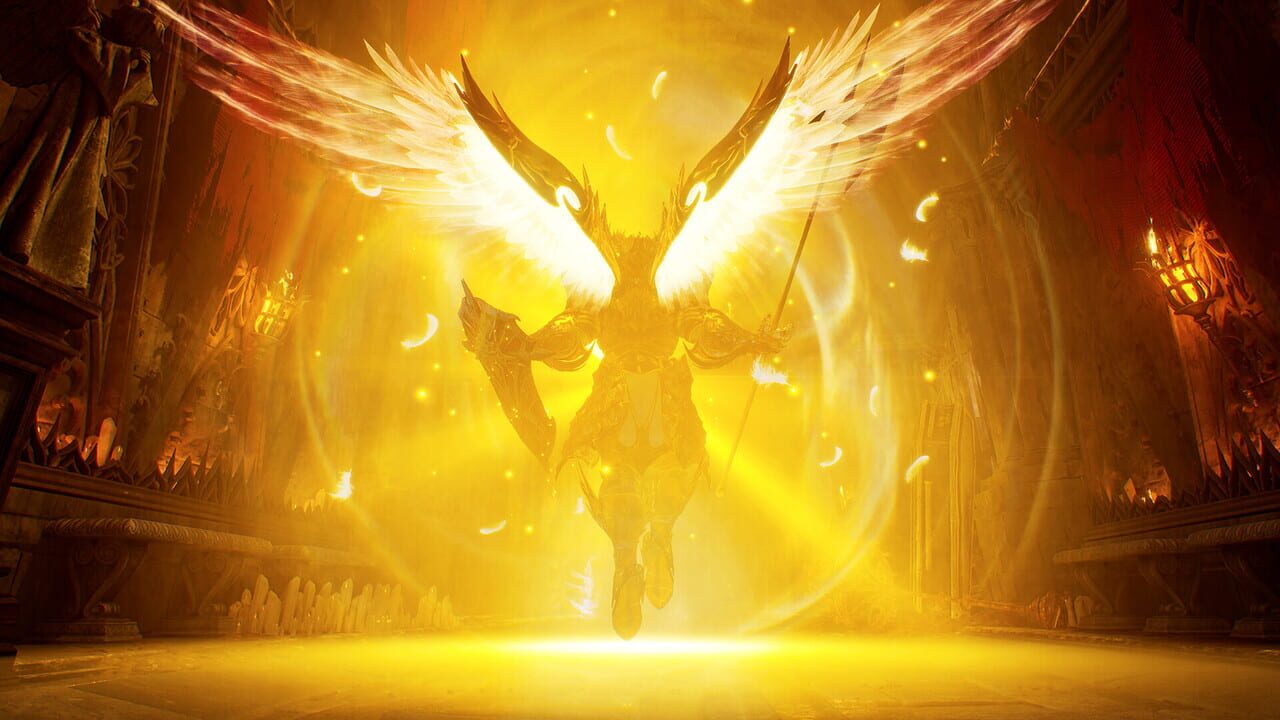
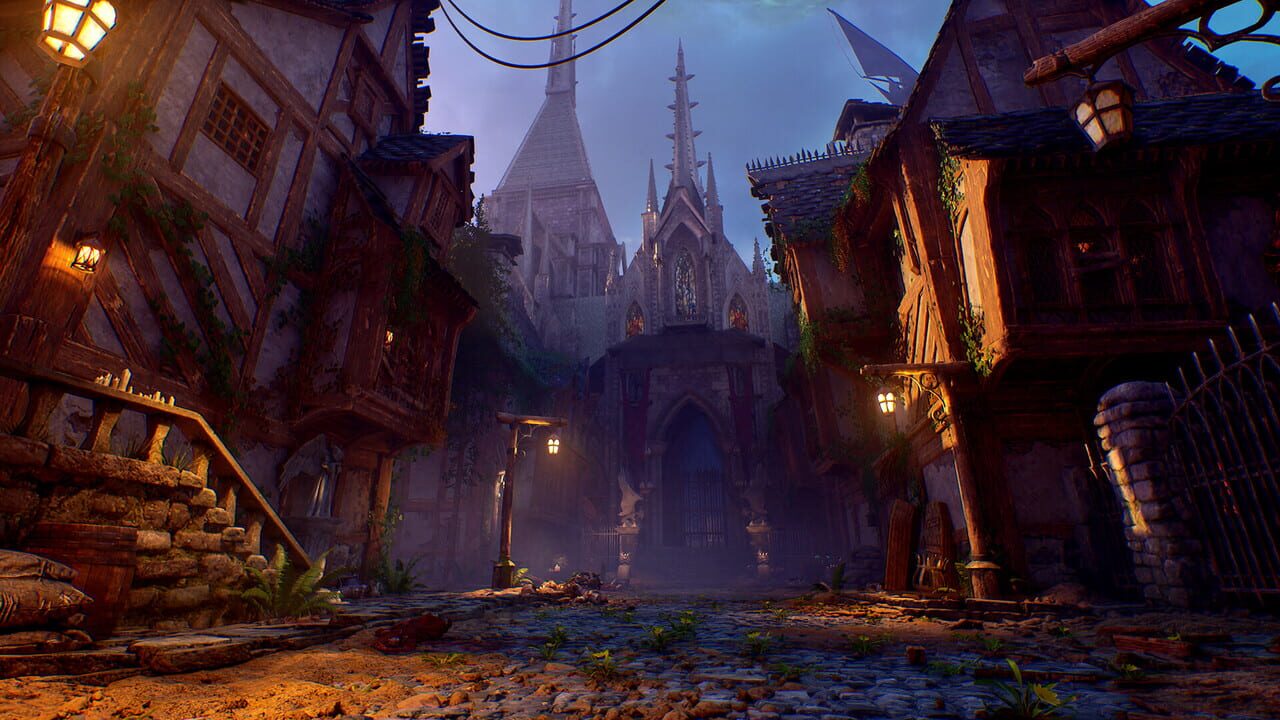
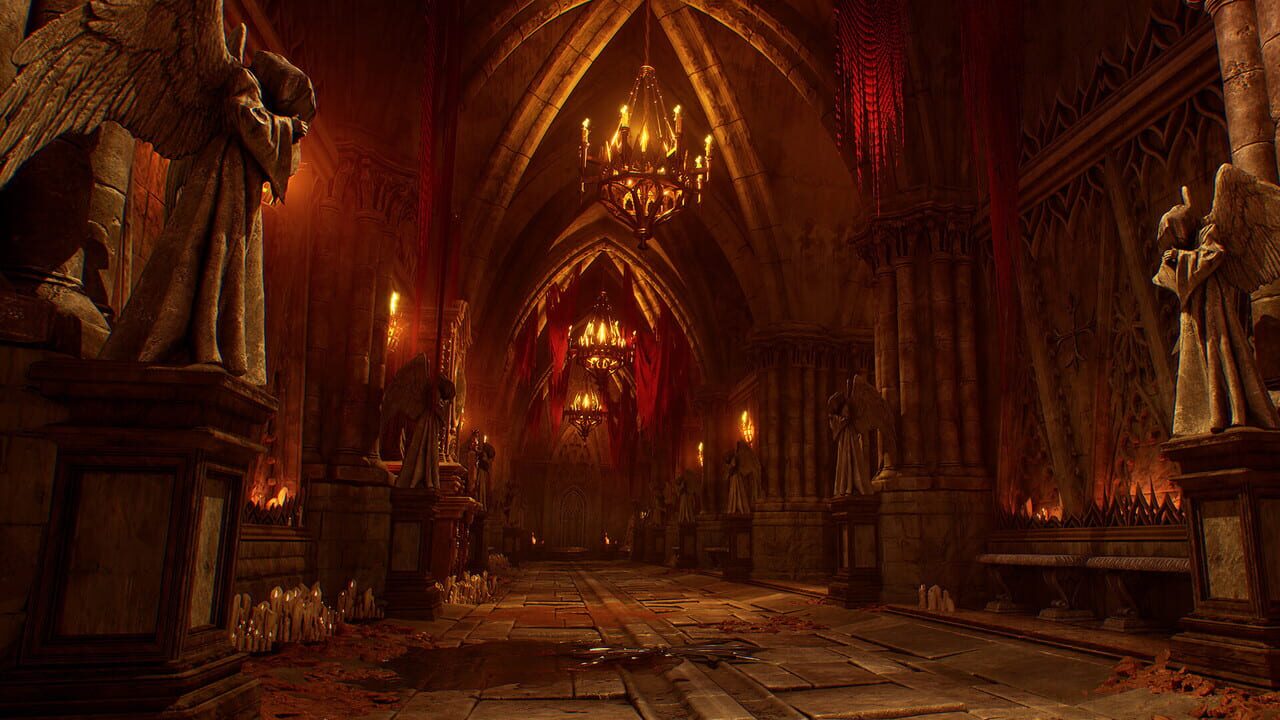
The first thing the Crimson Moon reveal trailer establishes, before it establishes anything about the player, is a corpse the size of a cathedral. A statue of an angel lies broken across a plaza, wings shattered into the architecture, gold leaf peeling off a face that used to be worshipped and is now just weather-stained stone. The city built around it, Gildenarch, was a "High Renaissance" capital of faith. It is now a ruin that remembers being one. The player's job, playing a Nephilim, half human and half angel, is to walk through the wreckage of a religious order that has already lost, against a Dead God the marketing capitalizes with the confidence of a proper noun, in a war that was decided before the game begins.
This is a people-and-culture argument, not a plot summary, because the interesting thing about Gildenarch is not what happened to its god. It is that the audience for this trailer did not need to be told a god had died to understand the genre they were looking at. The broken statue, the guttering candles, the order of knights still fighting a war their deity lost, all of it reads instantly, the way a diner sign reads instantly as a diner. That instant legibility is the subject here: what it means that a whole commercial genre has converged on beginning after divinity fails, what that convention buys its designers, and what it declines to pay for.
Crimson Moon is not an isolated choice. It is the newest entry in a lineage that has become close to a genre default. Diablo's Sanctuary was built as a hiding place from both Heaven and Hell, a world where angels are as capable of pious atrocity as demons. Dark Souls opens on the Age of Fire already guttering, its gods long since walled up or fled or gone mad, its player character an Undead nobody, tasked with propping up a divine order that visibly does not deserve propping up. Elden Ring's Golden Order is a fiction maintained by a goddess who shattered her own source of power and vanished from the story she started. God of War's Norse arc spends two full games walking Kratos and his son through the wreckage of a pantheon that is actively, on-screen, in the process of ending. None of these games open with a working heaven. All of them open with the paperwork after the funeral.
The convention has a name in philosophy that the games themselves rarely use and do not need to. Friedrich Nietzsche's parable of the madman, from The Gay Science, has a lantern-carrying man run into a marketplace at dawn shouting that he is looking for God, to a crowd of people who do not believe in God and find this hilarious. "God is dead," the madman tells them. "God remains dead. And we have killed him." The crowd laughs because it has already stopped believing, and has simply not worked out what that means yet, what would have to be rebuilt from scratch once the wall holding up a shared cosmic order came down. Nietzsche was not describing atheism as a debate to be won. He was describing a structural problem: an entire civilization's ethics, meaning, and sense of proportion had been built on a foundation that had stopped holding weight, and almost nobody present in the marketplace understood the renovation they were about to be living through.
Gothic fantasy games did not read Nietzsche to arrive at this shape. They arrived at it because it solves several problems at once, and because a century of horror and fantasy fiction had already worn the path smooth before the medium showed up. But the parable is useful here for a reason that has nothing to do with intellectual pedigree and everything to do with structure: it names exactly the gap these games live inside. The madman's crowd still had the cathedral, the calendar of feast days, the priest's collar, all the outward furniture of a functioning faith, with the actual belief scooped out from underneath. That is precisely the visual grammar Gildenarch is built from. The candles are still lit. The Order of the Crimson Moon still has ranks, oaths, and a war table. The god the order swore to is not merely absent, in the way an off-screen deity in a high-fantasy epic might be busy elsewhere. It is confirmed, marketed, dead.
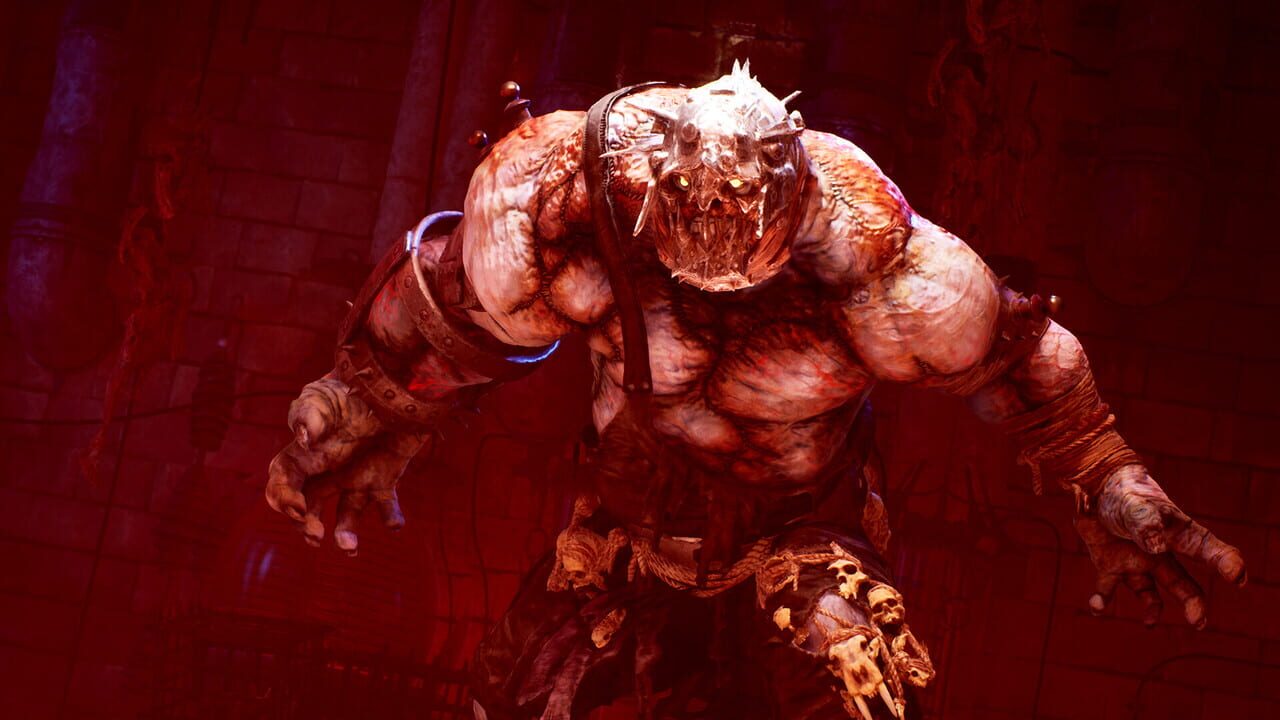
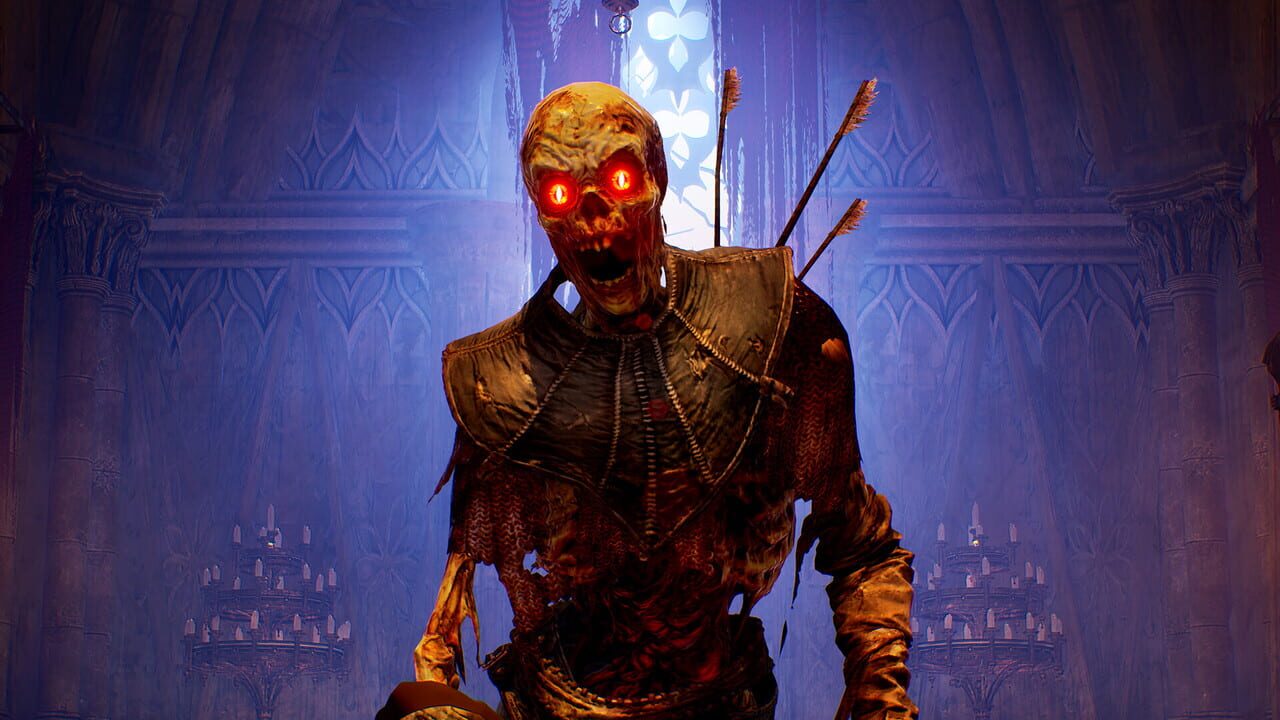
Why does a design studio reach for this so reliably. The honest answer is that a dead god is an extraordinarily efficient piece of world-building technology, and efficiency in this genre is not a dirty word. Consider what it hands a team like ProbablyMonsters for free. A ruined, contested city like Gildenarch justifies every square meter of level design without a single line of new dialogue: broken cathedrals, battlements retaken block by block, districts that have to be reclaimed rather than simply visited, all follow logically from a divine order that has already collapsed. A dead god licenses moral chaos, angels capable of violence, demons with something like a case, vampire lords like Solomon Moore operating in the space where clerical authority used to be, without the writers needing to construct and defend a working theology first. It converts metaphysics into level design and into loot. The Nephilim's "Angel Power," rendered as a resource bar the player spends and refills, is a divine attribute doing mechanical work, no different in kind from a mana pool, except that it gets to carry the emotional charge of celestial inheritance while behaving exactly like a videogame resource. The game gets the numinous weight of angels and gods, priced at the mechanical cost of a cooldown meter.
There is also a narrower, more practical reason the convention has become so durable in action RPGs specifically, and it is worth being fair to it before treating it as pure shortcut. Hidetaka Miyazaki, whose Dark Souls did more than any other single game to popularize this exact structure for a modern audience, has spoken about deliberately withholding narrative exposition from Dark Souls so players would piece the world together from environmental fragments, item descriptions, and the postures of the ruins themselves, rather than from a script that explains what happened. A dead god is uniquely suited to that kind of storytelling because its absence is legible without a cutscene. You do not need a character to tell you the faith failed. You can see it in the wing shattered off the statue. This is a real formal achievement, not a lazy default: it lets an action game, whose combat design and animation budget are where most of its resources actually go, deliver a working sense of scale and tragedy through set dressing instead of through the dialogue trees a game like this was never going to have the writing budget to make good. Scott Brodie, Crimson Moon's design director, has described wanting a world that "remembers, reshapes, and pushes back, without demanding punishing repetition." That is a mechanical promise, but the dead god is doing quiet work underneath it. A world that remembers what it lost is a world that does not have to explain, at length, what it currently believes.
The convention displaces something specific, and naming what it displaces is the actual argument here. High fantasy in Tolkien's mode did not begin after divinity failed. It began inside a cosmic order that was working, however imperfectly, and whose central drama was the temptation to defy or corrupt that order rather than the aftermath of its collapse. Tolkien's Eru Ilúvatar is distant from the day-to-day action of The Lord of the Rings, but The Silmarillion is explicit that the world was sung into being with intention, that the Valar are still present and still governing, however remotely, and that evil in Middle-earth is a deviation from a working order rather than evidence that no order survived. Tolkien's own essay "On Fairy-Stories" argues for the fairy tale's obligation to end in eucatastrophe, the sudden joyous turn that affirms, rather than merely survives, the possibility of grace. That is a structurally different promise than the one Gildenarch is making. A world with a functioning god at its center has to argue for what that god's order is actually worth, has to show the reader or player why the thing being defended deserves defending. A world that begins after the god is already dead never has to make that case. It only has to show you the wreckage and let the wreckage argue for itself, which it will, because ruins are one of the most reliably moving things a camera can point at.
This is the cost the convention is not paying. A story that opens after divinity has failed gets to gesture at grief, at the human cost of a broken cosmic order, at the moral vertigo of angels behaving like demons and demons behaving with something like reason, without ever having to commit to a positive theology of its own. It borrows the emotional register of loss without paying the harder narrative debt of having built something worth losing in the first place, on-screen, in front of the player. James George Frazer's The Golden Bough, for all its Victorian overreach, identified something durable about the dying-and-reviving god as a cross-cultural structure: agricultural societies across the ancient Mediterranean and Near East built entire ritual calendars around gods who died and returned, Osiris, Adonis, Attis, Dionysus, because the death of the god was never really the point. The point was the return, the renewal the death made possible, the way the community's own survival through winter was rehearsed and guaranteed by watching the god come back. A dead god in Crimson Moon's genre rarely promises a return. He promises a war table, a co-op partner, and forty hours of reclaiming districts. The theological structure Frazer described was cyclical and communal, oriented toward the whole village's renewal. The gothic action RPG's version is linear and individual, oriented toward the player's own power curve. It keeps the funeral and drops the resurrection.
There is a version of this argument that treats the pattern as merely visual, a set of gothic props a marketing team reaches for because ruins photograph well in a reveal trailer. That version undersells what is actually happening. A working god obligates a writers' room to specify, in some detail, what divine order is supposed to look like when it is functioning: what the priesthood actually does for people, what prayer is understood to accomplish, what the moral logic of reward and punishment is supposed to be. Those specifications are hard to write well and easy to write badly, and a badly specified working theology is far more damaging to a story's credibility than an absent one, because the audience can interrogate a present god's choices in a way it cannot interrogate a dead one's. A dead god cannot be cross-examined. He left no policy to defend. Gildenarch's Order of the Crimson Moon can therefore be sincere, mournful, and armed to the teeth without the game ever having to justify why its god allowed the Infernal Legion to take the city in the first place. The absence is not only convenient. It is protective.
Mircea Eliade's distinction between the sacred and the profane sharpens this further. For Eliade, sacred space was space that had been broken open by a hierophany, a manifestation of the sacred that reorganized the ordinary world around a fixed point, a temple, an axis mundi, a place where the community's cosmology became physically legible. A cathedral was sacred because something real was understood to have happened there and to still be happening. What a game like Crimson Moon offers instead is what might be called profane-sacred space: the architecture of the hierophany, the vaulted ceiling, the votive candles, the golden ornament, fully intact and rendered at considerable art-department expense, with the hierophany itself subtracted. The player walks through a cathedral built to signify divine presence precisely because divine presence is confirmed absent. This is not a criticism unique to Crimson Moon. It is close to the entire visual vocabulary of the gothic action RPG since Dark Souls, and it works, reliably, as spectacle. But it is worth being precise about what kind of experience it is manufacturing. It is the experience of standing in a ruin, not the experience of standing in a working temple. The two produce very different feelings, and the genre has decided it prefers the first because the first requires so much less of the writers' room.
It is worth tracing how recently this became the default rather than one option among several, because the shift is not ancient. Tabletop fantasy carried a working pantheon well into the 1990s: Dungeons and Dragons deities intervened, granted spells, answered clerics who kept their favor. Warhammer's Old World ran on gods who were very much alive and very much fighting, Sigmar's cult a going concern rather than a memory. The turn toward a dead or dying god as the default premise tracks with grimdark fantasy's rise in the same period, Warhammer 40,000's God-Emperor sustained on life support by ten thousand psykers, technically alive and functionally a corpse the Imperium worships anyway, which is itself close to the purest possible statement of the convention this essay is describing. Diablo's Sanctuary, built in 1996 as a hiding place from both angels and demons, pushed the idea further into playable form: a world literally founded on divine absence, its two warring pantheons both explicitly barred from entering except through corrupted proxies. By the time Dark Souls arrived in 2011, the dead god was no longer a twist a fantasy setting could spring on its audience. It was the register the audience expected to be handed on the loading screen, the way a noir film's audience expects rain on the pavement before the detective says a word.
The fair version of the case for the convention has to be made honestly, and it holds up better than a purely cynical reading would suggest. A dead or absent god is not merely a shortcut around theology; it is also one of the few narrative devices flexible enough to hold both sincerity and irony in the same scene, which matters enormously for a genre aimed at players who have grown up thoroughly literate in fantasy cliché. A world with an intact, benevolent, present god forces a story to either defend that god's goodness against every obvious objection, why does this god allow demons at all, or retreat into a knowing wink that undercuts its own stakes. A dead god sidesteps both traps. It lets Crimson Moon be sincerely gothic, genuinely committed to its cathedrals and its melodrama, its Nephilim wings and its vampire lord antagonist, while also being honest that the order it depicts already failed once, catastrophically, and that failure is baked into the premise rather than something the plot has to protect the audience from noticing. There is an intellectual honesty in a ruin that a still-standing temple does not always have. The genre's gods die so that the games do not have to lie about how well things are actually going in the world they are asking you to save.
The convention also does real emotional work for a specific kind of player, and this deserves to be taken seriously rather than waved off as market cynicism. A story that begins after the failure of a total system, religious, political, cosmic, gives its player character something to do that a story about defending a still-functioning order cannot: it gives them agency inside the wreckage rather than obedience to an institution. The Nephilim is not a knight sworn to defend heaven's plan. The Nephilim is the result of a forbidden union, an unsanctioned hybrid, fighting for a city whose god already failed it once. That is a different offer to the player than "defend the faith." It is closer to "build something out of what the faith left behind," which is a more honest description of what a great many contemporary players actually want from an escapist fantasy after a decade of institutions, civic, religious, corporate, visibly failing to hold weight in their own daily lives. The genre's dead gods are not simply aesthetic. They are, whether or not any given studio would put it this way, a recognizable structure of feeling for an audience that has already lived through its own versions of the marketplace scene, the moment the myth underneath stopped holding.
None of that cancels the cost. It just explains why the trade is worth making often enough that an entire commercial genre keeps making it. What the convention buys is spectacle, efficient world-building, and a sincerity that does not have to defend itself. What it spends, every time, is the harder, slower work of building a positive account of what was lost, and forcing the player to feel the weight of that loss rather than simply touring its ruins. A game willing to show its god alive, however briefly, however doomed, commits itself to answering a much harder question than a game that opens on a broken statue: what, specifically, made this order worth having in the first place. Very few gothic action RPGs, Crimson Moon very likely among them, are going to answer that question, because the genre has learned it does not have to. The ruin argues for itself, and audiences, trained by two decades of exactly this convention, are fluent enough to fill in the rest without being asked.
What a player carries out of Gildenarch, then, is worth being precise about, because it is not really grief for a god. It is the pleasure of touring a very well-lit funeral. The frame is worth keeping for the next gothic fantasy that opens on a broken statue, the next cathedral rendered at four times the resolution its congregation is rendered at, the next order of knights defending a god the marketing copy has already confirmed is not coming back. The dead god at the door is not there to be mourned. He is there to save the writers a chapter, and the player, walking past the statue's shattered wings toward the war table, rarely stops to notice what that chapter would have had to contain.