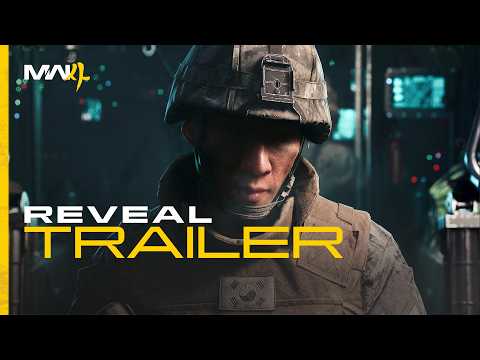


The trailer holds on a boy's hands. They are wrapped around a rifle he was issued three days ago, and they are shaking in a way his voice, on the radio, is trying very hard not to. Around him a South Korean city is coming apart at the seams, tracer fire threading between apartment blocks that were somebody's home that morning, and the private, whose name is Park, is doing what every frightened person in every trench in every war has done, which is stay close to the man next to him and hope the man next to him knows something he doesn't. A few scenes later, in the same marketing reel, a different man walks into a different frame entirely. He is unhurried. He is disavowed, wanted, operating with no flag on his shoulder and no chain of command above him, and the city he moves through treats him less like a soldier than like weather. This is Captain Price, and where Park's war is happening to him, Price's war is something he is doing, deliberately, to other people, on his own schedule, answering to nobody who could stop him if they tried. This is a Form & Systems reading, and the form in question is a structural choice Call of Duty: Modern Warfare 4 has made before a single copy exists to review: the dual-perspective campaign, cutting between Park and Price as its two point-of-view characters. The choice is not new to the series, which has alternated protagonists since the original Modern Warfare trilogy, but it is doing unusually legible work here, because the two men Infinity Ward has built the campaign around are not simply two soldiers with different assignments. They are two incompatible fantasies about what war is, held inside the same disc, and the alternation between them is not incidental to the story. It is the mechanism that lets the story avoid ever having to decide which of the two fantasies it actually believes. Start with what each man is for, because the marketing has already told us, plainly, in the language it uses to describe them. Official previews describe Park as a young South Korean soldier facing live combat for the first time, caught when North Korea launches a full-scale invasion and forced into a fight through collapsing cities. Everything about that description is calibrated toward vulnerability. He is young. It is his first time. He did not choose the invasion; the invasion arrived at him. The value Park supplies to the campaign is not competence, because competence is not what a first-combat private has. The value he supplies is exposure. Through Park, the game gets to say, in the clearest terms it has available, that this war has a cost measured in people who did not ask for it, and that the cost is being paid in real time, on streets that look like streets, by a body that can be hurt. Price is calibrated toward the opposite pole of the same story. The previews describe a vengeful Captain Price waging a personal war from the shadows, staying one step ahead of those hunting him, still wanted, in the 2019 reboot's continuity, for the killing of General Shepherd, the American officer he and his unit exposed as a traitor who had covered up an atrocity to protect his own career. Price does not answer to a command structure because the command structure tried to have him killed for telling the truth about one. That backstory matters, because it is what lets a story about an unaccountable operator present the lack of accountability as a virtue rather than a problem. Price is not outside the chain of command because he is a rogue element the narrative is worried about. He is outside it because the chain of command, when tested, failed, and he is the character who gets to act on that failure instead of merely surviving it, the way Park has to. Put the two side by side and the incompatibility is not subtle. Park's fictional value depends on him being acted upon: shot at, terrified, small against the scale of the thing happening around him. Price's fictional value depends on him acting: choosing targets, moving through cities other people are trapped in, never asked for his authorization because he granted it to himself already. A campaign that is honestly interested in war as something that happens to people would need to sit with Park's condition and refuse to let it resolve into competence, because the honest version of a first-combat private's story does not end with him becoming Price. A campaign that is honestly interested in selling the player forty hours of skillful violence needs Price, unencumbered, good at what he does, free of the institutional guardrails that would slow the fantasy down. Modern Warfare 4 needs both registers to function as the product it is. It cannot commit to either one exclusively, because committing to Park's register alone would mean making a game that refuses the pleasure it is selling, and committing to Price's alone would mean making a war story with nothing at stake in it. So it does not commit. It alternates. The alternation is, credit where it is due, genuinely effective craft, and a fair reading has to grant that before it goes looking for the seam. Dual-perspective structure is one of the oldest tools available to a war story precisely because juxtaposition does work that a single point of view cannot. Cut from the private under fire to the captain moving with total assurance through a different battlefield in the same conflict and the contrast lands as commentary even when the script never states it: this is what the same war looks like from underneath and from above it, from someone spending it and from someone spending it wisely. The device has earned its place in the genre's toolkit because it is not merely a way to vary the pacing between a slow, vulnerable mission and a fast, capable one, though it is certainly that too. It is a way to hold two true things about organized violence in the same work without either one canceling the other out. War is chaos that arrives at ordinary people uninvited. War is also, for a narrow professional class, a domain of skill, discretion, and control. Both are real. Few narrative structures let a single campaign hold both as cleanly as cutting between two protagonists does. The trouble is what the cut lets the campaign not do. Because the two threads never actually have to negotiate with each other, the campaign never has to answer the question its own structure raises: what is the relationship between Park's terror and Price's competence, beyond the fact that they are both, this month, set on the Korean peninsula and its overflow into New York, Paris, and Mumbai. Is Price's freedom purchased with soldiers like Park's fear. Does an operator who answers to no one make Park safer or does he make the war Park is trapped in more likely to happen the way it is happening. A campaign willing to sit both men in the same scene, forced to reckon with each other, would have to take a position on that question. A campaign that cuts between them, each getting his own missions, his own tone, his own competence level, never has to. The switch itself becomes the argument's escape hatch. Every time the incompatibility between the two fantasies starts to become visible, the game changes the channel, and the player, following the plot rather than auditing its structure, experiences the switch as pacing rather than as evasion. This is where the series' own history is worth being specific about, because Modern Warfare has run this exact structural bargain into public controversy before, and the controversies were never really about a single scene. They were about what happens when the game's dual commitments, seriousness and spectacle, land on the same real geography the audience actually lives near. The 2009 mission "No Russian," in which the player, undercover, walks through a Moscow airport during a staged mass shooting of civilians, was defended at the time as a way to make the player feel the weight of the villain's plan rather than simply be told about it. It was also, inescapably, a set piece, built with the series' customary craft, playable and replayable, in a franchise that has always needed its horror to also be entertaining enough to sell sequels. Russia banned the game. The mission has remained, more than fifteen years later, the series' most argued-over ten minutes, not because the ambition behind it was dishonest but because a franchise cannot fully have it both ways: a scene built to be viscerally playable will always also read as a scene built to be played. The 2019 reboot ran a version of the same collision in the other direction. Its mission "Highway of Death" restaged the real 1991 bombing of the Iraqi retreat along Highway 80, a documented, criticized event in the actual Gulf War, but relocated it to a fictional country and attributed it, in the game's fiction, to Russian forces rather than the American-led coalition that carried it out in reality. Coverage at the time, including reporting from The Week, PCGamesN, and The Conversation, described the resulting backlash as sharp enough to produce a visible split between critic and user review scores, and narrative director Taylor Kurosaki defended the choice by saying the team had built a fictional country specifically to draw on patterns repeated across fifty years of real conflicts rather than simulate one in particular. The defense is not unreasonable on its own terms. It is also, structurally, the same move the dual-perspective campaign makes at a larger scale: borrow the moral seriousness of a real, documented history, then route the specific responsibility for what happened away from the party that actually bears it. Modern Warfare 4's premise, an invasion of South Korea by the North, sits in the same territory the franchise has occupied uneasily before, drawing its stakes from a real and active geopolitical situation while building its plot, characters, and outcomes as fiction. Nothing in what has been announced suggests the new campaign intends to misattribute a real historical atrocity the way the 2019 mission did. But the underlying discipline the franchise needs, precision about what is invented and what is not, is the same discipline the dual-perspective structure lets itself off from practicing, because the switch between Park's ground-level terror and Price's operator confidence gives the game two different rhetorical registers to retreat into whenever either one alone would require it to take a harder position than it wants to take. None of this means the structure is dishonest in its intentions. It means the structure is doing exactly what dual-perspective war narratives have always been used for, which is to let a franchise sell two different pleasures under one title without ever forcing the audience, or the writers, to reconcile them. The frightened private is real work, dramatically, and there is nothing cynical in wanting the player to feel small in a war for a few missions. The unaccountable operator is real work too, and there is nothing cynical in wanting the player to feel, for other missions, powerful and precise. The problem is not that either fantasy is illegitimate. The problem is that a structure built to alternate between them, rather than to force them into the same scene, will always be more comfortable holding both than actually weighing one against the other, and a franchise with a public track record of flinching from exactly that weighing has a specific reason to be honest with itself about what the switch is for. The obvious defense of the structure is that it is simply accurate. War genuinely does contain both men. Somewhere in every large-scale invasion there is a private who did not choose to be there and a special operator who chose everything about how he fights, and a campaign that shows both is not distorting the historical record, it is reflecting it. That defense deserves to be taken seriously rather than waved off, because it is not wrong about the world. It is incomplete about the game. Showing two true things side by side is not the same as showing the relationship between them, and a campaign has to choose, moment to moment, whether it is asking the player to notice that relationship or asking the player to forget it exists. The evidence for which choice Modern Warfare 4 has made is not in the premise, which is announced and therefore fixed. It is in the verb economy each man is given, because that is the part the campaign controls scene by scene, and the verbs are where the alternation stops looking like even-handedness and starts looking like a thumb on a scale. Consider what a player is actually asked to do inside each register, based on how the series has always built its dual-protagonist missions and what the previews for this campaign describe. A Park mission is built around reaction: hold a position, follow a squadmate's call, survive a collapsing structure, keep a rifle raised at a doorway until the order comes to move. The verbs are defensive, and the camera work the franchise favors for this register, close, handheld, cutting to faces under fire, is built to make the player feel the gap between what Park can control and what is happening to him. A Price mission is built around initiative: breach, flank, choose the angle, decide who dies and in what order. The verbs are transitive in a way Park's are not. Price acts on the world; Park endures it acting on him. A player spending a campaign moving between these two verb sets is not simply switching settings. They are switching what kind of agent the game considers them to be, and the switch itself teaches something no line of dialogue has to state directly: that competence is what makes a man's violence legible as choice, and its absence is what makes a man's violence legible as tragedy. Park's fear reads as pathos because the game has denied him the verbs that would let it read as anything else. This is also where the alternating structure does its most efficient work, and where the honest reading has to give the design its due before returning to the complaint. A campaign that gave Park Price's verb set, that let the frightened private start acting with the same initiative and precision, would not be telling a more honest story about first combat. It would be lying in the opposite direction, flattering the player with competence a green conscript would not plausibly have. The restraint is correct. Park should feel small, should fumble, should need the man next to him, because that is what the first three days of a war do to an eighteen-year-old holding a rifle he did not choose. The problem is not that Park is written this way. The problem is that the campaign never lets that honestly written vulnerability sit in the same scene as the fantasy it is otherwise selling, so the two accounts of what a rifle does in a person's hands, one that breaks him and one that completes him, never have to answer to each other on screen. The player gets the tragedy and the fantasy in full, back to back, and is never asked which one they believe, because the cut always arrives before the question can be posed. There is a version of this campaign, still unmade and unannounced, that would force the question, and naming it clarifies what the alternation is currently avoiding. It would not need a shared mission or a scripted meeting between the two men, a device the franchise has used before and which tends to resolve into one man rescuing or vindicating the other rather than either one complicating the other. It would only need a single mission in which Price's initiative produces a cost that a later mission makes Park pay, on screen, in a register the player cannot look away from the way the current cut lets them look away. The campaign already has the pieces. Price's operation is disavowed, unaccountable, running on a timeline nobody above him approved. Park's unit is fighting an invasion that Price's operations are, presumably, trying to blunt from the shadows. A structure willing to draw a line between the two, even a partial and disputed line, would be taking the position the current dual-perspective format is built to avoid taking: that the operator's freedom from oversight is not a cost-free good, that somewhere downstream of every unaccountable decision there is a Park absorbing what the decision cost. Nothing in what has been announced suggests the campaign intends to draw that line. The previews describe two protagonists and two tones. They do not describe a hinge. That absence is worth dwelling on because it is not a failure of imagination so much as a structural incentive working exactly as designed. A campaign that drew the line between Price's freedom and Park's cost would be making an argument, a specific and possibly uncomfortable one, about the kind of soldier the franchise has spent seventeen years asking players to want to be. Price is not merely a character in this series. He is close to its mascot, the gravel-voiced constant across three separate sub-continuities, and a campaign that made his unaccountability legible as a cause of someone else's suffering would be indicting the thing the marketing is simultaneously trying to sell. No franchise builds a hundred-million-dollar quarter around a character and then, in the same release, asks the audience to reconsider whether that character should exist. The alternating structure is not simply a storytelling choice made in isolation from the business it serves. It is the storytelling choice that lets the business keep both halves of its audience, the one that wants to feel the war and the one that wants to win it, without ever forcing either half to notice the other is being sold something the first would not recognize as the same conflict. None of this requires bad faith from the people writing it. Dual-perspective structure has produced real, serious war fiction before, precisely because it can hold contradictory truths without flattening either one, and there is no reason to assume Infinity Ward's writers do not believe both halves of what they have built. The frightened private is not a lesser register than the confident operator, and a studio that spent real care calibrating Park's vulnerability, giving him a first-combat premise specific enough to carry an entire performance, is not phoning in half its game to sell the other half. What the structure does, regardless of the sincerity behind either half, is let sincerity on both sides substitute for a reckoning between them. A writer can believe completely in Park's terror and completely in Price's competence and still have built, without meaning to, a campaign engineered never to let those two beliefs meet, because the cut between missions is doing the work that a harder scene would otherwise have to do. Park's hands are still shaking in the trailer, and Price is still walking, unhurried, into a room nobody sent him to. The two of them will likely never share a mission that forces the terror in one to answer to the assurance in the other, because the structure that puts them both in the same box was built, like the ones before it, to keep that reckoning permanently one cut away.
Tuesday analysis
The Frightened Private and the Man Who Answers to No One
- Writer
- J. A. Marsh
- Lens
- Form & Systems
- Published
- JUN 5, 2026
- Length
- 3,273 words / 15 min
- Notes
- 5 sources
The private supplies the war's weight. The captain supplies the reason anyone bought the controller in the first place, and the campaign never has to choose between them because it never has to be in the same room as both truths at once.