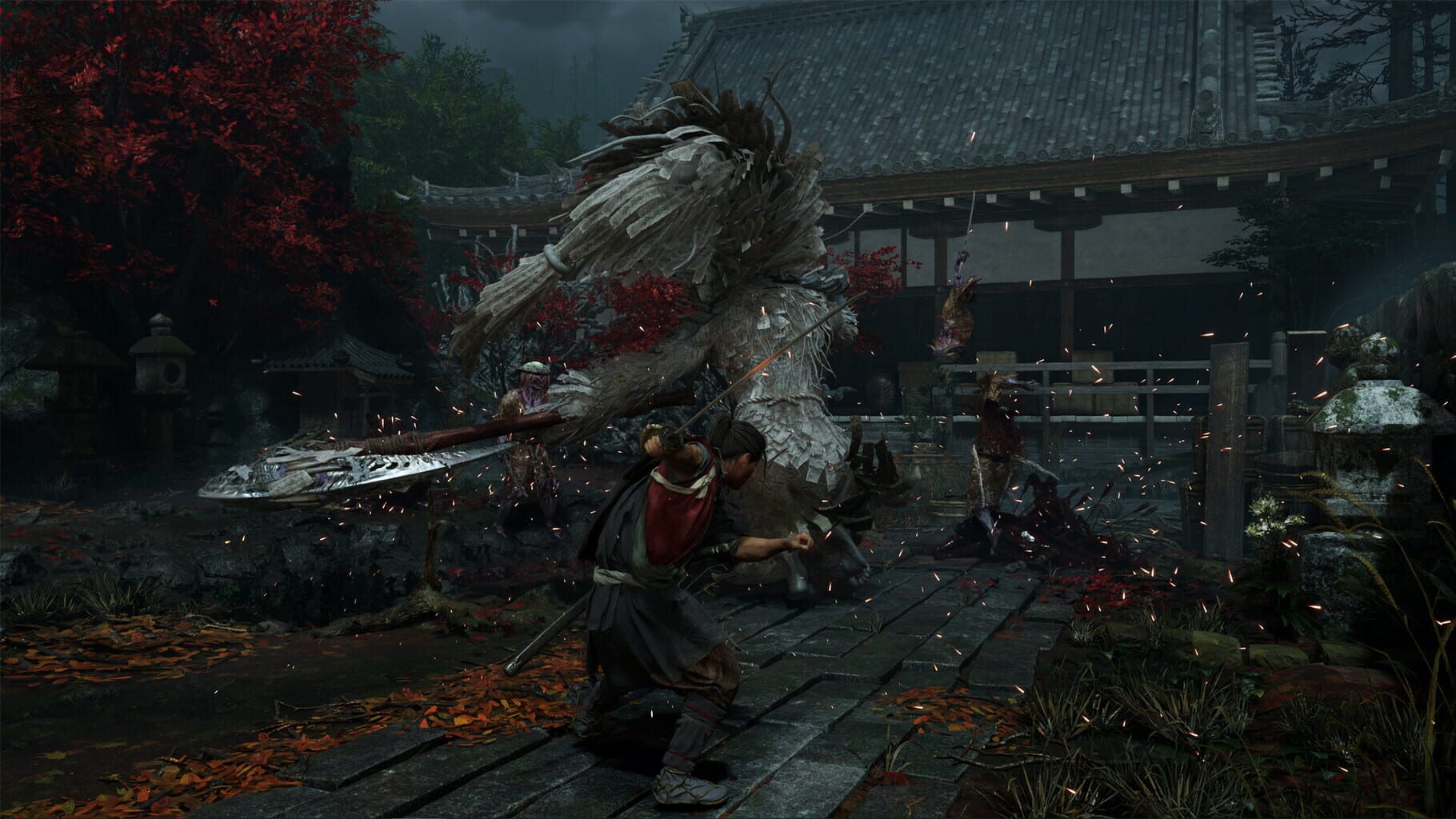
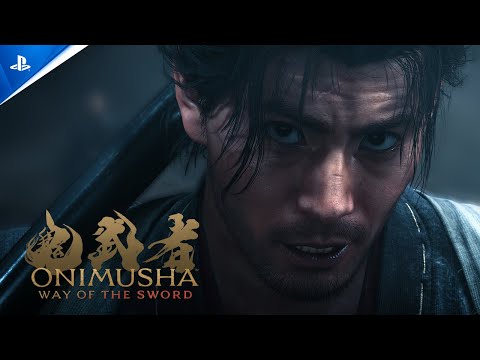


The camera in the Onimusha games has always loved a single stroke. A swordsman stands in a ruined courtyard or a lantern-lit corridor, something monstrous closes the distance, and the blade leaves its sheath, moves once with more precision than the surrounding chaos should allow, and the thing falls in halves. Way of the Sword puts that stroke in its title, and the promise is legible before a second of play: the Japan of the warring centuries, delivered the way popular memory almost always delivers it, through one disciplined body and one decisive cut.
This is the compression worth examining. Between roughly 1467 and 1600, Japan came apart. The authority of the shogunate collapsed, provincial lords made war on one another with little interruption for the better part of six generations, and the violence reached almost everyone. There were peasant levies, burned harvests, shifting borders, and mass death by blade, spear, arrow, fire, and eventually gun. Cultural memory has taken that enormous, grinding, many-handed catastrophe and refined it down to an aesthetic object: the individual warrior, the beautiful sword, and the honor of the man who carries it. The sword is real. The honor it is said to obey is, to a degree most players never suspect, a later invention read backward onto the violence. Take Onimusha seriously as an act of historical memory, which is what any period piece is, and the question turns precise. What does the blade remember, and what does it edit out.
Begin with what the war actually ran on. Karl Friday, in Samurai, Warfare and the State in Early Medieval Japan (2004), spent a career correcting the romantic picture of premodern Japanese fighting, and the correction starts with the weapons. The classic arm of the mounted warrior was not the sword but the bow. The older name for the warrior's vocation was the way of horse and bow, not the way of the sword. On the Sengoku battlefield the decisive instruments were increasingly the massed spear and, after Portuguese traders brought the matchlock to Tanegashima in 1543, the firearm. Armies were mostly ashigaru, light foot soldiers drawn from the peasantry, standing in formation with pikes and guns. The sword was a sidearm and a finisher, worn by nearly everyone and deciding little at scale. When the master swordsman met the anonymous conscript with a loaded matchlock, the matchlock tended to win. The field that produced the samurai was an infantry war fought at industrial scale, and the individual duel was closer to its decoration than its engine.
The texture of the fighting compounds the point. Sengoku warfare turned on castles, sieges, supply, and the control of rice-producing land, far more than on meetings of champions in an open field. Campaigns were won by the lord who could feed the most men longest, move grain and powder over the worst roads, and hold or seize the fortifications that governed a province. The formal single combat that fiction treats as the heart of samurai war, the announced name, the accepted challenge, the honorable duel, was more a convention of later storytelling than a documented engine of victory. Friday's warriors were pragmatists who used ambush, numbers, deception, and whatever weapon reached furthest, because the object was to win a war rather than to perform a code. The beautiful cut is what survives after the logistics are forgotten.
If the sword did not decide the battlefield, it did something else: it marked a caste. In 1588 Toyotomi Hideyoshi ordered the great sword hunt, confiscating blades from peasants, temples, and villages, and the disarmament was as much social as military. It drew a hard line between the people permitted to carry steel and the people who now farmed without it, and the separation of warrior and cultivator into fixed hereditary classes followed. The two swords worn together became a uniform of status rather than a report from the battlefield, and they became that at the very moment the great wars were ending. The katana rose to its symbolic height as the fighting that had used it wound down. By the long Tokugawa peace that settled after 1600, the samurai was mostly an administrator with a hereditary stipend and a sword he would very likely never swing in earnest, and the sword schools that refined the mystique of the perfect cut flourished as arts of peace. The soul of the samurai was polished brightest when it had the least blood on it.
The honor was real, but it was not the serene inheritance the aesthetic implies. Eiko Ikegami, in The Taming of the Samurai (1995), gave the honor culture its sharpest account and its most useful name: honorific individualism. The samurai's honor was fierce, competitive, and touchy, closer to the honor of a feuding aristocracy than to a monastic ethic, and it drove men to lethal sensitivity about slight and rank. It did not stay in that form. The Tokugawa state that ended the wars spent the long peace disciplining that honor, taming a caste of armed men into a bureaucracy that pushed paper far more often than it drew steel. Ikegami's argument is that the honor and the state were made together, actively, over centuries, and neither descended intact from an ancient source. The dignity the sword is supposed to carry was engineered, and much of the engineering happened after the fighting stopped.
The code itself, the thing usually called bushido and treated as the timeless soul of the warrior, is the latest construction of all. Oleg Benesch, in Inventing the Way of the Samurai (2014), traced the coherent doctrine of bushido not to the Sengoku battlefields but to modern Japan, largely the Meiji era and the twentieth century. The word surfaces in scattered earlier texts, and warrior ethics of many local kinds existed, but the unified national creed of loyalty, self-sacrifice, and calm readiness to die was assembled late, in argument, by writers with modern purposes. Its most famous single document, Inazō Nitobe's Bushido: The Soul of Japan, was written in English in 1900, for Western readers, explaining the Japanese warrior spirit as an equivalent to European chivalry. Hagakure, the text most often quoted today as the ancient voice of the samurai, was compiled around 1716 in a single provincial domain and stayed obscure until the twentieth century recovered it for its own uses. The ancient way of the warrior is in large part a modern object wearing antique dress. It is genuinely old the way a restored castle is old: real stones, recent assembly.
A sharp reader could push back hard on the last several paragraphs, and the pushback deserves a direct answer rather than a footnote. The argument so far risks sounding as though medieval Japanese warriors had no honor at all: no real stakes of shame, no functioning code, nothing but tactics and land-grabbing dressed up afterward in borrowed Victorian and Meiji vocabulary. That would be too strong, and it would flatten the Sengoku dead a second time in the act of correcting the first flattening. Friday's own later work says as much directly. In a 2022 lecture at the Hoover Institution, "Bushido and What Bushi Did: Loyalty, Reputation, and Honor in the Samurai Tradition," he argued that warrior values were never absent from medieval Japan, only radically inconsistent across time, tied to specific eras rather than to one continuous code. Warriors fighting in the Genpei War of the 1180s did announce their names and lineages before engaging a chosen opponent, a practice called nanori, because a warrior's reputation, and his house's claim to land and office, genuinely depended on witnessed, individual deeds.
The system hardened rather than disappeared as the fighting scaled up. By the Sengoku period, a warrior who took an enemy's head in battle could present it afterward at a kubi jikken, a formal head-viewing where the head was first washed, its hair dressed, and its face arranged so as not to look unsightly, before a commander who by custom held a fan in front of his own face and inspected the result at an angle rather than looking at it directly. The warrior testified to how the kill was made, and the testimony could be checked against other accounts, or against a prisoner or a turncoat who might recognize the face, before any reward followed. The ceremony verified a claim on land and stipend, not a soul or a code, confirmed the way any claim on scarce reward has to be confirmed: against a body, a witness, and a record.
Neither system restores the aesthetic Onimusha borrows, because the borrowing runs somewhere else entirely. Nanori-era reputation and kubi jikken alike were local, partial, and tied to one house's standing with one lord; neither had anything to say about a universal warrior soul, and neither survived contact with a Sengoku battlefield built around massed ashigaru who had no house honor to defend and no lord who would have recognized their names if they had. What Onimusha's title invokes, and what Nitobe wrote down and Hagakure eventually supplied a vocabulary for, is a different and later object: a single, portable, cross-class code that any warrior anywhere could be said to share, independent of house, era, or battlefield. Real medieval honor was thick, local, and specific to a name a herald might actually call out, or a face a commander might actually inspect. The bushido the game's title gestures toward is thin, general, and built to travel, which is exactly why it was ready for export first to Kurosawa's international audience and, decades later, to a PlayStation box.
Onimusha does not reach the Sengoku directly. It reaches it through cinema. The visual grammar of the lone swordsman, the held pause before the strike, and the single clean cut that resolves a scene is the grammar of jidaigeki film, and above all of Akira Kurosawa. Seven Samurai (1954) and Yojimbo (1961) taught global audiences how a Japanese sword should be framed, and the games inherited the framing wholesale. What is worth noticing is that Kurosawa already knew the thing the aesthetic hides. In Seven Samurai the finest blade among the defenders, the serene master Kyūzō, is killed not in a duel but by a hidden bandit with a matchlock, and the most disciplined body in the film is erased by an anonymous gun. The film ends with its surviving samurai observing that the real victors are the farmers, not the warriors. Yojimbo took the figure a further step, making its wandering swordsman a cynical mercenary who sells his skill to both sides of a squalid town feud. The iconography of the honorable blade and the knowledge that the blade was overrated were born in the same films, at the same moment. The game inherited the iconography. It mostly left the knowledge behind.
Onimusha's supernatural premise is, read generously, a form of honesty about this. By making the enemy a demon rather than a rival lord's pikemen, the series concedes that it is not depicting the actual war. The real Sengoku conflict, the war of taxes and rice and conscripted villagers and massed gunfire, is not what the player cuts through. A mythic distillation is. That is a legitimate thing for a game to be. The trouble is only that the distillation is so complete, and so consistent with every other popular rendering, that it becomes the period in memory. What the blade remembers is skill, discipline, individual agency, and the beautiful decisive instant. What it edits out is the mass: the ashigaru who did most of the killing and the dying, the gun that actually decided the field, the peasant whose harvest and body funded and filled the armies, and the machinery of domains and levies and grain that the war was largely fought over. Way of the Sword, as a title, is an accurate confession. It reduces a country at war to a blade, and calls the blade the way.
The confession goes further than the title alone lets on, and it is worth being exact about where the game actually sets its player down, because the exactness sharpens the point rather than softening it. Way of the Sword does not, in the end, place its player inside the Sengoku wars at all. Capcom has said plainly that this entry breaks from the Sengoku backdrop of the earlier games and moves the action into the early Edo period, a generation into the Tokugawa peace, where the protagonist, a young Miyamoto Musashi, wanders Kyoto as a masterless ronin looking for opponents worth fighting rather than a war worth winning. The historical Musashi is reported to have fought his most consequential duels in exactly this Kyoto, against the Yoshioka school, in 1604: by tradition he broke Yoshioka Seijuro's arm outside a Kyoto temple, disarmed Seijuro's brother Denshichiro at Sanjusangen-do, and, when the school sent its new twelve-year-old head and several dozen archers and swordsmen to ambush him at Ichijoji, killed the boy and cut his way out through the rest. The Yoshioka school never recovered its standing; its heirs were dyeing silk for a living within a generation. All three encounters took place during what the game's own marketing calls "a time of relative peace for Japan." The demons are new. The absence of a war for the demons to replace is newer still, and it is the more honest move of the two. A game set during the wars and populated with monsters at least gestures at replacing one mass violence with another. A game set after the wars, following a duelist with no campaign to fight, drops the war as a subject altogether and settles on the sword's afterlife instead.
The choice of protagonist could not have landed on a more precise historical figure for that argument. The real Musashi's single most mythologized encounter, against Sasaki Kojiro on the tidal island of Ganryu, took place on April 13, 1612, twelve years after Sekigahara had already settled the war for the shogunate. By reputation he arrived hours late and carrying a sword he had carved from a boat oar on the way over, a detail every retelling keeps because it is the least honorable part of the story. The earliest surviving account, a stone inscription raised in 1654 at the request of his adopted son Iori, says only that Musashi killed his opponent with a wooden sword and that both men arrived together; the oar and the delay were added later, by accounts written well after Musashi's death, to a story his own era recorded more plainly. Musashi wrote down what any of it meant only decades afterward, between 1643 and 1645, as an old man living as a guest of the Hosokawa domain in a hillside cave outside Kumamoto, a full generation removed from any war he might have fought in earnest. The Gorin no Sho, his treatise on strategy and swordsmanship, is a peacetime document about a wartime art, composed by a man who had personally lived through the same transition, from war to the war's afterlife, that the whole culture underwent. Way of the Sword's writers did not need to invent a swordsman who mattered more after the fighting than during it, and whose own legend visibly grew in the telling after his death rather than during his life. History had already supplied one.
It supplied his face as well, twice over. Toshiro Mifune, who died in 1997, played Musashi across Hiroshi Inagaki's Samurai Trilogy, closing the cycle in 1956 with Duel at Ganryu Island, a restaging that fixed the embellished version, oar and all, in popular memory far more firmly than the 1654 inscription ever did. Capcom spent two years negotiating with Mifune's estate to recreate his likeness for Way of the Sword's Musashi in the RE Engine, sharing drafts with the Mifune family for approval at every stage, so that the actor most responsible for teaching a global audience how a samurai ought to look is now, three decades after his death, digitally cast in the same role a second time. The restored castle from a few paragraphs ago has a face now, and the face belongs to a dead man playing a long-dead man playing, in turn, whatever the Tokugawa peace, the Meiji nationalists, and Kurosawa's cameras needed him to be next.
This gap, between what a period's violence actually was and the beautiful, honorable image a later age builds on top of it, is not a Japanese peculiarity or a problem specific to games. It is the standard operation of historical fiction, and once a reader can see it in Onimusha it becomes visible almost everywhere. The American West was mostly land speculation, railroad capital, boredom, and disease, and popular memory keeps the quick-draw duel and the gunslinger's code. The medieval European knight was a heavily subsidized cavalry investor inside a brutal extraction economy, and memory keeps chivalry. In each case a real weapon, the six-gun, the lance, the katana, is preserved, the surrounding apparatus of economics and mass violence is discarded, and a code of honor that was thinner and later than advertised is draped over the survivor. The flattering version is rarely neutral. Someone in the later age usually needs the dead to have died for honor rather than for grain or a lord's ambition, and the remembered code is built to supply that need. The useful habit is to ask, of any historical fiction, three questions together: whose weapon got remembered, whose weapon got edited out, and what later ideology is being read backward onto the dead.
None of this requires holding the game in contempt, and contempt would be the wrong response. A period piece is allowed to be a distillation, and distillation is much of what art is for. The point is to keep both objects in view at once, the blade and the country, and to notice that they are not the same size. A player can love the perfect cut and still remember that the field was won by the man with the gun, that the honor was built as much after the war as during it, and that the code the swordsman is said to serve was written closer to the age of the railway than to the age of the castle. Holding the two together is the entire skill. It is what turns a beautiful game from a replacement for historical memory into an occasion for it.
The single stroke will still land. The blade will still leave its sheath faster than the chaos around it, move once, and resolve the scene, and it will be as satisfying in 2026 as it was in Kurosawa's cutting room in 1954. It is worth letting it be satisfying. It is also worth remembering what stands outside the frame the blade draws so cleanly: a hundred and fifty years, a whole country, most of it holding a spear or a matchlock or a farming tool rather than a sword, and almost none of it living or dying by the honorable code that a later century would hand back to it as its soul. The country at war is larger than the blade. The difference between the two is the subject.