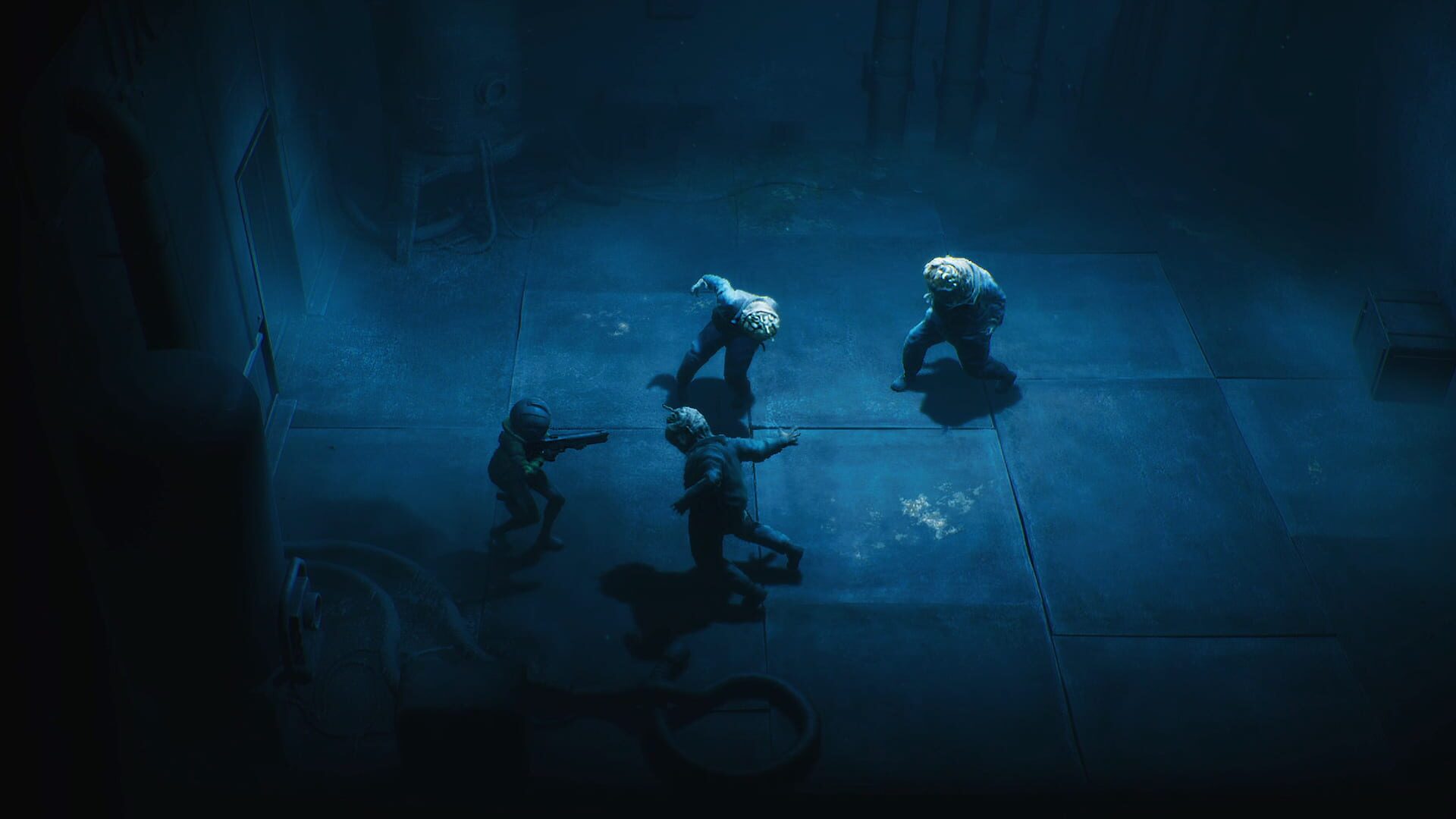
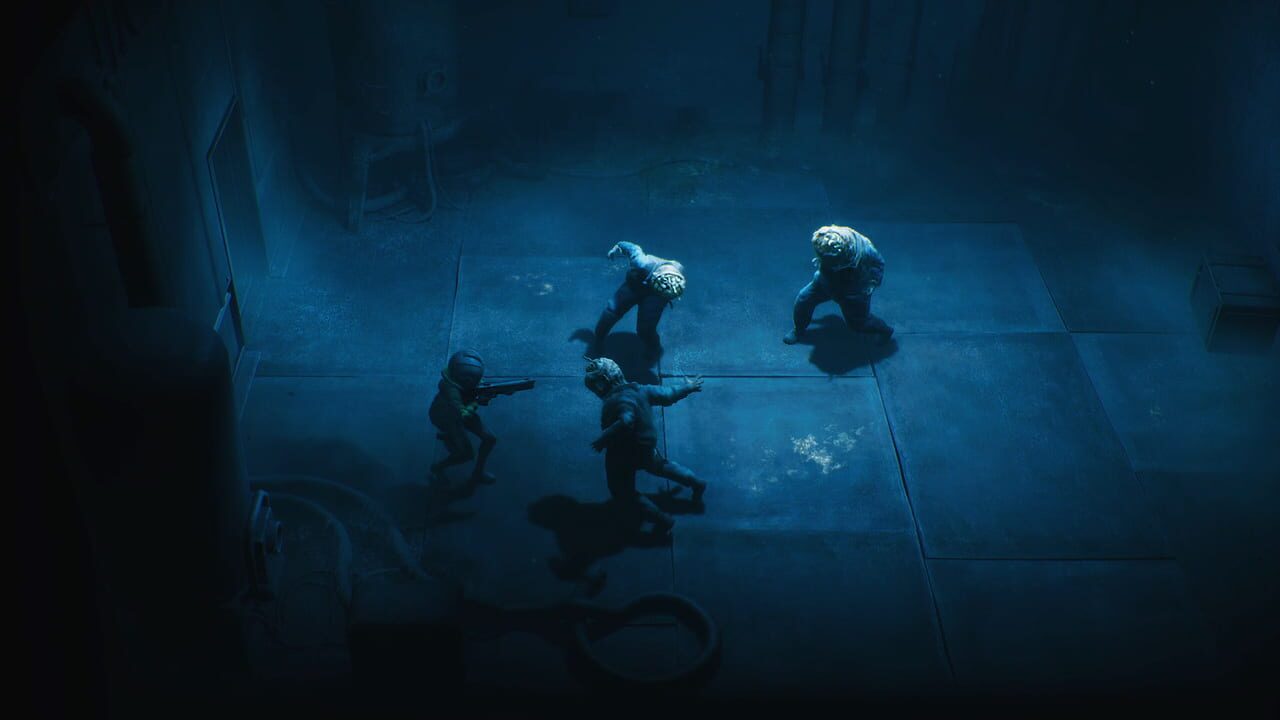

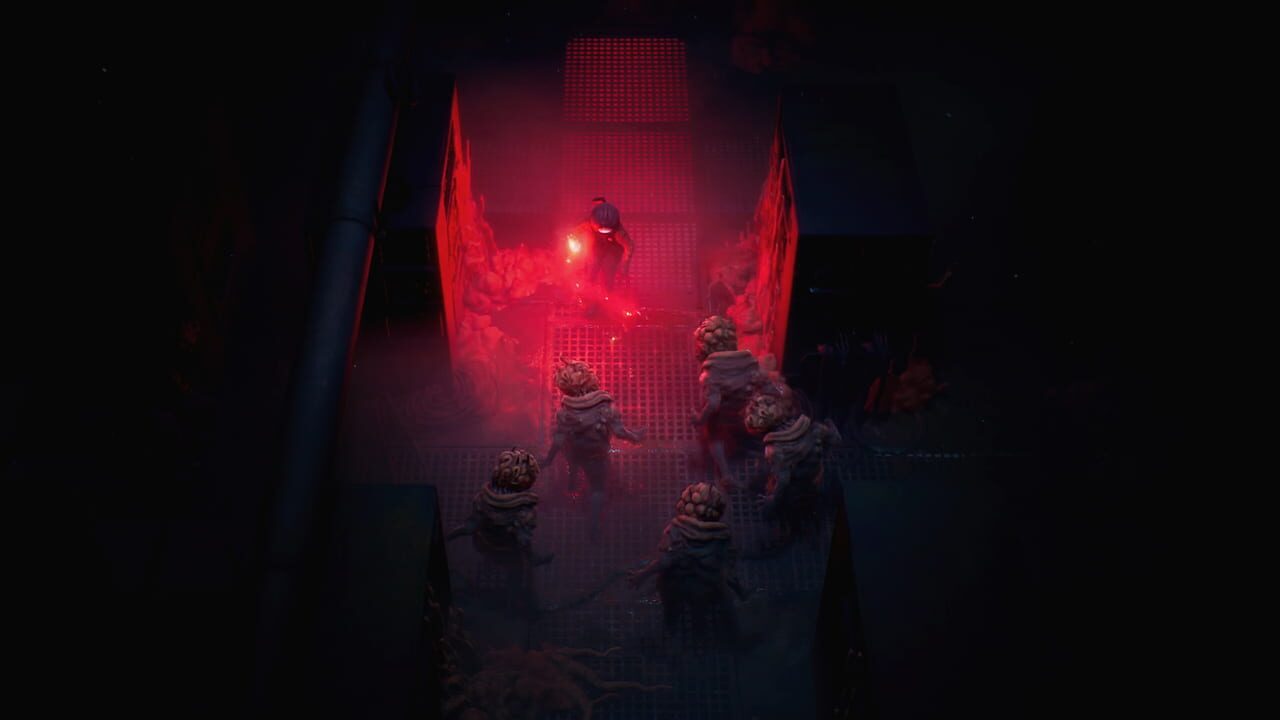
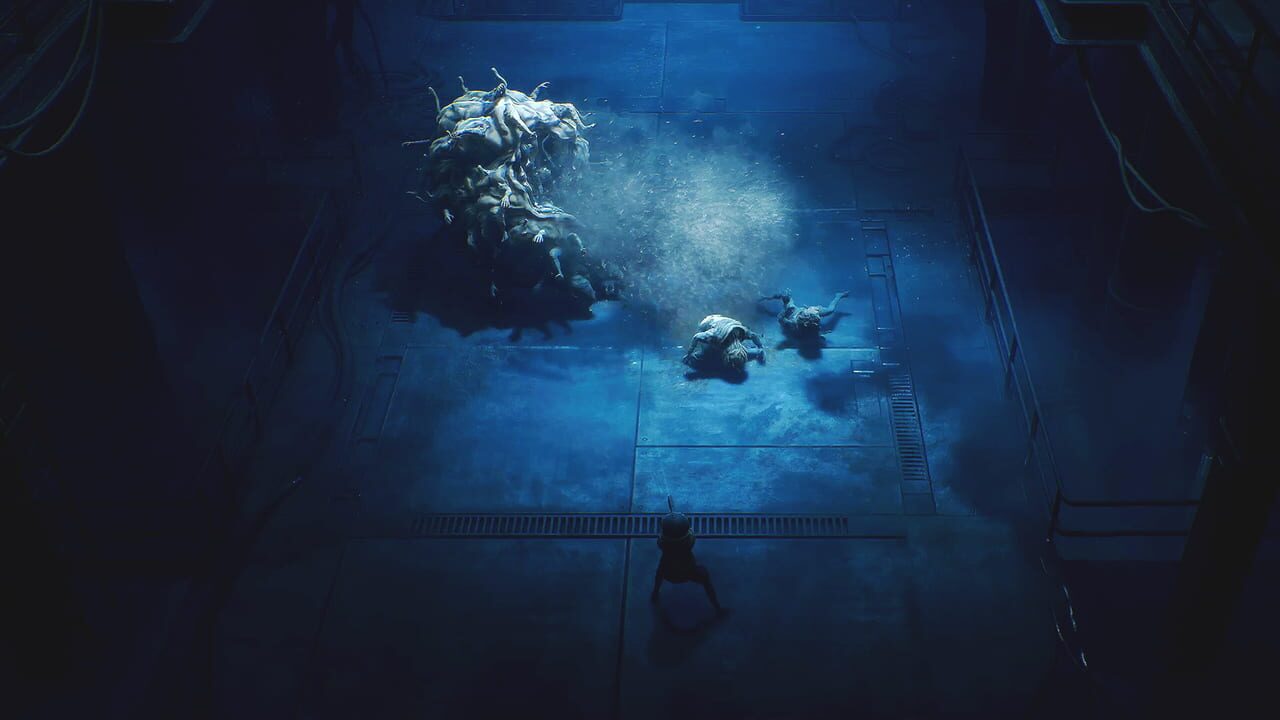
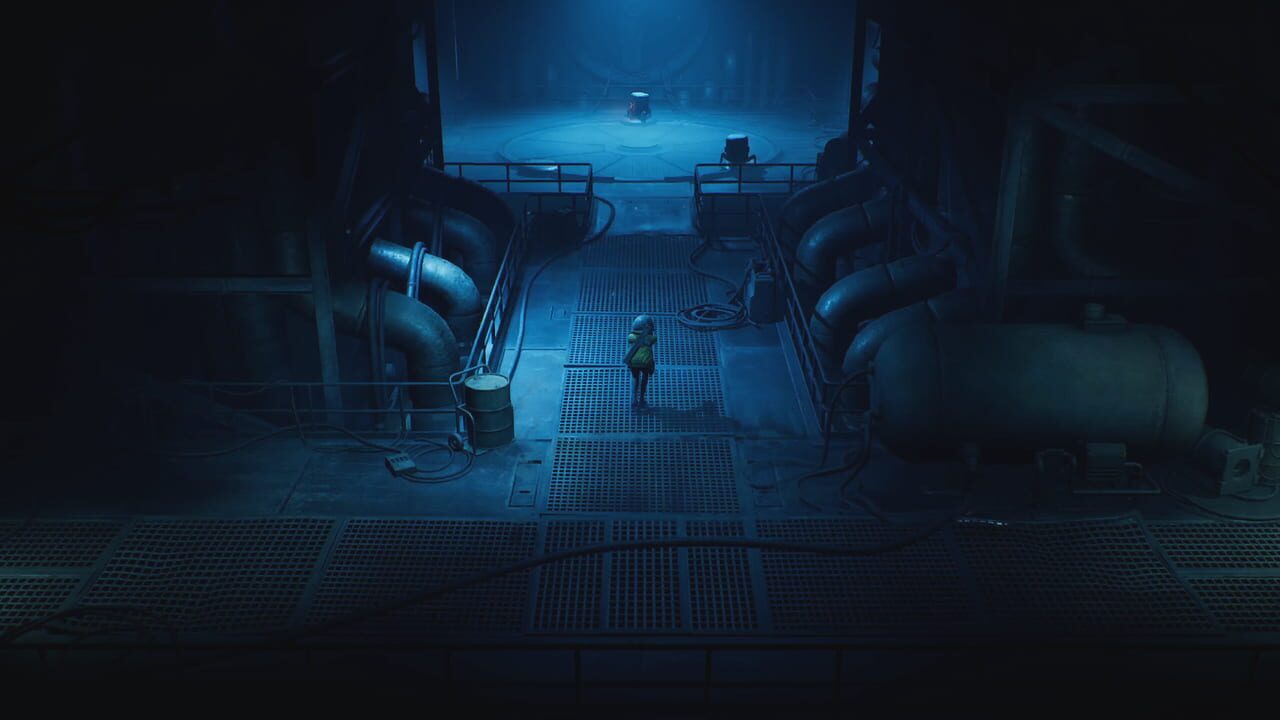
A hallway on the Nostromo, thirty-one minutes into Alien. The camera holds on a run of exposed piping along the ceiling, steam bleeding from a valve nobody has closed, a floor grate rattling under someone's boot. Nothing about the corridor announces a spaceship. It announces a plant that has been running a long shift. Ron Cobb, the concept artist who designed the ship's human-built interiors alongside Chris Foss, called his method the "used future": every surface engineered as though the ship's owners had cared about tonnage and maintenance schedules and nothing about how the place looked to a visitor. The corridor is a workplace before it is anything else. That is what makes it, thirty seconds later, unbearable. This is a piece about that corridor, and about the game that is about to walk down another version of it. End of Abyss, the debut title from the Malmö studio Section 9 Interactive, follows a combat technician named Cel through the derelict areas of an underground facility after something has gone wrong there, in the tradition that runs from Alien through System Shock, Dead Space, and SOMA. The lens here is history and memory: not what the corridor looks like, but what it is for, and what it has been asked to do across five decades of a genre that keeps building it. The corridor is science fiction's most durable set, and its durability is not laziness. It is because the set does a specific piece of work that almost nothing else in the genre's toolkit does as efficiently, and Section 9's specific twist on the formula, a protagonist whose competence is repair, gives the set something genuinely new to take away from her. Start with what the set actually is. A derelict facility, in the sense the genre means it, is not simply an abandoned place. It is an abandoned place that used to run. Someone drew up its schematics, ordered its parts, staffed its shifts, filed its incident reports. The horror the genre extracts from these spaces depends entirely on that administrative history being legible after the fact, in a form the player can read without anyone alive to narrate it. This is why the set recurs: it is the only environment in the genre's repertoire that can carry a story's entire moral prehistory in its furniture. Consider what System Shock did with that legibility in 1994. Doug Church and Warren Spector, coming off Ultima Underworld II at Looking Glass Technologies, built Citadel Station less as a level than as an archive. The player moves through the station picking up audio logs and email terminals left behind by a crew that is now dead or worse, and the station's layout, a mining and research facility retrofitted for weapons testing under corporate pressure, tells its own story through the mismatch between what rooms were built for and what they were later used for. The horror is not only SHODAN, the station's rampant AI. It is the discovery, room by room, that the disaster had a paper trail, that someone signed off on the retrofit, that the chain of decisions which produced the horror was made by ordinary people doing ordinary jobs under ordinary pressure to hit a deadline. The player never has to dramatize any of that. The station does it by sitting there, already ruined, filled with the evidence. That is the first thing the corridor is for. Environmental storytelling is often described as a mechanical convenience, a way to deliver plot without cutscenes. It is that, but the deeper reason it works specifically in derelict-facility settings is institutional. Institutions leave paper. A forest does not generate incident reports when something goes wrong in it; a corporate mining vessel does, because bureaucracies produce documentation as a byproduct of existing at all, whether or not anyone is still alive to read it back. The genre discovered, more or less by accident with Alien and then systematically with System Shock, that setting a horror story inside an institution rather than a wilderness converts every hallway into a potential archive. The player becomes an investigator without the game needing to hand them a magnifying glass. They are simply walking through the paperwork. Dead Space, released by EA Redwood Shores in 2008, pushed the same logic toward a specific kind of dread that depends on scale rather than intimacy. Glen Schofield, the game's executive producer, has described building the USG Ishimura with Event Horizon and Solaris as explicit reference points alongside the immediate mechanical inspiration of Resident Evil 4: a "planet cracker" mining ship large enough that its corridors could plausibly contain an entire ecosystem of horror without the player ever seeing all of it at once. The Ishimura's derelict status is not incidental to its terror; it is the terror's delivery mechanism. Every maintenance bay, every crew quarters, every tram line between the ship's sections carries the same institutional signature System Shock's Citadel Station did: someone built this to a budget, someone staffed it, someone's decision to keep mining after the artifact appeared is the actual cause of everything that follows. The necromorphs are the monster. The mining company's incentive structure is what put them in the corridor. What both games share, and what Alien established before either of them existed as playable objects, is that the derelict facility lets the story stage the aftermath of a decision nobody currently in the room made. This is the second and more important thing the set is for. Horror fiction generally needs an origin, a moment where a door got opened that should have stayed shut. The derelict-facility structure allows that moment to have already happened, off-screen, to people who are now dead, while the protagonist inherits only the consequences. Ripley did not decide to bring the alien onboard; the ship's science officer, acting on a company directive she did not know existed, did. The protagonist of System Shock did not authorize the retrofit of Citadel Station into a weapons platform; a corporate executive did, years before the game begins. This structure does something particular to blame. It removes the protagonist's culpability while keeping the reader's or player's moral attention fully engaged, because the facility itself, its layout, its warning signs ignored, its budget cuts visible in the shoddiness of a bulkhead, still holds the decision's fingerprints. The player gets to be furious at a choice they never had to make and could not have prevented. That is a cleaner, more sustainable kind of dread than the horror of direct personal failure, because it does not require the player to have done anything wrong. It only requires them to keep discovering how wrong things already were. SOMA, released by the Swedish studio Frictional Games in 2015, is the clearest recent case of a developer treating the corridor as an argument rather than a backdrop. Thomas Grip, the game's creative director, has been explicit in interviews that Frictional wanted a horror built on philosophy of mind rather than on being chased: the game's central question, dramatized through the underwater research station PATHOS-II, is what happens to personal identity when a mind is copied rather than moved. Grip has said the team drew on Philip K. Dick, China Miéville, and Greg Egan rather than on horror-genre precedent, and that a science-fictional setting specifically eases a player into accepting scenarios that would seem outlandish anywhere else. The derelict station in SOMA is not primarily a place where a monster killed people. It is a place where a series of engineers, under deadline pressure and with good intentions, built a system for continuity of consciousness that none of them had fully thought through, and the ruin the player walks through is the physical record of that unthought-through decision playing itself out. The facility again does the moral prehistory. The player again inherits the aftermath without having made the choice. This is worth pausing on, because it is the point at which the lens matters most: the derelict facility is not a horror trope in the narrow sense, a haunted house with better production values. It is a specific solution to a structural problem in institutional storytelling, which is how to make an audience feel the weight of a bureaucratic decision that was, at the time it was made, entirely reasonable. Nobody at the Ishimura's parent company sat down and decided to unleash Necromorphs. Nobody on Citadel Station's board voted for SHODAN to go rampant. Nobody at PATHOS-II intended a philosophical catastrophe. The decisions that produced each disaster were incremental, defensible in isolation, made by people trying to hit milestones. The derelict facility is where those small reasonable decisions get to compound into something monstrous without anyone having to write a single moment of villainy. This is closer to how institutional failure actually happens, in mining disasters and reactor meltdowns and hospital systems, than the genre usually gets credit for. The set is doing historiographical work: it is a plausible record of how catastrophe accumulates through ordinary process rather than through a single evil act. End of Abyss inherits this entire tradition, and its marketing material, along with previews from GamesBeat and Xbox Wire following the game's reveal, signals that Section 9 Interactive knows exactly which corridor it is building. The facility Cel descends through is derelict in the genre's full sense: abandoned areas, an investigation into disturbances of unknown origin that spirals into what the studio's own materials describe as a harrowing descent through a broken and abandoned world. Section 9's three founders, Mattias Ottval, Marcus Ottval, and Gustaf Heinerwall, come from Tarsier Studios, the team behind Little Nightmares and Reanimal, and the pedigree shows in the studio's stated commitment to atmosphere over spectacle. What the available material does not yet let this essay do is describe specific rooms or specific incident logs, because the game has not shipped and this essay will not invent scenes it has not verified. What it can do is take the one structural detail Section 9 has been explicit about, Cel's job, and ask what that detail changes about the corridor's oldest trick. Cel is a combat technician. Not a marine, not a scientist, not a survivor thrown into the facility by chance. A technician's competence is a specific kind of competence: the ability to read a system, diagnose what has gone wrong with it, and fix it. This is a different starting position from nearly every protagonist the corridor has produced before her. Ripley is a warrant officer who becomes competent at survival because she has to. The System Shock protagonist is a hacker whose skill is intrusion, getting into systems that were not built for him. Isaac Clarke, the Dead Space protagonist, is an engineer, which comes closest to Cel's profile, and Visceral's choice to make him one was itself a deliberate departure from the marine-with-a-gun default; his tools are modified industrial equipment, a plasma cutter built for mining rather than for war, precisely because the genre had by then recognized that a repair-worker's relationship to a broken environment produces a different kind of fear than a soldier's does. SOMA's protagonist, Simon Jarrett, is barely competent at anything mechanical, which is part of what makes his horror existential rather than practical; he cannot fix what is happening to him because the crisis is not the kind of thing tools address. What a technician offers a horror story that a soldier or a scientist does not is a very specific object to take away from her: the belief that the facility is fixable. Helplessness is the genre's default engine, and it works, but it is a blunt instrument, because most protagonists never had competence to lose in the first place. A marine who runs out of ammunition is diminished; a marine who was never expected to solve anything more complicated than a firefight was already operating at the edge of what the genre asked of her. A technician is different. Her entire identity, on entering the facility, rests on the premise that broken systems yield to the right diagnosis and the right tool. That premise is exactly what a well-built derelict-facility narrative is structurally engineered to disprove, room by room, until the technician either abandons the premise or dies still holding it. Watching a marine discover a horror she cannot outshoot is frightening. Watching a technician discover a horror she cannot repair is a different, sharper kind of frightening, because it corrodes the specific thing the character is, rather than testing a general trait like courage or luck. Competence-loss, staged against a character whose competence is stated as her defining trait from the outset, gives the corridor a fresh mechanism for the same old dread: not simply "will I survive this," but "was I ever actually able to fix anything, or was I only ever qualified to fix the parts of the system that were designed to be fixable." This is also, not incidentally, a sharper way of dramatizing the institutional argument the genre has been making since Cobb's used-future pipework in 1979. A technician's job is maintenance, the ongoing labor of keeping an institution's systems from decaying past the point of use. To put a maintenance worker at the center of a story about a facility that has already decayed past that point is to stage, directly in the protagonist's professional identity, the genre's oldest question: at what point does upkeep stop being possible, and who is left holding the wrench when it does. Cel's competence is not incidental color. It is the argument the facility is making, embodied in one person walking through it. The obvious objection to all of this is that the corridor is simply cheap. A ruined institutional interior is inexpensive to build relative to a living city or a functioning ecosystem: fewer characters to animate, less crowd logic to simulate, no economy to model. A cynical account of the set's fifty-year run would say developers keep returning to it because empty hallways are what a modest budget can render convincingly, and every argument this essay has made about paperwork and moral prehistory is a post-hoc rationalization of a production constraint. There is something to this. Looking Glass Technologies was a small studio in 1994, working with technology that made crowded, populated spaces genuinely difficult to render at a stable frame rate; a mostly empty station solved a real technical problem. But the objection does not survive contact with the genre's better examples, because cheapness explains why a developer might choose a derelict setting and says nothing about why the choice keeps producing work that outlives its budget. Alien's production, by contrast, was not thrifty. Twentieth Century Fox gave Ridley Scott meaningful resources for 1979, and Cobb's team still chose grime and asymmetry and unglamorous pipework over the gleaming, expensive-looking modernism that films like 2001: A Space Odyssey had made the default vocabulary for cinematic space eleven years earlier. That was an aesthetic decision, not a cost-cutting one, and it is the decision the rest of the genre has been quoting ever since. The corridor persists because it works, not because it is cheap; the cheapness, where it exists, is a fortunate side effect rather than the cause. A second, more serious objection is that the corridor has calcified into pure iconography, a set of visual signifiers, the flickering light, the terminal with one working line of text, the vent someone should have welded shut, that a studio can now deploy without doing any of the historiographical work this essay has described. This is a fair criticism of a great deal of the genre's mid-tier output, and it is worth naming rather than waving away. A flickering light does not, by itself, constitute an institutional archive. The difference between the set working and the set decorating is whether the space actually rewards the kind of reading System Shock and Dead Space and SOMA built it to reward: whether the terminal really does contain a decision with a name attached, whether the layout really does encode the mismatch between what a room was built for and what it became. This is the test a reader can carry forward, and it is more useful than a simple inventory of whether a new game contains the familiar furniture. The question is not whether End of Abyss has a derelict facility. Nearly every game in this lineage does. The question is whether the facility, once the game is out and playable, turns out to hold a paper trail worth finding, and whether Cel's specific competence is allowed to be lost in a way that means something rather than merely staged as a difficulty curve. The corridor, then, is not a failure of imagination on the part of a genre that keeps returning to it. It is the site where science fiction does its most patient administrative work: the paperwork of a catastrophe nobody in the story is left to file. Alien found the visual grammar for a used, working, indifferent institutional space. System Shock found the narrative mechanism for reading that space as an archive of decisions. Dead Space found the way to attach the archive to scale and to a protagonist whose tools were built for repair rather than combat. SOMA found the way to make the archive itself philosophical, a record not of what broke but of what was never adequately thought through. End of Abyss, on the evidence available before its release, is positioned to take the technician thread and pull it taut: what happens when the person walking the ruined halls is the one person in the genre's long history of ruined halls whose entire self-conception depends on believing the halls can still be fixed. A reader who carries this frame into the next facility-horror game, whatever it turns out to be, has something more useful than a checklist of genre furniture. They have a question to ask of the space itself: what institution built this, what did its budget look like, and what is the protagonist's relationship to fixing the kind of thing that just broke. The pipework on the ceiling is never just pipework. It is a record of someone's Tuesday, decades before the story started, and the corridor is still waiting to show you what that Tuesday cost.
Tuesday analysis
Why Science Fiction Keeps Building the Same Corridor
- Writer
- J. A. Marsh
- Lens
- History & Memory
- Published
- MAR 20, 2026
- Length
- 3,045 words / 14 min
- Notes
- 8 sources
The corridor is not a failure of imagination. It is the site where science fiction does its most patient administrative work: the paperwork of a catastrophe nobody in the story is left to file.