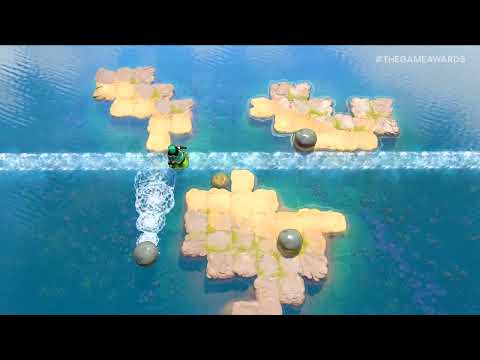


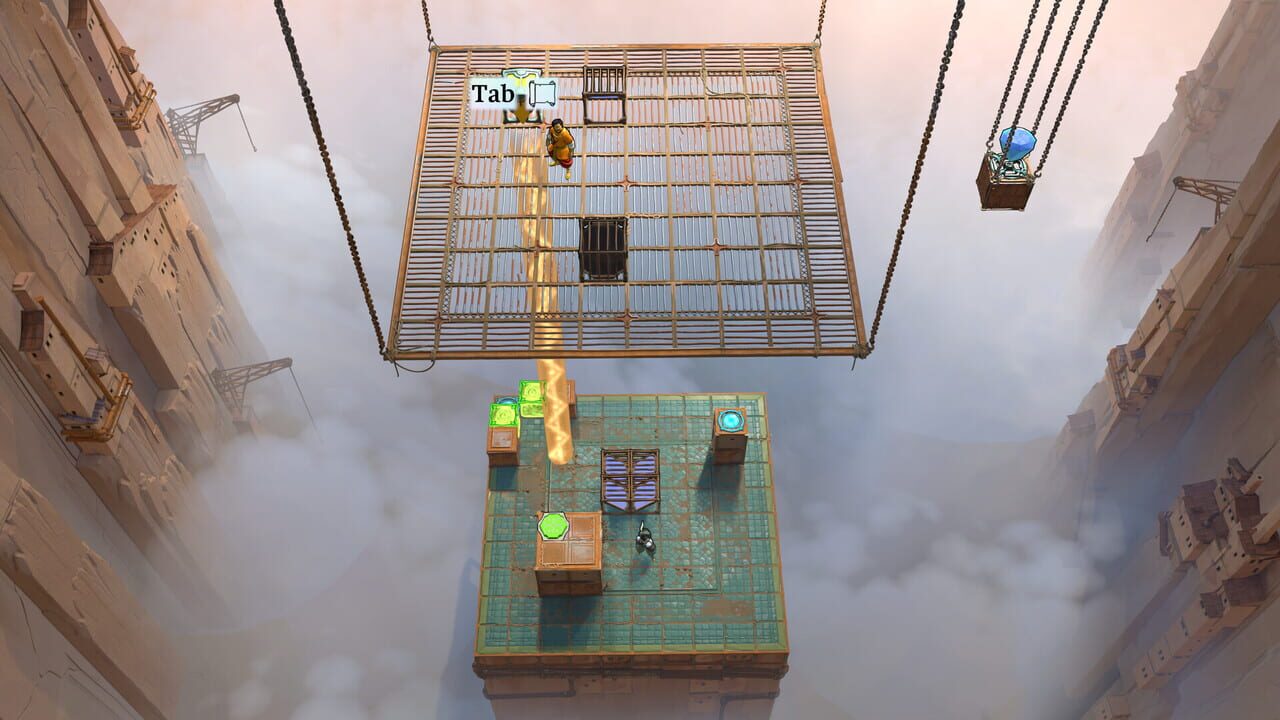
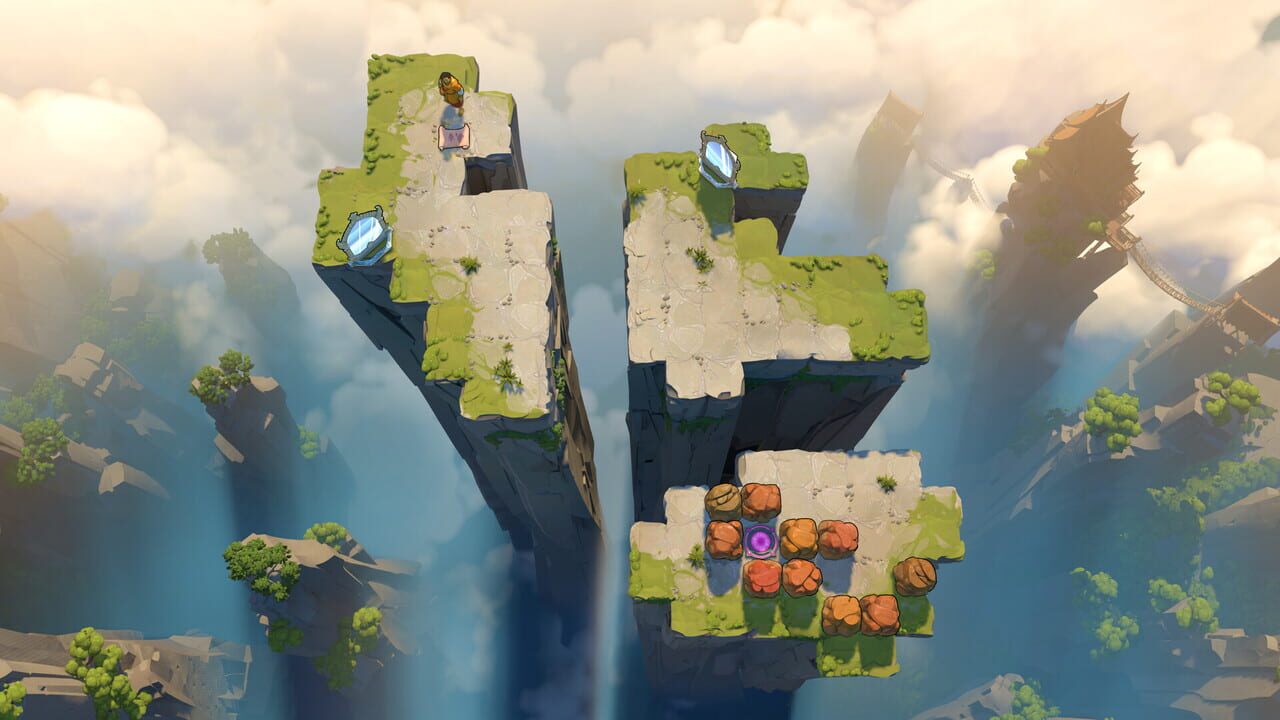


In the second hour of The Witness, a player stands in front of a stone panel carved with a maze of thick black lines, and nothing in the game has told her what the lines mean. There is no tutorial pop-up. There is no button prompt. There is a panel, and a stylus of light she can drag across it, and the accumulated experience of the eleven identical panels that came before, each one slightly harder than the last, each one teaching a rule the game never states in words. She solves it, or she doesn't, and either way the island does not comment. It waits for the next panel. That silence is the argument, and it is worth declaring the lens this essay is reading through before going any further: this is a piece about form and systems, about what a puzzle is actually built to do, and about the specific, unusual claim one designer has spent two decades making through the mechanism of puzzles themselves rather than through anything he has said about them. Jonathan Blow has been making this claim since Braid in 2008, refined it into something close to a thesis with The Witness in 2016, and is now, with Order of the Sinking Star, making it again at a scale that most of the games industry would consider commercially insane. The Thekla-developed game, releasing this October on PlayStation 5, Switch 2, and PC, reportedly contains more than 1,400 hand-built puzzles across four intersecting worlds, playable through several distinct heroes, a project Blow has described as having simply "blown up" past its original ten-to-twenty-hour scope during a decade of development. The number alone would be a curiosity if it belonged to almost any other designer. Attached to Blow, it is a continuation of an argument, and the argument deserves to be taken on its own terms before it gets waved off as eccentricity or bloat. The claim, stated plainly, is one that most designers do not actually accept, even when they nod along to it in panel discussions: a puzzle is not an obstacle placed between the player and the content. A puzzle can be the content. It can be a way of saying something that cannot be said the same way in a cutscene, a line of dialogue, or an essay like this one, because the saying happens inside the solver's own head, at the moment comprehension arrives, and that moment cannot be handed to someone secondhand. You can describe the aha. You cannot transmit it. Blow has put a version of this directly: the puzzles in The Witness are not, in his words, "just a thing you solve," because "there's an idea behind each one," and the game's job is to arrange the ideas so that solving becomes a form of communication running in a direction ordinary language does not run. The panels are not decoration wrapped around a game. On this account, they are closer to sentences in a language whose grammar the player has to learn by using it. This is a stranger position than it sounds, and it is worth sitting with the strangeness rather than rushing past it. Most games that contain puzzles treat the puzzle as friction: a pacing tool, a difficulty check, a wall between the player and the next cutscene, something to be cleared rather than understood. Most narrative games that want to say something serious say it through writing, through voice performance, through the arrangement of image and music, because those are the tools film and literature have spent a century refining and games can borrow. The puzzle, in that tradition, is the part of the game that isn't really about anything. It is mechanism. Blow's twenty-year project has been to reject that division, to insist that the mechanism can itself be the meaning, and that a designer who reaches for a cutscene to say the thing the puzzle should have said has, in some sense, failed the form. The Witness makes this case at length by declining almost every tool a game usually has for making a case. There is no dialogue in the traditional sense, no quest log, no map marker, no character who explains the island's premise. What there is instead is an environment built entirely from variations on a single visual grammar, the line drawn across a panel from a start point to an end point, obeying rules the game teaches only by example. Early puzzles establish that a line must separate black squares from white squares. Later puzzles complicate the rule with colored tetromino shapes, with hedges and trees that can be seen through the panel's geometry, with panels whose solution depends on a shadow cast by an object standing somewhere else on the island entirely. The panels never announce which rule is newly in play. The player has to notice. Blow has said his design attention is fixed on "what's going through the player's head right now, all the time," and that the key to a given puzzle is deliberately not hidden anywhere in the world, because "the key is just in your head." There is no object to find. There is only the moment before you see it, and the moment after. The island itself extends the argument past the panels. Roughly a third of the way through the game, a puzzle that looked exactly like the hundreds before it turns out to have a line drawn not on a stone tablet but by the negative space of a real object standing in the world: a coiled pipe, a row of tree stumps, the silhouette of a distant structure seen from one specific vantage point and no other. The panel was never separate from the island. The island was the panel the whole time, and the player simply had not yet learned to read it that way. This is the clearest possible demonstration of Blow's claim that comprehension itself is the progression system, because nothing about the player's inventory, map completion, or stat sheet has changed when this realization lands. What has changed is entirely internal: a way of looking that did not exist an hour ago now exists, and every environment behind the player retroactively becomes legible in the new way. A quest marker cannot produce that kind of change, because a quest marker tells you where to look. The Witness's trick only works because it has spent hours declining to. That refusal to explain is where the strongest objection to Blow's whole project lives, and it deserves its full weight rather than a quick wave-off, because it is a real problem and not merely a matter of some players lacking patience. Withholding explanation is not automatically a form of respect for the player's intelligence. It is very often, in practice, simply a failure of communication dressed up as a design philosophy, and the two can look identical from the outside. A puzzle that teaches its own rule through careful sequencing is respect. A puzzle that is merely obscure, that depends on a leap the designer happened to make and expects the player to happen to make too, is not respect, it is a coin flip wearing the costume of one. Critical response to The Witness bore this distinction out messily. Some players and critics found the game's insistence on silence exhilarating, precisely the kind of trust rarely extended to an audience. Others found long stretches of it simply obtuse, a game that mistook confusion for depth, whose late-game panels demanded a kind of lateral, perspective-based thinking that a meaningful fraction of players never happened to arrive at, no matter how attentively they had played the earlier hours. The island's audio diaries, excerpts from real philosophers and scientists scattered as environmental narration, drew a similar split: some read them as the game's clearest statement of its own thesis, that understanding the world is a matter of learning to see it rather than being told about it, and others read them as pretension bolted onto a puzzle box, a designer reaching for authority he had not quite earned through the puzzles alone. Both readings can be true at once, and that is the actual shape of the objection worth answering. Puzzle-as-meaning is legible mainly to a reader already disposed to look for meaning in a puzzle in the first place. A player who came to The Witness wanting an environmental adventure game with a satisfying click of solved logic, and who did not arrive already primed to treat obscurity as invitation, is not wrong to experience the same silence as withholding rather than as trust. The game does not accommodate that player particularly well. It was not built to. And a design philosophy that only works on the audience already sympathetic to it is a philosophy with a narrower claim on general truth than its defenders sometimes pretend. But the objection, taken all the way through, proves less than it first appears to. The fact that a form of communication requires the receiver to be attentive is not a special flaw of puzzles. It is true of poetry, of difficult film, of any art that declines to spell itself out, and no one treats a hard Tarkovsky film as illegitimate simply because plenty of viewers walk out unmoved and confused. The relevant question is not whether every audience member gets it. It is whether the thing being communicated actually depends on the form doing the communicating, whether it could have been said some easier way without becoming something smaller. And here the honest answer, tested against The Witness specifically, is that a good deal of what the game does could not have been said in dialogue. The specific experience of standing in front of a panel with no idea what it wants, watching your own attention rearrange itself around a shape you had been looking straight at without seeing, and then abruptly seeing it, is not a fact that can be reported to you. It has to happen to you. A cutscene can tell you that comprehension is a kind of grace that arrives without warning. A puzzle, built correctly, can make you feel the arriving. That gap between telling and making-happen is the actual substance of Blow's claim, and it survives the objection about obscurity even when individual puzzles, in individual playthroughs, fail to clear the bar the philosophy sets for itself. Braid had already made a version of this argument eight years earlier, with time rather than sight as its material. Blow's starting question for that game, by his own account, was simple: what happens if the player can rewind time without limit. He asked the question in code and watched what came back, and what came back was a set of puzzles that could only be solved by a player willing to abandon the ordinary assumption that a mistake, once made, is permanent. The rewind mechanic is not a convenience feature bolted onto a platformer to make it more forgiving. It is the puzzle's actual subject. Braid's late chapters complicate the rewind further, introducing objects immune to it, shadows that replay a previous loop while the present self acts around them, until the mechanical vocabulary is doing something closer to moral philosophy than platforming: what does responsibility mean in a world where the past can be revised, and what happens to blame when the revision is available to everyone but you. Critical response gathered a decade later, in Critical Distance's retrospective compilation on the game's tenth anniversary, kept returning to the same observation from different angles: that Braid's ending recontextualizes the entire mechanic retroactively, and that the recontextualization only lands because the player has spent six or seven hours physically manipulating time before the game asks them to reconsider what that manipulation meant. Read the ending as a plot twist and it is a clever twist. Play it as the payoff of a hundred small time-reversals your own hands performed, and it is closer to an argument the game has been making the entire time, one puzzle at a time, waiting for you to have done enough of them to understand what they add up to. Blow has described his own process in terms that make the philosophy sound less like authorship and more like inquiry. His account of Braid's origin, laid out in a 2010 GDC talk on the rewind mechanic, was that he asked a question in code, rather than in prose, and then watched what the code gave back. A game, on this description, is a system that can be interrogated, and the interrogation produces answers a designer working only in words could not have reached by thinking alone, because the system will surface consequences of a rule that its own author did not anticipate when the rule was written. This is a meaningfully different claim from the more common one, that games are good at delivering information through interactivity. It is a claim that some kinds of understanding cannot be authored directly at all, only discovered by building a system and then finding out, through play, what the system turns out to say. A puzzle designed this way is not a container for a lesson the designer already knew. It is closer to an experiment whose result the designer is reporting rather than inventing, and the player who solves it is not being told the result secondhand. She is running the experiment herself, on her own attention, and getting the same result Blow got when he first built the mechanism. That accumulation is the piece of the philosophy Order of the Sinking Star raises to a different order of magnitude, and it is worth being precise about what changes when the number goes from The Witness's roughly six hundred and eighty panels to Order of the Sinking Star's reported fourteen hundred puzzles across four worlds and multiple playable heroes. Scale, in most games, is not an argument. A thousand-plus levels in a mobile match-three game says nothing except that content is cheap to generate once a template exists. But Blow has been explicit that Order of the Sinking Star's puzzles are not generated from a template and are not meant to be interchangeable. "All the levels are about ideas," he has said of the project. "They're not just random puzzles." The design team, which includes Alan Hazelden and Marc ten Bosch, two of the more exacting puzzle designers currently working, has reportedly held to a standard in which a level does not ship unless it demonstrates something specific about how its objects interact, a rule closer to how a mathematician builds a proof from lemmas than to how a level designer fills out a checklist. Four heroes, a warrior who pushes, a thief who pulls, a wizard who teleports, and others introduced in later worlds, each restate the underlying puzzle logic in a different grammar, the way a fugue restates its subject in a different voice. The mirror-based eastern world, which lets a puzzle be solved twice, once directly and once through its reflected double, is reportedly explicit about this idea of restatement: the same shape, understood two ways, becomes a different and larger comprehension than either way alone. If The Witness's argument was that a puzzle can carry an idea the way a sentence carries a thought, Order of the Sinking Star's argument, at fourteen hundred puzzles deep, is that ideas compound the way sentences compound into an argument, that understanding is not a pile of discrete unlocks but a grammar a player is slowly, involuntarily acquiring. The bet is that a player five hundred puzzles in is not simply better at solving puzzles than she was at puzzle ten. She is thinking in a vocabulary the game spent five hundred puzzles building in her, one she did not choose consciously and cannot fully articulate, the way a fluent speaker cannot always state the grammatical rule she is nonetheless following correctly every time she opens her mouth. That is a genuinely different claim from The Witness's, even though it grows out of the same root conviction, and it is the more ambitious of the two. It is also the more exposed. A single obscure panel in The Witness is a local failure, absorbed by the six hundred panels around it. A grammar that fails to compound across fourteen hundred puzzles, that never actually accretes into the kind of fluency the design is betting on, would be a failure at the level of the entire architecture, not a rough patch. The scale is the proof and the risk in the same gesture. None of this requires pretending the counter-argument has vanished. It has not. There will be players for whom Order of the Sinking Star's four hundred, five hundred, however many hours of puzzle-solving reads not as an accumulating grammar but as an accumulating slog, a designer so convinced of his own philosophy that he mistook more for deeper. That reading will be available on release day and it will not be foolish. The relevant test, the same one that applies to The Witness, is not whether every puzzle lands for every player. It is whether the specific things this form can say, that a well-timed silence and a well-built rule can produce a species of understanding no explanation could hand you directly, are things worth saying at all, and whether the game actually says them rather than merely gesturing at the possibility. The frame worth carrying out of this, into other games and other puzzles entirely, is a question rather than a verdict: when a game withholds an explanation, is the withholding building toward a comprehension the player could not have reached any faster, or is it simply a designer declining to do the work of being clear. The two look almost identical from inside the first hour of confusion. They are not identical. One respects the player enough to trust her with the work of seeing. The other just isn't finished yet. Blow's whole career has been a long bet that the difference is visible, eventually, to a player willing to stay in the room long enough to find out which one she is looking at. Fourteen hundred puzzles is a great many rooms to stay in. It is also, on his account, the only way the argument was ever going to get made.
Tuesday analysis
A Thousand Puzzles Is an Argument
- Writer
- J. A. Marsh
- Lens
- Form & Systems
- Published
- MAY 1, 2026
- Length
- 3,064 words / 14 min
- Notes
- 10 sources
A puzzle, on this account, is not an obstacle placed between the player and the content. It is the content, and it cannot be paraphrased without becoming a different, lesser thing.