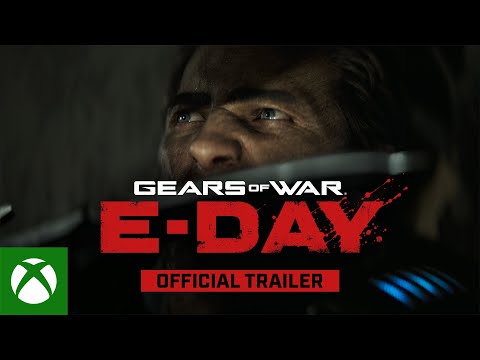
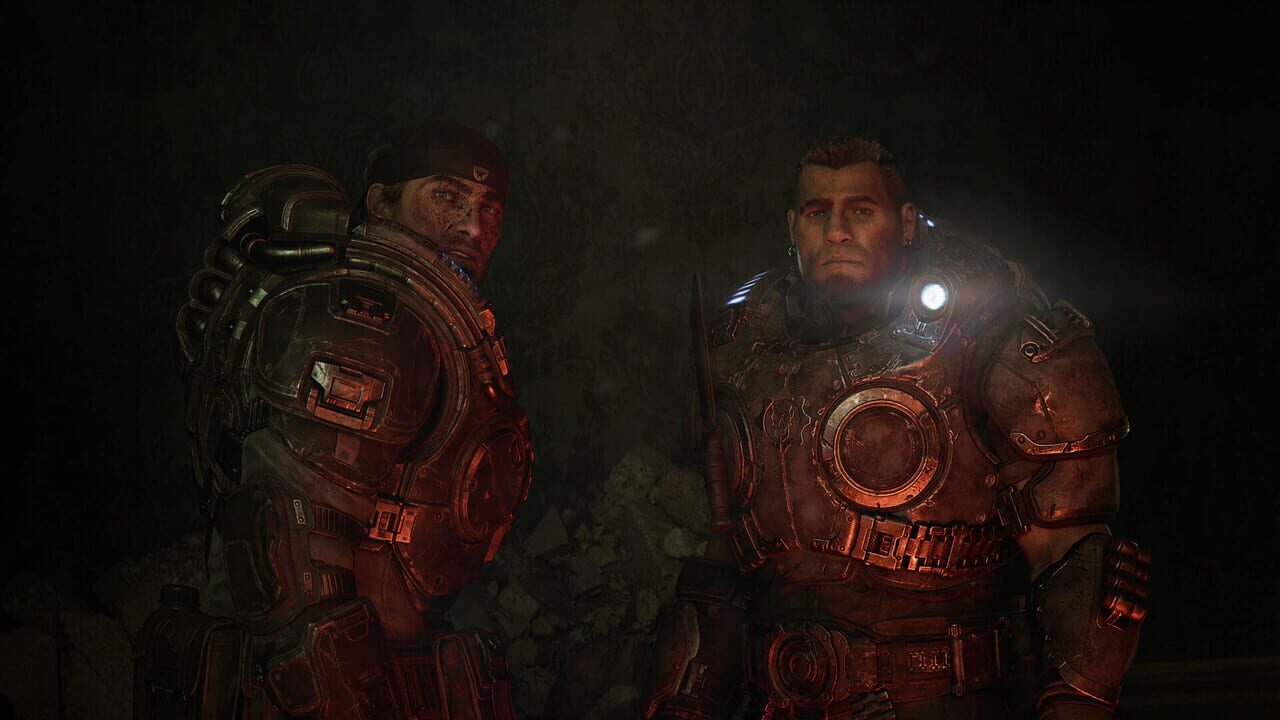
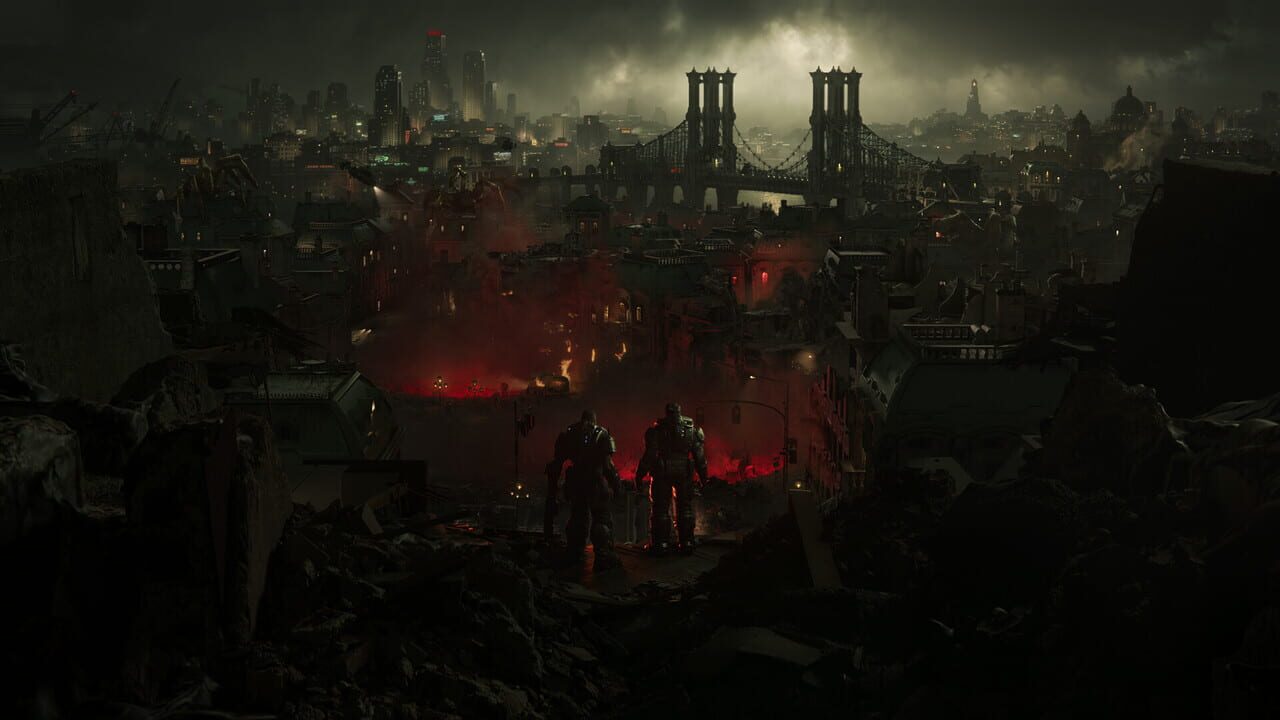
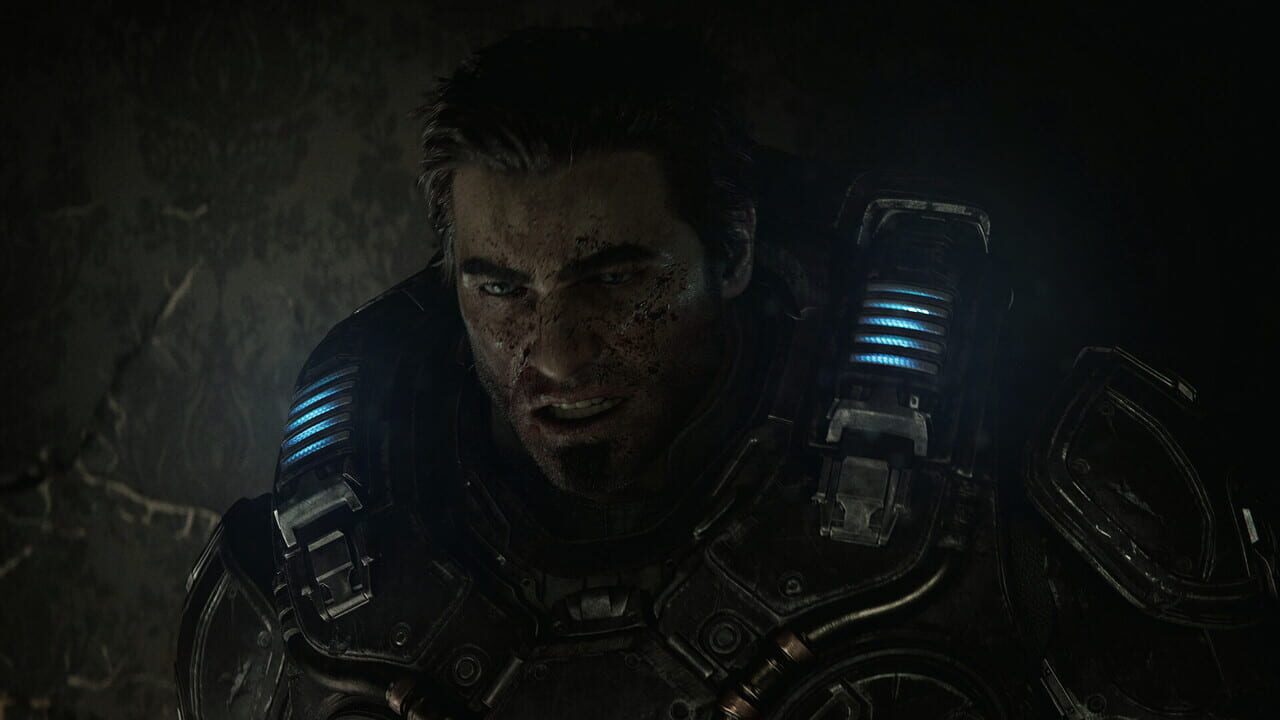
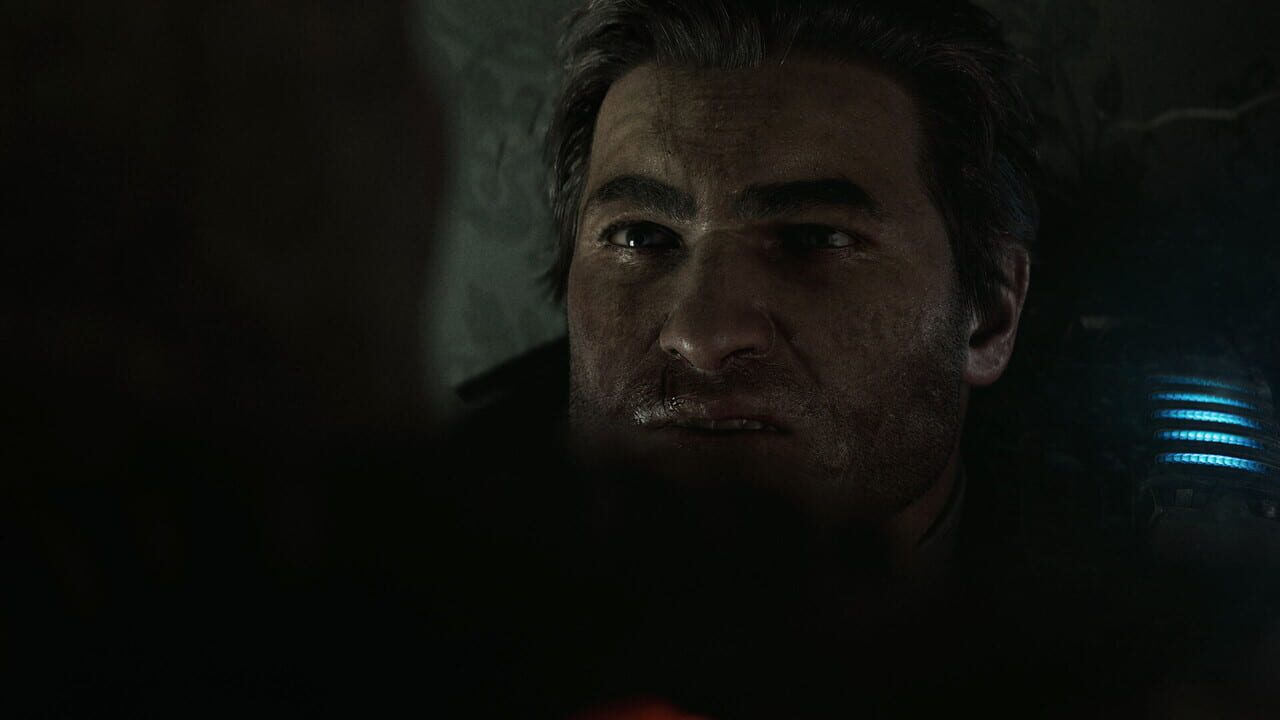
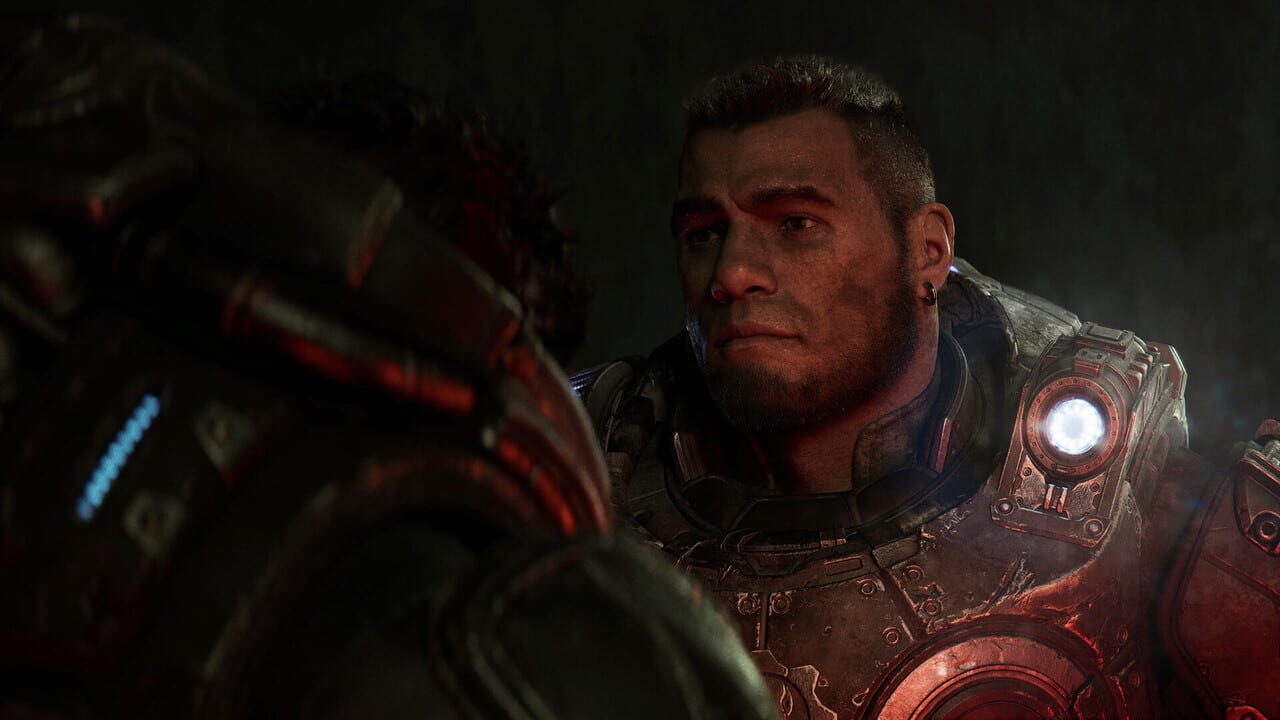
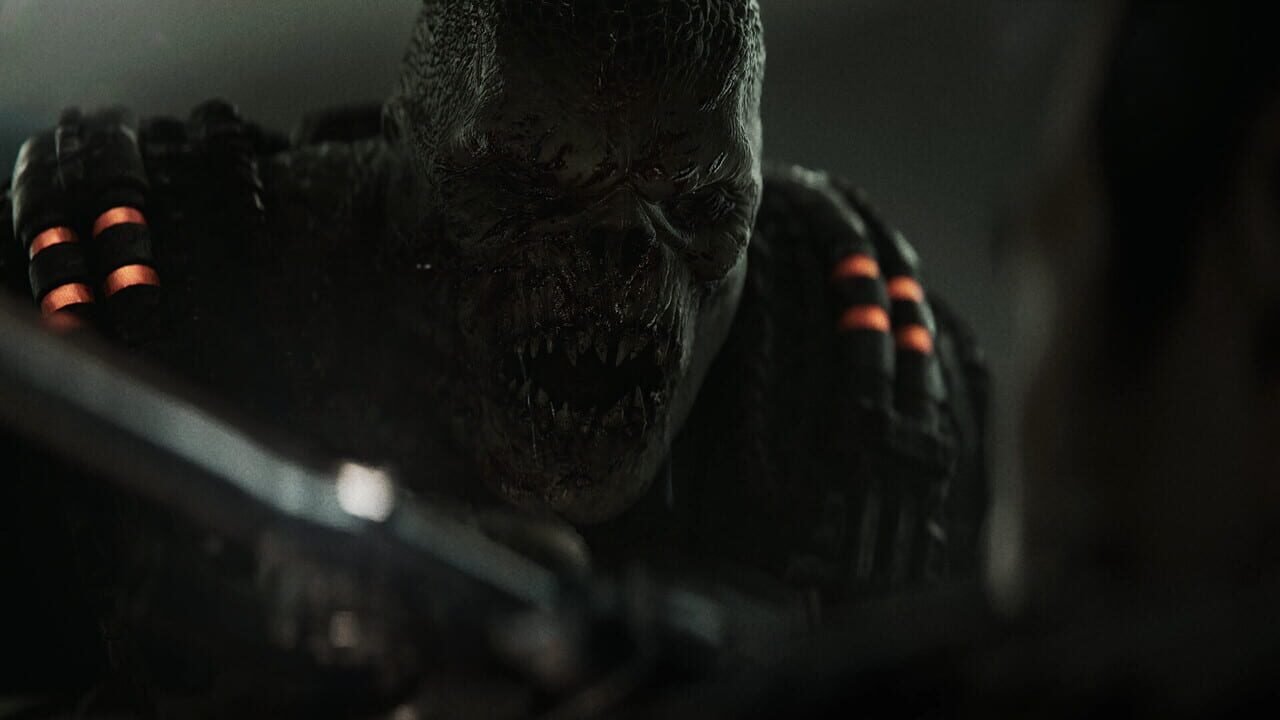
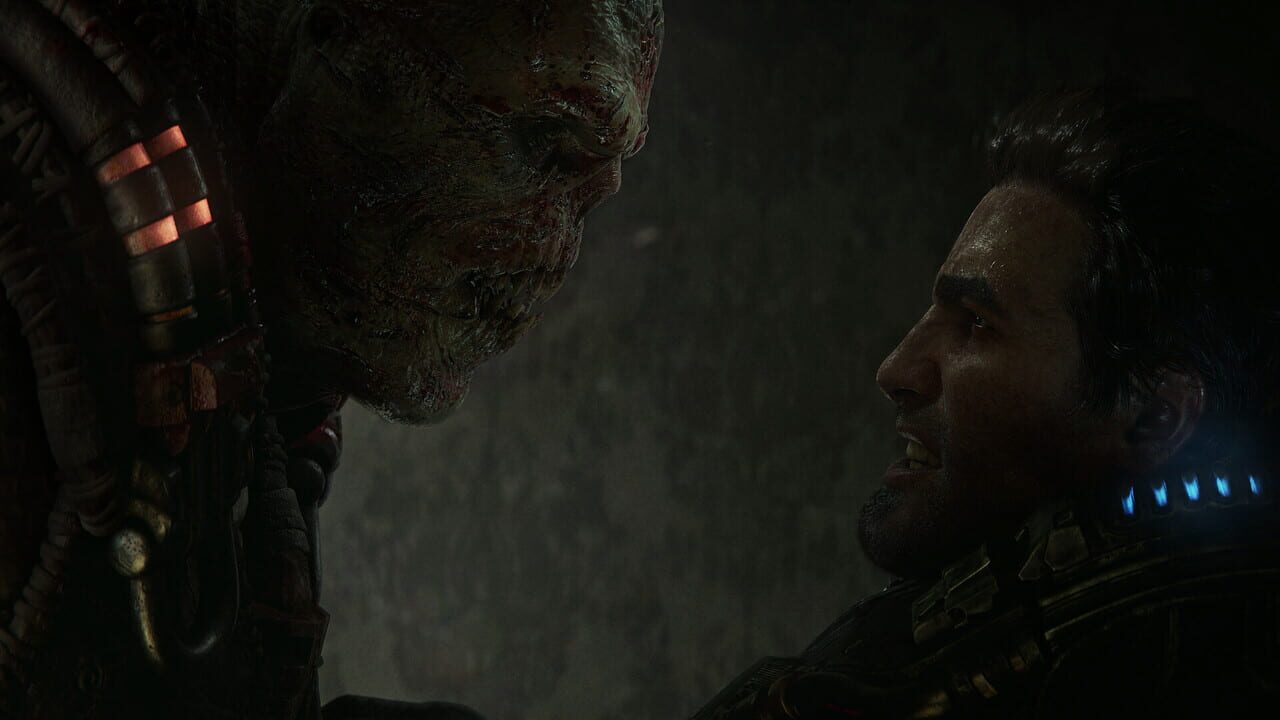
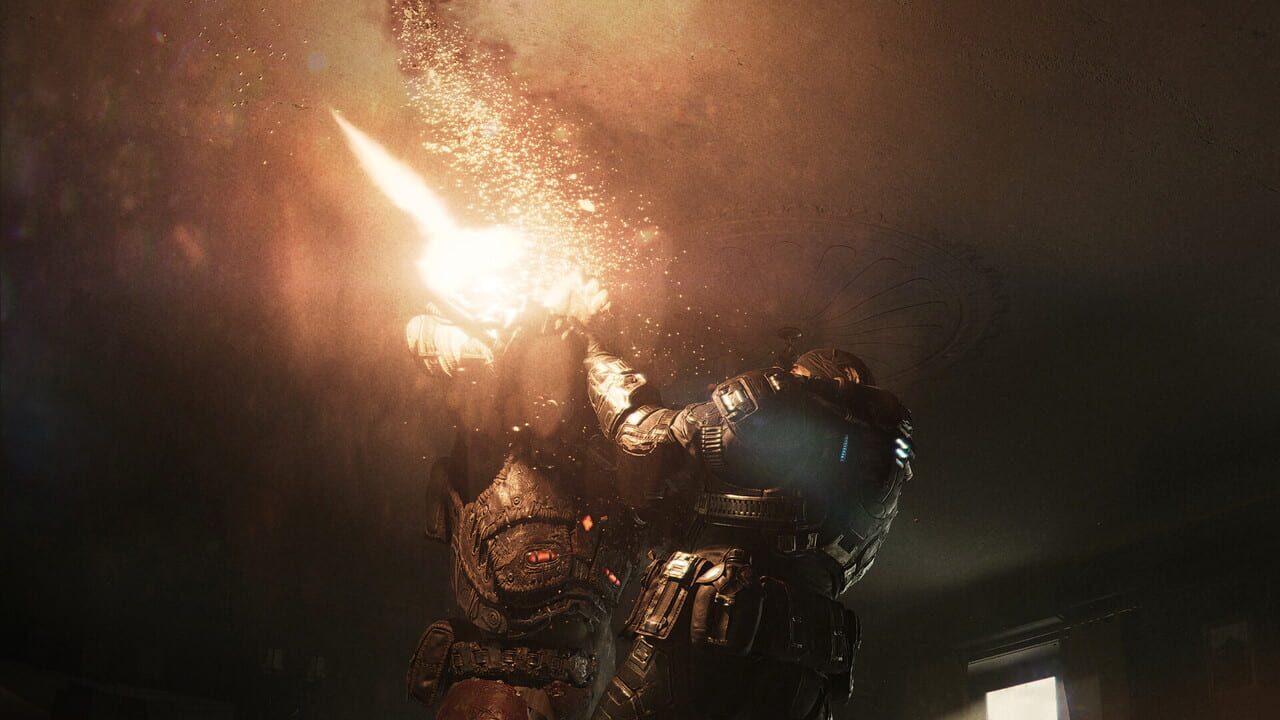
The player is behind a concrete planter, the kind that used to hold a hedge outside a municipal building, and the planter is the only thing standing between the player and roughly four hundred pounds of chittering exoskeleton. The player thumbs a button. The camera does not zoom or cut. The character's spine folds against the planter the way a person's spine folds against a doorway during a fire drill: fast, low, final. The screen's field of view narrows by a few degrees, as if the world itself had leaned in to watch. This is not a cutscene. This is the default unit of play, repeated several hundred times an hour, in a game that came out in 2006 and has not, in twenty years, stopped being the reason a very large number of subsequent games feel the way they feel. The lens for what follows is brain and body: not what Gears of War means, but what it does to the perceptual and motor systems of the person holding the controller, and what happens to that system's inheritance now that the series is returning, in Gears of War: E-Day, to the one morning its whole mythology has been pointing toward since 2006. Cliff Bleszinski, the lead designer at Epic who built that cover system, has told the story of its two source images often enough that it has calcified into design folklore, which is usually a sign that the story is true. The first source was Kill.Switch, a 2003 Namco shooter almost nobody played, which let a player snap to a wall and peek around it. Epic's Lee Perry saw it and pulled Bleszinski into his office. The second source was not a game at all. It was the roadie hauling amplifiers across a rock stage between songs, doubled at the waist, moving fast and low so as not to become part of the show. Bleszinski named the game's sprint after him. The "roadie run" ties the camera's behavior directly to the character's exertion: the field of view narrows, the image shakes with a handheld, CNN-crew jitter, and the player's read of the world gets worse in direct proportion to how fast the character is covering ground. Cover, by contrast, is the reward for stopping. Snap to the planter and the camera opens back up, the shake settles, the world becomes legible again. The whole loop is a negotiation between clarity and speed, and the negotiation happens at the level of the body before it happens at the level of strategy. That negotiation is where the interesting claim lives, and it is a claim about perception, not about taste. The psychologist James Gibson spent much of his career arguing that organisms do not perceive their environment as a field of neutral distances and angles, the way a cartographer would. They perceive it as a field of affordances: this surface is sit-on-able, this gap is jump-across-able, this ledge is grip-able. Perception, in Gibson's account, is already action-shaped before conscious thought gets involved. A cover shooter is Gibson's theory built out of concrete and rebar. The planter is not fifteen feet away at a bearing of thirty-one degrees. The planter is cover-able. The low wall past it is cover-able-from-there. The open ground between them is not a distance to be measured, it is a gap that is either roadie-run-able or it is a place to die. Gears of War did not invent this kind of perception, which is presumably as old as the first hominid to duck behind a rock. What Gears did was build an entire genre's camera and traversal system around making that perception the primary mode of reading a room, and it did this so thoroughly and so influentially that most cover shooters after it, from Uncharted to The Division to Fortnite's earliest building loops, inherited the same grammar without necessarily inheriting the same rationale. The urban planner Kevin Lynch, writing decades before any of this in 1960, gave the more general version of the same finding a name that has outlasted its original discipline. Lynch's The Image of the City argued that people do not hold a city in memory as a scale map. They hold it as a simplified structure of nodes, paths, edges, districts, and landmarks: the corner where you turn, the park that marks the edge of downtown, the bridge that is the only way across. Ask a longtime resident to describe their commute and they will not give you coordinates. They will give you a graph. Cover shooting performs the same reduction on a battlefield in real time. An open field, which is in principle a continuous two-dimensional space with infinite possible positions, gets collapsed by the cover system into a small, discrete, ranked set of nodes: this crate, that pillar, the sandbag line at the far end. The player is not solving geometry. The player is solving a graph problem, node to node, with the roadie run as the only edge available between safe points and the enemy's line of sight as the cost function. This is a real change in what a room is asking of the player's brain, and it happened at scale, across an entire console generation, because one designer decided that ducking should be a verb with its own animation, its own camera behavior, and its own risk. The felt weight of that graph is where the roadie run does its quieter work. Games before Gears mostly treated movement speed as a free variable: run as fast as the engine allows, all the time, because faster is generically better. Gears made speed cost something perceptual. The player who chooses to sprint across open ground is choosing degraded vision and a wobbling camera in exchange for covering the distance before the graph's other actors, the enemies doing their own version of the same node-to-node calculation, can close the angle. That tradeoff, repeated constantly, trains something like a felt intuition for tempo that a lot of subsequent third-person action design still runs on: the sense that movement in a combat space should have a texture, a cost, a reason a player might choose to walk instead of run even when nothing forces them to. Twenty years on, that intuition is so widely shared among action-game designers that it barely gets attributed anymore. It is worth attributing. It came from a hunched roadie crossing a stage between songs, because Cliff Bleszinski was watching a concert and thinking about cover. None of this is a claim that Gears of War invented ducking, or that no game before it had furniture you could hide behind. WinBack, a 1999 Nintendo 64 title almost nobody outside Japan played at the time, let players snap to walls and peek years earlier, and Kill.Switch built the mechanic Epic borrowed almost wholesale. The claim is narrower and, for a Brain & Body reading, more useful: Gears of War is the version of this idea that reached enough hands, in a game built well enough and marketed hard enough, that the perceptual habit it trained became the industry's shared default rather than one studio's curiosity. A genre needs more than a good mechanic to become a genre. It needs a mechanic wired tightly enough to the body's own reflexes, the doorway-flinch, the duck-behind-a-parked-car instinct, that millions of separate nervous systems learn it as if it were obvious, and then stop noticing they learned it at all. The spread is the part worth dwelling on, because it shows the node-graph habit outliving the specific game that trained it. Uncharted borrowed the cover-and-peek grammar almost intact and married it to vertical traversal, so that a room stopped being read as a flat graph and started being read as a graph with a height axis, ledges and outcroppings joining planters and pillars as nodes. The Division and Ghost Recon kept the grammar and added a squad layer, so that the graph a single player once solved alone became a graph solved cooperatively, with teammates calling which node they were about to occupy the way Bravo Squad calls contacts over the radio. Even Fortnite's building mechanic, which looks on its surface like a totally different genre, is doing a fast, improvisational version of the same cognitive move: a player under fire does not think in terms of a continuous field of possible wall placements, they think in terms of a small number of buildable nodes, this ramp, that wall, the tower two seconds from now, ranked by how much cover each one buys. None of these games needed to consult Gears of War's source code to inherit its habits of mind. They needed players who had already spent hundreds of hours in 2006 and 2008 learning to see a room as postures rather than distances, and who brought that trained perception with them into every subsequent game whether or not the game asked for it. It is worth pausing on the obvious objection to reading a control scheme as a claim about cognition rather than as a set of button prompts a designer happened to land on. Every action game asks something of a player's spatial reasoning; that alone does not make Gears of War special, and there is a reasonable version of this argument that says the roadie run and the cover snap are simply good, tight game feel, full stop, and that dressing them up in Gibson and Lynch is the kind of interpretive overreach VOICE.md would rightly flag in a lesser essay. The objection has real force, and the honest answer to it is that the mechanical tightness and the cognitive claim are not competing explanations, they are the same explanation described at two different altitudes. A cover system feels tight precisely because it matches, closely enough that the player stops noticing the match, the way a body already processes a dangerous room: not as coordinates, but as safe-here, exposed-there, reachable-if-I-hurry. Bleszinski did not need to have read Gibson to build a system Gibson's theory predicts will feel right. Good game feel and accurate modeling of embodied perception are, in this specific case, the same design decision wearing two names. Gears of War: E-Day, due this autumn from The Coalition with People Can Fly, inherits that whole perceptual grammar and puts it under a specific, self-imposed constraint. The game is a prequel in the strictest possible sense: it returns to Emergence Day, the single morning fourteen years before the original Gears of War when the Locust Horde broke the surface of the planet Sera and began the extermination war that every subsequent game in the series takes as its premise. The younger Marcus Fenix and Dominic Santiago, voiced again by John DiMaggio and Carlos Ferro, are assembled into Bravo Squad under Captain Akila Grey, alongside two newcomers, Mags and Lucas, and the game's marketing has been explicit that the story unfolds across three days in the city of Kalona. Every player who buys this game already knows, with total certainty, that Marcus Fenix survives Emergence Day. He is the protagonist of the game that follows it, and the one after that, and the one after that. The Locust are not going to be defeated on this particular Tuesday. Sera is not going to be saved. The outcome is not in question, because the outcome is the premise of a franchise that already exists. This is the actual design problem E-Day has set for itself, and it is worth taking seriously as a problem rather than treating it as marketing throat-clearing. A story whose ending the audience already knows cannot generate the ordinary kind of narrative tension, the kind built from the question "what happens next." Alfred Hitchcock gave the clearest account of the alternative in his interviews with François Truffaut, using the example that has since become shorthand for the whole idea. Two people sit at a table talking about nothing in particular. Under the table, unseen, is a bomb, set to go off in fifteen minutes. If the audience does not know the bomb is there, its eventual detonation is a surprise: fifteen seconds of shock. If the audience does know, the same scene of two people talking about nothing becomes fifteen minutes of unbearable suspense, because every unremarkable line of dialogue is now weighed against the thing the characters cannot see and the audience cannot stop watching for. Hitchcock's distinction is between surprise, which depends on the audience not knowing, and suspense, which depends on the audience knowing more than the characters do. A prequel, structurally, cannot use surprise about its own ending. It has one instrument available, and that instrument is suspense, dramatic irony, the gap between what Bravo Squad knows about their Tuesday and what the player already knows about the fourteen years after it. This reframes the question a casual read of E-Day's premise tends to skip past. The interesting question about a story whose destination is fixed is never whether. It is how, and prequels have exactly three workable answers to that question, each with its own cost. The first is to lean entirely into dramatic irony and let the audience's foreknowledge do the emotional work: every scene of casual optimism becomes freighted by what the player knows is coming, the way an early scene of Titanic's passengers admiring the ship's size plays differently once you know the iceberg is already out there in the dark. The cost of this approach is that it depends on writing disciplined enough to trust the irony rather than announce it, and on a cast the player is willing to feel dread on behalf of rather than simply wait out. The second answer is to shrink the scope of what "how" needs to cover, focusing so tightly on one battle, one squad, one forty-eight-hour window that the larger fourteen-year outcome recedes and the immediate stakes, will this specific soldier survive this specific bridge crossing, become legible on their own terms even though the audience knows the franchise-level outcome. The cost here is that the immediate stakes have to be genuinely well constructed, because they are doing all the work the larger mystery can no longer do. The third answer is the weakest and the most common: treat "how" as functionally equivalent to "whether" and hope momentum and spectacle carry the audience past the fact that they already possess the ending, which tends to produce the kind of prequel that gets accused, fairly, of feeling like an obligation rather than a story. E-Day's own design choices point toward the second answer, and the choice is visible in what the game has chosen to show. The gameplay demo the Coalition brought to its E-Day Direct is not a montage of the war's scale. It is one continuous stretch of ground: Marcus leading Dom and two soldiers along the upper deck of a suspension bridge over a river, working toward a forward operating base set up in a nearby Thrashball stadium. A studio confident it could coast on foreknowledge of the Locust War's outcome would have opened with the war. This one opened with a bridge. That is the vocabulary of a game narrowing its unit of drama down to one crossing, one squad, one stretch of exposed walkway. The framing around the reveal points the same direction: the Coalition has described the game as an origin story about brotherhood, which is to say about two specific men rather than about a species. This younger Marcus and Dom are not yet the rogue, insubordinate pair who instigate the prison break that opens the original Gears of War, and the distance between who they are here and who the player knows they become is the two people at Hitchcock's table talking about nothing in particular, unaware of what the next fourteen years are going to do to them. The player, who has played the game where those same two men are hardened, laconic, and half-feral with grief, is sitting on the bomb. Whether this actually works, at three thousand-plus words of critical distance and no ability to play the finished campaign, is not a claim this essay can verify and does not need to. What can be said is narrower and more useful: the premise commits E-Day to the scope-reduction answer whether the writers intended it consciously or arrived at it by instinct, because the franchise-level "whether" was foreclosed the moment the title screen said Marcus Fenix. Every scene that tries to generate tension from the larger question of whether humanity survives Emergence Day is working against foreknowledge the player brought into the theater. Every scene that narrows to whether this squad crosses this bridge, whether this magazine reloads in time, whether the planter is close enough to reach before the roadie run's narrowed vision gets someone killed, is working with it. The bridge and the stadium are not incidental reveal footage. They are the shape a prequel takes when its writers have understood, correctly, that the only kind of tension left to them lives at the scale of the next fifteen feet of open ground, not the scale of the war. A skeptical reading would point out that this is a generous way of describing what might simply be a smaller, more linear campaign than fans of the later games are used to, and that scope reduction is easy to praise in the abstract and much harder to sustain across a full campaign's length without the smallness curdling into monotony. That skepticism deserves an answer rather than a dismissal. The answer is that E-Day is not choosing smallness in a vacuum, it is choosing smallness against a franchise whose later entries are, almost without exception, larger: bigger set pieces, bigger casts, bigger stakes stacked on top of the war Emergence Day started. A prequel that matched that scale would be fighting its own foreknowledge problem on the least favorable ground available to it, trying to out-spectacle games whose outcomes are still in doubt with a game whose outcome never was. Choosing the bridge over the battlefield, the squad over the war, is not a concession. It is the one move available that turns the audience's foreknowledge from a liability into the actual source of the dread. Bravo Squad's mundane radio chatter about supply lines and Kalona's exhausted mayor reads entirely differently to a player who already knows what Marcus Fenix is going to become, and that difference is doing narrative work a bigger, louder version of the same game could not do, however good its set pieces were. That is also, not coincidentally, the exact scale the cover system was always built to operate at. Twenty years before E-Day existed, Bleszinski's planter and Bleszinski's roadie run collapsed a battlefield into a graph of nodes precisely because the human perceptual system is much better at judging the next safe position than it is at holding an entire war in mind at once. A prequel whose ending is already known is, in its own way, asking the same trick of its audience that the cover mechanic asks of the player's eyes: stop trying to read the whole field, read the next fifteen feet. The planter is close. The bridge is long. The Locust are already under the city, and Marcus Fenix does not know it yet. Neither does the player, crouched behind the concrete, thumbing the button, waiting to see how bad the next room is going to be.
Tuesday analysis
Crouching Changed Video Games
- Writer
- J. A. Marsh
- Lens
- Brain & Body
- Published
- JUN 19, 2026
- Length
- 3,236 words / 14 min
- Notes
- 8 sources
Cover shooting does not ask the player to judge how far away the enemy is. It asks the player to judge which node the enemy currently occupies, and which node is safe to occupy next.