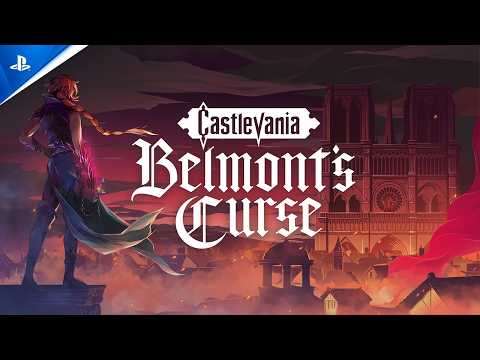


Simon Belmont stands at the bottom of a staircase in a castle that has never had a name shorter than "Dracula's," and he cracks a whip that reaches, at most, three body-lengths in front of him. A bat comes at him in a sine wave. He has to wait. Not brace, not block, not dash out of the way and back in. Wait, for the half-second it takes the bat to enter the whip's arc, and commit to the swing before he is certain it will land, because the swing itself takes just long enough that starting it after the bat arrives is already too late. If he is wrong, he does not get to change his mind mid-motion. The whip has already gone out. This is 1986. The whip has not changed since. That sentence is close to literal, and it is the reason this is a History & Memory piece rather than a preview of a game that has not shipped. Castlevania: Belmont's Curse, due from Evil Empire this October, is unreleased, and nothing here describes playing it. But the object at its center, the Vampire Killer, is not new. It is arguably the single most continuous piece of design in commercial games: an attack that commits the player to an arc, a recovery, and a window of vulnerability, repeated with only minor variation across twenty-six main entries and forty years. Very few objects in this medium have that kind of continuity. Mario's jump has been re-tuned in every generation. Link's sword has grown a dozen extra verbs. The whip has mostly just been the whip, and the fact that it has survived largely unchanged is itself a claim worth taking seriously: that slowness, deliberately built into a combat system, can be a design position rather than a limitation nobody got around to fixing. Konami's own account of the 1986 original frames the whip as inherited rather than found. The series portal describes it as "no ordinary whip," one "bequeathed to him by his father," a weapon that can "disintegrate some creatures at the slightest crack." The flavor text does narrative work the mechanics then confirm structurally: this is a family object before it is a combat object, and the family is defined by what the object requires of whoever holds it. What it requires, from the first game onward, is patience. The whip's arc is fixed. Its range is short. Its recovery, the interval after the animation completes before another swing can begin, is long enough that a wrong guess costs real health, not a wasted animation frame. Simon cannot walk while attacking. He cannot cancel the swing into a dodge. He commits, and the commitment is the entire grammar of the fight. Koji Igarashi, who took over the series in the mid-1990s and shaped its most influential era, put the underlying logic in plain terms when asked about the difference between the classic 2D games and the series' later, more spatially ambitious entries. "In 2D, the distance between the player and the enemy is very important, and can be planned carefully," he said. "In 3D, distance isn't the important thing, but rather timing." The remark is offhand, but it names exactly what the whip was built to teach: that combat is a problem of spacing, solvable in advance, rather than a problem of reaction speed, solvable only in the moment. A player who understands the whip's reach does not need fast hands. A player who understands the whip's reach needs to have already decided, before the swing starts, where the enemy will be when it lands. This is a genuinely unusual thing for an action game to ask of a player, and it has gotten more unusual as the decades have passed. Most of the genre's popular combat systems reward speed: parry windows, combo strings, dodge-cancels that let a player recover from a bad read without paying full price for it. The Vampire Killer, in its classic form, refuses all of that. It punishes the reflex to attack on sight, because attacking on sight, before the target is in range and before the swing has a clean line, wastes the recovery window on nothing and leaves the player exposed for a beat they cannot take back. The whip does not reward the reflex to attack. It punishes it, and in punishing it, it teaches something most action games have stopped bothering to teach: that distance is a decision, not an accident. The series has tested this design against its own impatience more than once, and the results are instructive. Castlevania II: Simon's Quest, released the following year, loosened the formula toward exploration and lost a chunk of the fanbase's affection for it, not because exploration was the wrong idea (the series would later build an entire sub-genre on exploration) but because the specific tension between commitment and spacing went slack. Castlevania 64, the series' first true 3D entry in 1999, struggled for the opposite reason: a fixed-arc whip translated badly into a camera and a movement system built around timing rather than distance, precisely the split Igarashi later named. The games that are remembered as the series' high points, Castlevania III in 1989 and Symphony of the Night in 1997, kept the whip's basic contract intact even as they multiplied everything around it. Symphony of the Night gave the player an entire castle to explore, a role-playing system, dozens of sub-weapons and relics, and it still made you learn the whip's arc in the first ten minutes, because the arc was the one thing that had to survive the redesign for the game to still be Castlevania. The pattern holds across the games that tried the opposite experiment, too. When a Castlevania entry has let the player attack fast, cancel freely, and close distance without penalty, the series has tended to feel less like itself even when the individual game was well made. Lords of Shadow, Konami's 2010 reboot built on a God of War-style combo system, gave its whip-equivalent, the Combat Cross, a chain-attack rhythm that rewarded aggression and rarely punished a mistimed lunge the way the original whip did. Reviewers largely liked it. Longtime players of the classic and Metroidvania lines tended to describe it as a good action game wearing the Castlevania name, which is a specific and telling complaint: not that the combat was bad, but that it had stopped asking the one question the series had spent two decades training players to answer. Speed, once it removes the cost of a wrong guess, removes the thing spacing was for. A player who can recover from any mistake in half a second has no real reason to have avoided the mistake in the first place, and a combat system built on that premise is teaching a different lesson than the one Simon's whip taught at the bottom of the staircase in 1986. Which raises the question the whip has been asking since 1986: what, exactly, does the series think it is handing down. The answer the fiction gives, consistently, across two dozen entries and a cast that changes almost entirely from game to game, is technique. The Belmont family is not a bloodline with a destiny attached to it in the way that, say, a chosen-one narrative usually means. It is a family whose entire cultural identity is a transferable skill: how to hold the whip, how to read a room full of the undead, how to wait half a second longer than instinct wants to. Trevor Belmont, introduced in Castlevania III: Dracula's Curse, defeats Dracula in 1476 alongside Sypha Belnades, the war-witch he travels with, and the two marry once the fighting is done, founding the branch of the family whose blood carries both the Belmont talent for the whip and the Belnades talent for elemental magic. That marriage is the hinge the new game turns on. It is also, notably, an invented event: there is no historical Belmont family, no real 1476 campaign against a real Dracula, and the series has never pretended otherwise. Konami's Castlevania has always been costume history, real geography and real dates dressed around a family that never existed, and the honest way to read that is not to fact-check it but to notice what the invention is doing. A franchise that wanted a chosen hero would have given itself one hero. Castlevania gave itself a skill and then spent forty years handing that skill to a new person every few games, which is a different and stranger kind of continuity than franchises usually bother with. It matters, too, that the Belmonts are rarely the only hunters in the room. Trevor's own party in Castlevania III includes Sypha, Grant Danasty, and Alucard, Dracula's own son fighting against his father, and the game lets the player recruit and swap between them. Later entries widen the cast further: Curse of Darkness in 2005 hands the whip's narrative weight to Hector, a former devil forgemaster rather than a Belmont at all, whose uneasy alliance with a wary, whip-carrying Trevor drives the plot toward the real villain, Isaac. The family is the throughline, not a closed guild. Anyone who commits to the discipline the whip demands can, in effect, join the lineage, which is part of why handing the weapon to a new successor, rather than resurrecting an old one, feels less like a twist than like the fiction finally saying outright what the mechanics had been implying since Simon first swung the thing at a bat on a staircase: that the whip does not care about bloodline so much as about whether the person holding it has learned to wait. Belmont's Curse is the first entry to make that inheritance mechanical rather than merely narrative. Every previous Belmont protagonist has been, functionally, a fresh copy of the same fighter: a new name on the box, the same whip in a new pair of hands, the family relationship supplied by a manual or a cutscene rather than by anything the player does. Konami's reveal describes the new game's protagonist plainly as "Trevor Belmont's successor," the first Belmont premise built explicitly around succession rather than substitution, with Trevor himself present in the story as an older hunter rather than a portrait in a hallway or a name on a title screen. Wikipedia's chronology places the game in 1499 Paris, twenty-three years after Castlevania III and twenty years after Curse of Darkness, with the castle manifesting directly among the city's burning streets. The reveal is careful not to hand the player a finished hero. It withholds a name, withholds the exact shape of the family tie beyond "successor," and lets the whip itself, shown in motion in the first trailer, do the work of establishing who this new hunter is before the story does. That withholding is itself a design choice worth noticing: the technique arrives on screen before the biography does, which is the same order the classic games have always insisted on. You learn what the whip requires of you well before you learn whose surname you are carrying. It is worth being honest, in turn, about how the game's own reveal copy complicates the argument this essay has been building. Konami's announcement describes the whip as letting the new hunter "swing freely across environments, chain acrobatic manoeuvres, and strike enemies from unexpected angles," language built for motion rather than stillness, and pairs it with a sword offered as a second weapon for "straightforward controls and reliable damage," a tool explicitly meant to widen the player's options rather than narrow them to one deliberate arc. None of that sounds, on its face, like the half-second stillness this essay has spent several paragraphs defending. It sounds like the series finally doing what Simon's Quest was accused of doing in 1987: trading the whip's original discipline for something more forgiving, or at least more mobile. The honest reading is that this tension is not new, and it is not necessarily a betrayal. Every era of the series has had to answer the question of how much speed the whip can absorb before it stops being the whip, and the answer has never been zero. Symphony of the Night let players juggle sub-weapons and relics at a pace the 1986 original never permitted, and the series is remembered fondly for it, not despite it. What has held constant across every successful entry, including the ones with faster combos and looser recovery windows, is that the whip still has to be aimed rather than mashed, that its range is still finite, that a player who has not learned the arc still eats damage a player who has learned it does not. Modernizing the animation speed is not the same as removing the underlying spacing problem. Evil Empire, a studio built by former Motion Twin developers specifically to carry Dead Cells forward after 2019, understands better than most contemporary developers how to keep a combat system's tempo high while keeping its decision-making precise; Dead Cells is, at bottom, a game about knowing exactly how far a given weapon reaches and exactly how long its swing commits you. If Belmont's Curse succeeds at the balance its own developers describe, it will not be because it abandoned the spacing discipline of 1986. It will be because it found a faster tempo that still asks the same underlying question the bat at the bottom of the staircase asked forty years ago: do you know where you are standing. The Paris setting deserves the same treatment as the Belmont genealogy: not fact-checked, because there is nothing to check, but read for what it is doing. Castlevania has never been squeamish about splicing invented monsters into real cities and real historical moments. The new game folds Joan of Arc, dead sixty-eight years before the story's 1499 setting, into its cast alongside Carmilla and Isaac the forgemaster, series regulars with no historical referent at all. This is the same move the franchise made when it planted a fictional vampire count's castle in Wallachia and then, decades later, in Romania proper, in cities the games never bother distinguishing from tourist geography. The point of putting this new hunt in Paris rather than a generic gothic non-place is not historical fidelity. It is the same instinct that put Simon's whip in his hands as an inheritance rather than a pickup: the series wants its fictions to feel like they are continuing something, a real place with a real name standing in for the sense that the story has roots, even when the roots themselves are invented. Cultural memory does not require the memory to be accurate. It requires the memory to carry weight, and Castlevania has spent forty years piling invented memory onto real maps until it does. What the whip actually carries, then, across four decades and a cast that turns over almost completely with each generation, is an argument about what combat is for. It is not the only argument an action game can make. Plenty of good ones make the opposite case, that combat should reward speed, reflex, and the willingness to commit to nothing until the last possible instant. But the whip's case, stated plainly by the object itself before any character ever states it in dialogue, is that spacing is a form of respect: respect for the enemy's pattern, respect for the consequence of a bad guess, respect for the idea that a fight can be solved by thinking about it rather than by winning the reaction-time contest. Igarashi's line about 2D distance being plannable while 3D asks for timing is, read generously, a description of two different kinds of attention, and the series has spent most of its history arguing for the first kind. A player who has internalized the whip's arc carries that attention into other games without necessarily noticing they are doing it: the moment in any action game where the smart move is to hold still, let the enemy commit first, and only then close the distance. That is not a Castlevania-specific skill. It is a general one, and Castlevania has been one of the medium's most patient teachers of it. This new successor's version of the lesson is not yet playable, and this essay will not pretend to know how it resolves, or even whose hand it turns out to be. But the shape of the inheritance is already visible in what has been shown: a legendary Belmont present in the story rather than legendary-and-absent, a city on fire, and a whip that has to be learned again from nothing, the same way it was learned in 1986, the same way it has been learned by every Belmont and Belmont-adjacent hunter the series has ever handed it to. The object does not care whose hand is holding it. It has only ever cared whether that hand knows how far it reaches, and how long it takes to come back.
Tuesday analysis
The Whip Is the Oldest Object in Games
- Writer
- J. A. Marsh
- Lens
- History & Memory
- Published
- MAY 29, 2026
- Length
- 2,826 words / 13 min
- Notes
- 9 sources
The whip does not reward the reflex to attack. It punishes it, and in punishing it, it teaches something most action games have stopped bothering to teach: that distance is a decision, not an accident.