On June 23, 1996, Nintendo released Super Mario 64 in Japan, the launch title for its first console built around a single analog stick, and one of the first things a great many players did with that stick was fail to read a sign. The lawn outside Princess Peach's castle holds several wooden signposts, and facing one and pressing a button calls up a page of text. The difficulty was facing one. The camera, embodied in the game's own fiction as a cloud-riding Koopa named Lakitu who trails Mario with a hand-held camera, had opinions of its own about where to point, and lining it up with a stationary sign at a stationary angle produced, for a great many players, a slow and useless orbit around the post instead. Nintendo's own staff eventually said as much in plain language rather than review copy. Toru Osawa, who two years later would coordinate the direction of The Legend of Zelda: Ocarina of Time, recalled the earlier game bluntly: "When you tried to read a sign, sometimes you would just go around it in circles."
The interesting thing about 1996 is not that its games look primitive by later standards. It is that an entire console generation spent roughly two years failing, in public, to answer a question that has since become so completely settled nobody thinks to ask it anymore: how a player controls a body, aims at an opponent, and reads a fight, all in three dimensions, using one thumbstick and a handful of buttons. The question was categorically new. Nothing in the two-dimensional consoles that preceded this generation had required a designer to decide where a camera stood, because there was no camera to place, only a fixed plane the player already understood completely. The Sega Saturn and the original PlayStation both launched in Japan within weeks of each other in late 1994, and the Nintendo 64 followed a year and a half later, each the first console in its maker's history built to hand a mainstream audience a fully three-dimensional viewpoint that someone now had to manage on the audience's behalf. Each new console also handed the player a new kind of controller to solve the problem with: the Nintendo 64's pad introduced the analog stick to a mass audience for the first time, a single thumb-operated input expected to do the job that an entire keyboard and mouse, or a bank of arcade levers, might otherwise have split between them. The honest record of that handover is a run of major releases, each proposing a different, incomplete fix, under ship dates none of the studios involved were able to move to wait for a better one.
The failure was not a retrospective judgment invented by later critics with sharper standards than 1996 could have had. Electronic Gaming Monthly's reviewers marked the game down for it on release, Dan Hsu, Shawn Smith and Crispin Boyer each docking half a point and citing a camera that, in the magazine's words, "sometimes could not move to a wanted angle or rapidly shifted in an undesirable manner." Next Generation, reviewing the same cartridge that same month, called the game "less accessible than previous Mario games," pointing to "occasional erratic movements and lack of optimal angle." Eleven years on, revisiting the game for a 2007 retrospective, Game Informer went further, judging that by the standard the genre had since settled into, the camera "would almost be considered broken." The three reviews describe the same camera from three different distances from the crisis it caused. In September 1996, serious professional critics were willing to dock a major release for it in its first week, with no benefit of hindsight at all. By 2007 the camera was being measured against a standard that had not yet been built when Mario 64 shipped. That standard, this essay is going to argue, was built two years later, in a different Nintendo project, by a team solving a harder version of the same problem that Super Mario 64 had never actually attempted.
Core Design's Tomb Raider, released across October and November of that year on Saturn, PlayStation and PC, tried a hybrid answer. The camera hung a fixed distance behind Lara Croft's shoulders by default and reassigned itself automatically at room transitions and set pieces, with a manual override the player could nudge when the automatic version guessed wrong, which in tight corridors and mid-air combat it did often enough to become the game's most reliable irritation. Capcom's Resident Evil, released that March, gave up on a free camera altogether. Director Shinji Mikami had prototyped a fully three-dimensional first-person version of the game, decided the original PlayStation could not render it at the fidelity he wanted, and replaced it with fixed camera angles cut against pre-rendered backgrounds, a solution indebted in spirit to the 1992 PC game Alone in the Dark. The fixed angles solved the camera problem by removing it: the player never touched the camera because the camera was no longer a variable, and movement was reassigned to the character's own orientation rather than the screen's, the scheme still remembered as tank controls. Both choices carried a price the reviews of the day were willing to name: Tomb Raider's camera was tolerated because the platforming and exploration built around it were judged strong enough to carry the frustration, while Resident Evil's fixed angles were embraced specifically because a horror game benefits from a viewpoint the player cannot control, an accident of hardware limitation the genre then kept on purpose for years afterward. Two of the year's most significant three-dimensional releases had reached opposite conclusions about the same unsolved problem. Core Design let the player wrestle a camera that mostly worked. Capcom removed the wrestling match and accepted the disorientation of a viewpoint that could cut behind the player's own back without warning. Neither studio was solving the underlying problem so much as pricing the cost of not solving it and choosing which cost its game could better absorb.
None of these three games, for all their difficulty, had attempted the hardest version of the problem. Mario 64 is a platformer whose combat is incidental, cleared as often by avoidance and a well-timed jump as by an aimed attack, and a player who never fully masters its camera can still finish the game. Tomb Raider's combat is mostly straight-ahead shooting, aimed by pointing Lara at whatever is in front of her rather than circling a target to one side. Resident Evil's combat happens from a vantage the game has already fixed before the enemy appears. None of the three asked a player to stand in open three-dimensional space, face an opponent free to move to either side, and fight that opponent at close range with a handheld weapon, while a camera somewhere behind the player's own shoulder tried to keep both bodies legible in the same shot. That is a materially harder problem than any of the three above it, because melee combat depends on continuous, reliable knowledge of where an opponent stands relative to the player's own front, and a camera free to point anywhere turns relative to the player's own front into a moving target no single stick has the vocabulary to track on its own. A shooting game can dodge the ambiguity by pointing a reticle at whatever is in front of the barrel, because the weapon and the camera can share one forward-facing axis. A melee game cannot borrow that shortcut, since the player has to be able to face an opponent, back away from an opponent and circle an opponent, all while the camera keeps both bodies in the same shot, which is three separate spatial relationships for one stick to represent rather than one. This was the specific, unsolved problem waiting for Nintendo's Zelda team in 1997. The solution the team found for it, not the ocarina, not the size of Hyrule Field, not the structure built on travelling seven years forward in time, the feature the game is usually remembered by, is Ocarina of Time's most durable technical export.
The team's own account of how the solution arrived, given years later in an interview conducted for the Nintendo 3DS remaster, is unusually specific for an origin story, and the specificity is worth keeping rather than smoothing into legend. Osawa, coordinating the game's five credited directors under producer Shigeru Miyamoto, had pitched the new Zelda around chanbara, the Japanese genre of sword-fighting film built on the choreography of feudal-era duels, the tradition most audiences outside Japan know secondhand through Akira Kurosawa. Having proposed the genre, Osawa proposed the team go and watch some of it performed live, and took the staff to Toei Kyoto Studio Park, a working film backlot outside Kyoto that also runs staged samurai and ninja shows for tourists on the same grounds where period dramas are shot, presumably a more useful reference for chanbara combat than screening a film back at the office would have been. The show they saw that day put a single sword-armed performer at the center of a ring of ninja attackers, one of whom threw a kusarigama, a sickle on a chain, which the swordsman caught and used to unbalance his attacker before the whole ring began circling him, looking for an opening. Two Nintendo staff watching that afternoon pulled two different design ideas out of the same few seconds of choreography. Yoshiaki Koizumi, the game's 3D system director, noticed that the ring never attacked as a group: "The enemies don't all attack at once. First, one attacks while the others wait." Osawa had been watching the chain rather than the formation, and came away with a spatial idea rather than a behavioral one: "I would make it so something like a kusarigama you can't see exists between Link and the opponent," an invisible tether a player could use to circle a marked target the way the swordsman had circled his.
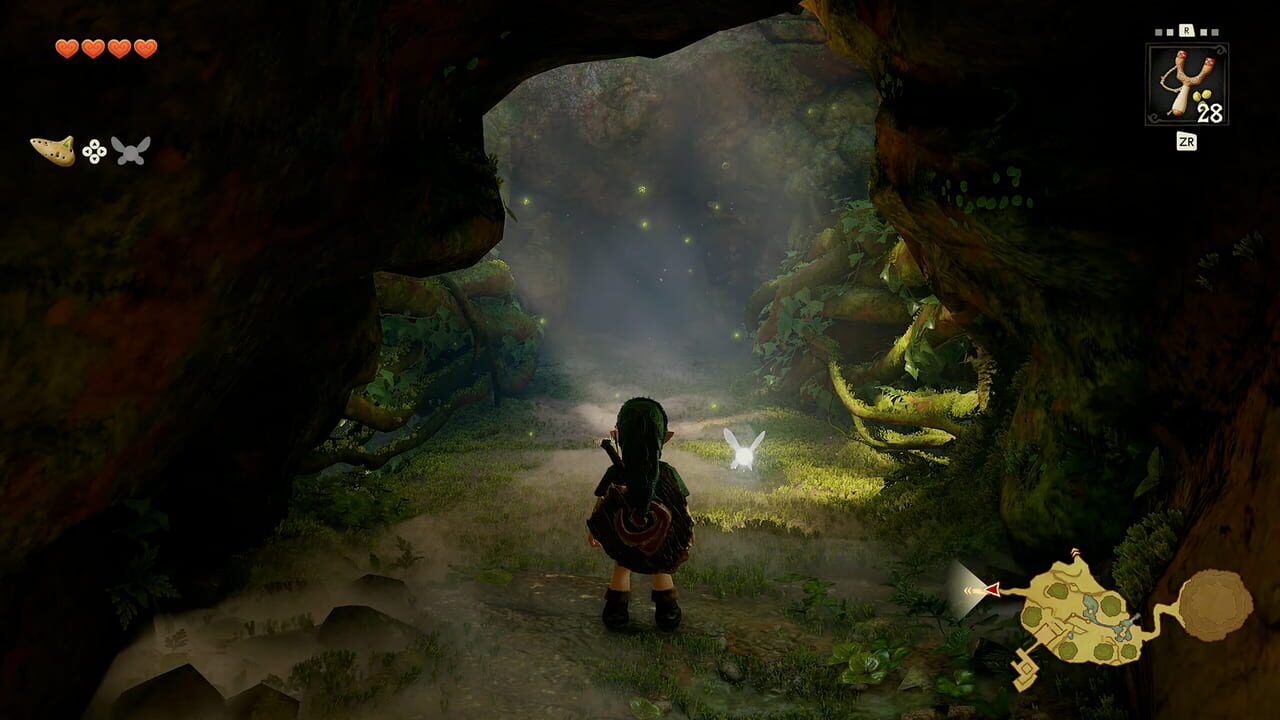
Those two half-formed readings of the same stunt show, filtered through the game's engineering, became Z-targeting. Hold the Z trigger on the underside of the N64 controller, and within a fraction of a second the camera swings to a position behind Link's shoulder that frames him and the marked enemy in a single shot, Link's own model turns to face that enemy no matter which way the stick is pushed, and the stick's meaning changes underneath the player's thumb, from walk in this compass direction to move along an arc around this one fixed point. Enemy design absorbed Koizumi's half of the insight directly: a group of enemies facing a targeted Link waits its turn rather than closing in together, because a group that attacked all at once would defeat the entire premise of a system built to track one relationship at a time. The same button closed a second, older failure the team had lived through personally. Targeting a signpost in Ocarina of Time snaps Link to face it and calls up its text immediately, which is the exact circling failure Osawa had just finished describing from the earlier game, solved this time by the same input that solved the fight. Nintendo also brought in Takumi Kawagoe, who had written the camera code for Mario 64 and, before that, for Star Fox 2, specifically to carry that experience into the new project. "I was originally in charge of camera programming for Super Mario 64," Kawagoe said of the move, "so they brought me in to The Legend of Zelda: Ocarina of Time project so I could make use of that know-how." Miyamoto, by his own account, wanted the Zelda camera held more tightly under the game's own control than Mario 64's had been, on the reasoning that a Zelda game should keep a player's attention on Hyrule rather than on managing a viewpoint, and Eiji Aonuma, early enough in his career that Ocarina of Time was his breakthrough assignment, designed the game's dungeons around encounters that assumed the new targeting would be available to use. The fix was not one clever idea arriving whole. It was a two-year-old public failure, a field trip, two engineers reading two different lessons into the same few seconds of a tourist attraction, and a team disciplined enough to let both readings become one system.
What happened after release is the part a purely technical account misses. Z-targeting did not stay a clever solution contained inside one 1998 game. It became the standing answer, renamed and lightly modified but structurally intact, in a large share of the third-person action games shipped in the twenty-eight years since, including entire genres whose designers would object to being called Zelda's heirs. The character-action lineage that runs through Devil May Cry, the soulslike games built on FromSoftware's own lock-on, the open-world adventures that adopted the camera-behind-the-shoulder default wholesale, all converged on some version of the same three moves: mark one opponent, swing the camera to frame both bodies in a single shot, reassign the stick to circle that point. Nintendo's own catalog is the plainest evidence of how completely the idea settled. The Wind Waker, Twilight Princess, Skyward Sword, Breath of the Wild and Tears of the Kingdom, spanning five console generations and more than two decades, all shipped with some version of the same targeting button doing the same job. Nintendo's own marketing stopped treating it as a feature worth naming somewhere around the Wii era, folding what the original game called Z-targeting into an unglossed line in a control diagram, the same quiet demotion any solved problem eventually gets once nobody has to be sold on wanting it. None of this required the games that adopted the idea to credit it, and mostly none of them have. A design solution this complete does not go on being cited as an influence. It goes on being a default setting, the choice a studio makes once, early, without convening a meeting about it, because by the time that studio starts work there is no longer a live alternative on the table worth discussing.
There is a name for what happens to a hard problem once it stops being hard, and it comes from a discipline with no interest in controllers. Thomas Kuhn's 1962 account of scientific revolutions argued that a field does not simply add a better answer to its existing stock of them. It replaces the whole frame the old question was asked inside, and the textbooks written afterward rewrite the field's own history to make the new answer look as if it had been waiting there all along, which erases the years of improvisation and anomaly that had made the old, worse answer feel like the only one available at the time. Kuhn drew a sharp line between the ordinary, unremarkable work done inside a settled frame, which he called normal science, and the crisis period beforehand, when practitioners can feel that the old tools no longer fit the problem but do not yet have new ones to replace them. Ocarina of Time's camera work belongs entirely to that crisis period, the two years before anyone in games had a settled frame at all. Kuhn's own subject was Newtonian mechanics giving way to relativity, not a lock-on button, but the mechanism he described is the one sitting in the twenty-eight years between a Mushroom Kingdom signpost and a Switch 2 remake. A crisis a solution resolves is legible only to the people who were living inside it before the resolution arrived. Every year afterward makes the crisis harder to recover, not because anyone benefits from hiding it, but because a solved problem stops presenting itself as a problem and starts presenting itself as a fact about how the medium simply works, the way a river's course looks inevitable to anyone born downstream of the flood that cut it.
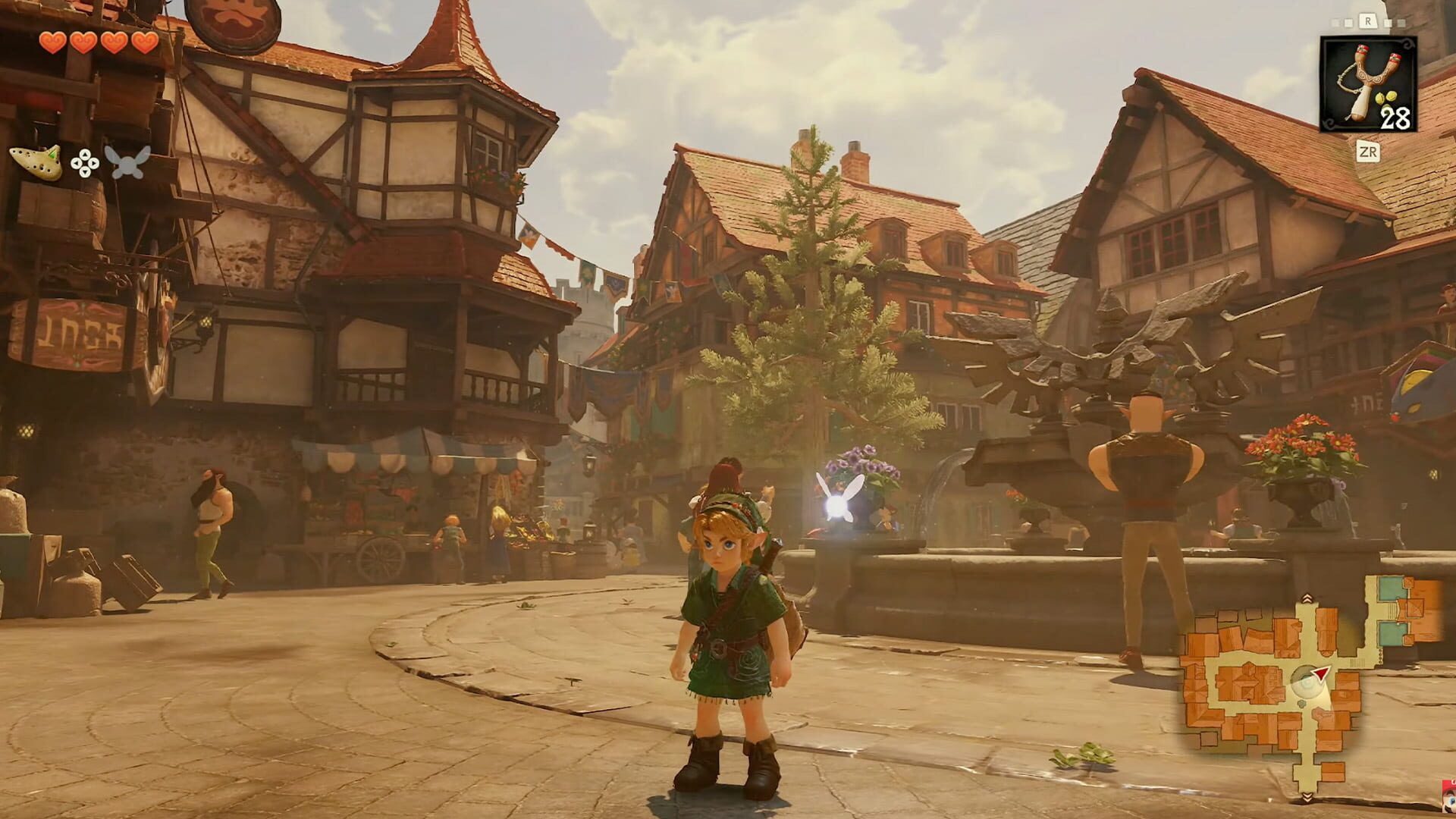
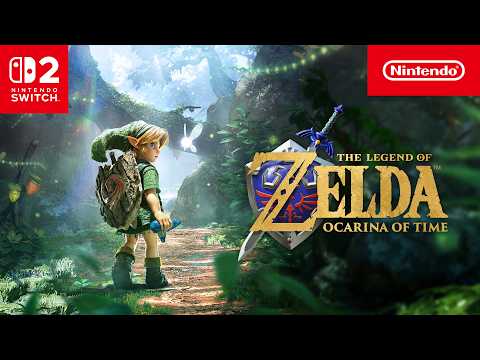
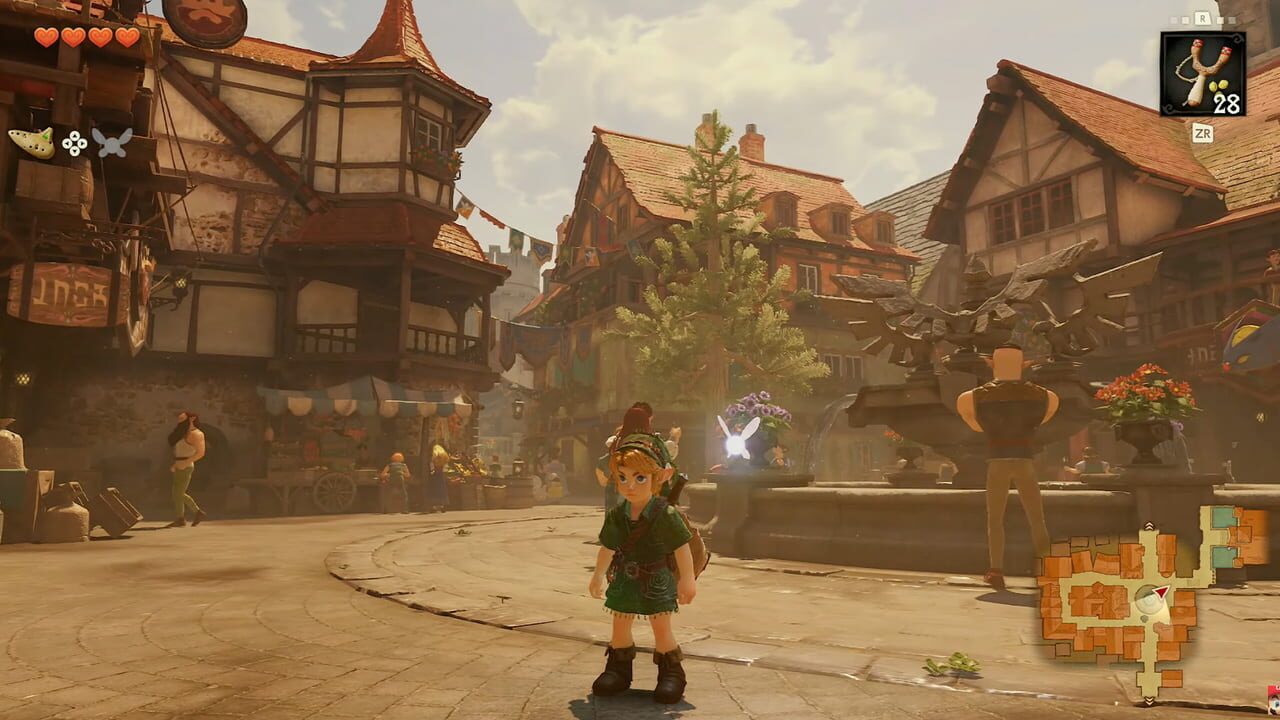
This is the specific difficulty facing a remake of the game that produced a resolution, rather than a remake of one of the games that failed to find one. A studio remaking Resident Evil or Tomb Raider today is restaging a widely recognized limitation, something a contemporary player can still register as a limitation by comparing it with what came afterward, so the remake gets to read as an improvement almost automatically. A studio remaking Ocarina of Time is restaging a success so complete that the player receiving it in 2026 has never once operated a three-dimensional action game without some version of what they are about to be handed. Nintendo has said little about the remake beyond the fact of it: a teaser shown at a Nintendo Direct on June 9, 2026, promising a release later that year with no specific day named. The franchise's own history makes one detail a safe inference rather than an invented one: no mainline three-dimensional Zelda since 1998 has shipped without some form of targeting descended from Z-targeting, and there is no visible reason to expect Ocarina of Time's own remake to be the first. Technique, in other words, is likely to transfer from 1998 to 2026 with very little friction. What will not transfer is the condition that made the technique an event rather than a feature: an audience that had just spent two years watching several honest, well-funded attempts fail at the same problem. The remake can reproduce the button. It cannot reproduce the two years of not having the button, because that absence was never a property of the mechanic. It was a property of everything surrounding the mechanic, and surroundings are the one part of 1998 a remake has no mechanism for shipping.
The obvious objection is that this is nostalgia dressed in a historian's clothing, the familiar and slightly tired claim that a thing can only be properly felt by whoever arrived first, a claim that usually collapses on inspection into an appeal to seniority rather than an argument about anything. The objection deserves a direct answer rather than a shrug, because the claim being made here is a different one. Nostalgia is a claim about feeling: that the 1998 player's experience was warmer, richer or more innocent, and that everyone arriving later has simply missed a mood. Nothing in this argument depends on 1998 having felt better than 2026 feels. The claim is about legibility instead, a narrower and more checkable thing: whether a design choice can be perceived as a choice at all, selected from live alternatives a person can name, rather than encountered as the unremarkable shape the medium has always apparently had. A player in 2026 can be told, accurately, that Z-targeting was once new. That player could even go and play Tomb Raider or Resident Evil afterward to see the alternatives it beat. Neither exercise reproduces the condition of not yet knowing a solution exists, because a comparison supplied after the fact is a different mental operation from living inside an open question, and the difference shows up even in a controlled version of the same test: a modern option to switch targeting off would ask a player to accept a chosen handicap, which is a fundamentally different experience from living, without having chosen anything, inside a limit nobody had yet lifted. Knowing a fight used to be unsolved is not the operation of sitting inside one, and the gap between the two is not sentimental. It is informational. The 1996 player had less data than the 2026 player has, and the missing data, specifically the absence of any working answer, was the entire content of what later made the answer worth having. The same gap shows up outside games. A student today can read about the ultraviolet catastrophe that troubled physics before quantum theory arrived, or watch a documentary walk through it, without sharing for even a second the vertigo of a physicist in 1900 who had genuinely run out of classical explanations. The student already has the answer in hand before the question finishes being posed, and having the answer in hand changes what the question can feel like, however carefully the documentary sets its historical scene.
The clearest evidence of how completely the problem got solved is how rarely Z-targeting comes up when the game's legacy is actually discussed. Retrospectives reach for the ocarina, the transformation into an adult body, the size of Hyrule Field, Ganondorf, the horse. The targeting system that made the combat playable in the first place gets mentioned, when it gets mentioned, as a line in a controls summary rather than as an idea, and that omission is itself the evidence: features that remain debatable stay visible, cited and re-argued, while features that won by a wide enough margin simply disappear into the furniture of the form. Nobody writes a retrospective arguing about whether Z-targeting was the right call, the way people still argue about the wisdom of the time-travel structure's pacing or the water temple's notorious boot-swapping, because an argument needs at least two sides still standing, and this one only ever had the one. Somewhere this week, a player with no particular interest in Zelda and no memory of 1996 is holding down a shoulder trigger in an entirely unrelated game, locking a camera onto a single enemy, circling it at a fixed distance while the stick's meaning changes under a thumb that has never had to learn what it changed from. Nothing about that moment asks the player to know where the trigger came from, and nothing will hand back the two years of not having it. The trigger is simply working, exactly as two engineers and a field trip designed it to, for someone who has never once needed it to do anything else.