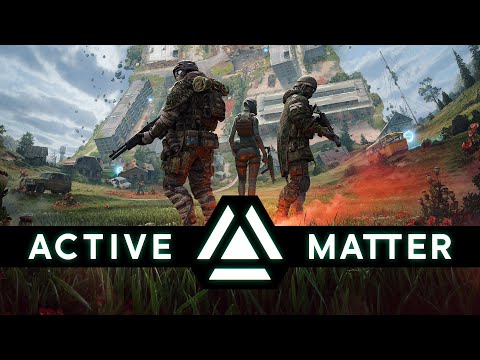


Gaijin Entertainment's own description of Active Matter states its central objective in one sentence, three verbs long, with a deadline welded to the end of it. Operatives harvest active matter, collect whatever else a zone offers, and extract to a safe place before the whole zone, in the storefront's own phrase, "ceases to exist with everything inside it." Read quickly, that sentence is doing the job marketing copy always does, promising urgency and reward in the register every shooter promises them in. Read as a rule, which is what it actually is, the sentence makes a specific claim about value: everything gathered inside a quantum unstable zone belongs to an operative only provisionally, on a lease that expires the instant the zone does, and the single action that converts a provisional hold into a permanent one is not a kill, not a level gained, not a rival eliminated, but a walk toward a marked exit.
That is a strange thing to organize an action game around, and the strangeness is the subject here: a systems question about what a design's verb economy actually offers a player, and what it withholds. Extraction shooters withhold something every other action genre has always supplied without being asked. A platformer's economy rewards forward motion, always another ledge. A role-playing game's economy rewards accumulation, always another level, another skill point, compounding, and a Diablo player's gathered treasure never has to be walked out of anywhere: it is simply, permanently theirs the moment it drops. Even the ordinary military shooter, respawns instant and consequence-free, rewards nothing but continuing to fire. Active Matter, like every game in its genre, gives a player a way to end a session that is not death, not fatigue, not a menu, but a deliberate, mechanically rewarded decision to stop while still ahead of the ledger. It is the first action genre whose central verb is quitting, dressed as extraction so nobody has to call it that.
The genre's nearest commercial relative makes the point by contrast. Battle royale games, PUBG and Fortnite chief among them, share the extraction shooter's shrinking map, its permadeath, its dozens of strangers converging on the same collapsing ground. What they do not share is any mechanism for leaving early. A battle royale match has exactly one way to stop playing with something to show for it, which is to be the person left standing when everyone else is dead. There is no marked exit, no early door, no partial reward for a player who has decided a strong position is good enough and would rather keep it than risk it against the last ten opponents. That genre demands continuation until an ending is imposed from outside. The extraction shooter is built from the opposite premise: that the best outcome available to a player is frequently to stop imposing risk on themselves before someone else does it for them, and that deciding when to do that is the whole game.
The genre is young enough that this premise can still be dated precisely. Escape from Tarkov, developed by Battlestate Games, opened its beta to paying players on July 28, 2017, and stayed there, officially unfinished, for more than eight years, not reaching a numbered release until November 15, 2025, ten months before Active Matter's own console debut. Tarkov's version of the rule has always been severe: die, or fail to reach an exit before the clock runs out, and a player forfeits everything carried in and gathered since, with two narrow exceptions carved out by the designers themselves, a small secured case exempt from loss and whatever gear was insured in advance and not yet recovered by whoever did the killing. Those exceptions are themselves a kind of admission. A design team does not build an insurance office into a game unless it already understands, and wants the player to feel, exactly how much the base rule is going to hurt.
Hunt: Showdown, Crytek's bounty-hunting variant on the same premise, reached Steam early access on February 22, 2018, exited it in August 2019, and did not arrive on current-generation consoles until August 2024, six years after its own debut. Both of the genre's founding titles spent years as PC-only propositions while consoles slowly caught up to them. Active Matter, scheduled to launch on September 15, 2026 simultaneously on Steam, PlayStation 5 and Xbox Series X|S after a year of PC-only early access on Gaijin's own storefront, is the first attempt in this lineage to skip that migration and arrive everywhere at once. A rule that took Tarkov eight years to formalize into a finished product is now confident enough in its own audience to launch across three platforms on a single date, which says something about how quickly an unusual premise can harden into a genre default once players have been shown exactly what it costs to stop, and what it costs not to.
Three different studios, arriving at the same rule from three different fictions, is convergent evolution rather than coincidence. Tarkov wraps the rule in grounded, almost bureaucratic realism, complete with an insurance office and a currency exchange. Hunt: Showdown wraps it in Victorian bounty-hunting gothic, swamp and lantern light. Active Matter wraps it in quantum catastrophe and multiversal war. The fictions differ completely. The rule underneath, harvest, hold, and get out before the window closes, does not vary at all, which suggests the rule is not serving any one fiction so much as the fictions are competing to serve the rule.
Active Matter's version of the mechanism borrows this premise and adds a mythology on top of it. Its zones are described in the game's own marketing as quantum unstable, saturated with a substance the copy calls "the most valuable and the most dangerous resource in all multiverse," one capable, in the same materials, of bending space and time and transforming whatever it touches. Operatives, deployed solo or in squads of up to three, harvest it from clusters, from the transformed creatures it produces, or by taking it from rivals who got there first; a teammate can revive a downed partner if the position holds long enough to attempt it. All of it is raced against a closing window. A hands-on preview from the outlet Big Boss Battle confirms the consequence in plain terms: an operative who dies without securing anything forfeits everything the zone produced, and most of what was carried in besides, and a successful exit is the only route to better equipment for the next attempt. None of this is unusual for the genre. It is, if anything, the genre's baseline rule restated with unusual bluntness, which is exactly why it rewards being read as a proposition rather than skimmed as flavor text.
The fiction wrapped around that rule is more elaborate than the genre usually bothers with. Active Matter's marketing describes a multiverse shattered by what it calls a quantum catastrophe, its zones populated by rivals pulled in from other timelines, by anomalies that bend gravity, and by what the game's own copy calls ethereal beings, indebted openly enough to SCP-style found-document horror that reviewers have noted the resemblance without much prompting. A studio does not typically spend this much invented cosmology on what is, underneath, a resource-collection timer. The elaboration matters for what follows, because a systems reading has to treat a game's fiction as part of its form rather than as decoration sitting on top of the form, and Active Matter is about to put its fiction to a specific piece of mechanical work.
The rule itself describes a documented asymmetry in how people weigh gains against losses, one that has nothing to do with games and everything to do with why time spent in one of these zones feels the way it feels. The finding is well known enough by now, and cited loosely enough in writing about games, that it risks functioning as shorthand, invoked the way a critic might invoke dopamine, gesturally, as decoration for an argument nobody has actually gone and checked. It deserves more precision than that. Facing likely gains, people turn cautious, preferring a smaller certain reward over a gamble for more. Facing likely losses, the same people turn reckless, preferring a risky gamble over a smaller certain loss, a reversal Daniel Kahneman and Amos Tversky named the reflection effect in their 1979 Econometrica paper, "Prospect Theory: An Analysis of Decision under Risk," work that would eventually anchor Kahneman's Nobel Prize and that remains the most cited account of how people actually evaluate risk, as against how classical economics assumed they did. The same paper documents loss aversion proper: losses weighted more heavily than equivalent gains, so the pain of forfeiting a given quantity of anything outweighs the pleasure that came from acquiring the same quantity in the first place. Kahneman and Tversky attributed the reversal in risk attitude to a further finding they called the certainty effect, the outsized weight a mind assigns to an outcome that is locked in compared to one merely probable, whichever direction that weighting happens to push behavior. None of this required imagining a life-or-death stake to demonstrate. Kahneman and Tversky's original subjects were choosing among cash amounts on a questionnaire, not standing inside a collapsing building; the asymmetry they documented is a property of how a mind processes any reference-relative quantity, money, matter, or otherwise, which is exactly why it transfers to a shooter without needing to be reinvented for one.
An operative who has spent several minutes filling a pack with active matter is no longer standing at zero. The instant matter is picked up, it stops being a hoped-for gain and becomes a held possession, and the reference point against which every later decision gets measured moves with it. Extracting now, even for less than a full run might have yielded, is the certain option, a known reward already within reach. Pushing on for one more cluster while the zone timer collapses is the gamble, and crossing a contested exit through gunfire rather than taking the slower, safer route is a smaller version of the same gamble. The reflection effect predicts, with some precision, which choice a loaded operative under deadline is likely to make, and it is rarely the cautious one. Facing what reads like a certain loss if the safe route is taken, a player sprints through open ground, picks the fight instead of the detour, attempts the greedy last harvest instead of the early exit, because a probable catastrophe has come to feel more bearable than a guaranteed smaller one. Squad play compounds this arithmetic rather than diluting it. Three operatives who have pooled a run's gains hold a single collective reference point, and the choice to attempt a revival under fire, dragging a downed teammate back to a defensible position instead of writing off both the person and whatever they were carrying, is the identical bet, run on a body instead of a resource. None of this requires a player to have read a page of behavioral economics beforehand. The zone timer teaches the lesson faster than any seminar could, which is rather the point of building a lesson into an interface instead of a lecture.
Games have exploited this asymmetry for decades without ever showing their work. Variable reward schedules, progress bars engineered around sunk cost, near-miss outcomes tuned to feel almost like a win: an entire design vocabulary exists to keep a player's reference point drifting without the player ever noticing it has moved. Extraction shooters are unusual, and worth crediting for it, because they do close to the opposite. The mechanism is not hidden behind visual noise. It is the interface. Hunt: Showdown makes this literal: a hunter who claims a bounty gains a limited view of nearby rival positions, but the same claim broadcasts that hunter's own location to every other player on the map, so the accumulated risk is not only felt privately but displayed publicly, a marker standing in for a reference point the whole match can watch move. Tarkov's insurance office performs the equivalent work in ledger form, selling a player partial protection, in advance, from a bias the designers assume will be acted on anyway. Active Matter runs the same logic through a countdown: a collapsing zone timer, a screen that states plainly what will be lost and how little time remains to prevent it. This is a genre that hands a player the ledger and asks them to feel the asymmetry on purpose, in real time, with the mechanism fully labeled.
Labeling the mechanism does not disarm it. Knowing that a countdown is built to make a gamble feel safer than a certainty does not make the gamble feel any less safe in the moment than it was built to, in roughly the way that knowing two lines are drawn the same length does not stop a Müller-Lyer arrow from looking longer than its twin. This is the genre's specific cruelty, worth stating plainly rather than admired from a distance: it takes a bias any player can be shown, in the abstract, to be operating under, and stages it as a live performance for that same player's benefit, repeatedly, with real held gains as the stakes each time. The candor is not a cure. It is closer to a magician who explains the trick while performing it, correctly confident the explanation will not stop it from working on the audience doing the watching.
Active Matter's specific contribution to this lineage is not the rule described so far. It is a second rule laid on top of it, and it is the one the marketing leads with rather than buries. Operatives, the storefront explains, are caught in a time loop, each one "an operative stuck in a time loop, always brought back from the dead to the same point." Death, in the fiction, is not an ending. It is a return. Kill an operative inside a quantum unstable zone and the game does not claim to have erased anyone. It claims to have sent them back to try again, which every other extraction shooter has always done anyway, mechanically, at the level of the menu screen, without ever making a fictional claim about it one way or the other.
The obvious response is that this should relax the tension the genre otherwise depends on. If death is explicitly, canonically survivable, the one ingredient that made a Tarkov raid or a Hunt: Showdown bounty hunt frightening, the possibility of the attempt simply ending for its player, appears to have been removed by the premise before a single match starts. A player who knows going in that the operative always comes back should reasonably feel safer than a player given no such guarantee, the way a stunt performed with a visible harness reads as less dangerous than the identical stunt performed without one, whatever the footage is later cut to suggest.
A second, quieter version of the same skepticism says the loop changes nothing mechanical at all, that it is a narrative gloss laid over a menu screen every game in the genre already had, and that a rule dressed differently is still the same rule. That version is closer to correct about the mechanics and further from correct about what the mechanics are for. A systems reading has to take the fictional frame as seriously as the numbers underneath it, because the frame is part of what the design is doing, not packaging wrapped around it afterward. What the loop changes is not the arithmetic of a run. It is the story a player is permitted to tell themselves about why the arithmetic feels the way it does.
That permission is the thing actually being withdrawn, and withdrawing it is a stranger, colder move than either skeptical reading gives Active Matter credit for. No Tarkov player's character has a biography or an interior life to lose, and no Hunt: Showdown bounty hunter is a continuous person rather than a costume; nobody who plays either game grieves the character itself as a self that has ended. What those games take from a losing player was always the run's gains and nothing else, dressed for the occasion in aesthetics borrowed from games where dying really had been the whole penalty: a ragdolling body, a reddening screen, a hush over a voice channel. Active Matter does not remove that borrowed costume. It removes the fiction's plausible deniability about wearing it. By stating outright that the operative always returns, the game forecloses the one story a player could previously tell themselves about their own pulse rate at the extraction point: that it was about survival. It was never about that, not in Tarkov and not in Hunt: Showdown, and Active Matter is the first entry in the genre honest enough to say so in its own premise. A studio willing to invent an entire fractured multiverse to explain its own respawn screen is a studio that has decided the explanation matters, and the explanation it chose was survival specifically, not amnesia, not a new recruit inheriting a dead one's debts. What is left standing, once the alibi built from ordinary ambiguity is gone, is the arithmetic by itself, undressed: a person deciding, under a closing window, whether to gamble a quantity of active matter already held against the chance of more, for reasons that have nothing to do with staying alive, because the fiction has already settled that question in advance. Nothing about that tension is defused. What survives, once the dignifying cover is stripped away, is the same weight with nowhere left to hide, which does not make it smaller. It makes it harder to misname.
The loop sharpens this further rather than dulling it with repetition, which is the direction familiarity usually pushes a fear. Because an operative has, by definition, done this before and will do it again, no single attempt is a first attempt, and no courage earned in a previous one carries forward into the next. What carries forward, on the rare run that ends in a successful exit, is whatever was extracted, converted into equipment for a future pass at the identical bargain. The reference point governing each decision resets with every new zone regardless of how many loops an operative has already survived, because it is defined by what is currently held, not by what was once endured. An operative deep into this cycle runs the same closing-window arithmetic as one on a first attempt, because the underlying fear was never about which attempt it is. It was always about whatever is currently sitting in the pack. The catastrophe that fractured the multiverse in the game's own backstory is, tellingly, described as ongoing and unresolved by any single operative's efforts: the war is not being won loop by loop, only paid for loop by loop.
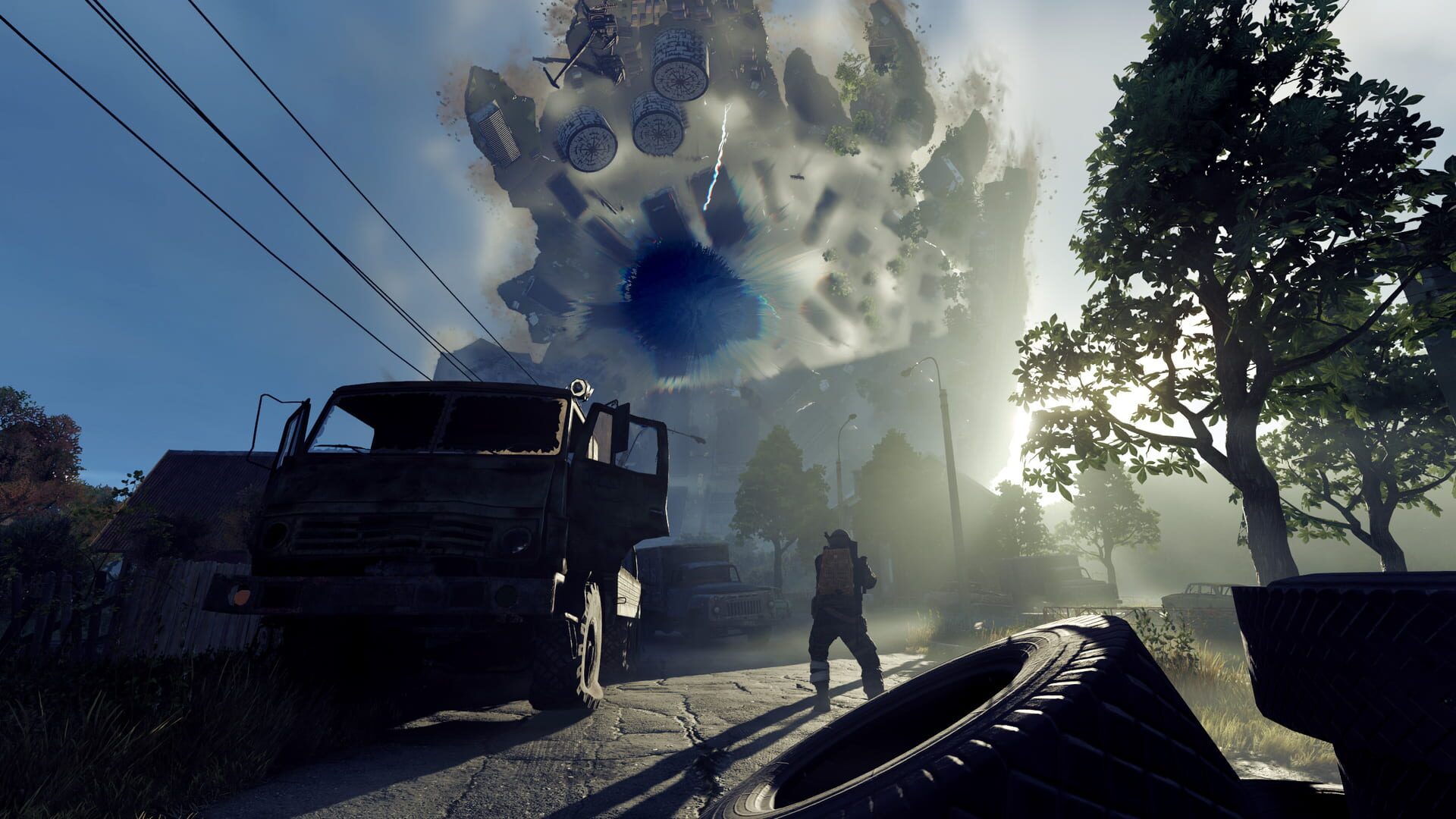
The zones are built to make that closing window a spatial problem as well as an arithmetical one. The game's own description of its setting favors a specific kind of ruin, a huge island of rusted Soviet industrial complexes and cryptic science facilities, the sort of landscape that already reads as unstable before any anomaly touches it. Active Matter's instability then warps geometry along with the clock: buildings tear loose from their foundations and hang inverted, and the same Big Boss Battle preview describes watching another operative scavenge the inside of a house standing upside down in the air overhead. Movement itself adapts to the instability, operatives running along walls and over warped structures, closely enough to Tarkov's grounded traversal that one outlet covering the game called it, not unfairly, a science-fiction version of the same walk. A named mission, Escape from Dogorsk, tasks a squad with reaching an extraction point while carrying a recovered case, fighting the facility's own transformed creatures the entire way there. An exit, in a space where up and down are provisional and the architecture was rusting before the timeline broke, is not simply a location on a map. It has to be found before it can be walked toward, and the collapsing zone does not pause for either part of that problem.
What the design finally asks of an operative, loop after loop, is not bravery in any sense a boss fight would recognize, and not skill in the sense a difficult jump requires. It is a single, repeatable act of arithmetic performed under a closing window, run by a body the fiction insists cannot permanently die, carrying a pack that can permanently empty. Somewhere on the shifting ground of a quantum unstable zone, an operative stands within sight of a marked exit with active matter weighing down that pack and gunfire somewhere between here and the door, the countdown already past the point where the safe route still adds up, and takes the walk anyway, or does not, and either way will be standing in exactly this position again, having forgotten nothing, and having, in the only sense the game was ever actually asking about, risked everything.