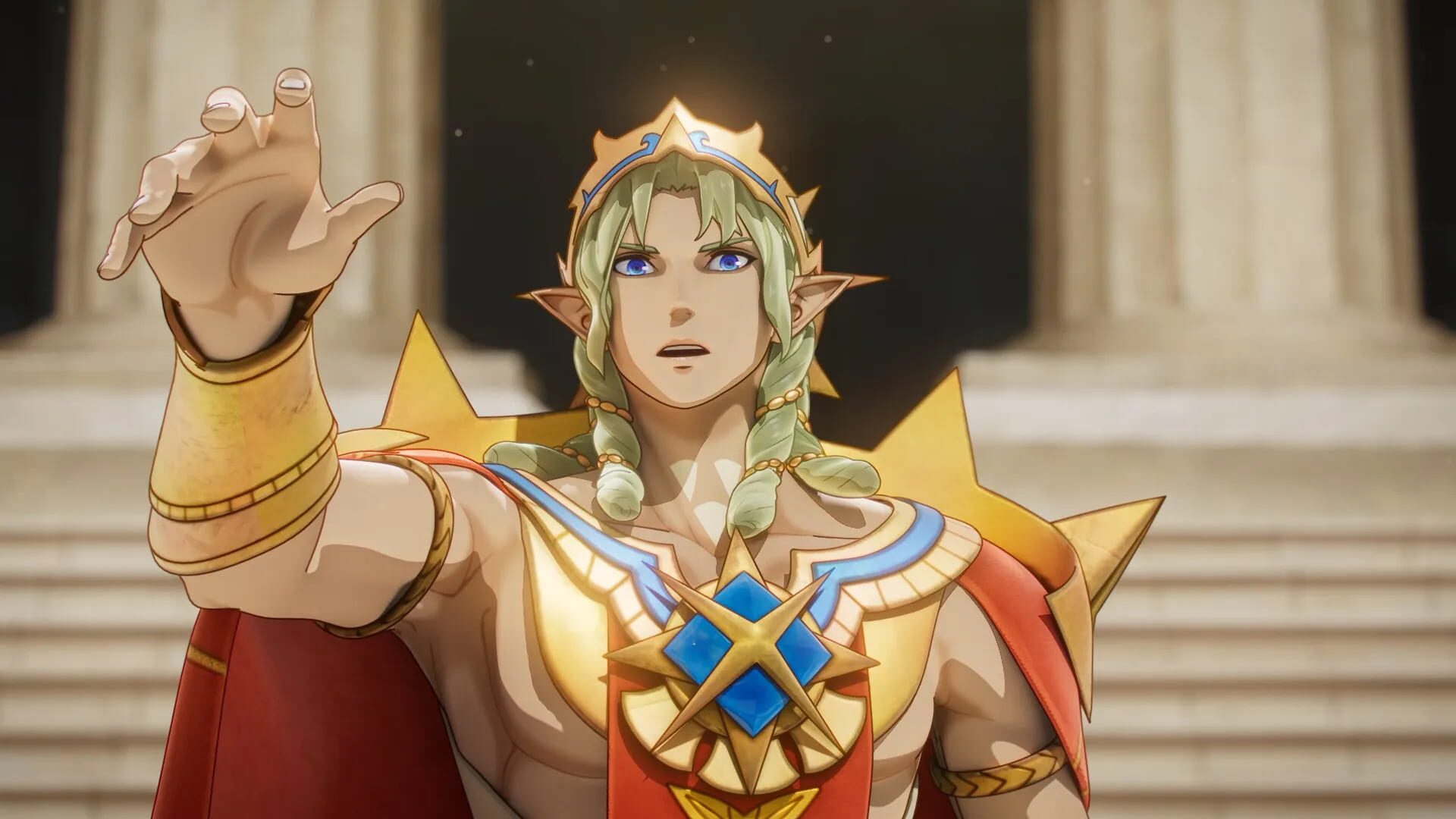
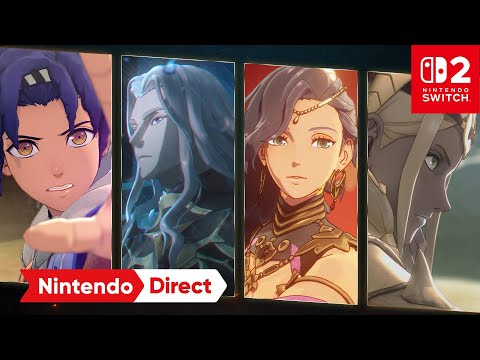


Cai has a burst of flame he can call up out of nowhere, a wide arc of it, enough to break a formation. It is not free. Somewhere on the interface, a number that used to only go down when an axe connected is about to go down because Cai decided it should. The trailer does not linger on this. It shows the fire, the enemies scattering, the meter filling. It does not show the arithmetic underneath: that the same value which measures how close this character is to dying is now also the currency he spends to win. That arithmetic is the subject here, and the discipline it belongs to is not narrative but form. This is a Form & Systems reading, which means the object under examination is not what Fire Emblem: Fortune's Weave says about its characters in dialogue but what its rules say about them whether the writers intend it or not. Intelligent Systems' eighteenth mainline entry, confirmed for Switch 2 sometime in 2026, introduces a mechanic called Blaze Arts: signature moves, unique to each of the game's four protagonists, that cost the caster a chunk of their own health points to activate. The reveal trailer shows the cost up front, in HP, every time. What it does not show is the payoff. Each protagonist's Blaze Arts feed a circle gauge in the corner of the screen, some consuming half of it in a single use, and the footage lingers for a moment on a command sitting beside that gauge: Manage Gauge, greyed out, unexplained. The game has told the player exactly what spending costs. It has not yet told them what spending buys. A resource system is never just a resource system. It is an argument, made in numbers instead of sentences, about what a thing is worth and what it can be traded for. Give a designer the freedom to decide what currency buys power in their game, and the choice they make is a small philosophical position whether they meant to state one or not. Mana is a position: power is a renewable, disciplined resource, replenished by rest, distinct from the body. Ammunition is a position: power is finite and physical, carried, weighed, run out of. Fire Emblem: Fortune's Weave has made a third choice, and it is the starkest one available to a strategy game. It has made health the currency. It has decided that the thing standing between a character and death is also the thing that character can spend. This would be a smaller observation if Fire Emblem were a series without a history on exactly this question. It is not. Fire Emblem has been arguing with itself about what a unit's health is for since 1990, and the argument has never really been about difficulty, whatever the marketing copy around any given entry has claimed. It has been about attachment, and about how much of it the audience can be asked to carry. The original Fire Emblem, released for the Famicom in 1990, made permadeath the rule the whole genre would rest on: a unit reduced to zero HP in battle does not return, not in the next map, not in the ending slideshow, not ever. This was partly a hardware artifact, a way of making a battery-save cartridge feel consequential in an era before players expected to reload a save file the instant a plan went wrong. But the rule outlived the hardware constraint that produced it, and it outlived it because it did something no difficulty slider could replicate. It made the player's roster into something the player had reason to protect rather than merely deploy. A unit in most tactics games is a set of stats arranged on a grid. A unit in Fire Emblem, under permadeath, is a set of stats the player has spent forty hours getting attached to, and the game's entire tension comes from knowing that attachment is exactly what the rule is designed to spend against. This is the part the "difficulty mechanic" framing misses. A difficulty mechanic makes a game harder to win. Permadeath does not primarily make Fire Emblem harder to win, since most maps remain completable with a smaller roster and most players who lose a unit simply proceed short-handed rather than restarting. What permadeath actually manages is how much the player is allowed to feel about the unit before the unit is gone. It is not a combat system. It is an attachment-management system wearing a combat system's clothes, and every mainline entry since Awakening in 2012 has been a renegotiation of how much of that management the audience will still tolerate. Awakening is the hinge because Awakening is where Intelligent Systems first let the player opt out. Casual Mode, introduced alongside the traditional Classic Mode, let a fallen unit return at the end of the current map instead of vanishing from the roster for good. The decision split the development team before it split the fanbase. Masahiro Higuchi, the project manager on Awakening, later described the internal argument plainly: permadeath was part of the series' identity, and it was also, in his words, "something that I think kept a lot of people from trying the game" in the first place. Some members of the team were ardently against the new mode. It shipped anyway, because Intelligent Systems had concluded that the series' core rule was costing it more new players than it was rewarding old ones. Higuchi still plays Classic Mode himself. The compromise he helped ship was not built for him. What Casual Mode actually did, read as a system rather than as a marketing bullet point, was separate two things that had previously been fused: the tactical stakes of a unit falling in battle, which Casual Mode preserves, and the narrative-emotional stakes of that unit being gone, which Casual Mode removes. A unit who falls in Casual Mode still cannot act again this map. The player still loses the turn, the position, the momentum. What the player no longer loses is the character. Intelligent Systems had figured out, a decade before Fortune's Weave, that permadeath's difficulty component and its attachment component were separable, and that a large share of the audience wanted the first without the second. Every entry since has kept pulling on that thread. Fates, in 2015, split into three versions with different structural relationships to loss and consequence. Three Houses, in 2019, let fallen students return to the classroom between battles in a way that softened permadeath's finality even in Classic Mode, because a beloved teaching sim cannot easily coexist with a roster that bleeds out. Engage, in 2023, built its entire premise around resurrecting the cast of the series' own past, an appropriately literal treatment of a franchise that had spent a decade figuring out how to bring characters back. The throughline across all of it is not softening for softening's sake. It is a design lineage slowly discovering that the dial between "loss is permanent and that is the whole point" and "loss is temporary and the point is elsewhere" is not fixed. It can be turned. The only question left open, entry after entry, was who gets to turn it. Blaze Arts answers that question by handing the dial to the player mid-battle. Casual Mode was a menu toggle, set once, before a single unit had moved. Blaze Arts is a live decision, made unit by unit, turn by turn, with the cost visible in the same health bar the enemy is trying to empty. Cai's fire, Dietrich's warp through the ink-black cloak, Leda's summoned monster conjured out of a song on the vihuela: each is a choice to convert survival into tempo, framed not as a debt the game imposes on the player but as a resource the player elects to burn. The genius and the risk of this design are the same fact. Fire Emblem has spent thirty-six years building a language in which a unit's health is the register of how attached the player should be to that unit staying alive. Blaze Arts asks the player to read that same number as a budget line instead, in the very same turn, on the very same unit, sometimes in the very same maneuver that decides whether the unit lives to see the next one. That is a genuine formal argument, not incidental color. What Blaze Arts is claiming, at the level of the ruleset rather than the cutscene, is that heroism in this game is a rate of exchange. A hero, on this account, is not a character defined by a virtue they hold constant regardless of cost. A hero is a character willing to spend down their own margin for survival in order to buy an outcome, and the game asks the player to make that trade on faith, without yet showing what the trade returns. The system does not merely permit self-sacrifice as an option among many. It makes self-sacrifice legible as a mechanical strategy with its own ledger, its own accumulating gauge, its own reserved command whose function the trailer has not yet spelled out. Fortune's Weave has built a spreadsheet out of a virtue, and withheld half the spreadsheet. The withholding is itself the argument. There is a second layer to the system worth sitting with before moving to the counter-reading, because it is where the design stops being merely permissive and starts being coercive in a specific, interesting way. The circle gauge does not simply track how often a unit has spent health on a Blaze Art. It fills, unevenly, some Blaze Arts costing half of it in a single use, and the player is asked to keep spending toward a state the interface only gestures at. That gesture, the greyed-out Manage Gauge command sitting beside a full meter in the footage, is a familiar shape to anyone who has played a game with a rage meter or an overdrive gauge: the system is rarely neutral about whether the player keeps spending, and a command reserved for a full gauge implies the top of that gauge does something the bottom does not. What that something is has not been said. The player, and for now the audience watching the trailer, are being asked to trust a mechanic whose full terms are not yet on the table. This is the part of the design that earns the word argument rather than merely the word system. A pure cost-benefit resource, of the kind mana or stamina usually is, announces both halves of its exchange up front: the player always knows roughly what a given expenditure buys and what it costs, because the whole rate is legible from the tutorial forward. Blaze Arts announces only the cost. The benefit is deferred, held back for the player to discover in play and, at this stage, for the audience to discover only once Intelligent Systems chooses to show it. Katherine Isbister's work on emotional design in games, in How Games Move Us, makes the case that a system's ability to produce loss as a felt experience rather than a merely counted one depends on exactly this kind of asymmetry: the player has to be uncertain, in the moment of decision, whether the choice in front of them is generous or ruinous. Fire Emblem has always produced that uncertainty at the level of the whole map, in the gap between a plan and the dice roll that executes it. Blaze Arts produces it at the level of a single unit's private ledger, turn by turn, spend by spend, with the far end of that ledger kept, deliberately or not, out of view. The uncertainty is not an accident of a marketing cycle still in progress. It is the mechanic already working as intended, before the mechanic has even been fully shown. It is worth taking the counter-reading seriously here, because the obvious objection is that this is overreading a battle mechanic that exists mainly to make the trailer's fight scenes look good. Games have always let players trade resources for power: mana costs, stamina bars, the entire genre convention of the limit break. Why treat Blaze Arts as a claim about heroism rather than as one more flavor of special-move economy borrowed from any action-RPG's skill tree. The answer is that Fire Emblem is not any action-RPG. It is specifically the series that spent three decades building the single most legible relationship in strategy gaming between a unit's health total and the player's emotional stake in that unit's continued existence. A mana bar in another franchise is just a mana bar, because that franchise never made health mean anything beyond "distance from defeat." Fire Emblem's health total has meant more than that since 1990; it has meant "how much longer do I get to keep this person." To then build a headline mechanic that spends precisely that number, on command, for tactical advantage, is not a neutral genre convention arriving in a new coat of paint. It is a direct rewrite of what the series' most loaded stat is allowed to represent. The context is what turns the mechanic into an argument. A limit break in a game with no permadeath history is a cost. A Blaze Art in Fire Emblem is a cost paid in the specific currency the series taught its audience to treat as sacred. The Heroic Games tournament that frames Fortune's Weave's plot does related work at a different scale, and it is worth reading alongside Blaze Arts because both are the game's answer to the same underlying problem: how do you let radically different value systems occupy the same board without the game having to referee them. The four protagonists enter Dagsion's arena for reasons that share almost nothing. Cai fights to free an imprisoned father. Dietrich fights because he washed ashore after a monster attack and has, by his own account, a thirst for battle that predates any cause. Theodora fights to restore her goddess's honor and defend a kingdom's peace. Leda, born into privilege she abandoned, fights to find and kill her father's murderer, who she has learned is also competing. One of these motives is love. One is closer to bloodlust. One is duty to an institution. One is revenge, arguably the least noble of the four and structurally the hardest for a game to endorse without also endorsing murder as a valid path to a happy ending. A tournament is how a game gets to seat all four of them at the same table without picking a winner among their reasons. This is a much older design solution than Fortune's Weave, and the theorist who named it most precisely was Roger Caillois, whose 1958 taxonomy of play identified agon, competition under a fixed and mutually accepted rule, as one of the fundamental categories through which societies stage conflict without resolving the deeper disagreement underneath it. Caillois's point about agonistic contests was that their appeal rests on formal equality: everyone plays by the same rule, and the rule is precisely what allows people who disagree about everything else to occupy the same contest without the contest itself having to adjudicate who was right to want to win. A duel settles who is faster with a blade. It does not settle whether either party's cause was just. The tournament is the container that makes that non-settlement bearable, even satisfying, because the container's fairness substitutes for a verdict the game has no mechanism to render. The Heroic Games do exactly this for Fortune's Weave's cast. The tournament does not ask whether Leda's revenge is more or less legitimate than Theodora's piety. It asks who wins the match. The rule is the same for both of them: fight, survive, advance. Victory earns a wish from the Divine Sovereign regardless of what the winner intended to do with it, which means the game's central structuring institution is explicitly agnostic about the moral content of anyone's goal. It is agnostic by design, not by oversight. A strategy game with four protagonists whose motives range from filial devotion to something close to bloodlust has a genuine narrative problem: it cannot make all four equally righteous without flattening them, and it cannot rank them without alienating whichever fraction of the audience is most invested in the one that loses the ranking. The tournament frame solves this the way agon has always solved it. It lets pluralism sit unresolved inside a structure whose fairness is the only value the structure actually enforces. Put the two systems next to each other and the shape of the whole game gets clearer than either explains alone. The Heroic Games handle moral pluralism among the cast by refusing to adjudicate it, deferring instead to a competition whose only rule is who wins. Blaze Arts handles the value of a single body by making that value negotiable, deferring to whatever the player decides a given turn is worth. Both are ways of taking something a lesser design would have to state outright, in dialogue, as a thesis, and instead encoding it into the parts of the game that are hardest to argue with because nobody experiences them as argument. A menu is not read as rhetoric. A meter filling is not read as a claim. But the meter is making one anyway, every time a player watches Cai's flame eat into his own health total and decides, this turn, that the trade is worth it. This is the frame worth carrying past Fortune's Weave and into whatever tactics game comes after it, or the next skill tree in the next action game, or the next limit break that asks a player to spend something the game has spent hours teaching them to protect. Ask what the currency used to mean before it became spendable. A stamina bar that always meant "how tired are you" is not saying much when a game lets the player burn it for a dodge. A health bar that a franchise spent three decades turning into a proxy for grief is saying quite a lot when that same franchise decides, in its eighteenth entry, that the bar should also be a wallet. The mechanic will not announce the shift. It will just be there, on the interface, the next time a beloved unit takes a hit they chose to take, and the number goes down for a reason that has nothing to do with the enemy's sword. Cai's fire clears the formation. The bar drops. The gauge climbs half a step toward the boost, and somewhere past that, toward the point where the trade stops being a bargain and starts being a wound the character cannot easily take back. Nobody on screen says any of this out loud. The number says it for them.
Tuesday analysis
A Game Where Health Is Money
- Writer
- J. A. Marsh
- Lens
- Form & Systems
- Published
- FEB 20, 2026
- Length
- 3,136 words / 14 min
- Notes
- 8 sources
A resource system is never just a resource system. It is an argument, made in numbers instead of sentences, about what a thing is worth and what it can be traded for.