






In Grand Theft Auto V there is a mission in which the player plants a bomb inside a prototype smartphone, and the phone is then held aloft on a stage by the founder of a social network, mid-keynote, in front of an audience of employees and press, as he explains what the device will do for human connection. The bomb goes off. The founder does not finish the sentence.
The joke is not that a tech executive is killed. The joke is the staging: the raised product, the darkened auditorium, the vocabulary of connection, the audience that has been assembled to applaud a rectangle. Rockstar built an entire mission around the choreography of a product launch and then detonated the product at the exact moment the choreography peaked. The satire is aimed at the presentation, not at the man.
That is the pattern, and it is the thing worth tracing across twenty-five years, because it is not the pattern most people describe when they describe what this series makes fun of. The usual account is that Grand Theft Auto satirises America: its violence, its consumerism, its cops, its cars. That account is too broad to be useful and it gets the target wrong. This is a history-and-memory reading of a specific and consistent habit: across six mainline entries the series has trained its attention on the pitch a place makes for itself, the advertising and the self-promotion and the language a culture uses when it is selling its own image back to itself. The crime plot is the delivery vehicle. The billboards are where the writing happens.
Which is why the new game is arriving into a genuine problem, and why the problem is more interesting than the usual complaint about whether satire can survive the present.
Take the entries in order, because the target moves with the decade and the movement is the evidence.
Grand Theft Auto III, in 2001, established the delivery system before it established much of anything else. Liberty City had a mute protagonist and a plot assembled from mob-film parts, and the most distinctive writing in it was on the radio: a call-in show whose host, Lazlow, spent his airtime being condescended to by callers who had phoned in specifically to be heard. It is a small thing and it set the series' method for two decades. The satire was not in the missions. It was in the ambient broadcast the player could not switch off without switching off the car.
Vice City, in 2002, was set in 1986, and its subject was the boom's own self-description. Talk radio hosts explaining what was wrong with the country. Gun retailers speaking the language of freedom. A fictional games console advertised with the claim that it produced real three-dimensional graphics. The 1980s were the decade in which American consumer advertising achieved a particular gloss, and Vice City reproduced the gloss with unusual fidelity and then let the fiction wander around inside it. The city was pink and the radio was confident and neither of them was lying exactly. They were pitching.
San Andreas, in 2004, moved to 1992 and to a different pitch. Its subject was the culture war as it was conducted on the airwaves: the self-help industry, the diet industry, the paranoid talk-radio caller, the entertainment press. The game's plot ends in a riot modelled on the Los Angeles riots, which is to say it ends where the decade's rhetoric had been pointing all along, and the radio is still broadcasting through it.
Grand Theft Auto IV, in 2008, took the largest available pitch, the one the country makes to people outside it. Niko Bellic arrives in Liberty City because his cousin has been sending letters describing a life of mansions and women that turns out to be a bedsit and a taxi depot. The immigrant American dream is stated in the first ten minutes, in a specific character's voice, and then dismantled at a pace that most novels would envy. Weazel News broadcasts throughout, delivering the domestic version of the same product.
And Grand Theft Auto V, in 2013, found the target the series had been circling: the individual as a brand. LifeInvader, Bleeter, the reality talent show, the yoga instructor, the self-actualisation seminar, the founder on the stage with the phone. By 2013 the pitch had stopped being something institutions made about places and had become something people made about themselves, continuously, in public, and Rockstar noticed early and built the whole satirical apparatus of Los Santos around it.
That is a coherent twenty-year project, and it has a specific method: find the language a culture uses to sell itself, reproduce it with almost no distortion, and set it next to what is actually happening in the street. The distortion is minimal because it does not need to be large. A reader who can see both at once has already got the joke.
There is a practical reason the method settled on invented brands, and it is worth stating because it explains why the device is now weaker than it was. Rockstar could not use real products. No fast-food chain licenses its name to a game about carjacking, and no gun manufacturer wants its logo above a counter where the player buys a rocket launcher. The fictional brand began as a legal necessity. What the studio discovered was that the necessity was an advantage: a made-up soft drink can be given the exact register of a real one without the register belonging to anybody, and the player recognises the type instantly because the type is what advertising has spent a century standardising. Cluckin' Bell is not a joke about a specific chain. It is a joke about the fact that the reader can identify the category from four syllables.
That device depended on real branding maintaining a straight face. Through the 2000s it did. A soft drink advertised itself with sincerity, and the parody worked by matching the sincerity and letting the product be absurd. The device has been eroding since roughly the middle of the last decade, as real brands took up self-aware, ironic, deliberately unhinged voices in their own marketing, largely on social platforms, because the audience rewarded it. When a fast-food company's official account posts something surreal about its own product, the fictional version has nowhere left to stand. The satirist's exaggeration and the marketing department's engagement strategy have converged on the same tone, and only one of them is being paid to be there.
Erving Goffman's The Presentation of Self in Everyday Life, published in 1956 and widely read from 1959, is the book that describes the machinery. Goffman's claim was that social life is organised into front regions and back regions, and that a person performing in the front region is not being false so much as doing the work the situation requires, with the back region reserved for the dropping of the performance. A waiter is one person at the table and another in the kitchen. The interesting part of Goffman, the part that matters here, is that he insisted the front-stage performance is not a lie, because everyone present understands the terms. The gap between the two regions is a normal and necessary structure, and it is what makes performance legible as performance.
Satire has always operated in that gap. It reproduces the front-stage voice, moves it slightly out of position, and lets the reader see the back region through the crack.
The problem in 2026, and the argument this essay wants to make, is that the gap has been closing for fifteen years and is now, for a large share of the population, gone. The phone did not merely give people a stage. It gave them a permanent one, with an audience metric attached, and it moved the back region onto it. The unguarded moment, the confession in the kitchen, the sentence that used to be said only to a friend, all of it is now front-stage content, produced deliberately, for reach. A person filming themselves crying in a car has not failed to perform. That is the performance, and it is a genre with conventions.
A country in which every citizen maintains a continuous public feed has closed Goffman's gap by hand, on camera, voluntarily, and is charging nobody for the service. Which means that a satirist arriving in 2026 with the traditional method finds that the material has already done to itself the thing the method was going to do to it. There is no distance to open up between the pitch and the reality, because the pitch is now being made by the same people, in the same frame, in real time, about the reality they are standing in.
The trailers for Grand Theft Auto VI suggest that Rockstar has worked this out, and their response is the most interesting formal decision the series has made in a decade.
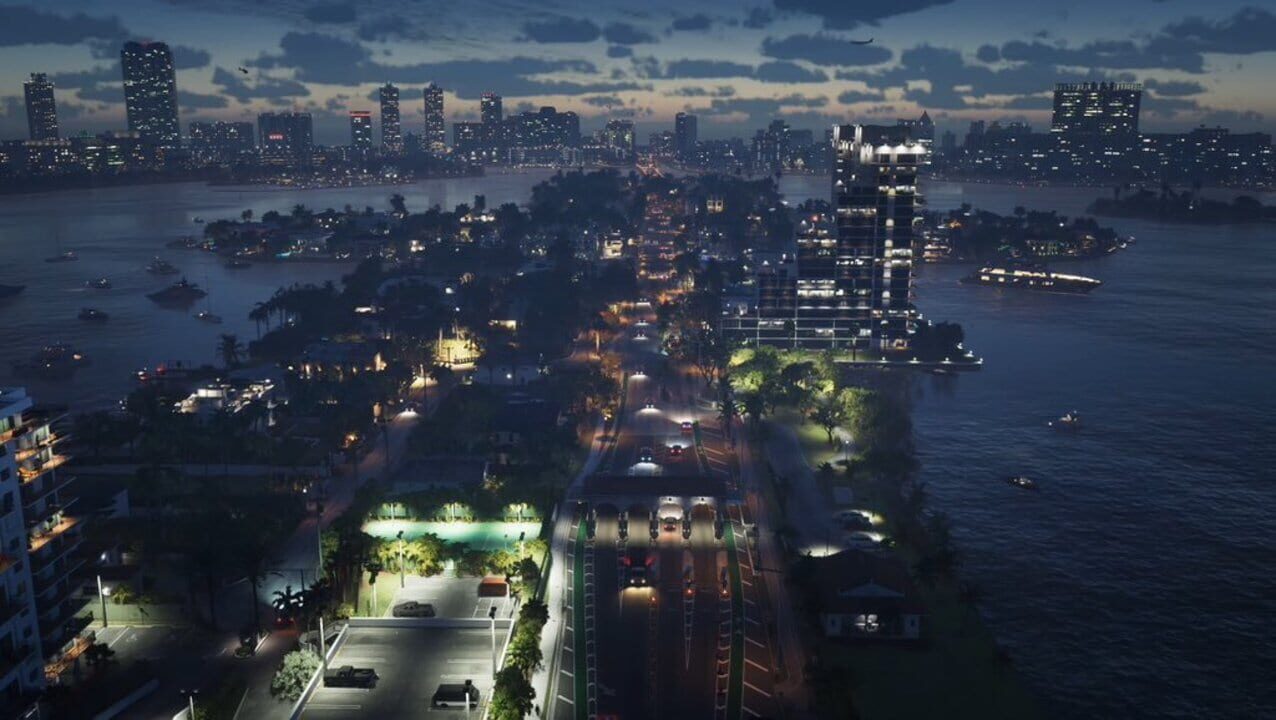
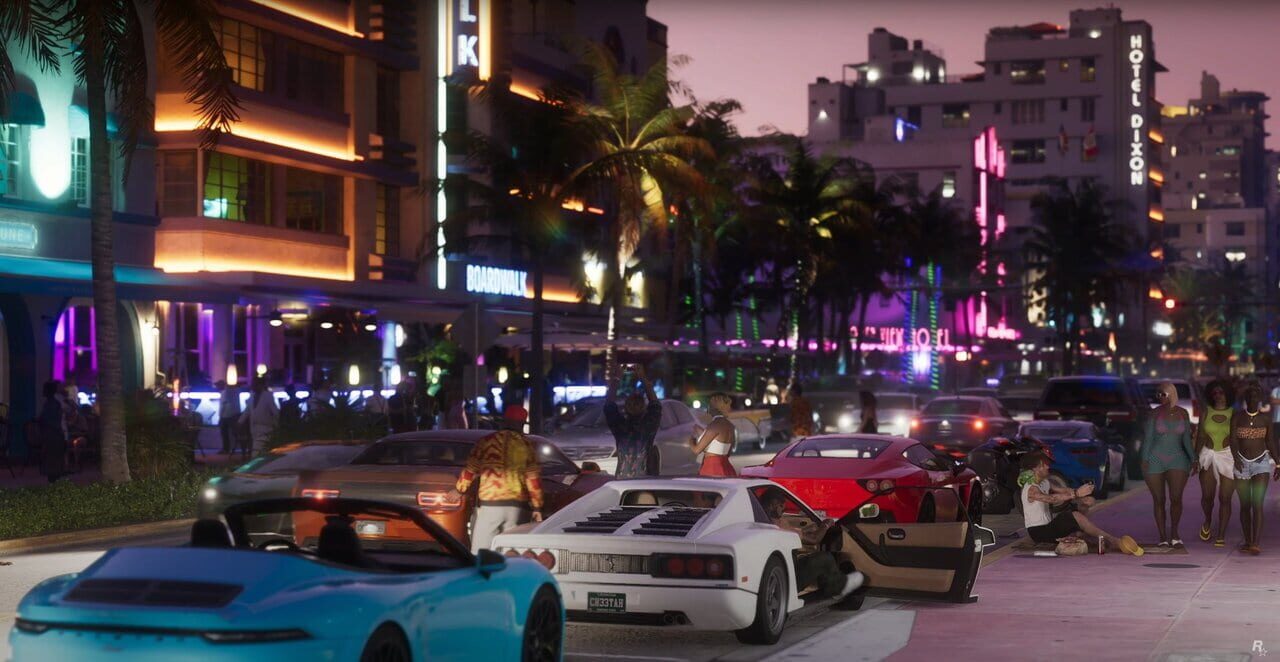
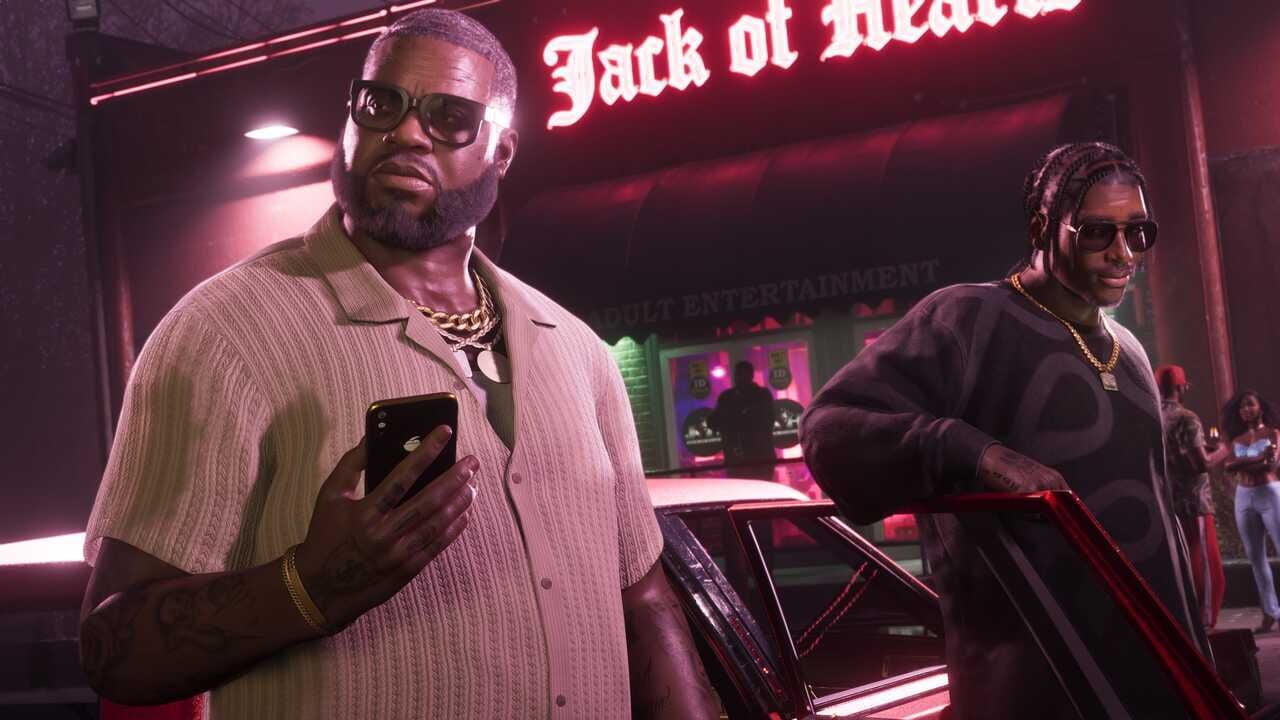
The first trailer, released in December 2023, is built substantially out of footage that presents itself as having been shot on phones. Vertical framing. The specific compression artefacts of uploaded video. Vignettes of people filming other people at their worst, an alligator in a shop, a man on a roof, a woman dancing on the roadside, all of it staged in the visual grammar of material that has already been posted somewhere. The game's state, Leonida, is Florida, and Florida arrives in the popular imagination pre-packaged as a feed: the Florida Man headline is itself a genre of aggregated local news, circulated as entertainment by people a thousand miles away.
That is not parody. Nothing in it is exaggerated. It is reproduction, and the framing device is the thing being reproduced.
There is a less elevated explanation available for the same shift, and intellectual honesty requires putting it next to the cultural one.
The two people most responsible for how this series sounded are no longer at Rockstar. Dan Houser, who wrote or co-wrote every mainline entry from the beginning and whose fingerprints are on the whole tonal register, left the studio in 2020. Lazlow Jones, who ran the talk radio from Grand Theft Auto III onward and lent it his own voice, left in the same year. Grand Theft Auto VI is the first game in the series to be finished without either of them, and it is being finished by a studio that has also spent the intervening years becoming a considerably larger and more scrutinised organisation than the one that shipped San Andreas.
So one reading of the move from parody to reproduction is that it is a considered response to a closed cultural gap. Another is that the reproduction is what a very good art department produces when the writers' room that used to supply the jokes has been reconstituted, and that the phone-footage framing is a strength the studio still has rather than an argument it has decided to make.
The second reading should not be dismissed, and it cannot be settled from outside. But it is weaker than it looks, for a structural reason. Rockstar's satirical apparatus was never a single desk. The billboards, the shop signage, the in-fiction websites, the pedestrian dialogue, the brand identities on every truck in traffic: that is hundreds of small authored decisions distributed across an art and design organisation, and it is the accumulated texture rather than any individual line that has done the work in every game since Vice City. A studio can lose two extraordinary writers and keep the habit, because the habit is in the pipeline. What a studio cannot do is keep a method that has stopped working on the material.
Whether the new game counts as a retreat therefore depends on what satire was ever for, and here the obvious counter-reading deserves a hearing, because it is strong.
The counter-reading says the premise is wrong: satire never did depend on exaggeration. Jonathan Swift's A Modest Proposal, in 1729, works by refusing to exaggerate anything. Its power comes from the flatness of its delivery, the way it adopts the voice of political economy and follows the arithmetic to the end without a single raised eyebrow. The proposal to eat the children of the Irish poor is presented in the register of a costing exercise, with tables. Swift's method is not distortion, it is deadpan literalism, and it is more devastating than any caricature because it makes the reader supply the outrage themselves.
If that is what satire is, then reproducing a phone-shot Florida with total fidelity is not a surrender. It is the Swiftian move, executed for a culture whose front-stage voice happens to be a fifteen-second clip.
There is a second, less flattering version of the counter-reading, and it should be conceded too. Rockstar's satire has always been better at texture than at targets. The radio stations are superb. The billboards are funny. The individual missions, when they engage a specific institution, tend to arrive at the position that everyone involved is a fool, which is a position rather than an argument. A series that has spent twenty-five years establishing that advertising is dishonest, that talk radio is stupid, and that self-improvement is a racket has not been risking very much. If the new game finds that reality has caught up with it, one honest reading is that the satire was never far ahead.
Both of these land. Neither of them disposes of the problem, because the problem is not about the quality of the jokes. It is about what the method requires in order to function.
Deadpan literalism works when the reader can still recognise the voice as a voice. Swift's reader knew what a political-economy pamphlet sounded like, and knew it was a performance, and could feel the horror of the register being applied to children. The move depends on the audience holding a stable sense of the front stage as a stage. Neil Postman, writing in 1985 about television, worried that a medium of continuous entertainment would not censor discourse so much as dissolve the categories that made discourse possible, and that the loss would be unnoticed because it would be pleasant. The relevant part of that worry, four decades on, is the unnoticing. An audience that has spent fifteen years living inside the frame may no longer read the frame as a frame at all.
Which is the actual test facing Grand Theft Auto VI, and it is a harder one than any it has faced before. Not whether Rockstar can be funny about a country that is already funny about itself. Whether a reproduction of the feed, presented inside the feed's own visual grammar, to an audience that thinks in it, can still be seen from the outside by anyone.
The series has one asset the trailers cannot show, and it is the reason the question stays open rather than settled.
The radio has always been the sharpest surface in these games, and the radio is the one place where the performance is unambiguously a broadcast: someone is speaking into a microphone, in a booth, to sell something, and the player is in a car listening. The booth is a front region with visible walls. Vice City understood this in 2002 and the design has not changed since.
The reason it keeps working is the position it puts the listener in, and that position is not a design conceit. It is a reproduction of the actual conditions under which Americans have consumed advertising for seventy years. A driver cannot skip, cannot scroll, cannot mute without losing the music, and is going to be in the car for another twenty minutes regardless. Broadcast radio is the last mass medium that still addresses a captive listener rather than a self-selecting one, and the advertisement that plays between songs is the last common experience of being sold something without having chosen the seller. Every other channel now negotiates: the feed is personalised, the video can be skipped after five seconds, the subscription removes the advertisements for a fee. The car radio does not negotiate.
That is why the satire survives there when it struggles elsewhere. The gap Goffman described has not closed inside a car. The voice on the radio is still audibly a voice performing for money, addressed to nobody in particular, and its target has not learned to be knowing about itself, because it is not on a platform where being knowing gets rewarded. Local radio advertising in 2026 sounds almost exactly as it did in 1996, which is the closest thing to a stable reference point the medium has left. Whatever else Leonida contains, the dial is the one place the old method still has ground to stand on.
There will be a moment, some hours into November, when a player parks somewhere in Leonida with the engine running and an advertisement comes on for something that does not exist. Everything the series has ever been good at is in that thirty seconds. The open question is whether anyone in the car will still hear it as an advertisement.