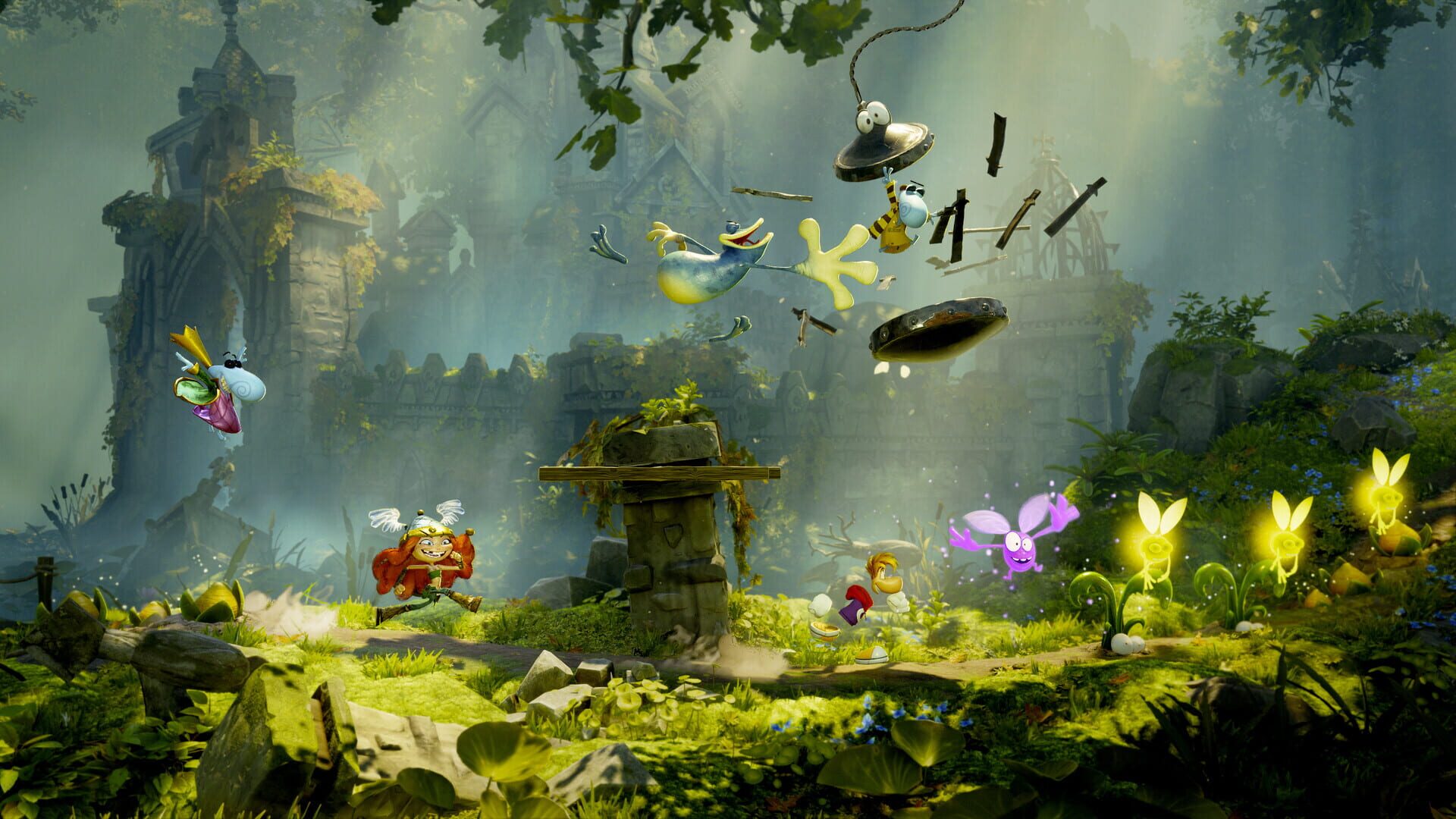
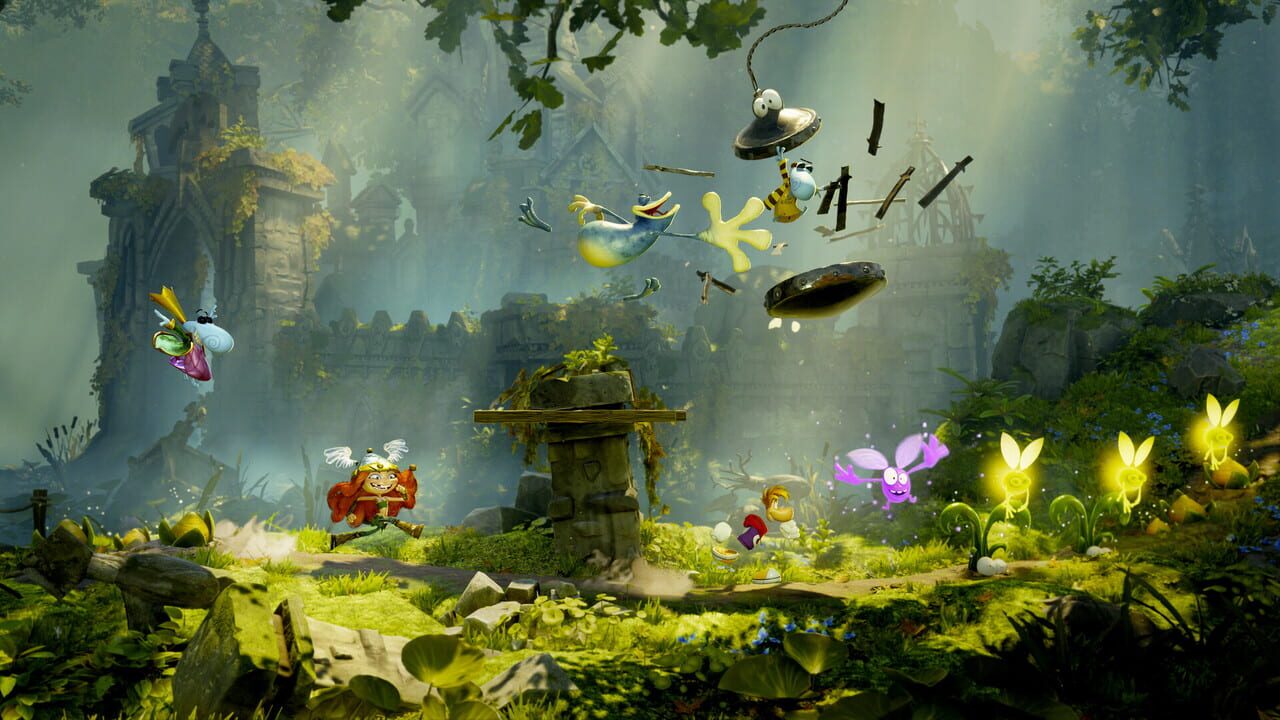
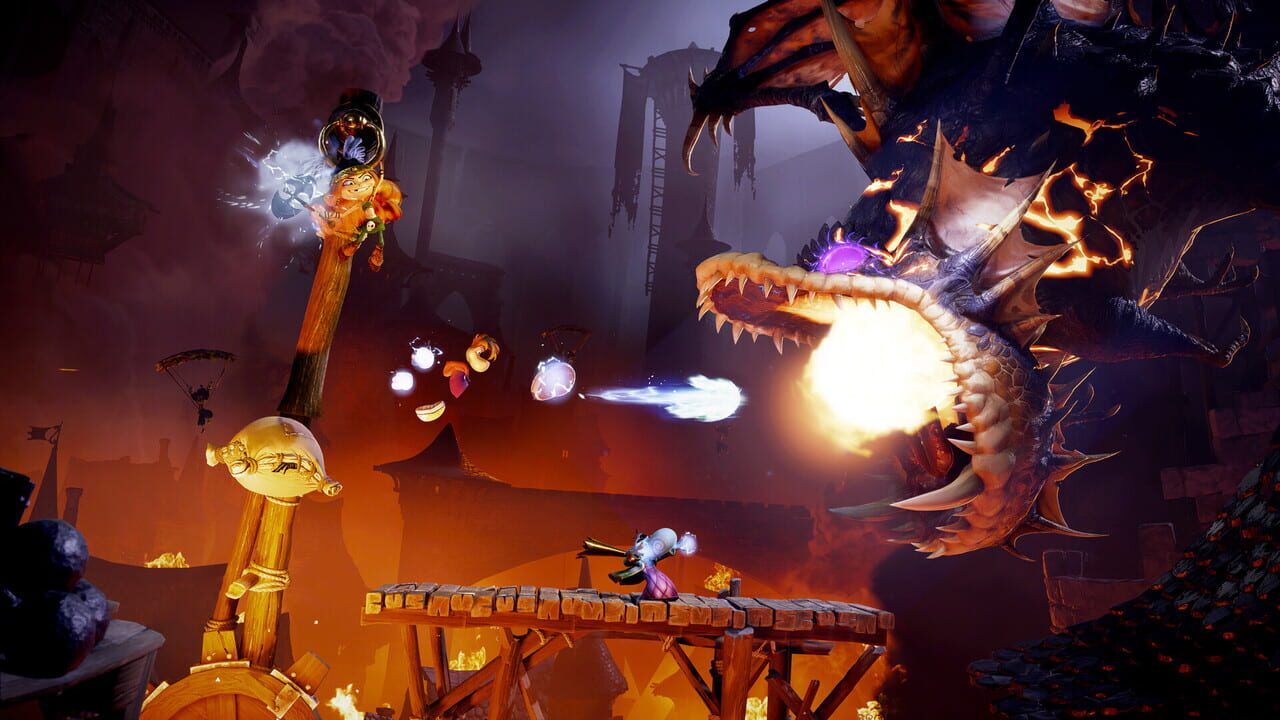
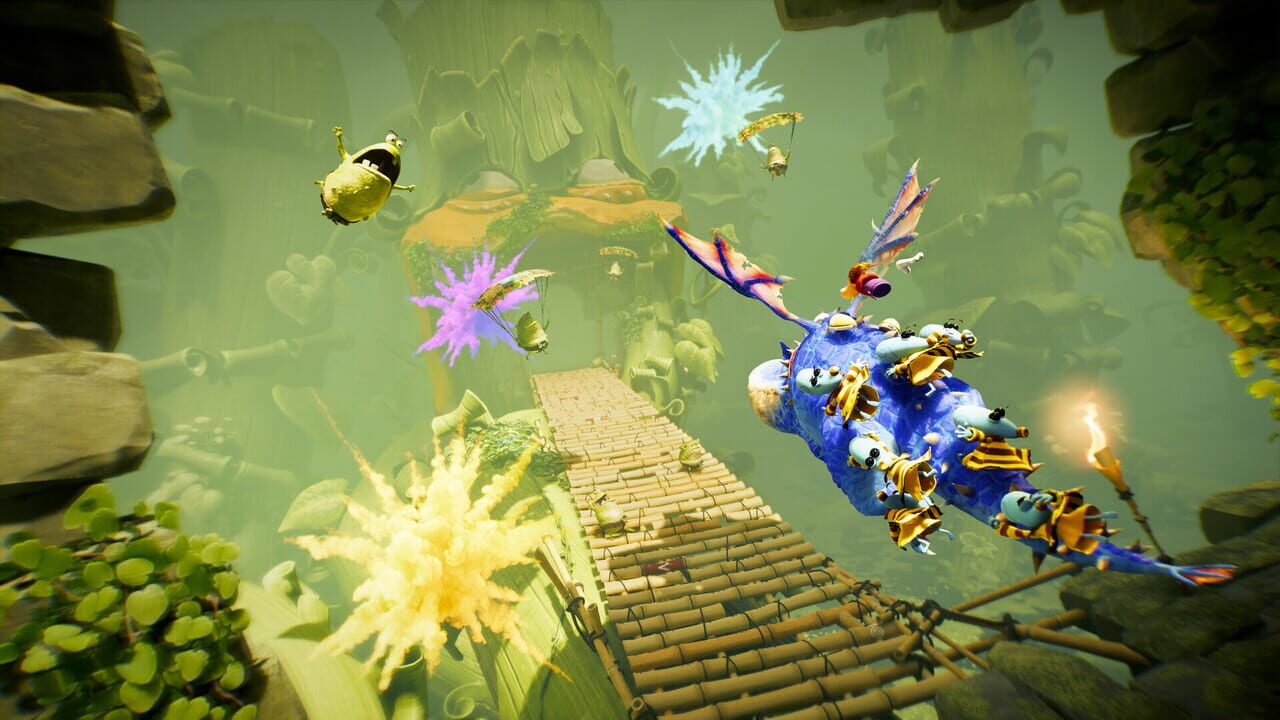
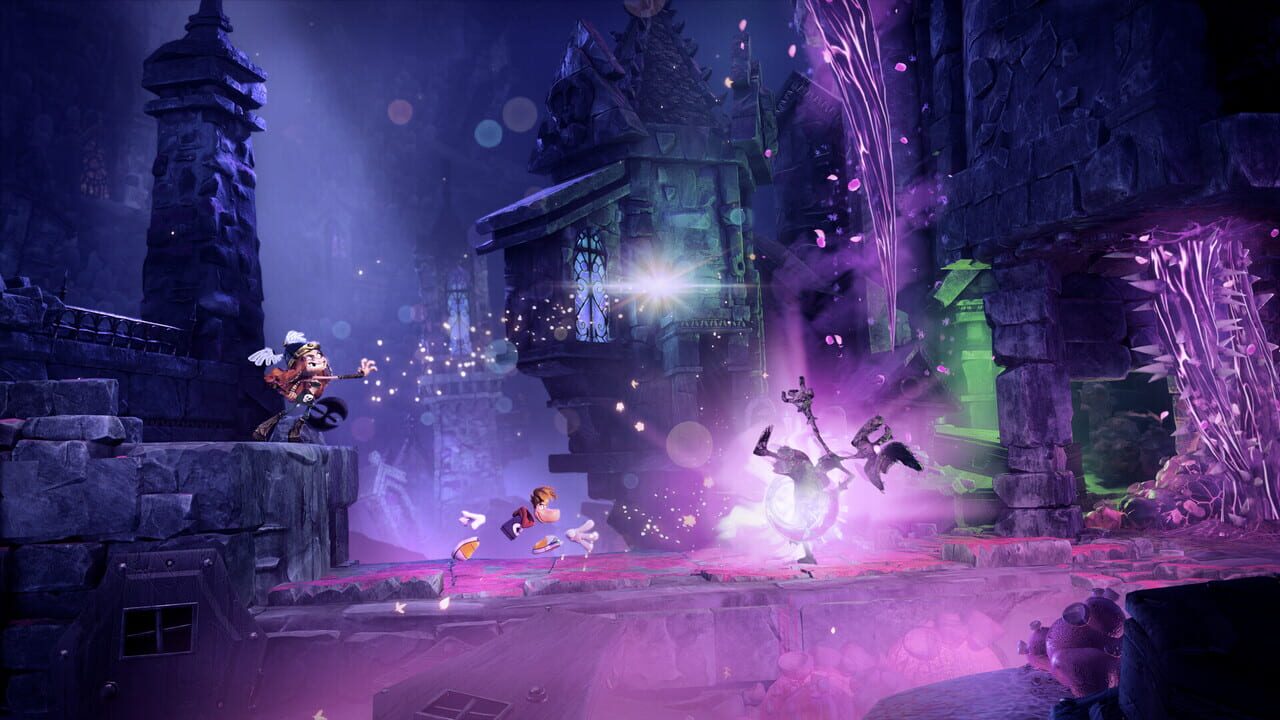
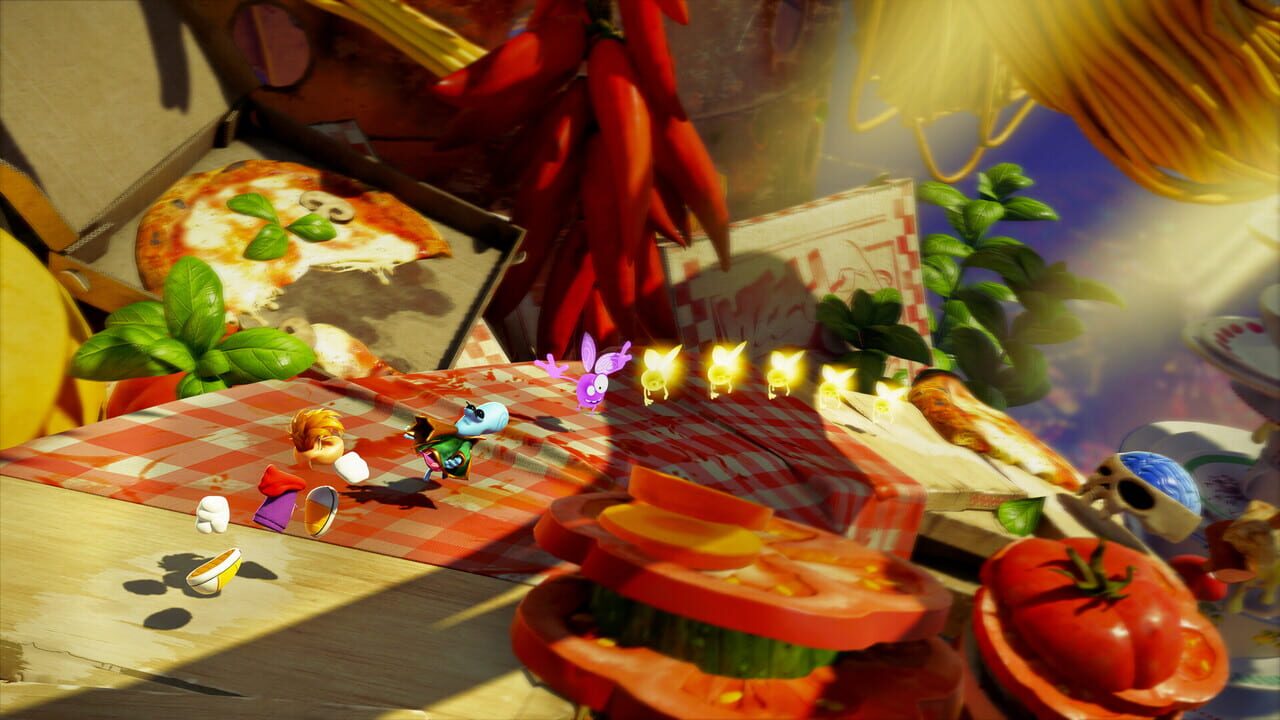
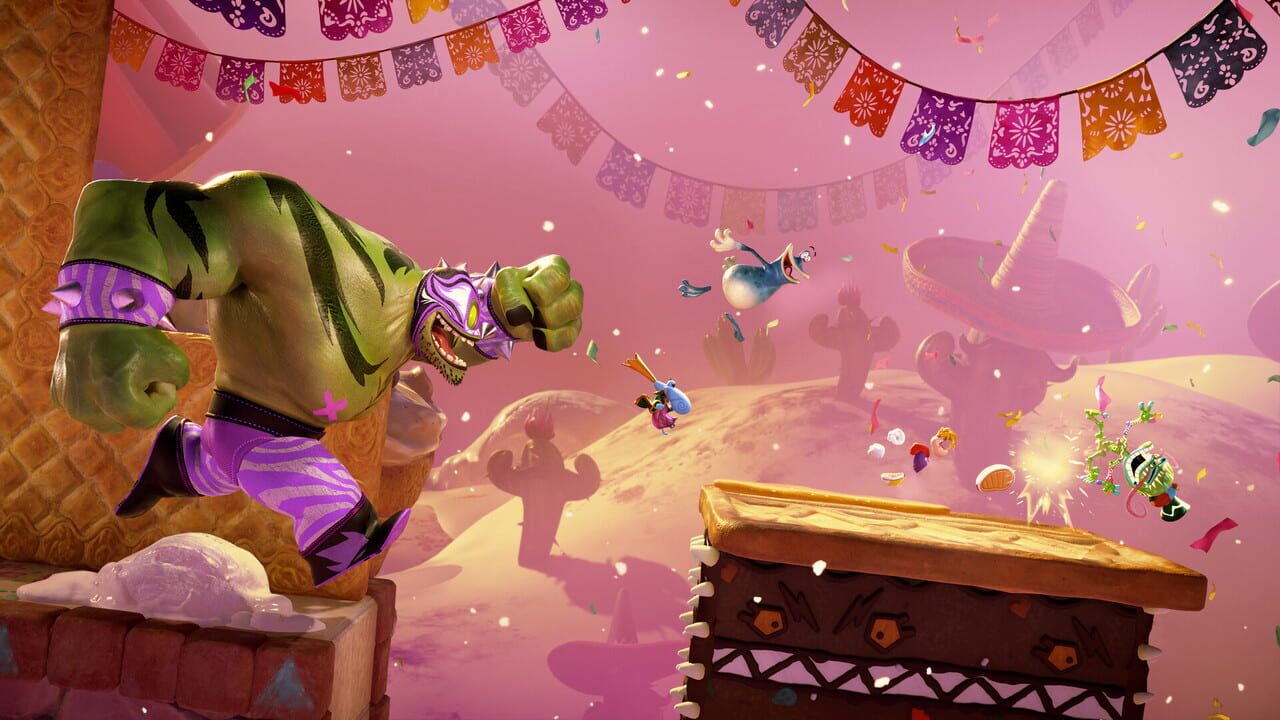
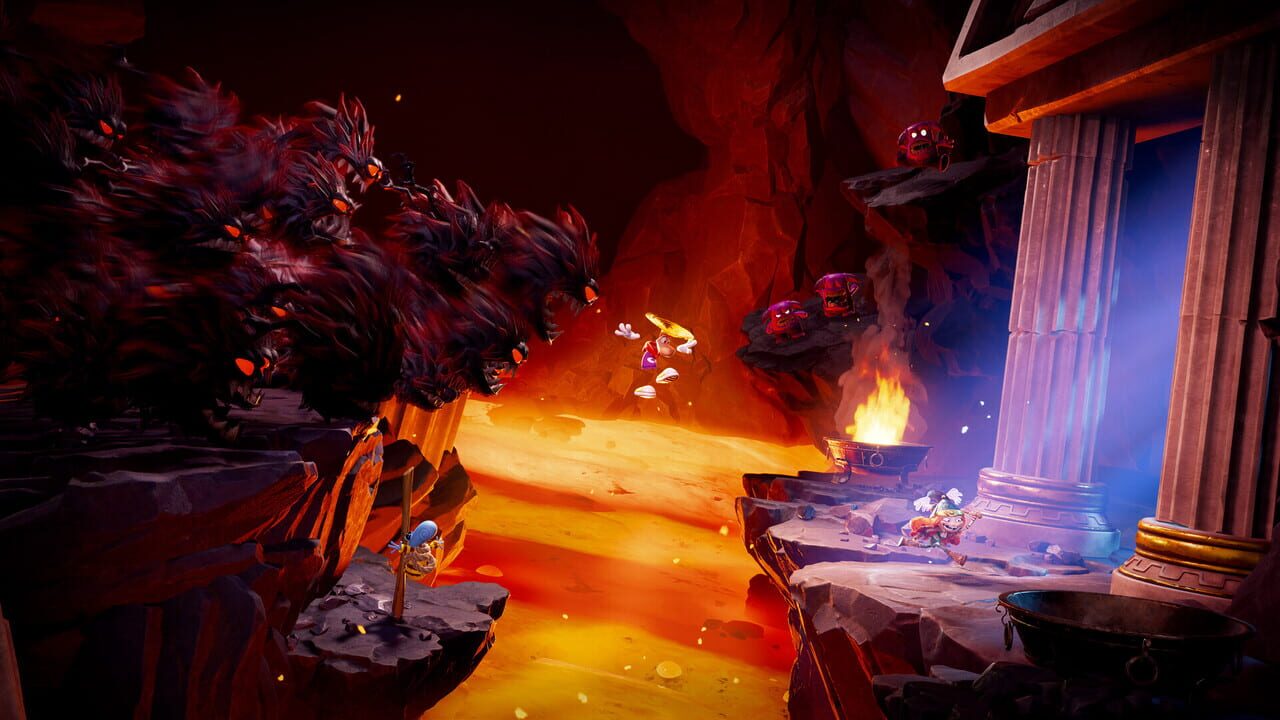
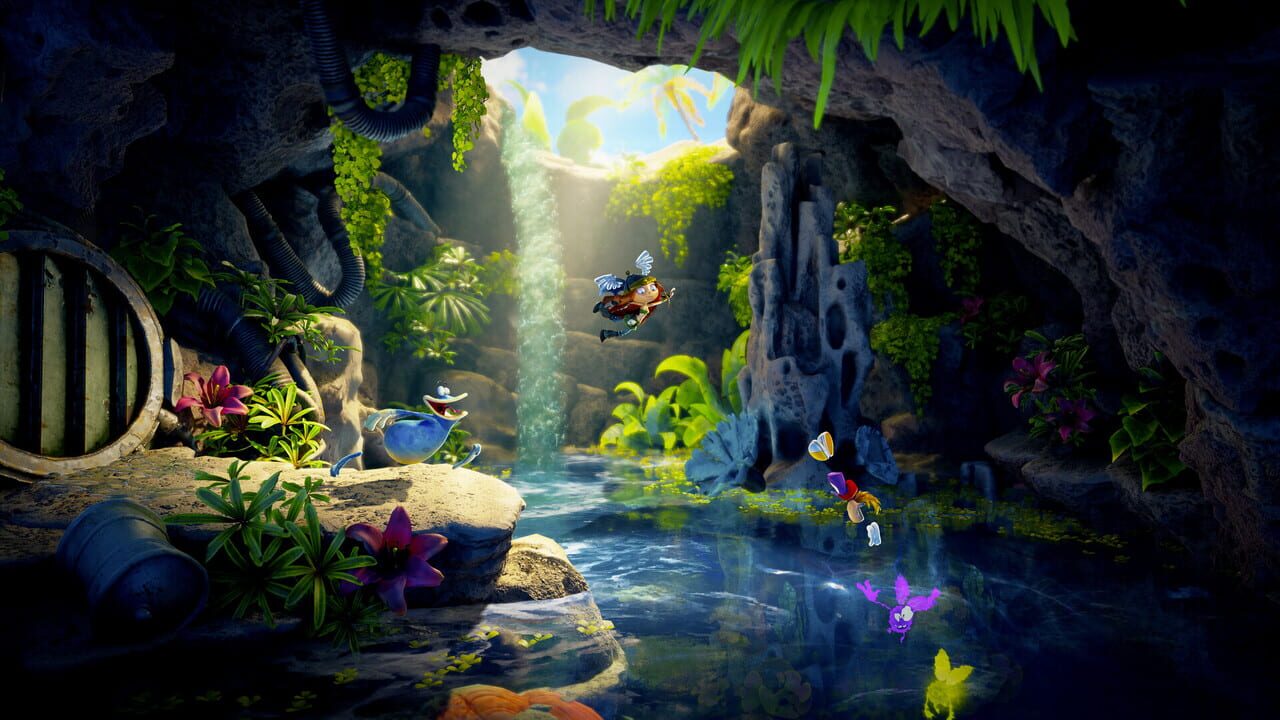
The flame is already climbing the tapestry when the drums start. A castle interior, four running figures, a wall of fire chasing them left to right at a speed that has nothing to do with how fast any of them can actually run. Then the guitar riff drops in, unmistakable, the one everyone over the age of thirty has heard blaring out of a car stereo without ever learning its name, and the level stops being a corridor you survive and becomes a corridor you perform. Every jump lands on the snare. Every wall-run peels off on the turn of a phrase. A stone gargoyle head bobs to the beat in the background, mouthing the words. This is Castle Rock, the first of Rayman Legends' music levels, built around a parody arrangement of Ram Jam's "Black Betty," and it is, for a very large number of people who played it once in 2013 and have not touched the game since, the single most vividly remembered platforming sequence of the last fifteen years. That is a strange thing for a level to be. Rayman Legends has hundreds of stages. Most of them are good, some of them are excellent, and almost none of them get talked about with the specific, decade-spanning fondness reserved for Castle Rock, for the Louis Armstrong stage a few worlds later, for Fiesta de los Muertos with its guitar built into the string of pinatas. Ask someone who played the game which level they remember and they will not describe the plot, because there mostly isn't one, or the boss fights, which are perfectly fine and instantly forgettable. They will hum the music. This essay is a brain-and-body reading of why that happens: not a claim about taste, but a claim about what a body does differently when its movements are locked to a beat instead of released against a threat, and why that difference leaves a much deeper groove in memory than ordinary platforming ever does. Rayman Legends Retold, Ubisoft Montpellier and Ubisoft Milan's ground-up remake of the 2013 game, announced at State of Play in June 2026 for an October 1 release, is arriving with four new music levels alongside the returning originals. It has not shipped as of this writing, and nothing here describes playing it. But the remake is the occasion to ask what those levels were actually doing to the fifteen-year-old memories the marketing is now trying to reactivate, and the honest answer runs through psychology and neuroscience rather than nostalgia alone. Start with what ordinary platforming asks of the nervous system. A standard Mario or Rayman stage is a sequence of decisions under time pressure: a gap appears, the player judges its width and the character's momentum, and presses jump at a moment calculated, mostly unconsciously, from that judgment. The technical term for this kind of action is reactive timing, and it is effortful in a specific way. Each jump is a fresh computation. The brain is running a small physics model on the fly, updating it against the geometry in front of the character, and firing a motor command at the output of that computation. It is a skill, and skilled players get very fast at it, but it never stops being computation. That is why platforming is tiring in the particular way it is tiring: not physically, but in the register of sustained decision-making. A rhythm level replaces that computation with something else. When the game locks the beat to the level and the level to the beat, the timing information stops arriving as a spatial judgment and starts arriving as a periodic signal, evenly spaced, predictable in advance. The player is no longer asking "how far is that gap and when do I need to jump," a question that has to be answered freshly each time. The player is asking "where are we in the bar," a question the body can answer by feel once it has locked on. This is the process researchers call sensorimotor synchronization: the coordination of a rhythmic movement with a predictable external event, most commonly studied through the deceptively simple task of tapping a finger in time with a metronome. Bruno Repp and Yi-Huang Su's 2013 review of the sensorimotor synchronization literature, surveying work from tapping studies through dance to full ensemble musical performance, is the standard account of what happens once a person locks onto a beat: movement becomes both faster and more accurate than the same movement performed in response to an unpredictable cue, because the nervous system stops reacting and starts predicting. The technical name for this predictive lock is entrainment, and once it has taken hold the player's motor system is doing something categorically different from what it does in a normal platforming stage. It is not solving each jump. It is riding a wave it can already feel coming. This is worth sitting with because it inverts the usual difficulty logic of a video game. Ordinary platforming gets harder by demanding faster and more precise reactive computation: shorter windows, less warning, more variables per jump. A music level in Rayman Legends can be objectively fast, full of consecutive jumps that would be brutal if you had to judge each one individually, and still feel easier to a player who has locked onto the beat than a slower level that keeps breaking the player's rhythm with irregular gaps. The difficulty in a rhythm level is front-loaded into finding the pulse. Once the pulse is found, the level plays the player almost as much as the player plays the level, which is exactly the sensation Castle Rock is known for, the feeling of being carried rather than performing. Michel Ancel, Rayman Legends' creative director, has described the moment this design idea entered the studio in blunt terms: a message sent from inside a meeting reading, roughly, that the team had to build levels where players would be forced to play in rhythm with the music, rather than levels that merely had music playing over them. That distinction, between music as ambience and music as the actual timing mechanism the player's body is locked to, is the whole argument in miniature. Ancel has also described the level-design process at Ubisoft Montpellier during this period as one where "some levels are driven by the music, some others are driven by an artistic idea," treating the beat as a legitimate design substrate on the same footing as geometry or enemy placement, not decoration laid over a level that would exist without it. The music levels were, on his own account, built from the beat outward: geometry, enemy animation, and background business all hand-timed to a chosen track, a process the sound designer Alexander Pensler has described in detail as painstaking manual synchronization rather than an algorithm generating the level from the waveform. The gargoyle nodding along in Castle Rock is not a background flourish added after the level was finished. It is on the beat because a human being put it there on the beat, by hand, because the whole stage was built to make the beat visible everywhere the eye lands. Why does any of this produce memory that outlasts memory of the rest of the game. The entrainment explains why the playing felt different in the moment. It does not, by itself, explain why the levels are still rememberable a decade later. For that, a second and separate research line matters: what music does to the encoding of memory generally, independent of platforming or motor coordination at all. Music is not neutral background when the brain is laying down a memory. Laura Ferreri's research on musical pleasure and memory, conducted with Josep Marco-Pallares and collaborators, has traced a specific mechanism: pleasant music activates the brain's dopaminergic reward circuitry, the same midbrain structures involved in anticipating and receiving any strongly rewarding stimulus, and that dopamine release interacts with the hippocampus in a way that strengthens the encoding of whatever else is happening at the same time. In a 2020 study published in Scientific Reports, Ferreri and colleagues found that material encoded alongside music people rated as more pleasant was recalled significantly better the next day than material encoded in silence or alongside less-liked music. The effect is not simply that music is distracting or absorbing. It is that a rewarding auditory stimulus appears to tag the surrounding experience for stronger storage, the same broad mechanism by which an emotionally charged moment tends to stick in memory more firmly than a neutral one. Put the two findings together and Castle Rock stops being a mystery. A music level in Rayman Legends is a moment where the player's motor system has entered a predictive, low-computation, high-flow state through entrainment, at the exact same time that a rewarding, licensed, recognizable piece of music is triggering the dopaminergic encoding boost the memory research describes. The level is not memorable because it is clever, though it is clever, or because "Black Betty" is a good song, though it is. It is memorable because it is one of the few moments in ordinary platforming where the reactive-computation system gets to switch off and the reward-and-memory system gets to switch fully on, at the same moment, for the same three minutes. Most of a platformer's runtime asks the brain to solve. Castle Rock asks it to feel a beat and be rewarded for feeling it, and the brain files that experience differently than it files a solved puzzle. There is a broader claim worth drawing out of this, because it extends past Rayman entirely. Platforming as a genre has always been a rhythm game that mostly declines to admit it. Every Mario level has an implicit tempo: a spacing between enemies and gaps that a skilled player internalizes until the jumps stop feeling like decisions and start feeling like a gait, the same way an experienced runner stops thinking about footfall on familiar terrain. Speedrunners of non-musical platformers talk about "flow" and "muscle memory" in language that, read against the sensorimotor synchronization literature, describes entrainment to an implicit beat the level design never states out loud. The jump timing in a well-tuned Mario level is periodic enough, often enough, that expert players are functionally synchronizing to it even though no soundtrack is telling them where the beat falls. What Rayman Legends' music levels did was not invent this phenomenon. It took the beat that expert platforming has always been organized around and made it audible, visible, and explicit for every player, not only the ones who had put in the hours to feel a level's implicit tempo on their own. The music levels are platforming with the rhythm game's actual skeleton showing. This reframes what looks, on the surface, like a gimmick, a novelty world tucked into an otherwise conventional platformer, as something closer to a thesis statement about the genre it belongs to. If ordinary platforming is rhythm game with the beat left unstated, then a level that states the beat is not a departure from platforming. It is platforming with the disguise removed, for exactly as long as the disguise stays off, before the game goes back to asking the player to compute gaps by eye in the next world. The music levels are not the exception in Rayman Legends. They are the rule, made visible. The obvious objection is that this cannot be the whole story, because Rayman Legends has other memorable levels that have nothing to do with music, and because plenty of games with excellent implicit rhythm never get remembered the way Castle Rock does. Both points are fair, and the second one sharpens the argument rather than undermining it. An implicit beat, the kind an expert Mario player entrains to without the game ever announcing it, produces exactly the smooth, low-computation flow state the sensorimotor synchronization literature describes, but it produces it privately, inside one skilled player's nervous system, invisible to anyone watching and often invisible to the player's own conscious attention. Repp and Su's review is explicit that entrainment can operate below the level of deliberate awareness; a person can synchronize to a beat while reporting, if asked, that they were not thinking about rhythm at all. That privacy is exactly what a music level removes. Castle Rock does not merely let a skilled player entrain to an implicit tempo. It hands every player, skilled or not, an explicit, audible, visually reinforced beat and asks them to notice they are locking onto it, in real time, while a gargoyle nods along to confirm the feeling is shared rather than private. The memorability gap between an implicitly rhythmic platformer and an explicitly musical one is, on this account, a gap in whether the entrainment ever surfaces into something the player can consciously register as having happened to them. Ferreri's dopaminergic encoding mechanism works on experience the brain can tag, and a private, unconscious flow state is harder to tag than three minutes of visibly, audibly, unmistakably playing a song with your own legs. The other levels in Rayman Legends that people remember well without music tend to prove the same rule from a different angle. The game's Toad Story world, styled after old black-and-white cartoons, or the underwater sections in the fourth world, are recalled for their visual invention, not their platforming feel, which is a different kind of memory entirely, closer to remembering a striking image than remembering a physical sensation. Nobody describes those levels the way they describe Castle Rock, by humming them. The distinction between an image remembered and a rhythm remembered in the body is itself worth naming, because it maps cleanly onto two different encoding routes: visual memory for the cartoon worlds, and the combined motor-and-reward encoding described above for the music stages. Both are real memory. Only one of them is remembered the way a favorite song is remembered, which is to say, with the body ready to perform it again before the conscious mind has finished recalling it. Which brings the argument to the word in the remake's title. Rayman Legends Retold is not calling itself a remaster, a definitive edition, or an anniversary port, all of which would signal an attempt at preservation: take the object as it was, improve its resolution and frame rate, change as little as possible about what it actually is. Retold is a different verb. To retell a story is to keep its shape while changing the telling, and Ubisoft Montpellier and Ubisoft Milan have been explicit that this is a ground-up rebuild in the Snowdrop engine, with new levels, a new sixth world, and four new music stages added to the returning ones, rather than the 2013 UbiArt Framework original run through a resolution upscaler. That is a real and honest distinction, and it deserves to be taken at its word rather than treated as marketing hedge. Preservation and retelling are not the same act, and conflating them is where a remake can go wrong even when every individual change is defensible. A preserved object asks to be met on its own historical terms: the original UbiArt Framework rendering, hand-tuned by the same team that built the beat-timed geometry Pensler describes, is itself a document of a specific technical and creative moment, 2013 Ubisoft Montpellier working within the constraints and possibilities of that engine. A retelling asks to be met on the terms of the retelling, the way a new production of a play is judged by what its choices reveal, not by how faithfully it reproduces the blocking of the premiere. The historian Roger Chartier's distinction between a cultural object and the successive practices that use and re-use it is useful here without needing to be imported wholesale: the "same" story told again is never inert, because the retelling is itself an act that reflects the conditions of its own moment, not a transparent window onto the original. Rayman Legends Retold, by its own naming, is declaring that it is doing the second thing, not the first, and that declaration is more honest than most remaster marketing manages. What is actually at stake in that distinction, for the specific argument this essay has been making, is the fate of the hand-timed synchronization the original music levels depended on. Ferreri's memory research and Repp's entrainment research both describe mechanisms that are exquisitely sensitive to timing: a beat that is a fraction of a second off does not entrain the body less strongly, it fails to entrain it at all, and a reward signal fired at the wrong moment in the encoding process does not weakly strengthen the wrong memory, it simply does not attach. A remake that rebuilds Castle Rock's geometry in a new engine and a new camera has to re-earn that millisecond-level synchronization from scratch, by hand, the same way the original team did, rather than inheriting it automatically from having kept the same assets. This is not a doubt about whether Ubisoft Montpellier can do it again. It is the correct standard to hold the remake to, because it is the actual mechanism the original leaned on, not the nostalgia the marketing is leaning on now. The frame worth carrying out of Castle Rock and into the next game that tries something similar is this: notice when a game stops asking the body to compute and starts asking it to predict. The two feel different from the inside, and the difference is not incidental to how memorable the moment becomes. A level that locks movement to a beat is trading one kind of skill for another, reactive judgment for anticipatory feel, and the trade happens to land on exactly the neural machinery that also does the strongest work of laying memory down. That is not a coincidence built into one platformer's marketing campaign. It is a fact about nervous systems that a French studio, chasing an artistic idea in a meeting room in 2011, happened to build a very good instrument for demonstrating. The flame is still climbing the tapestry. The riff is still landing on the beat it has always landed on, in whichever version of the castle a player eventually runs through this October. What the body will remember about it, ten years from now, was decided in the first three minutes, by whether the timing held.
Tuesday analysis
Why You Still Remember the Music Levels
- Writer
- J. A. Marsh
- Lens
- Brain & Body
- Published
- JUN 12, 2026
- Length
- 3,053 words / 14 min
- Notes
- 8 sources
The moment a game locks a jump to a beat, the player stops computing when to press the button and starts feeling when the button wants to be pressed, and the body remembers what it felt far longer than it remembers what it solved.