



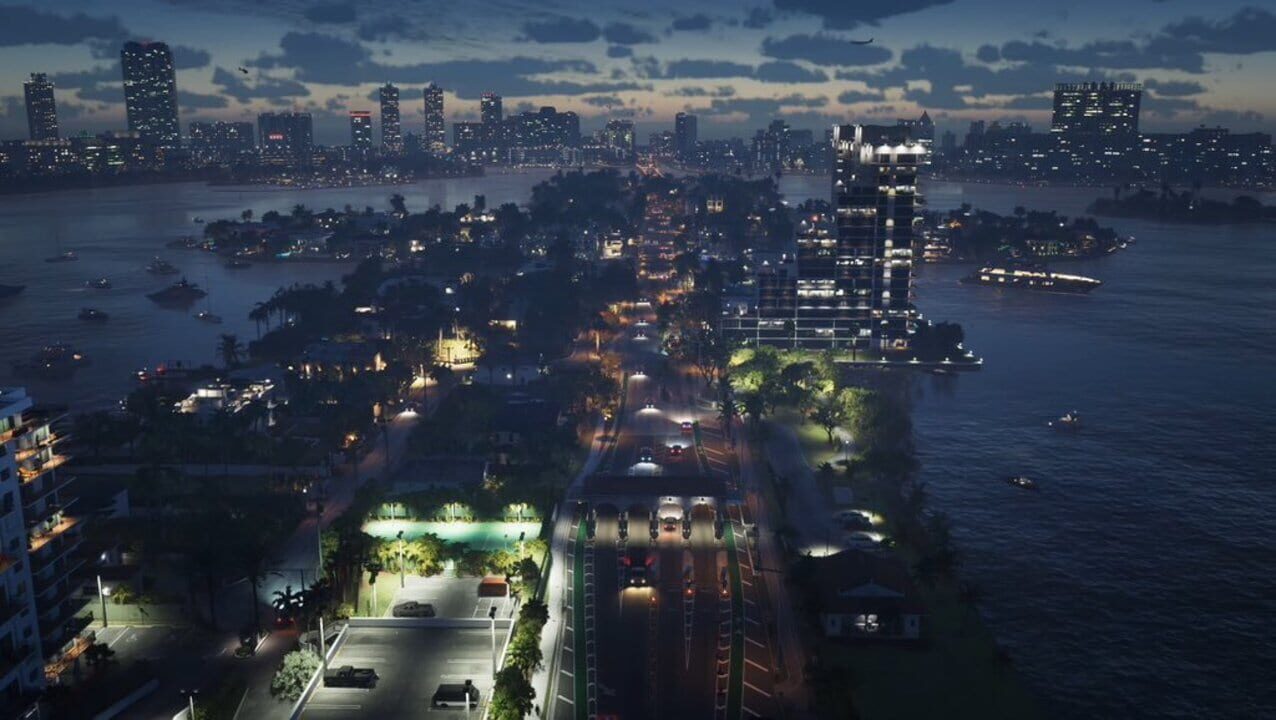
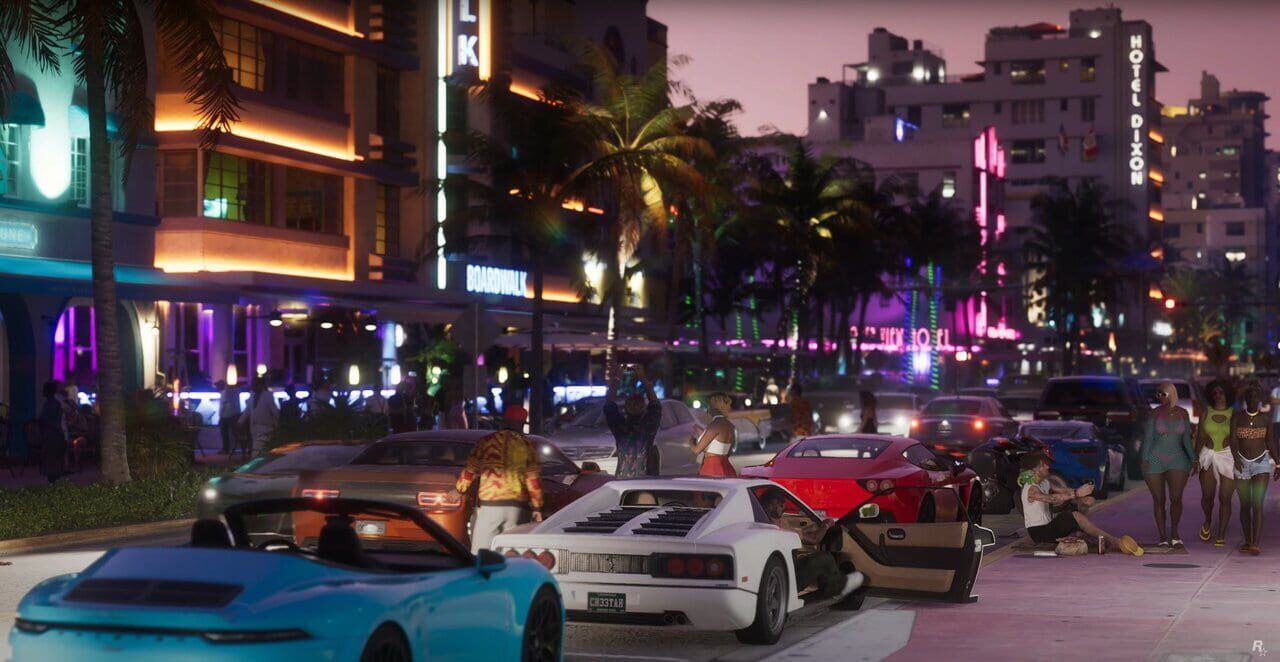


It is somewhere after two in the morning in Los Santos and the mission ended twenty minutes ago. There is no objective on the map. The player is on the highway that runs down out of the hills toward the city, in a car they did not need to steal, doing something in the region of the speed limit because there is no reason not to. The radio is on. The lights of the refinery go past on the left in the order they always go past. Nothing is happening. Nothing is going to happen until the player decides to make something happen, and the player is not deciding.
This is not a lapse in Grand Theft Auto V's design. It is the part of the game that two hundred million people bought, and it is the reason the series has outlasted every other franchise that copied its map.
The claim this essay wants to make is that the driving was never connective tissue between the missions. It was the product, and the specific thing it delivered was a cognitive state that the surrounding culture has spent the last thirteen years dismantling in actual life. This is a people-and-culture reading, because the subject is not what the driving does to a player's hands. It is what a population was practising, where, and what has happened to the place they were practising it.
Start with what the state is, because it has a name and a literature and the name is not mysterious.
Mihaly Csikszentmihalyi's Flow, published in 1990, described the condition in which a task's demands sit just above the level at which the body has to think about them and just below the level at which it struggles: attention narrows, self-consciousness drops away, and time reports itself incorrectly afterwards. Driving is the classic everyday case and it has been in the literature for decades, with one feature that makes it unusual. In most flow activities the whole mind goes into the task. In routine driving the sensorimotor system takes the task and leaves the rest of the mind unoccupied but awake. Lane-keeping, throttle, mirrors and gaps run on their own. What is left over is a substantial amount of alert cognition with nothing assigned to it.
That leftover is the thing. It is where people plan arguments they will never have, work out what they actually think about a decision, remember something from 1997 for no reason, compose the letter, decide to leave the job. Not because driving is spiritually improving, but because it is one of the few remaining daily situations that occupies the body sufficiently to prevent restlessness while occupying the mind insufficiently to prevent thought.
Cotton Seiler's Republic of Drivers, a cultural history of American automobility published in 2008, makes the case that this was not an accident of the machine but close to the point of it. Seiler traces how the car was sold to Americans across the twentieth century, and the pitch was not primarily about speed or distance. It was about a particular kind of privacy: a sealed compartment, publicly licensed, in which a citizen could be unobserved and unaccountable while in motion through public space. The freedom being advertised was freedom from being watched, and the interior of the car became one of the very few rooms in American life where a person could reasonably expect to be alone without having to explain why.
Put those two things together and the shape of the thing becomes visible. A machine designed and marketed as a private compartment, operated by a task that leaves higher cognition free, used daily by most of the adult population for decades. Whatever else the American car was, it was a national infrastructure for unsupervised thinking, built by accident, maintained at enormous expense, and almost never described that way by anyone.
There is an obvious and serious objection here, and the honest thing is to raise it before making any more of the argument.
The objection is that people hate commuting, and the data say so unambiguously. In December 2004, Daniel Kahneman, Alan Krueger, David Schkade, Norbert Schwarz and Arthur Stone published a method in Science for reconstructing how people actually felt during the previous day, activity by activity, rather than asking them in the abstract how satisfied they were with their lives. Applied to a sample of employed women in Texas, it produced a ranking of daily activities by reported positive affect, and the morning commute came in at the bottom. Not near the bottom. At it. Every subsequent replication of that basic finding, across countries and decades, has said something similar: time spent commuting is among the least pleasant time in an ordinary day, and long commutes correlate with worse reported wellbeing across almost every measure researchers have tried.
Any essay claiming that the car is a site of valuable cognitive practice has to sit with that, and the resolution is not a dodge. The commute is unpleasant. It is unpleasant because it is compulsory, because it is unpredictable in length, because it is bracketed by two things a person would rather not be doing, and because a large share of it is spent in traffic where the task stops being automatic and starts being effortful, which is precisely the condition that destroys the state described above. The cognitive-practice claim is not a claim about the commute. It is a claim about a category of driving that includes the commute's better stretches, the errand, the long highway leg, the drive home from somewhere at night, and it survives the wellbeing data because the two are measuring different things. Kahneman's method captured how the hour felt. It could not capture what the hour was for.
Which is where the game comes in, because Grand Theft Auto V was built as though somebody at Rockstar understood this precisely.
Look at the specific decisions. The in-game clock runs at a rate that puts a full day at about forty-eight minutes of real time, which means the player who drives across Los Santos in the evening will watch the light change while doing it, on a cycle short enough to be felt and long enough not to be a gimmick. The radio carries more than a dozen stations, hours of licensed music sequenced by hand with continuity in the announcers and advertisements between tracks, which is an enormous production expense for content most players will hear as background. The handling model sits deliberately between simulation and arcade, light enough that the car does not demand attention on a straight road, weighted enough that it is not nothing. And the map is arranged so that the distances between mission markers are long, which every efficiency-minded design critique of the last decade has treated as a flaw.
Those four choices only cohere under one interpretation. They are calibrated to produce, inside a game, the exact ratio of body-occupation to mind-freedom that the actual American car produces on the actual American road. The game is not simulating driving. It is simulating what happens to a person while they drive.
The series arrived at this by increments, and the increments are the strongest evidence that it is deliberate.
The original Grand Theft Auto in 1997 was viewed from directly above, and the car was a token moving across a plan. There was no interior, no windscreen, no horizon, and nothing to look at that was not either an obstacle or an objective. Driving was transport in the plainest sense. Vice City in 2002 added the thing that changed the series permanently, which was not the third-person camera but the radio: a set of stations with continuity, advertisements and hosts, playing to a driver who now had a windscreen and a sunset. That is the first entry in which sitting in a car doing nothing became a thing a person might want to do.
San Andreas in 2004 made the decisive move and took the most criticism for it. The map was enormous by the standards of the time and a large part of it was desert, which is to say a large part of it was nothing: long roads between towns with no missions on them, no traffic to speak of, and nothing to collect. Contemporary reviews treated the empty stretches as filler, a consequence of ambition outrunning the hardware. Twenty years on that reads differently. Empty distance is not a failure to fill space. It is the only way to produce a drive long enough for the state under discussion to arrive, because the state has a minimum duration and it is longer than two city blocks.
By 2013 the technique was fully worked out and the emptiness had been redistributed rather than removed: Los Santos is dense, and the hills, the coast road and the desert north of it are not, and the game moves the player between the two registers constantly.
Rockstar has never said any of this, and it would be strange marketing if they did. But the studio has been circling the same interest for twenty years and the evidence is in the neighbouring work. Red Dead Redemption 2 in 2018 was built around a horse rather than a car, and its most discussed quality was the slowness: the long rides through snow with nothing to do, the refusal to let the player fast-travel out of the middle distance. Critics divided over whether this was profound or self-indulgent. Read from here it is neither. It is the same design instinct applied to a different vehicle, by a studio that has worked out that the interval between destinations is where its audience actually lives.
Now the part that has changed, and it is the reason the new game is arriving into a different country than the one that received the last one.
In 2013, when Grand Theft Auto V shipped, the car was substantially the last enclosed daily environment in American life that a screen had not entered. The phone was in the driver's pocket and using it was illegal, dangerous and awkward. The dashboard was buttons and a radio. Every other room had already gone: the living room first, then the bedroom, then the workplace, then the waiting room, the queue, the lift, the walk between buildings. The car held out, not through anyone's resistance, but because the physical arrangement made it difficult.
Apple announced CarPlay in 2014. Google announced Android Auto the same year and shipped it in 2015. Within roughly a decade the standard new car in the American market carried a screen mounted at eye height, running the driver's own phone, with messaging read aloud, calls placed by voice, a podcast queue synced from the house, and increasingly a set of driver-assistance systems that take over exactly the low-level sensorimotor tasks that were producing the state in the first place. Adaptive cruise control and lane centring are safety features and they are good ones. They also remove the specific ongoing physical task that occupied the body and left the mind alone, and they replace it with monitoring, which is a different and worse cognitive situation: too little to do to sustain attention, too much responsibility to let it go.
The interior has been colonised, in other words, and it was colonised during the exact interval in which Grand Theft Auto VI was being made.
This is the argument's real judgment, and it is not the elegiac one. Grand Theft Auto V reflected something its audience was still doing. Whatever Grand Theft Auto VI does with the same material, it will not be reflection, because a substantial share of its players now drive with a podcast running and a text being read aloud over it and the steering wheel making small corrections by itself. The simulation has become the more reliable version of the experience than the thing it was simulating. In a game, nobody has synced a phone to the car.
The colonisation of the interior is only half of what changed, and the other half is a change in who is in the car at all.
The share of American teenagers holding a driver's licence has been falling since the early 1980s, a decline documented across successive analyses of federal licensing data and large enough that it is not a statistical artefact. Young adults in dense American cities drive substantially less than their parents did at the same age. Since 2020 the mean commute has been disrupted in both directions at once: a professional class that stopped commuting daily and has not fully returned, and a larger group whose jobs never permitted the option and whose distances have if anything grown as housing costs pushed them further out.
What that produces is not a country that has stopped driving. It is a country in which the practice has separated by class and geography into two different things. For one group the drive has become occasional, chosen, and often pleasant, which is roughly the condition of a hobby. For the other it has become longer, more compulsory and more crowded, which is the condition the wellbeing research keeps measuring. Neither group is doing what the middle of the twentieth century did, which was to drive moderate distances daily, out of habit, in a vehicle with a radio and nothing else in it.
An entertainment product that arrives in 2026 offering a very large map, a very good radio and long distances between destinations is therefore offering different things to different halves of its audience. To one it will read as a version of something they already like doing and now do rarely. To the other it may read as the drive without the parts that make the drive bad: no arrival, no lateness, no other drivers with anywhere to be. That is a strange position for a work to occupy and it is not one Grand Theft Auto V occupied in 2013.
There is a second objection worth taking, and it is the one most players would raise first.
Nobody drives contemplatively in Grand Theft Auto. They drive at a hundred and forty into oncoming traffic, roll the car, get out, take another one, and do it again. The whole physics model is tuned for collision. Watching almost any recorded session would suggest the argument above describes a mode of play that a minority of players enter for a minority of their time.
That is true and it does not damage the claim, for a reason that is about how the two modes relate rather than about which is more common. The demolition is available at all times and costs nothing, which is what makes the quiet drive a choice rather than a limitation. A game that could only be driven calmly would be a driving simulator, and driving simulators are a small and specialised category with a devoted audience of people who are not buying this. The state under discussion requires the alternative to be present and declined. That is also, incidentally, the structure of the real thing: the road is genuinely dangerous, the car genuinely can be driven at twice the limit, and the ordinary driver's calm is a continuously renewed decision rather than an absence of options.
Robert Putnam's Bowling Alone, in 2000, documented the withdrawal of Americans from the associations, leagues, unions and clubs that had structured mid-century social life, and the book has been argued about ever since. The part of it that matters here is smaller than its thesis. Whatever happened to collective life in the second half of the twentieth century, the compensating growth was in solitary time, and a great deal of that solitary time went into a car. The country did not merely become more alone. It became alone in a specific place, at specific hours, moving.
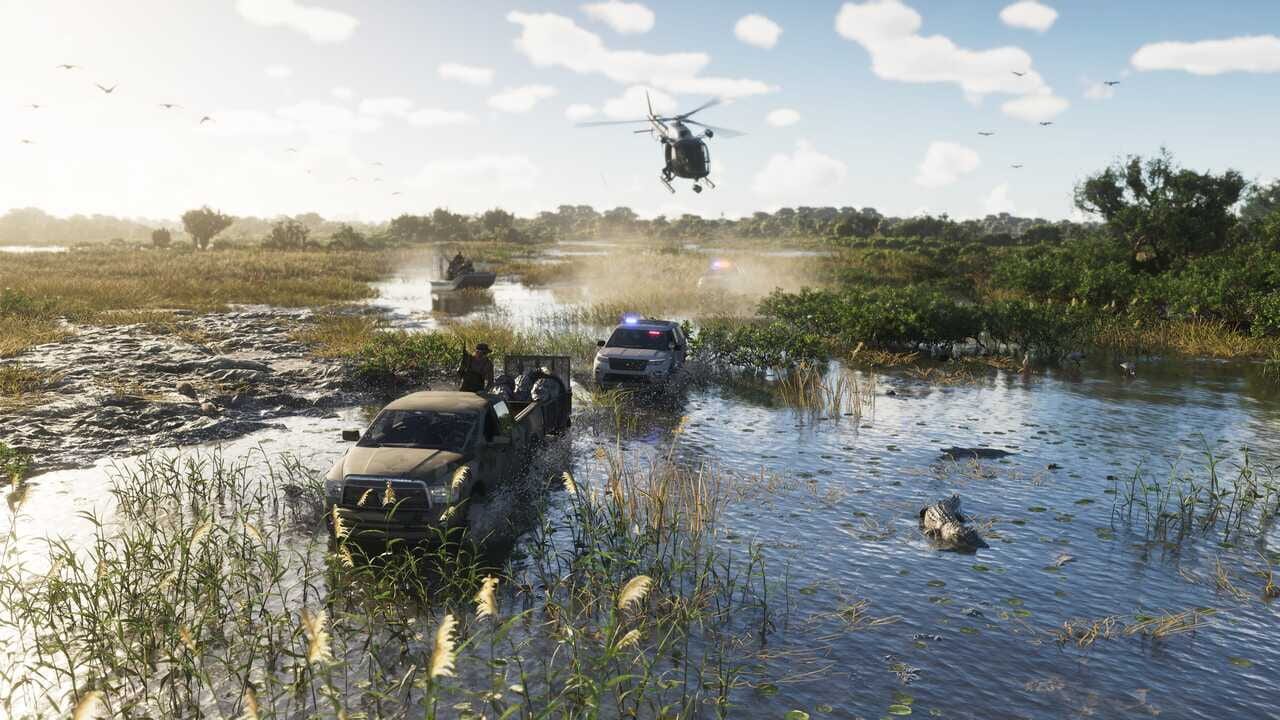
Leonida is Florida, which is a state that people drive across rather than through, and whose distances are the kind that produce two-hour stretches of nothing between one town and the next. The trailers show a lot of water and a lot of road. Somewhere in the game there will be a highway running north out of a city at an hour when the traffic has thinned, and a car on it going the speed limit for no reason, and a radio playing to a driver who is not listening to it.
The odd thing, when November comes, is that this will be one of the few places left where that is still what driving is like.