

In a small office above a shoe shop in Hammersmith, in 1975, three men in their early twenties named Steve Jackson, Ian Livingstone, and John Peake formed a company they registered as Games Workshop Limited. The company's initial business was importing the American role-playing game Dungeons & Dragons, which had been published in the United States the previous year and which Jackson and Livingstone had encountered at an early convention. The British distribution rights were available cheaply. The three men obtained them. The shop, which they opened in 1978 on Dalling Road, was the first dedicated hobby-games retailer in the United Kingdom and was, at the moment of its opening, the only place in London where one could reliably buy a copy of D&D over the counter. The company would, across the following half-century, expand from importing other people's games to manufacturing its own, from a single Hammersmith address to a global retail network, from a turnover of a few thousand pounds in its first year to an annual revenue of approximately five hundred and twenty million pounds in fiscal 2024. The principal property the expansion has been built on, since the late 1980s, is a science-fiction miniature-wargaming setting that the company first published as the rulebook Warhammer 40,000: Rogue Trader in September 1987.
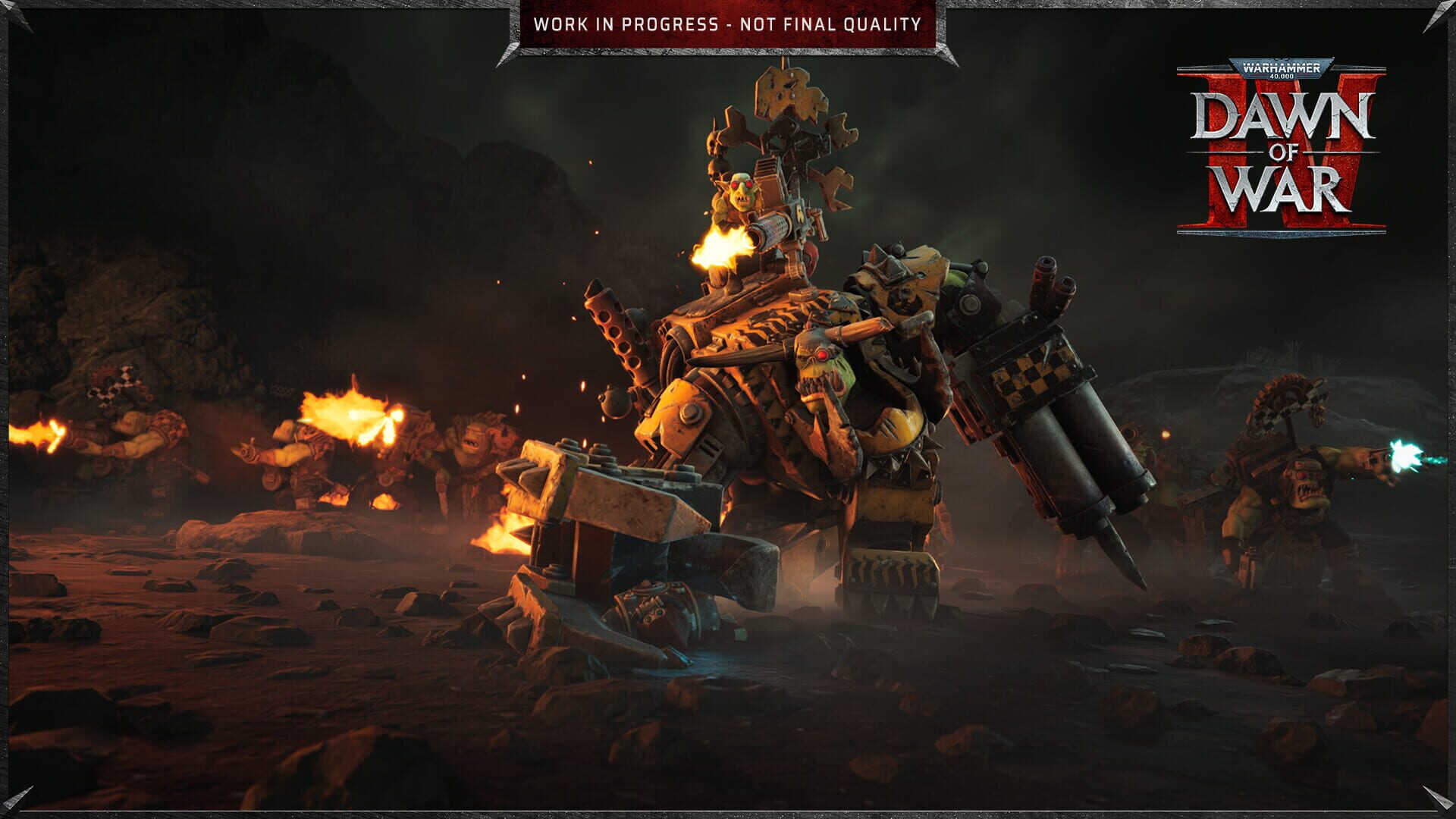
The setting has, in the intervening thirty-nine years, generated something on the order of fifty commercial video-game adaptations. The contemporary entry in the lineage, the real-time strategy game Warhammer 40,000: Dawn of War IV, is being released by the Vancouver-based developer Relic Entertainment under Sega's publishing imprint on 14 September 2026, and is the fourth main-line entry in the Dawn of War series that Relic launched in 2004 with the original Dawn of War. The series has been one of the most influential lines of real-time strategy gaming the medium has produced, and its return after the commercial and critical disappointment of Dawn of War III in 2017 is the proximate occasion for this essay.
This is a Form & Systems essay. Its subject is the longstanding pipeline running from tabletop hobby games into video-game adaptations, the specific design affordances tabletop produces that translate cleanly into the digital medium, the asymmetries of cultural attention that have made the pipeline run more reliably in one direction than the other, and what the specific Games Workshop case reveals about why this pipeline has become, across the past four decades, one of the most durable production patterns the medium contains. The argument the essay wants to commit to is plain and slightly unflattering to the conventional account. The video-game industry has been outsourcing one of its most expensive design problems, the problem of producing balanced, deep, replayable systems from scratch, to the tabletop industry for the better part of forty years. The tabletop industry does this work cheaply, on long timeframes, and using volunteer labour that the video-game industry could not pay for at any price. The translation pipeline that ports the work into digital form is the visible commercial mechanism. The work itself is older and has been done by other people.
The Games Workshop case is unusually clean for an essay on this pattern because the same publisher controls both the tabletop source and the licensing to digital adaptations, and the company's historical records and corporate filings make the financial scale of the arrangement legible. Warhammer 40,000, the science-fiction miniature wargame the company published in 1987, sits inside a long-running family of tabletop properties that the company has been continuously expanding since the early 1980s. The Warhammer Fantasy Battle first edition appeared in 1983. The Warhammer 40,000: Rogue Trader rulebook appeared in 1987. The Warhammer Quest dungeon-crawler appeared in 1995. The Necromunda gang-warfare game appeared in 1995 also. The Mordheim skirmish game appeared in 1999. The Blood Bowl fantasy-football game had been published since 1986. Each of these settings has its own developed lore, its own published novels (some hundreds of them, across the Black Library publishing imprint the company founded in 1997), its own visual conventions developed across decades of miniature-painting and box-art production, and its own substantial community of players whose accumulated rules-debate has been refined into successive editions of the rulebooks across the intervening decades.
The video-game adaptations of these properties have been continuous since shortly after the tabletop properties' commercial establishment. The first major Games Workshop adaptation was the home-computer version of HeroQuest, the boxed game Milton Bradley had published in 1989 under licence from Games Workshop, which Gremlin Interactive released for the Amiga, Atari ST, and PC in 1991. The second was the Electronic Arts version of Space Hulk in 1993, which translated the 1989 boxed game into a real-time strategy-with-tactical-pause format that anticipated, by roughly five years, the design solutions XCOM and several other strategy properties would eventually settle on. The third was Final Liberation: Warhammer Epic 40,000, produced by Holistic Design and published by SSI in 1997, a turn-based strategy game built directly on the Warhammer Epic 40,000 tabletop ruleset. The fourth was Warhammer: Dark Omen, published by Mindscape in 1998, a real-time-with-pause battle simulator built on the Warhammer Fantasy Battle ruleset. The list goes on, across the late 1990s and the entirety of the 2000s, in a steady cadence of one or two adaptations per year, of variable quality but consistent licensing activity.
The Relic Dawn of War in 2004 was the moment the adaptation pipeline became culturally central rather than peripheral. Relic Entertainment had been one of the most accomplished real-time strategy studios of the early 2000s, with Homeworld (1999), Homeworld 2 (2003), and Impossible Creatures (2003) to its credit. The Dawn of War licence was the studio's first major engagement with an external setting. The game shipped in September 2004, sold roughly two million copies across its first year, and produced four expansion packs across 2005 to 2008 (Winter Assault, Dark Crusade, Soulstorm, the standalone Dawn of War: Retribution that arrived after Dawn of War II had launched), each of which extended the game's faction roster and built out the systems the original release had established. The franchise's commercial position by the end of the 2000s was unusual. It was, at once, the dominant Warhammer 40,000 video-game property, one of the most commercially successful real-time strategy series of the decade, and the productive proof of concept that the tabletop-to-digital translation, done seriously and with respect for the source material, could produce work that justified the licence at every level.
What Relic was actually doing, in the design work of the original Dawn of War, was substantially less original than the game's reception sometimes suggests. The systems Dawn of War shipped with were the systems Games Workshop had been refining in tabletop editions for seventeen years. The faction roster (Space Marines, Orks, Eldar, Chaos) had been play-tested across millions of hours of unpaid hobbyist labour at the kitchen tables and club basements of the global Warhammer community. The relative balance of unit types, the rough cost-effectiveness ratios, the texture of the tactical decisions the player would be asked to make, the broad shape of what made each faction interesting to operate, were all conditioned by the cumulative rules iteration the tabletop community had performed across the preceding decades. Relic's contribution was the digital translation, which was substantial in its own right (the real-time combat engine, the squad-based unit handling, the visual production values), but the design substrate the translation operated on had been built in another medium by other people across a much longer timeframe. The video game inherited a deep system. The depth was the tabletop's. The video game's accomplishment was figuring out how to render it in a different format without losing the depth.
This is the part of the analysis the broader video-game industry has been slow to acknowledge openly, in part because the acknowledgment unsettles the standard narrative the industry tells about its own design accomplishments. The Australian games-history writer Tristan Donovan's 2017 book It's All a Game, which traces the institutional history of the modern hobby-games industry from Monopoly to the post-2000 Eurogames wave, lays out the broader pattern at length. The tabletop industry has been functioning, across the entirety of the video-game era, as a kind of system-design R&D laboratory whose outputs the video-game industry has been drawing on whenever it has needed depth a year of new game design could not by itself produce. The classic Eurogame designers (Klaus Teuber's Settlers of Catan in 1995, Reiner Knizia's substantial output across the 1990s and 2000s, Uwe Rosenberg's Agricola in 2007) have produced game systems whose digital adaptations have been continuously profitable. The classic American hobby-game designers (Richard Garfield's Magic: The Gathering in 1993, the various TSR D&D designers' output across the 1970s and 1980s) have produced systems whose digital adaptations have been even more profitable. The digital industry has, across the same decades, produced relatively few original game systems of comparable depth. The depth, in most cases, has been outsourced. The outsourcing has been to the tabletop industry, and the outsourcing has been continuous.
The Australian games-studies scholar Stewart Woods's 2012 Eurogames extended Donovan's institutional history with a sociological account of why the tabletop industry produces what it produces. Woods's central observation was that hobby-game design operates under conditions the video-game industry does not, and the conditions are what produce the design depth. The hobby-game designer ships a rulebook and a set of physical components and is then dependent on a community of players to play the game enough times across enough sessions that the rules' interactions become visible, the balance flaws become detectable, and the necessary errata can be assembled. The community does this labour for free, motivated by its own interest in playing the game well. The designer revises across editions, incorporating the community-detected flaws into the next version. The cycle runs across years. The result, after two or three editions, is a system that has been collectively stress-tested at a scale no commercial QA budget could replicate. The video-game industry runs no equivalent process. The video game ships in a more-or-less final form, is patched briefly, and is then replaced by the next title in the same line. The deep system-iteration the tabletop industry does as a matter of structural necessity has, in the video-game industry, no equivalent operational pattern. When the video game wants a deep system, it borrows one.
The Warhammer 40,000 system the Dawn of War lineage is built on is, in this light, an unusually well-tested asset. The tabletop game has been continuously played since 1987. The rules have gone through ten editions, the most recent of which was released in 2023. The community of active players is in the range of one to two million globally, with the majority engaged enough to play the rules across multiple sessions per month. The cumulative play-testing, across the past thirty-nine years, runs into the high tens of millions of hours. Every faction's strengths and weaknesses have been argued out at every level of the rules' interaction. Every army composition that the players are likely to find compelling has been pre-engineered. Every rules edge case has been documented in successive editions of the errata. The Dawn of War IV that Relic ships in September 2026 is building on this. The systems the studio is implementing have been pre-stress-tested by a population larger than the studio's projected first-year player base, across a longer timeframe than the studio has existed, at a labour cost that the studio has not had to pay. The studio is doing the digital translation. The studio is not doing the system invention.
The reverse pipeline is worth pausing on because its asymmetry confirms the framework. Video-game properties have, occasionally, been translated into tabletop games (the Dark Souls board game, the Bloodborne card game, the various Halo and Gears of War tabletop releases of the late 2000s and early 2010s), but the resulting tabletop products have tended to perform modestly relative to their digital sources and have rarely produced sustained tabletop sub-traditions in their own right. The video-game source can supply art, lore, and brand recognition. It cannot supply the play-tested systems the tabletop format requires. The tabletop adaptation has to do the system work from scratch, and the system work it has to do is the work the tabletop industry has been organising itself around for half a century. The video-game-to-tabletop pipeline is slow and unreliable. The tabletop-to-video-game pipeline is fast and reliable, because the system work the video game is borrowing has already been done.
The broader pattern is visible across multiple cases that have nothing in particular to do with Games Workshop. The Dungeons & Dragons system that Gary Gygax and Dave Arneson assembled across the early 1970s has produced, across the past five decades, what is essentially a continuous video-game adaptation programme. The 1980s SSI Gold Box games. The 1990s BioWare Baldur's Gate series. The 2000s Atari and Obsidian adaptations. The 2023 Larian Baldur's Gate 3, which sold approximately fifteen million copies across its first eighteen months and won that year's Game of the Year at virtually every awards programme that tracks the medium. Larian's design work on Baldur's Gate 3 was substantial and the studio deserves the credit it has received. The systems Larian implemented, however, were systems Dungeons & Dragons had been refining across fifty years of community play-testing. The depth the game won its awards on was, in significant part, the depth the source had built. The same pattern holds for Magic: The Gathering Arena, for the X-Wing tabletop adaptations, for the Catan digital editions, for the entire commercial machinery the post-2010 digital-tabletop crossover has produced.
There is an obvious counter-reading and the essay has to engage it. The counter-reading is that the framework is unfair to the digital adaptation studios, which do substantial original design work in the translation process and which deserve the credit for the resulting games rather than the tabletop source. Relic did not just port Warhammer 40,000 in 2004. Relic invented the real-time combat engine, the squad-based handling system, the cover mechanics, the morale system, all of which had no direct tabletop equivalent. The framework above is, on this reading, undervaluing the genuine design contribution of the digital studios in favour of an overly-flattering account of what the tabletop source supplied.
The objection is partly right and the response has to acknowledge it. The digital studios do substantial original work, and the work the framework above is pointing at is not denying that. The framework is claiming something narrower. The depth of the systems the digital game ships with, the long-tail replayability that determines whether the game becomes a sustained property or fades after its first year, the texture of the choices the player will be asked to make across the hundreds of hours of post-release engagement, are properties that the digital studio inherits from the tabletop source rather than producing from scratch. The translation work is real. The translation work is also operating on a substrate the translation did not have to build. The substrate is where the weight sits. The translation is the part that makes the substrate playable in the new medium. Both contributions matter. The framework's contribution is making the substrate's contribution visible in a literature that has tended to credit the translation alone.
The closing image is from the Games Workshop financial report for 2024, which contains, among the routine corporate-disclosure tables, a line item indicating that the company's licensing-and-royalty revenue from video-game adaptations across the year was approximately fifty-six million pounds. The number is roughly eleven percent of the company's total revenue. The number is also, in the more relevant comparison, approximately equal to the total production budget of a single major AAA video game. The company that sold the licensing rights underlying that revenue was a Nottingham-based plastic-miniatures manufacturer with somewhere in the range of two thousand employees. The video-game studios that paid the licensing fees employ, in aggregate, several times that number. The system-design work the video-game studios were paying for was the work the Nottingham miniatures manufacturer had been doing across forty years of unpaid community play-testing. The miniatures manufacturer continues to make miniatures. The video-game studios continue to make video games. The pipeline runs in one direction, at a steady cadence, for reasons that the framework above has been trying to make explicit. The Dawn of War IV that Relic ships in September is the next entry in the pipeline. The pipeline will continue running, because the work the pipeline carries is the work the digital medium cannot, on its own, produce.