
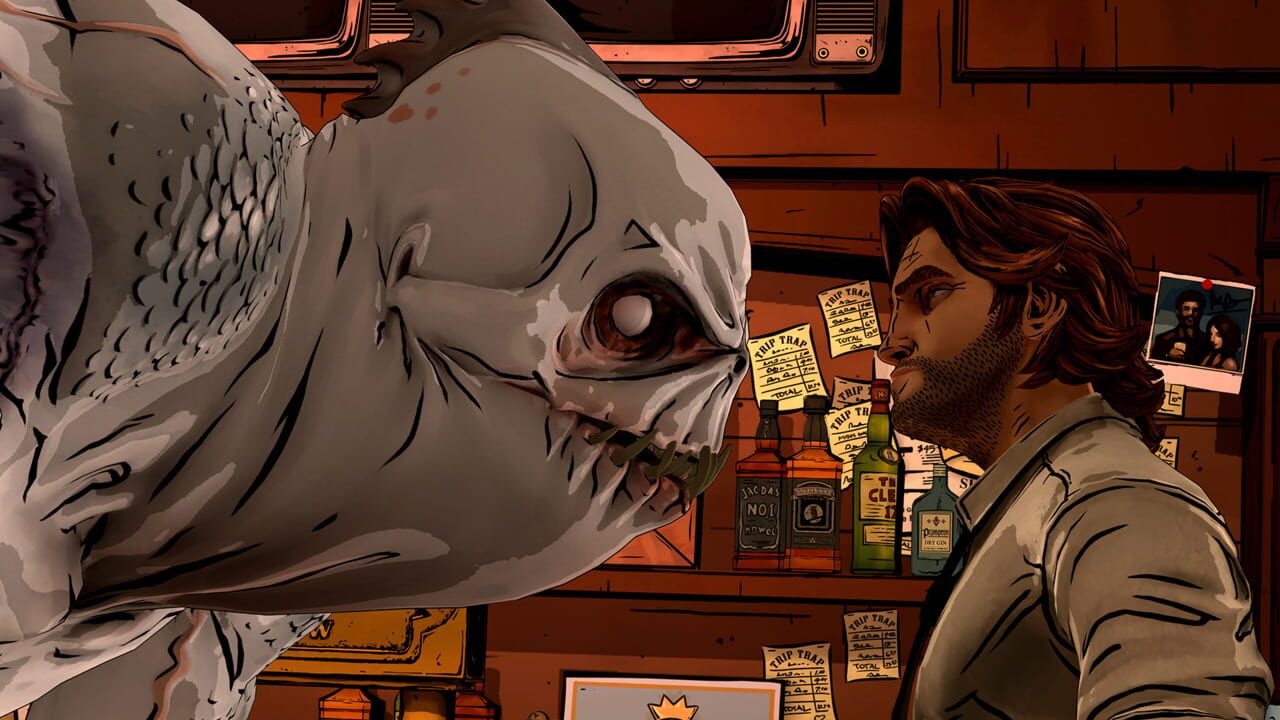
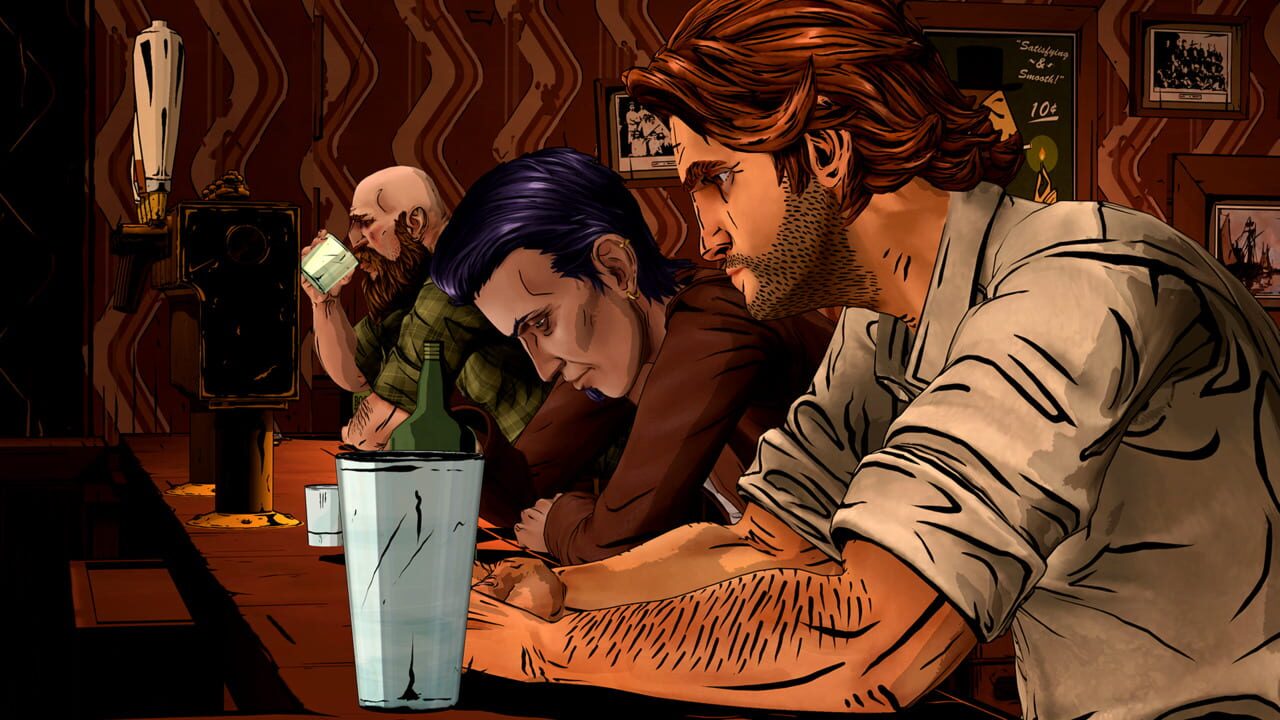
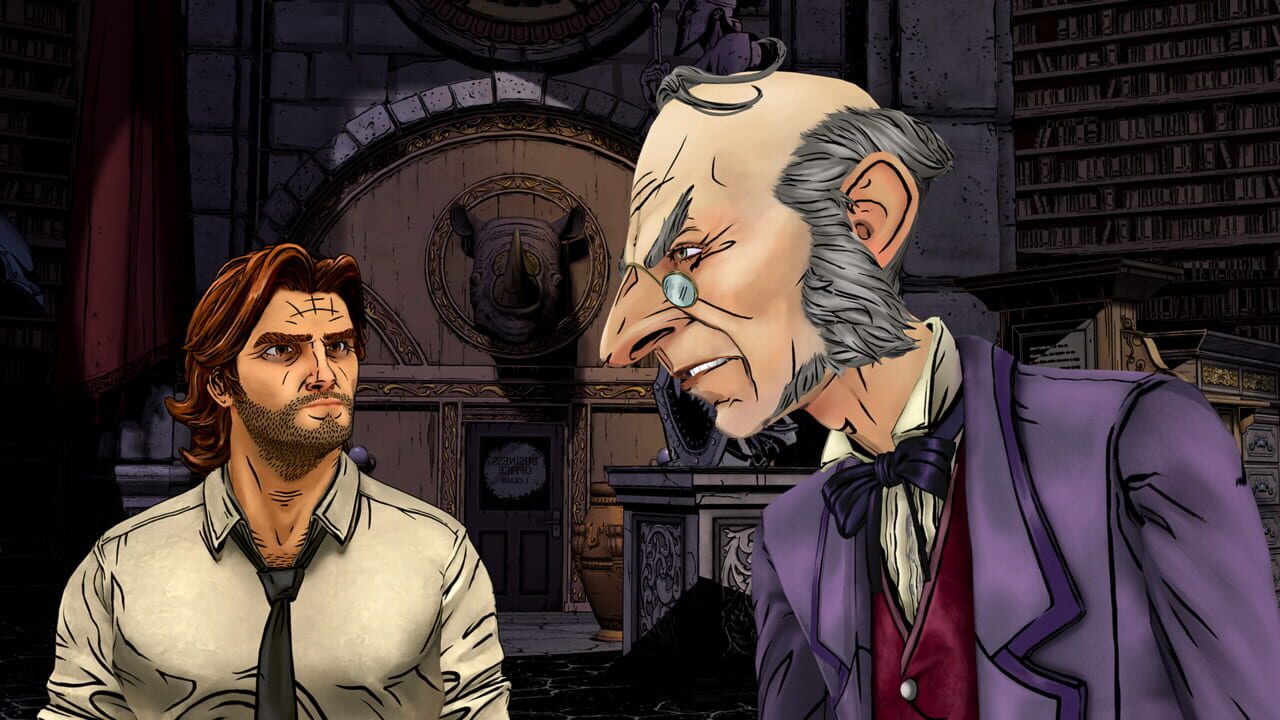
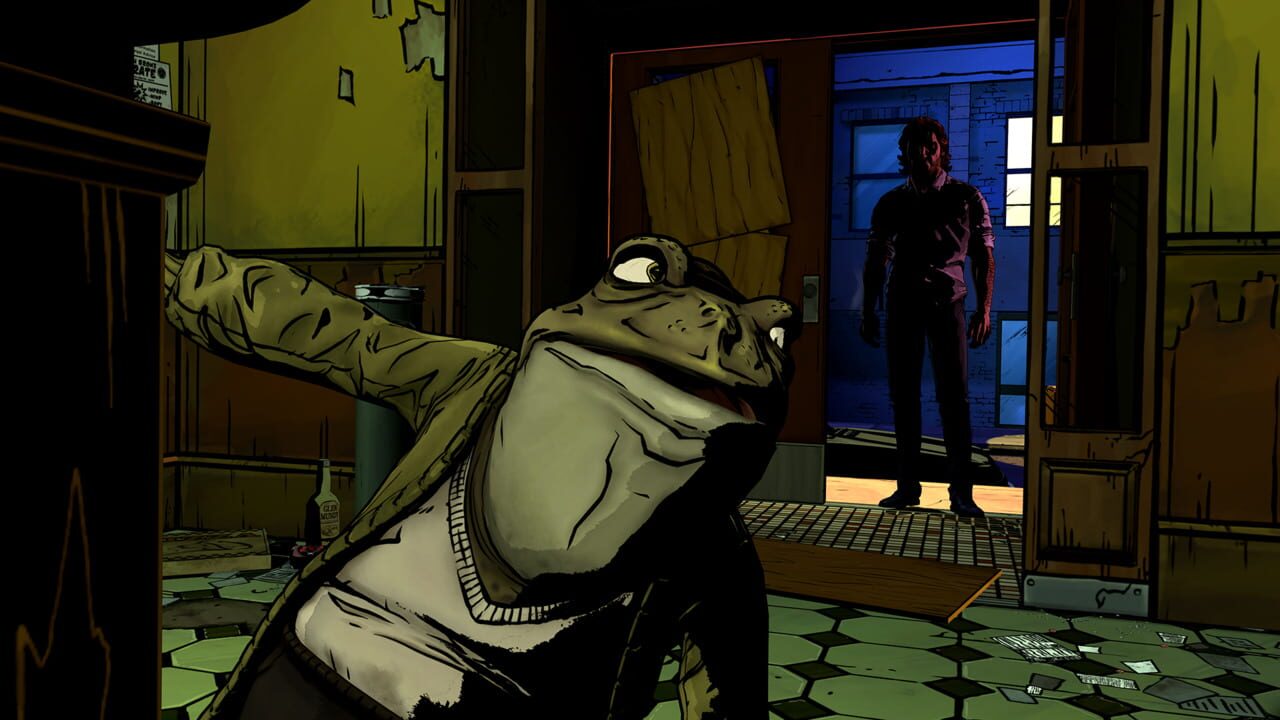
Episode one of The Wolf Among Us opens with a domestic disturbance call, which is the least remarkable kind of call a sheriff can get, and Bigby Wolf takes it himself because Fabletown employs exactly one law enforcement officer and he is it. Inside the apartment, a man built like a felled oak, carrying a woodsman's axe, is beating a woman the game has not yet named. Bigby breaks in, and the game hands the controller a fight, quick-time prompt by quick-time prompt, furniture and glass going over, until the Woodsman is down and the axe is nowhere near his hand. The fight ends the way these fights end in this kind of game: with the aggressor beaten and the player deciding, in the two or three seconds a prompt allows, how much further Bigby takes it. Whatever gets chosen, a small grey bar appears in the corner of the screen a moment later and holds for a few seconds before it fades: "The Woodsman will remember that."
He is not a stranger Bigby happens to be arresting. In Bill Willingham's Fables, the comic series this game and its remaster both adapt, the Woodsman is credited with cutting the Big Bad Wolf open to free Red Riding Hood and her grandmother, Fabletown's one celebrated act of heroism against Bigby specifically, from long before either of them crossed the ocean to New York. The fight in the apartment is, structurally, a rematch that neither the game nor the Woodsman bothers to announce as one.
Nothing downstream depends on what the player chose in any way a save file could prove. The Woodsman survives the scene regardless of how far the beating went, reappears later in the episode as a suspect regardless, and says substantially the same lines in substantially the same order regardless. Fabletown's murder case, the one Bigby is about to be handed the moment he leaves this apartment, resolves on its own schedule no matter what happened in the previous four minutes. None of that is speculation. It is the observable behavior of a piece of branching software, checkable by replaying the scene twice and comparing notes. The interesting object here is not the fight, or the mystery it opens onto. It is the notification itself: a UI element a few words long, on screen for a handful of seconds, that a designer had to decide to build, to time, and to word in the future tense of a named character rather than the generic language of a system message. What that object was built to do, independent of what the branching document behind it does or does not contain, is a question of form, not of plot.
The critique that the notification lied is, as far as it goes, correct, and no part of this argument pretends otherwise. Telltale had introduced the same notification format a year earlier, in 2012, in The Walking Dead, the season that made the studio's reputation and made "will remember that" a piece of grammar its audience already recognized by the time Bigby inherited it in 2013. Players spent the years after that first season running the experiment the developers presumably hoped nobody would bother running: replaying with the opposite choices and diffing the results. The results were consistent across titles. Character deaths landed on schedule. Antagonists survived or died according to plot requirements that had nothing to do with dialogue trees. A season finale was reachable from nearly any prior configuration of choices, because a studio shipping four or five feature-length episodes a year, on the budget and the engine Telltale actually had, could not afford to build the divergent content its marketing implied. Jason Schreier's reporting on the studio's internal history, published shortly after its 2018 closure, describes exactly this arithmetic from the inside: a small team, a compressed schedule, and a narrative design process that had made peace with reconvergence as a production necessity long before any player noticed. "The Woodsman will remember that." He will also do the same handful of things two episodes later regardless.
What the critique gets wrong is the referent. It treats the notification as a receipt, evidence submitted for a promise the game is supposed to keep later, and then correctly observes that the promise bounces. But a receipt implies the transaction is the point, and the transaction was never where the value sat. The notification does not fire only at forks that matter to the plot. It fires after Bigby picks a tone of voice, after he decides whether to be polite to a subordinate, after exchanges no branching document on earth would bother tracking, exactly as often as it fires after a man is left broken on the floor of his own apartment. A tool built to report state accurately would be rationed and sparse, appearing at the handful of junctures where the story genuinely forks and silent everywhere else, because that is what an honest ledger looks like. This one is promiscuous. It comments on nearly everything, in the same grey typeface and the same three-word verb, whether the moment carries consequence or none at all. That indiscriminateness is not a flaw in the accounting. It is the tell that accounting was never the job.
The job becomes legible once the notification is measured against a finding that has nothing to do with games. In 1975 the psychologist Ellen Langer published a paper in the Journal of Personality and Social Psychology called "The Illusion of Control," built from experiments in which the actual odds never moved and the subjects' confidence moved anyway. In one, people allowed to choose their own lottery ticket demanded far more money to sell it back, or refused outright, than people simply handed a ticket at random, even though a chosen ticket and an assigned one carry identical odds in a drawing neither party can influence. In another, subjects playing a plainly chance-determined card game bet more aggressively against a nervous, fumbling opponent than a poised one, as if a shuffle could be intimidated. Langer's subjects were not confused about how lotteries or shuffled decks work. They knew the mechanism was blind. What she demonstrated is that a small set of surface features, being asked to choose, competing against a visible opponent, doing something with the hands rather than waiting, is enough to produce a felt sense of control regardless of what a rational audit of the odds would report.
The notification is built from exactly those surface features, ported into a fictional register. It addresses the player through a named character rather than a generic system message. It arrives immediately, not at some deferred, aggregated moment where its weight might be judged against everything else that happened. It uses the grammar of memory and futurity, someone who will carry this forward, rather than the grammar of a save state. None of that constitutes actual control over anything. It constitutes the identical set of cues Langer's subjects responded to when a lottery ticket became theirs by choice rather than by assignment. A player who has just decided how hard to hit a man on the floor of his own apartment has been given, in under five seconds, a named witness, an implied future, and a grammatical structure that files the decision under his own name rather than the software's. The choice was not more consequential a moment after the bar appeared than a moment before it. It only felt owned in a way it had not felt owned thirty seconds earlier, and feeling owned is the entire deliverable.
What earns this an analysis rather than a debunking is that the effect survives full disclosure, which is exactly what Langer's data predicts and exactly what critics of the notification kept re-discovering to their own irritation. Her subjects were not naive; a shuffled deck's randomness is common knowledge, and they bet on it anyway. Players who had read the wikis, watched divergent playthroughs side by side, and knew to the letter that the Woodsman's fate did not depend on the fight's ending still reported the same small lurch when the bar appeared on a second or third run. Knowing the mechanism did not retract the feeling, because the feeling was never downstream of belief about the state machine. It was downstream of surface features doing what surface features reliably do to a nervous system that reads a named, personalized, immediate address as ownership whether or not an audit agrees. Call it what the case history suggests it should be called: not an error the player keeps making, but a response the interface keeps producing, correctly, on schedule.
The feeling deserves a precise name. It is not guilt, which requires believing an alternative was foreclosed, and it is not pride, which requires believing the outcome reflects well on the chooser. Call it retrospective responsibility: the sense that an action taken in the past has been filed somewhere, attributed to a specific person, and will be produced again later as evidence of who that person is. A detective plot runs the identical operation in the other direction. Bigby's job for the rest of the season is assigning retrospective responsibility to Fabletown's residents for things they already did and would prefer forgotten. The notification performs the same maneuver on the player, one scene ahead of the case Bigby is about to open. Both depend on the same premise, that an action, once taken, has passed out of the actor's hands and into a record that can be consulted later. Fabletown's residents cannot un-happen their pasts. For four seconds at a time, in a genre built almost entirely from resettable failure, neither can the player.
The fiction supplies its own gloss on why this particular mechanism suits this particular game, and the gloss is not incidental. Bigby is, in the story's own terms, a reformed predator serving a community that remembers, in granular detail, every act he committed against its members in the tales that predate this one. He cannot outrun the ledger Fabletown keeps on him; the premise of his badge is that the community has provisionally agreed to weigh his present against a past it has not forgotten and will not. A game about a character who lives permanently inside someone else's retrospective judgment, asking its player to inhabit choices that will likewise be filed and judged later regardless of what changes on screen, is not borrowing a mechanic from an unrelated genre and hoping it fits. The notification is Bigby's condition, handed to whoever is holding the controller, four seconds at a time. It would be a smaller achievement bolted onto a game about someone with no history to answer for.
The rest of the season keeps making the same offer at a larger scale. Every episode closes on a screen tallying the choices just made and reporting them back in aggregate, a given percentage of the audience having done what this player did or having done the opposite. The screen has no mechanical function; nothing about the next episode changes because this one's numbers came out a particular way. What it does is confirm, in the coldest possible register, that a ledger exists and that this player's entries sit in it, alongside however many thousand strangers made the same call under the same grey bar. Between the in-scene notification and the end-of-episode tally, the game surrounds nearly every choice with formal evidence of a record-keeping apparatus that, examined mechanically, keeps almost no records that matter. Examined as an instrument for producing retrospective responsibility, it is closer to relentless.
Consider what the alternative costs, because the comparison is where the achievement becomes legible as an achievement rather than a shortcut. A studio that wants a player to feel a choice mattered can build the content to make it actually matter: divergent maps, alternate performances, entire sequences a fraction of players will ever see, multiplied across every meaningful fork. That approach is enormously expensive and still often fails to produce the feeling it is purchasing, because a player who senses the budget behind a given fork, one path visibly richer than the other, tends to intuit which branch the studio expected most people to take and discounts the illusion accordingly. Telltale's notification produces a comparable sense of ownership for the cost of a text string and a timer. It is worth being precise about what kind of achievement that is. It is not a cheap trick standing in for real design work. It is a different order of design work, aimed at the nervous system's accounting rather than the disk's, and by that measure it is the more efficient of the two at producing the specific feeling both approaches are after.
None of this should be mistaken for an acquittal of the anger the reconvergence discovery produced, and the anger deserves its strongest form rather than a version convenient to dismiss. Telltale's own marketing told buyers, repeatedly and in plain declarative language, that the story would be shaped by what they chose, and a reasonable consumer reading that promise is entitled to read it as a claim about branching content, not about a psychological instrument operating on the autonomic nervous system regardless of content. Discovering that a decision advertised as consequential was decorative is not a failure of media literacy on the player's part. It is the discovery of a gap between what a product claimed to sell and what it delivered, and gaps of that kind are ordinarily, correctly, treated as grounds for complaint in any other line of commerce. A player who felt cheated ran the audit correctly. The cheated feeling is not confusion about the evidence. It is a proportionate response to it.
The disagreement, stated in full on both sides, turns out to be about where the dishonesty actually occurred, and it did not occur where the anger usually lands. The marketing overpromised, in the specific sense that it described a branching document thicker than the one the studio built. But the notification itself never made the claim the marketing made. It made a smaller and, on inspection, fully honest one: that this action would be remembered, a claim about registration rather than consequence, one the game keeps by design every single time the bar appears. The instrument delivered exactly what it was built to deliver, a reliable, repeatable, low-cost feeling of retrospective ownership, engineered through means a cognitive psychologist would recognize on sight. What it did not deliver was the surrounding sales pitch's account of itself. Blaming four seconds of grey text for the sales pitch's dishonesty is understandable and still misdirected, in roughly the way it would be a mistake to blame a thermostat for a landlord's lease claiming central air that was never installed. The thermostat still works.
This is also where a remaster stops being a matter of preserving assets and starts being a matter of preserving a mechanism, and the two are not the same project. Restoring the notification's wording, its typeface, its few seconds of screen time, preserves the object without necessarily preserving the effect, because the effect was never produced by the object alone. It was produced by the object plus a condition the original release imposed on every player without asking permission: distance in time between a choice and the next opportunity to think about it.
The original season shipped across nine months, not as a marketing cadence but as a production reality the studio was fairly open about struggling with. Episode one, "Faith," released in October of 2013. Episode two, "Smoke and Mirrors," did not arrive until February of the following year, a gap of roughly four months that contemporary coverage flagged as a genuine liability, a season losing momentum between installments instead of gaining it. The remaining three episodes closed out the season by the summer of 2014. A player who finished the Woodsman's beating in October did not get to see what episode two made of it until winter. Whatever that player decided in the apartment sat, unrevised and unrevisited, for the better part of a season, available only to memory, which is a far less reliable and far more generous editor than a save file.
Memory did something to that decision no engine could have scripted. Unresolved action of any kind is, independently, stickier in memory than resolved action, a phenomenon documented as early as Bluma Zeigarnik's 1927 studies of interrupted tasks; a choice with no further word on it for four months is close to a textbook case. A decision that can be immediately revisited, reloaded, or simply outpaced by the next five minutes of plot does not have time to become anyone's in particular. It is still current events. A decision with four months in front of it before the story says anything more gets worked over: remembered selectively, second-guessed on a commute, mentioned to a friend who played it differently, recast in hindsight as more deliberate or more reckless than it felt at the moment of the prompt. By the time episode two loaded, the choice the notification had flagged was no longer the four-second event the engine recorded. It was whatever the player's memory had made of it across a winter, which is to say it had become exactly the kind of possession retrospective responsibility requires: a thing held, turned over, and owned well before the game asked to see it again. The gap did the notification's job for it, for free, on a schedule no designer chose and every designer benefited from.
A remaster that delivers all five episodes on one release date, with nothing between them but a menu, removes that gap by definition and inherits none of its labor. The notification can be rebuilt pixel for pixel and will still be doing a materially smaller job, because the choice it addresses will still be current events when the next episode begins ninety seconds later rather than a decision the player has spent months co-authoring with their own recollection. That is a real loss, not a nostalgic one, and it is not solved by faithful preservation of whichever asset happens to be easiest to preserve. What a remaster owes this device is not reverence for its wording. It is an honest account, somewhere in how the thing is paced and shipped, that four seconds of grey text were always the smaller half of a two-part mechanism, and that shipping the smaller half intact while discarding the larger half is not restoration. It is a different, thinner object wearing the first one's clothes, and a studio that knows its own history would say so rather than let the marketing imply otherwise twice.
Waiting, in the original release, was never a design decision anyone would have claimed credit for. It was a production schedule, a distribution constraint, the ordinary friction of releasing a game in installments in 2013, and it happened to manufacture, as an uncosted byproduct, the exact psychological runway a different mechanism needed to finish its work. Nothing in a same-day, five-episode release replaces that runway, because a runway built on purpose behaves differently from one nobody had to build at all. A studio could, in principle, lock each episode for four months after a player finishes the one before it, and call the delay fidelity to the original experience. Almost none will, because a deliberate delay reads as an inconvenience where an accidental one, in 2013, read as simply how games arrived on a schedule nobody controlled. A 2026 player will be free to open the next episode before the last one's adrenaline has left the hands, and a choice that is always one menu away from its own continuation does not get four months in which to become anyone's in particular before the game comes back to ask about it.