

The letter arrived once a week. In ArcheAge, the online world that the Korean studio XLGAMES operated from January 2013 until March of last year, owning a house meant that the game's postal service delivered a tax bill on schedule, and the bill was due in a currency called tax certificates, which were themselves crafted out of a second currency called labor. Payment kept the house standing. Nonpayment started a clock, and when the clock ran out the house lost the only protection that mattered: it could now be demolished by anyone who wanted the ground underneath it, and someone always wanted the ground. The building came down, the plot reverted to open land, and whatever furniture the game deemed salvageable went back to its former owner the way it had come, by mail. People lost houses this way constantly, to vacations, to exam seasons, to the ordinary human failure to log in to a fantasy world and pay a pretend bill on a real deadline. There were players who made a hobby of watching lapsed plots the way speculators watch foreclosure lists. A demolished house was not a tragedy in that world. It was an opening.
That world no longer exists, and its successor is on the calendar. ArcheAge Chronicles, from XLGAMES and the publisher Kakao Games, is slated for 2026 on PlayStation 5, Xbox Series consoles, and PC; as of this writing, in July 2026, it has no announced release date, and the closed beta promised for June arrived instead as a small private focus test. The game is set on Auroria, the northern continent of the original's world, fifty years after the events of the first game and roughly two years after the demolition of the first game itself: the western servers closed on June 27, 2024, the Korean servers followed on March 6, 2025, and of the world where the tax letters used to circulate, one official service remains, in Russia. What follows is a History & Memory reading of the announcement, because the announcement does not permit any other kind. Chronicles occupies a position very few sequels have occupied, succeeding a world that is gone, and every design decision it has disclosed reads as a comment, deliberate or not, on the twelve-year property experiment the original ran to its end.
The founder's diagnosis is the right place to start, because the franchise began as a complaint. Jake Song, who built Nexus: The Kingdom of the Winds in 1996 and Lineage in 1998 and founded XLGAMES in 2003, gave an interview at the Korea Games Conference in the autumn of 2009, while the project that became ArcheAge was still a working title, in which he compared the massively multiplayer games of the day to theme parks, offering "guaranteed fun with limited choices." "Players became passive consumers," he said. The first generation of online worlds had let players find their own material; the polished product of the 2000s walked them from ride to ride. His remedy was a game in which the world itself would be the material: a player could fell trees and raise a house from the timber, plant a hillside, build a ship and run cargo across a sea that other players were free to pirate. The studio's own term for the genre it was proposing was sandpark, a sandbox with theme-park conveniences. What Song was actually proposing, though nobody used the word, was property.
ArcheAge launched in South Korea on January 15, 2013, and it delivered the proposal with a literalism the genre has not attempted since. Land in the game was ground, finite and visible, spread across two home continents and a contested third. Any player could carry a farm or house design to an open patch, place it, and own the result, in the plain sense that the game would thereafter treat the parcel as theirs: crops on it could not be harvested by strangers, structures on it could not be moved by anyone else, and the deed could be sold. Ownership also came with obligations of a kind the genre had never seriously imposed. Placement required a security deposit paid in tax certificates; every seventh day the postal system delivered the bill; taxes scaled upward with holdings, so that hoarding land carried a running cost; and delinquency ended, after a grace period, in the scene this essay opened on. Without ever quite saying so, the game had built the least fashionable mechanic imaginable: rent, owed to the world itself, as the standing price of keeping a thing.
The other half of the economy was a meter called labor. Nearly every productive act in ArcheAge, harvesting a crop, felling a tree, crafting a hull plank, even opening the coin purses that enemies dropped, spent labor points, and labor regenerated slowly, on a timer, like attention. The name was doing philosophical work whether or not anyone intended it. The claim that mixing one's labor with land is what turns land into property is the oldest argument in the liberal tradition, made in John Locke's Second Treatise of Government in 1689, and ArcheAge implemented it with the fidelity of a seminar exercise: improvement was the game's entire verb set, and title followed improvement. Locke attached a condition, that a claim is legitimate only where there is "enough, and as good, left in common for others," and the game implemented the violation of that condition too, as its business model. When ArcheAge came west in September 2014 under the American publisher Trion Worlds, it came free to play with a consequential exception: anyone could play, but only subscribers, called patrons at fifteen dollars a month, could place property at all, and patron labor accumulated even while its owner slept, while a free account offline earned nothing. The justification of ownership was sold as a monthly service. Locke, who held that the mixing itself was the title, would have had questions about the licensing fee.
What happened at that western launch is the reason the historical comparison this essay is built on is not a conceit. Trion opened a four-day head start for founder's-pack buyers on September 12, 2014, and general access on September 16. Demand outran the hardware immediately. Queues for paying patrons ran upward of three hours; queues for free players ran to ten and twelve; and because claiming opened with the servers, every hour spent in the queue was an hour in which the continents were being staked by whoever had already gotten through. Players who had paid for the head start specifically to claim land watched the login counter instead. By the time the general population arrived on the sixteenth, the arable world was substantially gone. Scott Hartsman, Trion's chief executive, gave an interview to the MMO press ten days into the launch that now reads like a primary document of the whole era. The company had spent millions of dollars on additional hardware and stood up new North American servers in three days, the fastest he had seen in fifteen years in the business. The game would be "announcing that second million users a lot sooner than we would have expected." And to players asking whether missing the land rush through no fault of their own might be compensated, the answer was the sentence that defined the game: "competition for, and trade of, contested land is a core part of this game." Scarcity, in other words, was the product, and the publisher said so in launch week.
The event this replays sits in the American record with unusual precision, thanks in part to the Oklahoma historian Stan Hoig, whose The Oklahoma Land Rush of 1889 remains the standard account. At noon on April 22, 1889, on signals given by pistol shots, bugles, and in places artillery, an estimated fifty thousand people crossed the line into the Unassigned Lands of Indian Territory, some two million acres the federal government had opened to settlement. The claiming ran under the Homestead Act of 1862: a quarter section of one hundred and sixty acres per claimant, with title contingent on five years of residence and improvement. When the first train from Arkansas City reached the Guthrie townsite at 1:25 that afternoon, its passengers found the place, in the phrase of Hoig's account, "already brimming with people"; by nightfall Guthrie was a tent city of roughly ten thousand, Oklahoma City had materialized at similar scale, and an estimated eleven thousand agricultural homesteads had been claimed. The day also minted a word. Participants who had slipped across the line early and hidden in the brush to stake the best parcels were called Sooners, the name was an insult for a generation, and the contests their claims generated ran through the land offices and courts for years afterward.
Term by term, the 2014 launch ran the same protocol. The head start was the line; the queue was the border; the patron subscription was sooner-hood, sold openly rather than smuggled; the labor meter was the improvement requirement; the weekly tax was proving up; the forum threads contesting sniped plots were the land-office litigation. ArcheAge rebuilt the homestead run faithfully enough to inherit its social physics wholesale, and the inheritance is instructive mostly for the one term it deleted. The Unassigned Lands were unassigned because the people who had lived on them had been removed, by treaty revision and forced cession, across the decades before the cannon fired; every land rush in the historical record begins with a clearing that the celebration afterward is designed to forget. The game's continents, by contrast, came pre-cleared by fiat, wilderness with no prior tenant, which is to say that ArcheAge staged the American land myth in the only form in which it was ever innocent, the form in which nobody had to be removed first. That is the memory-work the game performed, whether or not a single designer ever thought of Oklahoma. It let the settler fantasy run clean, and several million people, handed the clean version, reproduced the rest of the pattern on their own within weeks.
The pattern arrived on schedule. With land finite and demand effectively unbounded, plots acquired exchange value the moment the servers stabilized, and a class of holders emerged whom the community named, without needing the term explained, land barons: players and guilds who had claimed early, held wide, paid their taxes in bulk, and let scarcity do the appreciating. Deeds moved for in-game fortunes and, against the rules, for real money. A landless newcomer could end up farming a corner of an established player's claim on sufferance, which is a tenancy in everything except the word. None of this was griefing. All of it was the design operating exactly as designed, under the publisher's stated principle that competition for contested land was the core of the game.
Property produced law next, which is what property does. ArcheAge's justice system, still the most elaborate the genre has attempted, existed almost entirely to process crimes against ownership: uprooting a stranger's crops, emptying a stranger's chest. Offenses left evidence at the scene for other players to report, and enough accumulated crime points sent the accused, on their next death, to a courtroom where five randomly empaneled player jurors reviewed the rap sheet, heard whatever defense the accused cared to type into the record, and voted out a sentence that could run from a few minutes to days of confinement in a prison that could be escaped but not usefully, since the escapee stayed marked. The trials were a circus with a devoted following, and the institution underneath the circus was serious. A world that lets things be owned must decide what theft is, and a world that charges taxes will eventually need a court. Few shared game worlds before or since have taken the civic consequences of ownership that far, because few have dared the ownership.
The experiment broke on monetization. Across its first western years ArcheAge accumulated a catalog of escalations that players documented with the diligence of grievance historians: the patron gate on land, labor sold back in potions, randomized crates whose contents moved the gear economy, until pay-to-win hardened from an accusation into the game's fixed western reputation. The publisher did not survive its own catalog. In October 2018 Trion Worlds was sold to the German free-to-play operator Gamigo, and a staff that had numbered above two hundred was cut, by the contemporary reporting, to roughly twenty-five.
The remedy, in October 2019, was one of the stranger products in the history of online monetization: ArcheAge Unchained, the same game sold again at twenty-six dollars flat, subscription abolished, marketplace reduced to cosmetics, every player a patron by default. The pitch, and the name, conceded everything the player base had spent five years saying. And it opened, necessarily, on fresh servers, which meant a new world of unclaimed land, which meant that the actual product under the reform branding was the land rush itself, run again. It sold. The fresh continents filled within days, the queues returned, and for a season Unchained was the healthiest the western game had been since 2014. The season did not hold. The frontier turns out to be a nonrenewable resource even in a world where it is technically renewable; each fresh start after that one mined the same nostalgia at thinner yield. By the time the western operation passed from Gamigo to Kakao Games at the end of 2021, a handover that could not carry property across and therefore itself required a scheduled land rush, Unchained had reacquired a subscription. In August 2023 it was folded back into the two remaining legacy servers. The reform had lasted four years.
The end, when it came, arrived in the genre's standard administrative prose. On April 25, 2024, Kakao Games announced that declining populations had made the western service unsustainable; recent purchases would be refunded; the support desk would stay open through September. At 08:00 UTC on June 27, 2024, the North American and European servers went dark, every deed on them expiring in the same instant, the one demolition the tax system had never priced. The Korean announcement followed within six months, and on March 6, 2025, at midnight, the original service closed in the country that built it, twelve years and seven weeks after launch. The world Song proposed in 2009 now persists, officially, on one licensed service in Russia, and in whatever its sequel chooses to carry forward.
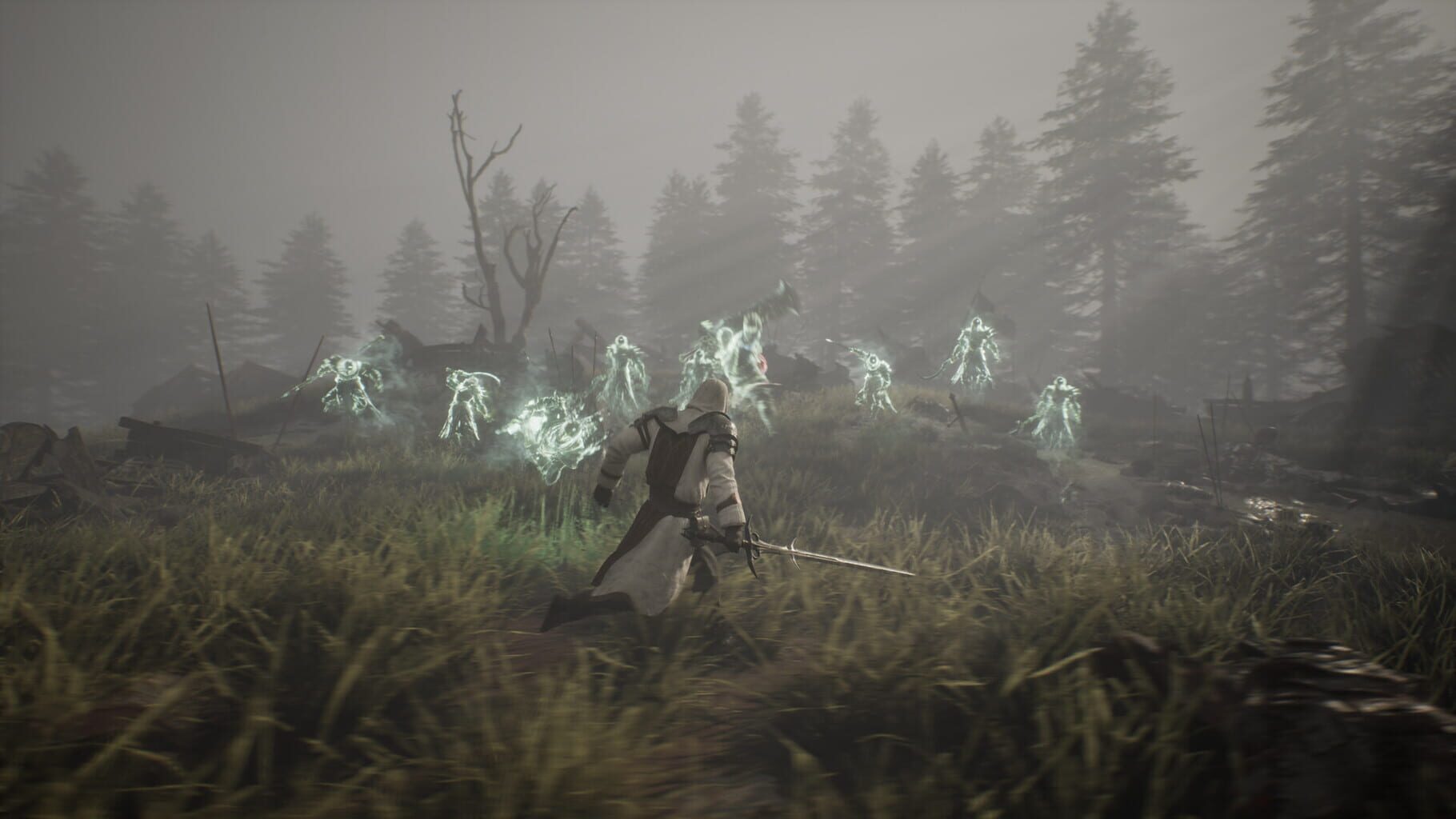
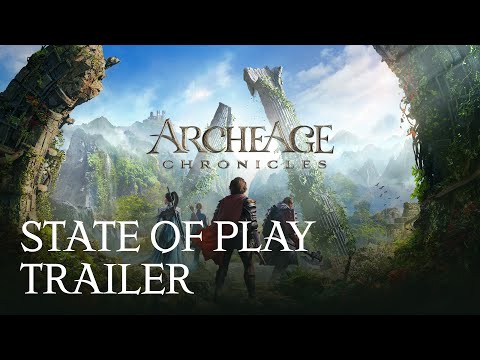
ArcheAge Chronicles was announced into the middle of this sequence, which is the fact around which any honest reading of it has to organize itself. The project had existed since 2020 as ArcheAge 2, a straightforward Unreal Engine 5 sequel that Song announced himself with a team of forty or fifty. What surfaced at PlayStation's State of Play on September 24, 2024, three months after the western shutdown and ten weeks before the Korean one was announced, was a different object with a different name and a studiously different category. The materials call it an "online action RPG." The phrase MMORPG appears nowhere in them, an absence the MMO press noticed at once, and one the studio has since defended on purpose: in an interview the following summer, XLGAMES described Chronicles as an exploration-driven action role-playing game with online elements, offered Breath of the Wild and the original ArcheAge as its two parents, said a given zone would surface dozens of other players rather than crowds, and confirmed that Jake Song, whose complaint about theme parks the entire franchise exists to prosecute, is no longer directly involved in its development.
The executive producer, Yongjin Ham, set out the new position in a Steam statement that deserves quoting at length, because sequels rarely file their revisions this plainly: "In lieu of a direct sequel, we've prepared a fresh take on the ArcheAge universe by shifting away from large-scale competitive battles to smaller group activities and interactive adventures. Our aim is for ArcheAge Chronicles to be approachable and enjoyable for both veteran players as well as those who are just joining our world." The story runs fifty years after the original, on Auroria, the continent the old game reserved for its most violent contests. Much of the inventory survives: a seamless open world, farming, crafting, trading, raids for ten and more players. The word approachable is doing the heavy lifting. The original was many things; approachable was never among them; and every constituency the old design punished, the free player behind the twelve-hour queue, the homesteader evicted by a lapsed subscription, the owner who came back from two weeks away to an empty plot, is legible between the lines of the new game's stated aims.
Then there is the sentence this essay has been walking toward, from the announcement's official blog copy on housing: "Transitioning from the previous open-world model, ArcheAge Chronicles now features dedicated housing zones where players can showcase their creativity and achievements." Housing remains, the same copy insists, a cornerstone. The nouns disclose the settlement. Zones, dedicated ones, are set aside; what is set aside is not contested; what is not contested cannot meaningfully be lost. Showcase is the giveaway verb, land as gallery. Nothing in the announced material mentions taxes, and it is hard to see what work a tax could do, because a levy on ground nobody else can take is just a fee with scenery. The franchise that spent a decade proving virtual property could be real enough to evict people from it has kept the houses and retired the property. Fifty years after the land wars in the fiction, the survivors have built the one thing the old world never contained: a suburb, safe, zoned, and unforecloseable.
What is actually known about the release, for the record, is this. ArcheAge Chronicles is slated for 2026 on PC, PlayStation 5, and Xbox Series X|S. It was 2025 at the reveal; Kakao's third-quarter report that November moved it to 2026; an earnings call the following summer conceded a further slip within the year; and the December 31, 2026 date circulating on release trackers is a database placeholder, not a plan. In April of this year the studio published a letter assuring players the game was "coming together," and a closed beta was promised for June. June produced instead a private focus group test: 165 players, 2,006 hours of play, results released as an infographic of favorite weapons and furthest-reached levels. A game intended for release this year has, at the year's midpoint, been played by fewer people than fit in a provincial cinema. None of this is damning on its own; focus tests are how games get finished, and delay is how online games avoid the kind of launch this franchise is famous for. But a reader who arrived at this page asking when ArcheAge Chronicles comes out deserves the plain answer: the official window is 2026, no date has been announced, no public test has been held, and the schedule's own body language says late.
The case for the great retreat is strong, and it deserves to be made at full strength. The open-land model's record is not ambiguous. It produced the queue as a class system, a monthly fee as the qualification for ownership, land barons within a season, an aftermarket denominated in real currency, and a customer base whose defining shared memory is grief. Zoned housing is the settled consensus of the surviving genre, adopted everywhere for humane reasons; World of Warcraft never dared open land at all, and Final Fantasy XIV, the genre's most populous survivor, still rations a scarce stock of neighborhood plots through lotteries whose frustrations are chronic and public, the exception that documents the rule. Nobody at XLGAMES needed a historian to explain any of this. They lived it, through ticket queues and refund waves and two shutdown notices. If the sequel to the land-rush game declines to hold a land rush, the refusal is memory, functioning.
The judgment still has to sit on the other side of the ledger, because something true is being surrendered along with everything painful. The original game's cruelty and its meaning were the same feature seen from opposite sides of a fence. The house mattered because the ground was finite; the neighbors were real because they could have taken the plot and chose not to; the weekly letter was the world asking its owner, in the only language a game has, whether they still meant it. Guthrie at nightfall on April 22, 1889 meant something that no planned subdivision has ever meant, and the reasons are not separable from the reasons the day was a catastrophe for the people it had been cleared of. Chronicles' housing zones will be better places to live by every measurable standard, and they will mean less, and both of those facts together are now, on the evidence of twelve years, the considered position of the only studio that ever ran the full experiment to its end. That is what makes this announcement historically valuable rather than merely prudent. The court that has ruled against open virtual property is the court that built it, heard every appeal, and paid the costs.
The 165 players in June's focus test spent their 2,006 hours inside a build of Auroria set half a century after the wars over land, which is to say inside the first version of this world arranged so that nothing in it can be forfeited. The infographic the studio published afterward tallied favorite weapons and the highest level reached, the ordinary census of an ordinary modern online game, and there is no reason to doubt that the world it sketches will be handsome, generous, and kind. The mail will work; games keep their post offices. It will carry quest rewards, login gifts, seasonal greetings from the operations team. What it will not carry, in the world this franchise is now preparing, is the letter that arrived once a week for twelve years to ask the only question a game has ever seriously asked its players about the things they built, which is whether they would keep paying something to keep them.