

One night in the last days of January 1925, the musher Leonhard Seppala left the marked mail trail on Alaska's western coast and drove his dog team out onto the sea ice of Norton Sound instead, in full dark, with the temperature well below thirty below zero and a storm building that would turn into one of the worst in the territory's recorded history. The shortcut across the sound would save hours he did not have. A diphtheria outbreak was spreading through the isolated town of Nome, the nearest antitoxin sat in Nenana, some six hundred and seventy-four miles away by the only route available, and no road or railway closed that gap in winter. A bush plane was floated as an option and rejected: the open-cockpit aircraft available in the territory could not be trusted to fly through that storm at that temperature, and an exposed face at thirty below frostbites in minutes, faster than a disoriented pilot could correct a course. Only a relay of dog teams could move fast enough, and Seppala's stretch, agreed by most accounts to be the longest and most dangerous of the twenty-odd legs that finally carried the serum in, ran straight across ice that shifts, opens, and closes with no more warning than a groan a driver may not hear over the wind. There was no trail once drifted snow had erased it, no lit window to steer toward, in places no visible seam between the ice and the sky. What Seppala had instead was Togo, his lead dog, twelve years old that winter and running the coast for close to the last time in his working life, whose head, ears, and gait were, for several hours that night, the only functioning instrument on the ice.
The arrangement is older than sled dogs specifically, and it has a name only in hindsight: outsourced perception. A hunter reading a dog's changed gait as a seal's breathing hole underfoot, a shepherd trusting a dog's sudden stillness over a shepherd's own eyes, a musher watching ears rather than a horizon that has stopped existing, are all deferring to a nervous system that processes certain categories of information, motion at a distance, structural change underfoot, a shift in wind-borne scent, faster and more completely than the human nervous system riding beside it. No instrument built before or since has fully replaced the arrangement. A compass names a direction. It says nothing about which forty feet of ice ahead of that direction will hold a sled's weight and which will not.
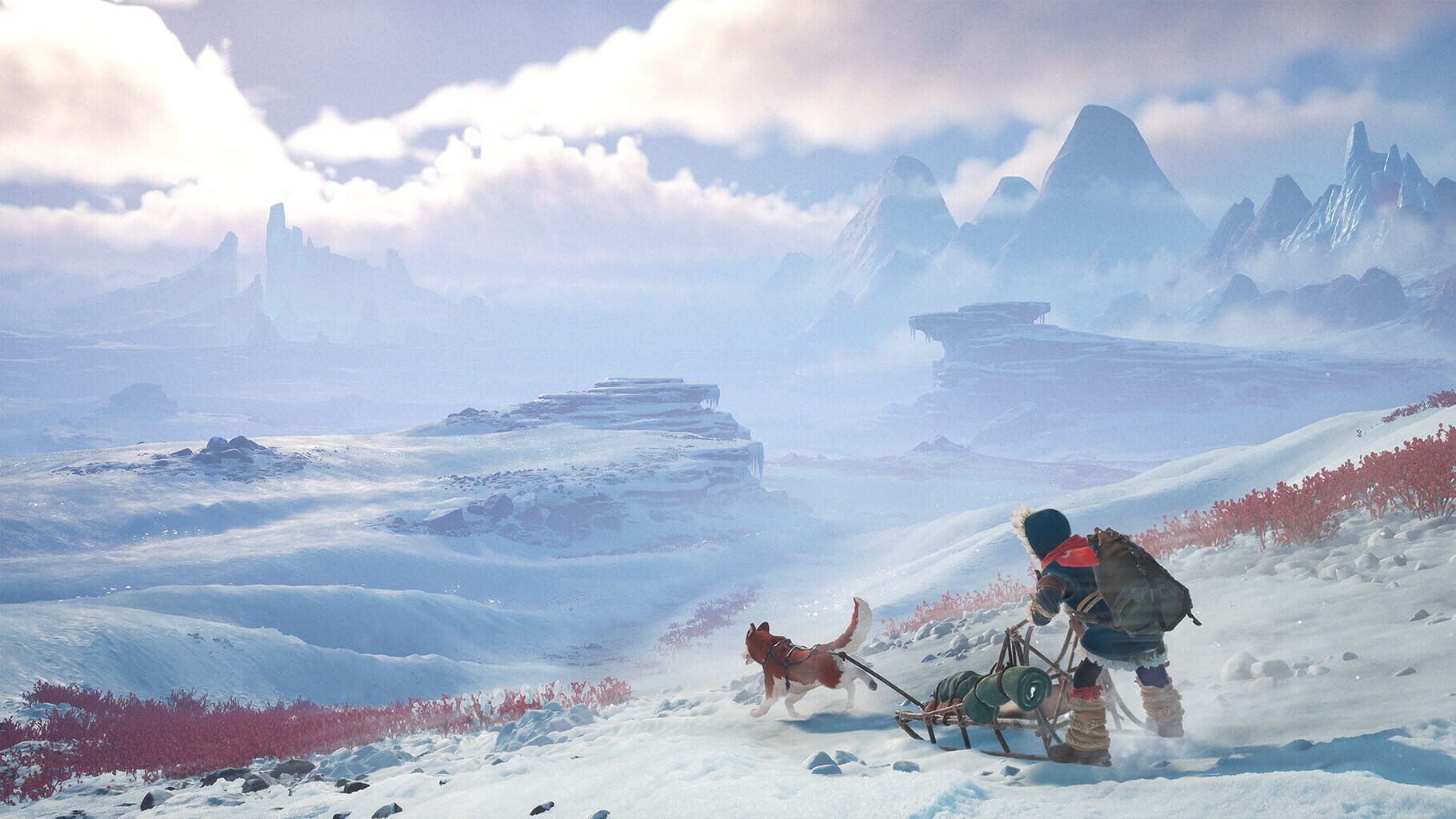
Ikuma: The Frozen Compass, a narrative adventure from Mooneye Studios, the German team behind the quiet, wolf's-eye adventure Lost Ember, builds an entire game out of the same arrangement, moved from a documented Alaskan winter into an invented one. It ships in 2026 for PlayStation 5, Xbox, and PC, playable alone or with a second person alongside in a two-player cooperative mode, and its premise sits close to Norton Sound with the historical names sanded off: Sam, a teenage boy, is stranded in the Arctic, facing an environment that wants to kill him by ordinary means and a second, less explicable threat that stays, for now, in the shadows. What he has, in place of Seppala's Togo, is a dog of his own, and functionally the same working instrument.
The Norton Sound crossing is one instance of a pattern that predates it by thousands of years and extends well past sled work. Herding dogs read livestock behavior a shepherd's eye is too slow to catch. Guard dogs, among the oldest documented working roles the species has held, register an intruder's presence by scent and hearing long before a human sentry's eyes would find anything to see. The domestication itself is old enough that estimates of its origin, by the most cautious accounting, run to fifteen thousand years, which means the specific transaction Sam and his dog are dramatizing, a human trusting an animal's senses because the animal's senses are better tuned to the immediate danger than the human's own, has been rehearsed for longer than agriculture, longer than the wheel, longer than any written language that could have recorded the first time it happened.
That is the environmental half of what a dog supplies. The narrative half solves a much newer and more specific problem, one belonging to the craft of stranding a single character in an unpeopled landscape for the length of a game. A story built that way has a narrow menu of ways to keep its protagonist's interior life legible. It can narrate internally, a voice laid over the action to explain what the character thinks or fears or plans, which is the oldest solution and also the most expensive: it means writing, casting, directing, and recording tens of thousands of words of monologue for a performer who is never on screen, done well it is a castaway's journal, done badly it is exposition in a coat, and done even at its best it tends to pull a visual medium toward telling what a visual medium exists to show. Or a story can say nothing at all, trusting posture and terrain to carry the whole weight, which is formally the purer choice and also the harder one to sustain, since a protagonist mute for the length of a full game risks reading as empty rather than stoic. Mooneye has already solved this problem once, the first way. Lost Ember gave the player a wolf that could not speak in any human register, so the studio routed its actual story around that silence, through voiced human memories that surfaced as flashback while the wolf moved across the ruins where the remembered history had happened. It worked, by most accounts of the game's reception, but it worked by repeatedly stepping outside the wolf's own present tense to let two people who were never playable characters do the talking. A boy who can talk, stranded with an animal who can listen, does not need to leave the present tense at all.
A boy alone with a dog is not, in the relevant narrative sense, a boy alone. He is a boy with someone to talk to who will never talk back in words, which is a different position than either silence or voiceover, and different in a specific, checkable way. Sam can say a plan aloud, can name a fear, can work through an argument with himself by aiming every sentence of it at the dog's face, and none of it lands on an audience as monologue, because a monologue has no listener by definition and Sam very visibly has one. Compare the nearest thing cinema has offered to the same device. In Cast Away, a volleyball with a bloodied handprint for a face gives Tom Hanks's character someone to address, but only because the character, and by extension the audience, agrees to grant the object a listener it does not have. Wilson does not turn toward a change in tone. Wilson does not register a held breath. A dog does both, reliably, in ways a design team does not have to script individually because the animal already does them on its own schedule. The listening in a game like this, in other words, does not have to be faked for the fiction to work. It only has to be filmed.
The reason this reads as true rather than as a convenient screenwriting trick has a name in the research on canine cognition. Dogs are unusual among animals, chimpanzees included, in their spontaneous skill at reading a human point or a human's held gaze and using it to locate something they cannot otherwise find, a finding the biological anthropologist Brian Hare has spent much of his career documenting, and one he attributes to domestication rather than to general intelligence: thousands of generations spent alongside a species that communicates largely by looking and gesturing selected, in dogs specifically, for a nervous system tuned to exactly that channel. Developmental psychologists have a term for the underlying capacity: joint attention, two minds oriented to the same point in the world while each remains aware that the other is oriented there too. Human infants develop it gradually, over their first year, as the foundation later language is built on top of. Dogs arrive at a working version of it without needing language at all, which is what makes the exchange with Sam legible as attention rather than as coincidence. A wolf pup raised from birth by the same humans, fed the same way, handled the same way, does not develop the skill to the same degree. It has to be bred into the animal, and across a very long span of time, it was. What Sam reads off his dog's body, and what the player reads off it in turn, is therefore not an invention introduced to solve a design problem. It is a working channel of interspecies communication considerably older than the medium now using it, one species furnishing the attention and the other furnishing, across the same stretch of time, an unusual capacity to notice it.
That channel does double duty as an instrument in the plainer sense the game's own subtitle points toward. Most games solve the problem of telling a player which way is safe, how much reserve is left, or how close a threat has come by building an interface: a compass rose in a corner of the frame, a stamina bar, a red pulse at the edge of vision. Dead Space, in 2008, famously moved that information onto the character's own body, printing a health bar down the spine of a suit rather than across the top of the screen, and the move was celebrated as a step toward the world absorbing its own instrumentation. It is still, however, a light. It still has to be placed there and lit on cue by someone in an art department. A dog that slows and drops its head into a headwind is reporting the same category of fact, that the cold has crossed some threshold worth respecting, without anyone having had to place a light anywhere. A dog that stops pulling toward open ground and sits down, refusing to advance, is doing the work a warning prompt would otherwise do, without the interruption of a prompt appearing on screen. The information is the same information. What collapses is the seam the medium has spent decades trying to sand down by other means: the distance between what a player needs to know and what a character standing inside that world could plausibly know already.
The same mechanism covers the half of the premise that has nothing to do with weather. A dog's ear registers frequencies rising toward forty-five thousand hertz against a human ceiling closer to twenty thousand, and its nose carries something on the order of three hundred million scent receptors to a human's roughly six million, which is the ordinary biological reason dogs have been used for detection, of intruders, of prey, of anything a camp needed advance warning about, for nearly the whole span of their domestication, arguably longer than they have been used for herding or hauling either one. A dog that goes rigid, or plants its feet, or turns its whole body toward a treeline that looks, to the human eye and to the game's own camera, exactly like every other treeline the player has already walked past, is running a sensory check no interface in the game can run and reporting the result the only way an animal has to report anything, through its body. Whatever the unexplained threat actually is does not need to be seen to be registered. It only needs a dog nearby that has already smelled or heard it, and a boy, and a player behind him, who have both learned by then to watch the dog instead of the tree line.
It would be easy to describe everything above, the weather gauge, the threat detector, the conversational partner, as a bundle of functions the design has loaded into an appealing animal shape, and stop there. Donna Haraway's The Companion Species Manifesto argues against stopping there, and the argument earns its place in this essay rather than serving as a decorative citation. Haraway's claim is that the relationship between dogs and humans is neither ownership nor, finally, use. It is a mutual, historically specific co-shaping in which both species altered each other's biology and behavior across a span of time that neither one experienced as a transaction. The dog is what it is partly because of humans. The human capacity to read a dog, the specific one this essay has spent several paragraphs describing, is a real and evolved capacity that would not exist without the dog on the other end of it. Haraway's term for the animal on the other end of that history is a significant other, chosen precisely against the alternative readings, tool and symbol, that flatten the relationship into something one party controls. A dog has not been assigned significance the way a game assigns significance to a key or a map fragment. It arrives already carrying significance built by ten thousand years of a relationship neither species ran alone, and a design document can borrow that weight, but it did not create it, which is exactly what makes the borrowing worth examining rather than simply accepting on the animal's behalf.
The otherness in Haraway's phrase is doing real work and is not a rhetorical flourish. It is the reason a dog can supply information a volleyball cannot, returning to the comparison made earlier. Wilson's attentiveness exists only inside Tom Hanks's character's own head, which means it can never tell him anything he does not already know, since a projection cannot carry news from outside the mind that produced it. A dog's alertness is not the boy's own fear reflected back at him. It originates somewhere his mind has no access to, a nose and an ear doing their own independent work on the same cold air, which is precisely why the dog's stiffening at a treeline counts as evidence and a shiver of the boy's own nerves would not. Significant otherness, in other words, is not a sentimental way of saying the dog matters. It is the specific claim that the dog's difference from Sam, its refusal to be a mirror, is what makes its attention worth trusting in the first place. The game's own two-player mode raises the question without quite settling it. A second human being can step into the position ordinarily held by the dog, and this essay can pose the resulting question without resolving it: if that position admits a person as readily as it admits an animal, some part of what made it specifically a dog, rather than a role a dog happens by default to fill, is doing less work than the premise's warmth would suggest.
None of this settles the harder question, which concerns risk rather than mechanism. Placing a dog in a hostile Arctic, threatened by cold and by something the game has not yet shown in full, is not a neutral choice among equivalent options. It is the deployment of one of fiction's most reliable levers, reliable enough that a website, Does the Dog Die, exists for the specific original purpose of warning audiences in advance whether that lever is about to be pulled on them. Audiences brace for a dog in danger in a way they do not brace, evenly, for every human extra placed in identical danger, and a studio that puts a dog in an Arctic knows this, or ought to. Whether the device works is not seriously in doubt; it reliably does. What deserves scrutiny is whether a given use of it has earned the reaction by building an actual, specific animal first, with its own legible behavior and its own half of a relationship, of the kind described above, or whether it is cashing a check the surrounding culture already wrote before the game arrived, drawn on the species rather than on the character. Mooneye's own record offers a reason for cautious confidence rather than either dismissal or faith. Lost Ember was, by most critical accounts, patient close to a fault, more interested in atmosphere than in shock, willing to let grief sit rather than detonate it for effect. A studio with those instincts is not guaranteed to resist the cheaper version of this device merely because it resisted a comparable temptation once. But it has already shown that it knows the difference between earning a reaction and extracting one, which is not nothing, and is more than most studios reaching for the same animal can currently claim. Whether Ikuma keeps that discipline is not a question its premise can answer. Only the finished game can, and the fact that the question is worth asking before release, rather than only in the reviews written after, is itself worth registering now.
The obvious objection is that all of this overreads a simple appeal. A dog is good company, the objection runs, and a boy alone in the snow with a good dog needs no further explanation than that; cognitive science and companion-species theory are a great deal of apparatus to bolt onto what is, at bottom, a nice animal doing a nice thing on screen. The objection deserves an answer rather than a shrug, and the answer is a question about substitution. If the function here were simply comfort, warmth, a friendly presence, any number of animals would serve it about as well, a cat, a horse, a tame fox, and design teams do sometimes reach for those. They reach for a dog specifically, and overwhelmingly, when the design also needs the animal to read the human and be read by the human in return, because a dog is measurably better at that particular exchange than a cat or a horse is, for the domestication reasons already given. The frequency with which this one species, rather than any other, keeps turning up at the side of a lone protagonist across the medium is itself evidence that something more specific than generic likability is being selected for. Good company is real. It is also not the whole explanation, or a great many stranded protagonists would be keeping warm beside a goat instead.
Somewhere in the finished game, presumably more than once, Sam will be doing something ordinary, checking a pack, arguing with himself about which direction to try next, failing to notice what he has not yet been given reason to notice, and the dog beside him will already have stopped. Its head will come up first. Its ears will find a bearing the boy's own ears cannot find, and hold it, a full beat before anything on the screen confirms there was ever anything there to find. Nothing about that beat needs to be read as loyalty, or love, or a symbol standing in for either one. It is a nervous system doing the specific thing ten thousand years built it to do, a beat ahead of a boy who has not yet turned his head to look.