The engraving folds out from the book to nearly twice the size of the page it is bound into, and it shows a flea. Not the flea anyone in London in 1665 would have recognized on sight, a smear, a bite, a nuisance flicked off a sleeve, but a flea drawn several inches long, its body armored in overlapping plates like a knight assembled by a locksmith, its legs jointed and coiled as if a watchmaker had gotten there first. Robert Hooke built his own compound microscope to look at it, and what came back was not a bigger version of the thing everyone already knew. It was a different kind of object, mechanical where it had been merely irritating, engineered where it had been merely small. The same book turned its lens on a needle's point and a razor's edge, two things a seventeenth-century hand already trusted to be perfectly smooth, and showed the needle's tip as blunt and pitted as a dropped nail and the razor's edge as a ragged, uneven ridge, nothing like the clean line a shave depends on feeling. The hand's report and the microscope's report did not agree, and the microscope was not the one lying. Samuel Pepys bought a copy of Hooke's Micrographia within days of its appearance and wrote in his diary, on the twenty-first of January, that it was the most ingenious book he had ever read in his life. He was not reacting to a flea. He was reacting to the discovery that changing an observer's distance from a thing can change what the thing turns out to be.
That discovery is older than photography, older than the word microphotograph, and it is the whole argument this essay wants to make about a video game that has not yet shipped. Shrinking the observer, or magnifying the observed, which arrive at the same problem from opposite ends, does not simply enlarge a picture. It changes the physics an object is subject to, and therefore what that object can do to a body nearby. A flea's leg does not become gentler under magnification, and a drop of water does not become friendlier at a smaller scale. The eye registers a change in size; what actually changes, underneath the eye's report, is the relationship between an object's surface and its mass, and that relationship governs whether water is a drink or a trap, whether a fall is a stumble or a funeral. Sound changes on the same terms, though no seventeenth-century instrument could show it: a world scaled down far enough is not only seen differently, it is heard and felt differently, by an ear and a body Hooke's engraving never had to render.
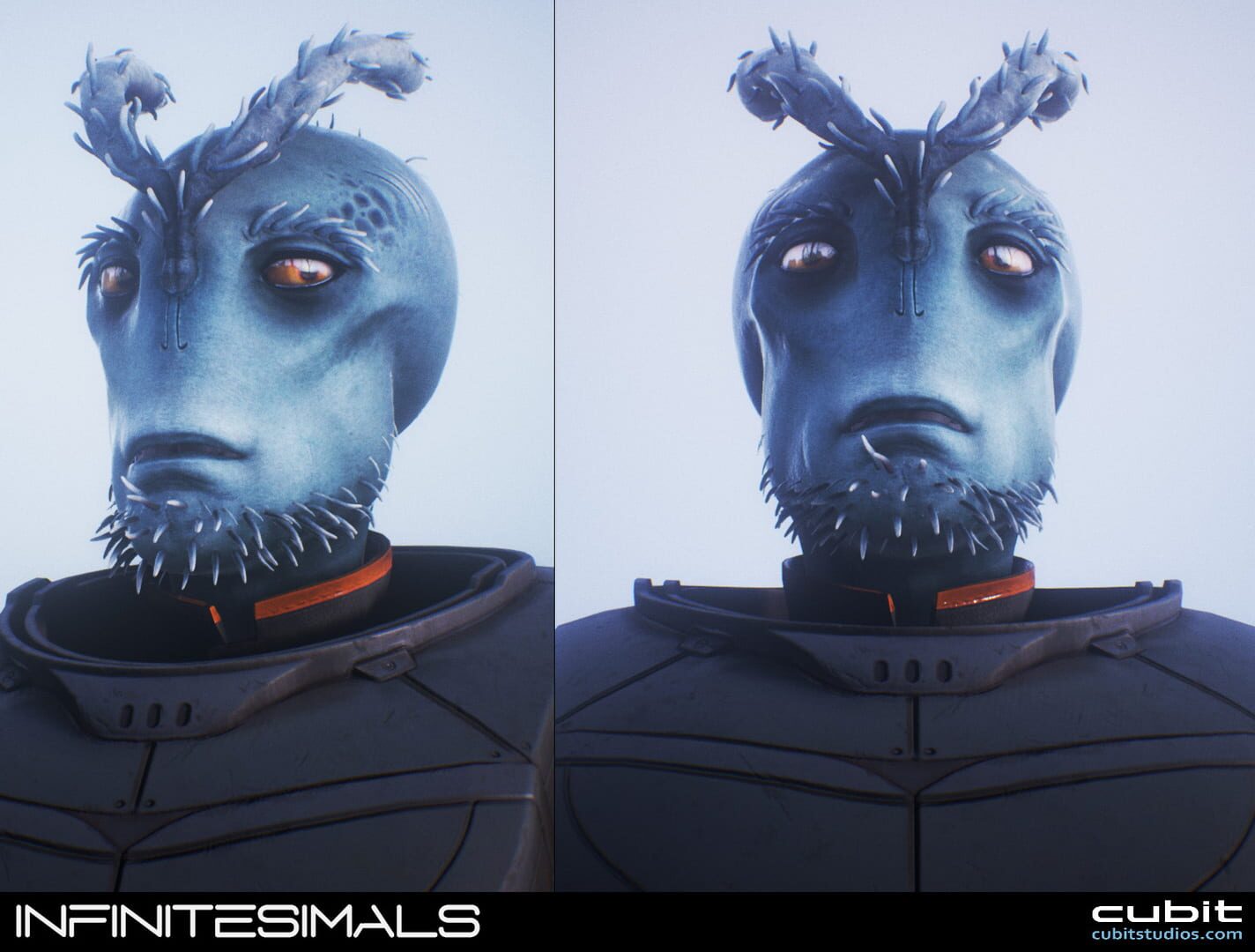
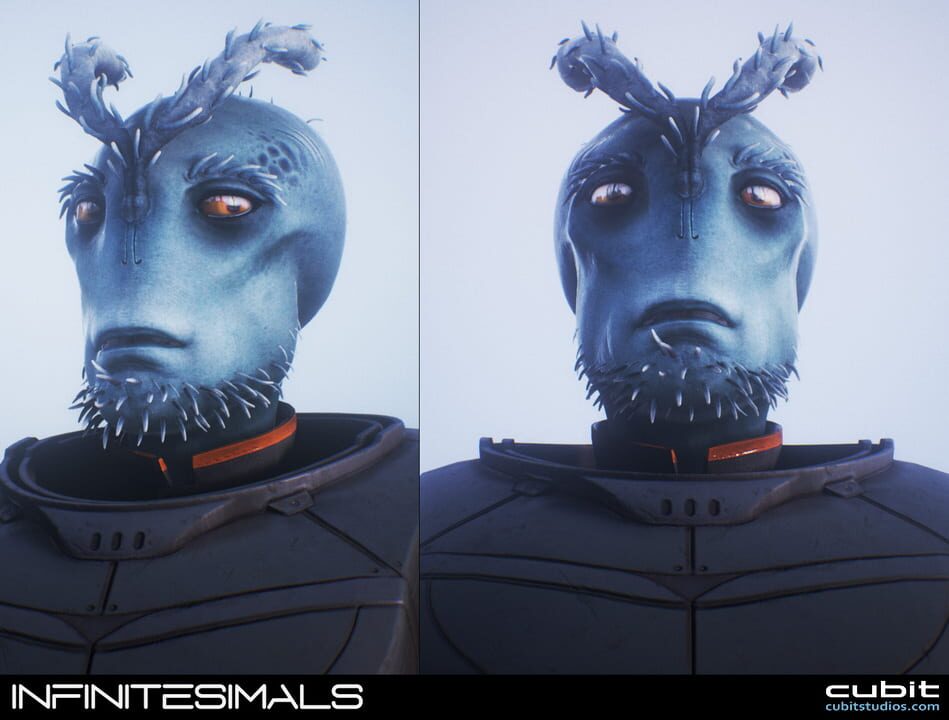
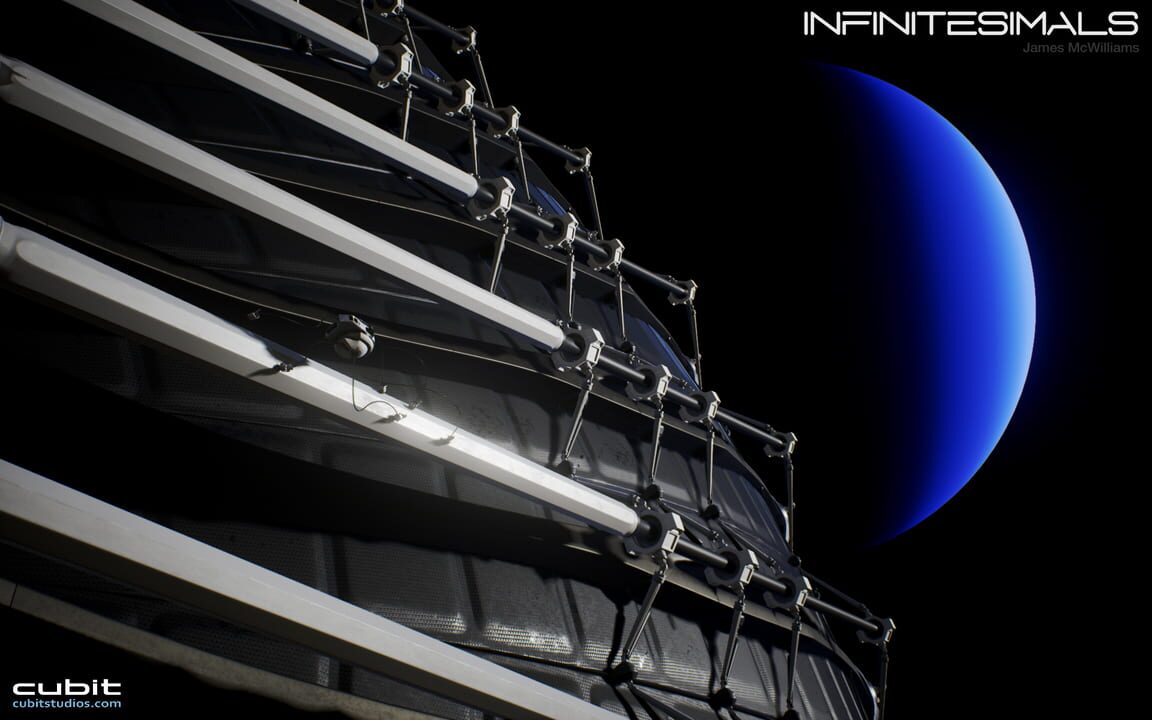
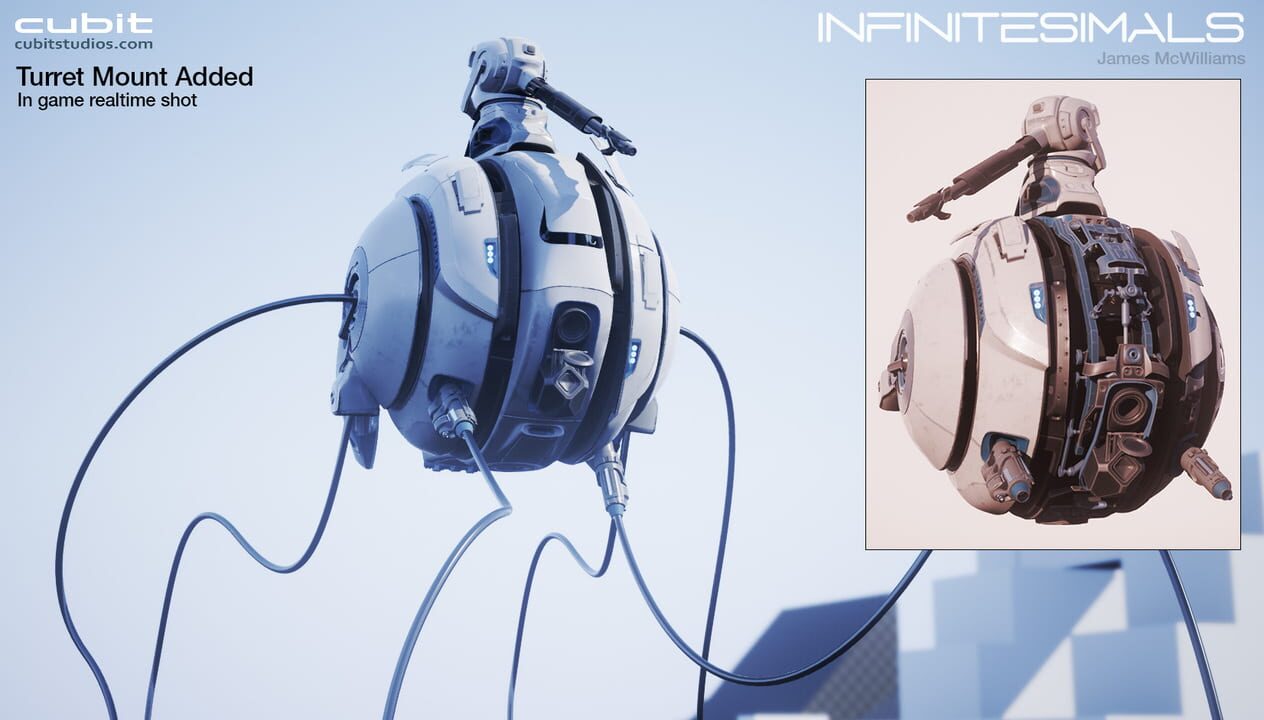
Infinitesimals, the third-person action-adventure Cubit Studios is building under Epic Games Publishing for PlayStation 5, Xbox, and PC, is built on exactly this premise, whether its designers have ever opened Micrographia or not. The player leads the survivors of a crash-landed alien squadron, spacefaring and technologically advanced, marooned on a planet that dwarfs them. Hands-on previews published in June 2025, at GamesBeat and at GamingTrend, both put a specific number on a scale the marketing otherwise leaves poetic: the protagonist stands roughly eight millimetres tall. Everything the trailers describe as towering terrain and giant local wildlife is, from any other vantage, an ordinary planet. What makes the premise worth an essay is less the size difference on its own than the question behind it: whether an eight-millimetre body is a smaller camera bolted onto the same rules a human-scale third-person game already runs on, or whether the game is willing to build a different physical regime for it to live inside.
Start with the plainest version of that physics, the one Jonathan Swift had already worked out by 1726 without the vocabulary to name it. In the first part of Gulliver's Travels, the Emperor of Lilliput's mathematicians measure Gulliver with a quadrant and find him twelve times their own height. From that ratio alone, Swift has them reason to a figure for his upkeep: since Gulliver's body is similar in shape to theirs, only larger, it must contain not twelve times the material but, in the treaty's own wording, "at least 1724" times as much, and his daily food allowance is fixed accordingly in a formal document sworn to at the Emperor's palace. The number is almost exactly right, and that is the interesting part. Twelve cubed is 1728, so Swift's mathematicians land four short of the true cube, as though someone at the Lilliputian court had done the multiplication by hand and rounded down out of caution. A linear ratio of twelve becomes, once volume is the actual question, a ratio of about seventeen hundred, because volume scales with the cube of length while height scales with length alone. Shrink a human being to eight millimetres, a reduction of roughly two hundred to one in height, and the reduction in mass lands on the order of ten million to one. Swift's joke about rations is also, whether he meant it this way or not, one of the more efficient explanations of the square-cube law in English literature, arriving a full century before biology had a settled name for it.
The same cubic relationship is what turns water from a drink into a wall. The geneticist J.B.S. Haldane gave the classic account of this in a short 1926 essay for Harper's Magazine, "On Being the Right Size," and its central point has needed no revision since. Weight is a function of volume, so it falls with the cube of an animal's length. Surface tension, the force that holds a drop of water together, acts along a boundary, a line, so it falls only with the length itself. Shrink an animal far enough and the second force overtakes the first. "A wet fly has to lift many times its own weight," Haldane wrote, and a fly that has actually gone into water rather than merely gotten damp is, in his account, in a very serious position: the same surface tension that a slightly larger animal could shrug off as an inconvenient film becomes, at the fly's actual size, a membrane it cannot break from the inside. Honey, I Shrunk the Kids, the 1989 Joe Johnston film that gave an entire generation its working idea of what a lawn looks like from an inch above the soil, gets this exactly right in a scene that is not played for laughs: shrunk to a quarter of an inch, Amy nearly drowns in an ordinary mud puddle after her father accidentally triggers the garden sprinklers, and the film does not treat the puddle as shallow water to wade through. It treats the puddle as what it has actually become at that height, a body of water with a skin, capable of holding a small enough person under it. The film got the physics right before any studio had the technology to render it convincingly, and the correctness was never a special effect. It is what surface tension actually does once weight stops being able to compete with it.
Falling works on the same arithmetic, toward the opposite emotional result. Haldane's most quoted passage follows soon after, in the same essay. Drop a mouse down a thousand-yard mine shaft, he wrote, and "it gets a slight shock and walks away, provided that the ground is fairly soft. A rat is killed, a man is broken, a horse splashes." Air resistance, like surface tension, is a function of surface area, while the force driving a fall is a function of weight. Divide an animal's length, breadth, and height each by ten, Haldane worked out, and its weight drops to a thousandth while its surface drops only to a hundredth, so the resistance to falling becomes, relatively, ten times greater than the force doing the falling. An eight-millimetre body inherits this arithmetic almost entirely: its terminal velocity is low enough that a fall which would kill a person outright is, for it, closer to a stumble. Honey, I Shrunk the Kids stages the inverse of the same fact when the children shelter from their own father's lawnmower inside an earthworm tunnel. The machine that would be bladed death to something their size was never built to notice them at all, and the scene's real threat is not impact but the wind of the blade's passing, which behaves, at their scale, less like a breeze than like a hurricane making landfall. A body that size does not fear the fall nearly as much as it fears the weather the fall's cause kicks up on the way past. The same logic explains why ordinary settling dust, harmless and nearly weightless at human scale, changes category entirely at that height. A dust mote's weight falls with the cube of its size, but the air resistance slowing its descent falls only with its surface, so the mote drifts rather than drops, held aloft by air currents too faint for a human hand to register at all. To a person, dust is a light coating that needs wiping off a shelf. To a body eight millimetres tall standing in the same room, the same motes are weather: a slow, constant, wind-driven precipitation that never fully settles, closer to a light and permanent snowfall than to household grime.
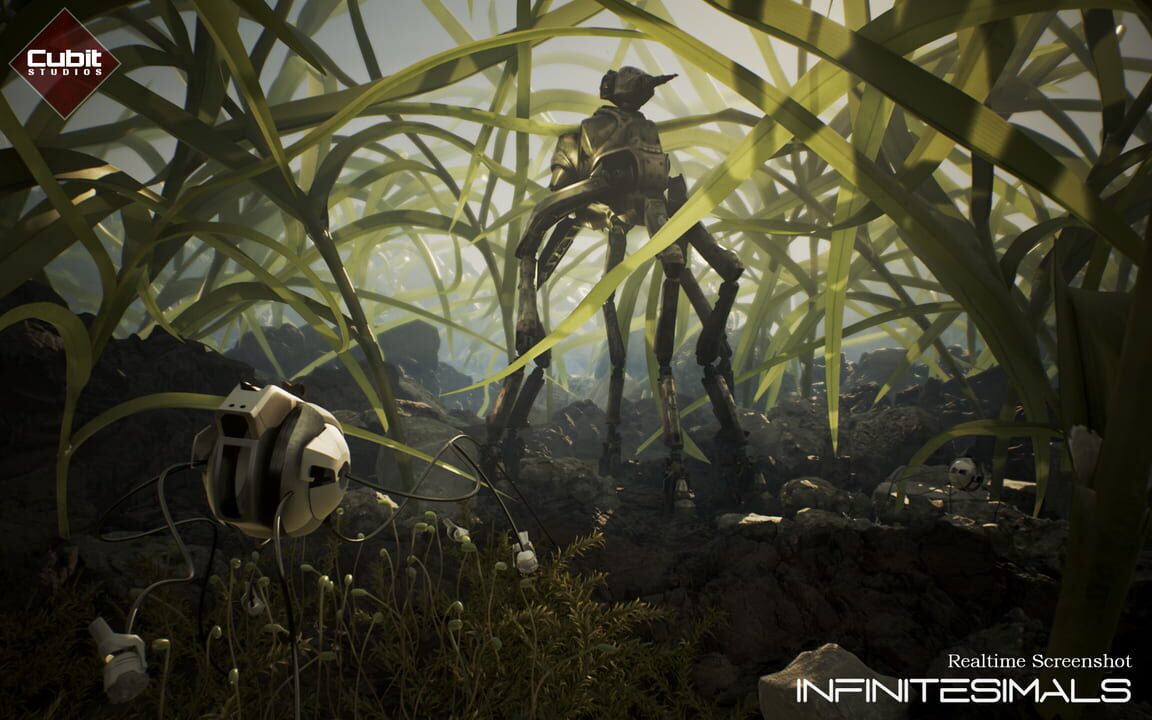
Danger is not the only thing that changes at that height. What a body that size can actually do changes just as much, and it is the more useful question for a game to ask, since a game's vocabulary is built out of actions rather than hazards. The psychologist James J. Gibson gave this idea its clearest name in his 1979 book, The Ecological Approach to Visual Perception, where he proposed that what an environment offers an animal, an affordance in his term, is never a property of the environment by itself. "The affordances of the environment," Gibson wrote, "are what it offers the animal, what it provides or furnishes, either for good or ill." A pond affords drowning to a mouse, drinking to a heron, and travel to a water strider, and the pond has not changed at all between those three outcomes. Only the animal has. Applied to a body the height of Infinitesimals' protagonist, the claim stops being an abstraction and becomes a design brief. A blade of grass affords a human ankle nothing in particular; it is texture, ground cover, the thing a lawnmower exists for. To a body eight millimetres tall, the same blade is closer to a beam than a plant: something to climb, to shelter under, to cross a gap on, carrying weight the way a girder carries it for a human-scale hero. An ordinary lawn, at that height, is not a lawn. It is a forest with a canopy overhead, blocking most of the light, and an understorey below it running on a different economy of movement and danger, the way a rainforest's floor keeps different rules than its canopy for the animals that never leave either layer. The same logic runs back through the dangers already described. A drop of dew caught in the crook of a leaf is not scenery either, at that height. It affords a startled water strider a runway, a careless walker a drowning, and a thirsty one a reservoir, and which of the three it turns out to be depends entirely on the body that arrives at it, exactly as Gibson's pond does for the mouse, the heron, and the strider. Gibson's point was never that small things are secretly large. It was that size sets the entire menu of what counts as an action in the first place, and a game that takes an eight-millimetre protagonist seriously has committed, whether it has realized it or not, to building that menu from scratch rather than borrowing the human one and rescaling the models.
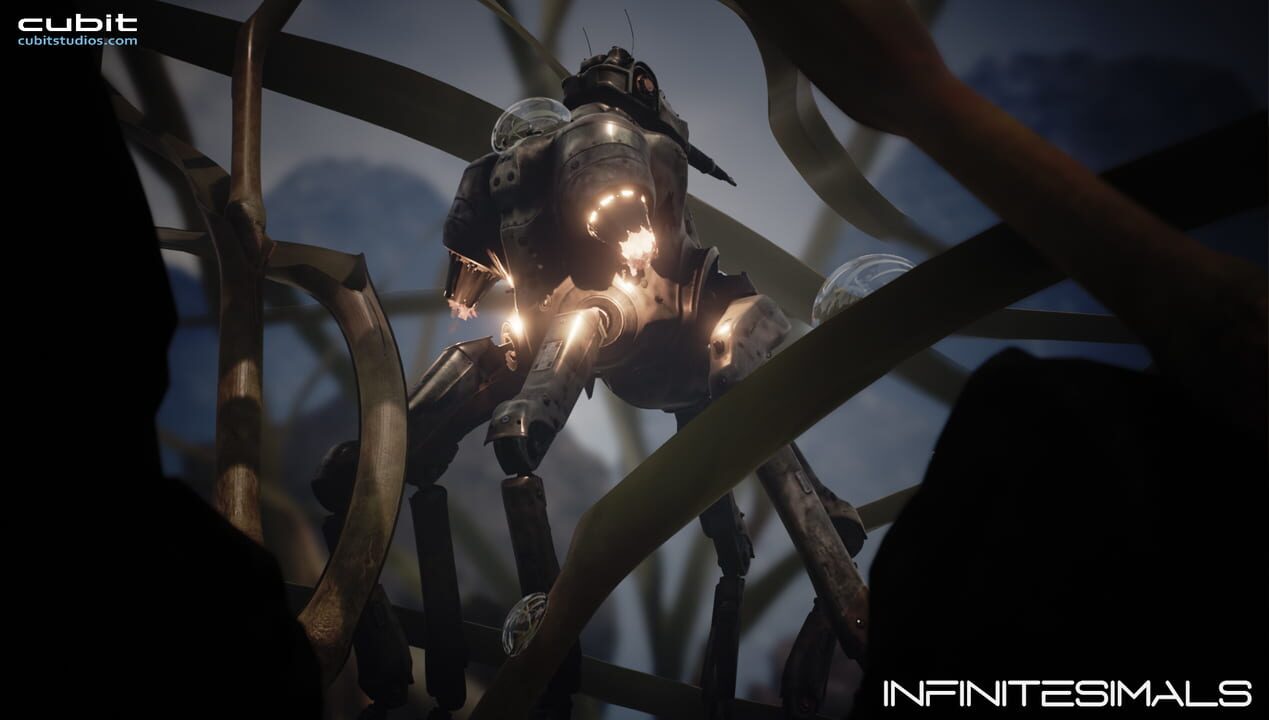
Measured against that brief, the available previews of Infinitesimals suggest a game that has done some of this homework with real care and skipped the rest for reasons that are easy enough to sympathize with. The fall damage in the current build is present but explicitly non-lethal, a choice previewers reported the developers made on purpose, prioritizing exploration over punishment. That is, by accident or design, closer to Haldane's mouse than to any human-scale action game's usual arithmetic, in which a three-story drop is routine death. The Hunter Gatherers, the game's mechanical sentinels, and the giant wildlife the marketing keeps promising, are built around a related and correct instinct: at this scale an ordinary animal is not scenery, it is an apex predator, the way Honey, I Shrunk the Kids understood that a single scorpion was a threat several orders of magnitude beyond a nuisance. Where the design turns conventional again is locomotion. The player crosses this landscape with a jetpack, which one previewer described as remarkably fluid, and a dedicated POD vehicle for longer distances, both perfectly legible action-game verbs that have little to do with how an eight-millimetre body would actually cross difficult ground. Real insects at that size do not need turbines. They rely on a different toolkit entirely, disproportionate leg strength, the ability to fall without injury, the option to simply let the wind do the traveling, and almost none of that toolkit survives translation into a scheme a player can run from a thumbstick. Call the jetpack a concession rather than a failure of research, an acknowledgment that some physically correct answers make for an uncontrollable video game, and the tagline Cubit has chosen for the marketing, that the player is "outsized, but never outmatched," is a promise about combat difficulty doing quiet double duty as a promise that the physics will not be allowed to get in the way either.
The harder test, and the one almost no game at any scale has passed, is what happens to light and sound rather than to legs. Haldane's essay makes a point about vision that the previews have not had occasion to raise, since nothing in the hands-on coverage so far touches it: a small enough eye runs into the wavelength of light itself as a hard limit. "A mouse's eye is not a small-scale model of a human eye," Haldane wrote, because an eye's resolving power depends on the size and number of its light-sensing cells, and those cells cannot be shrunk indefinitely before the image simply fails, with the result that "a mouse could not distinguish one human face from another six feet away." A body the height of Infinitesimals' protagonist, built along ordinary humanoid lines, would meet the same wall in a more extreme form: either its eyes are proportionally enormous, closer to an insect's relative size than a person's, or its vision is genuinely worse than human vision rather than merely magnified, with shallower focus, weaker color resolution, a different relationship to motion entirely. The limit is not a matter of manufacturing a better lens. Light itself has a wavelength, a few hundred nanometres across the visible range, and no optical system, biological or engineered, can resolve detail finer than roughly that wavelength, a ceiling that matters far more to an eye a few hundred microns wide than to one two centimetres wide. Every preview so far describes the combat and traversal as crisp and legible, a third-person camera behaving like every other third-person camera. That is almost certainly the right choice for a game that wants to be playable, and it is also,, the choice that walks furthest away from the premise's own physics. Sound presents the same problem from the opposite direction. An eardrum, or whatever an eight-millimetre alien uses instead, built at that size would be poorly matched to the low frequencies a human finds unremarkable, a passing engine, a low voice, while ordinary events at ground level, a footstep two body-lengths away, a raindrop's impact, would arrive with something closer to the force of a detonation than a background noise. A gust of wind that a person crossing a parking lot would not bother to mention would, at that scale, be a sustained physical event worth bracing against, the air itself behaving less like atmosphere and more like surf. None of the preview coverage surveyed for this essay, extensive as it already is on guns and jetpacks, mentions the game's sound design at all. In an essay about a game built on the physics of scale, that silence is the most informative detail so far available.
There is a reasonable objection to all of this, and it deserves more than a token nod before the essay moves on. A video game is a designed experience built to hold a player's attention for perhaps twenty hours, not a simulation built to satisfy a physicist, and the two goals genuinely conflict more often than enthusiasts for realism like to admit. A camera rendering true insect-scale depth of field would look, to most players, simply broken, a smear where clarity is supposed to be. A traversal system built on the actual, limited locomotor options of something eight millimetres tall would very likely be slower and more frustrating than a jetpack, not more thrilling for having been researched. Sound calibrated to the real acoustic experience of that scale, most of it either sub-audible rumble or painful transient spikes, would resemble a hearing test more than a soundtrack. Even a studio willing to attempt all of it would eventually have to ask how much of that fidelity actually serves the hours a player is being asked to spend, since a body that experiences ordinary wind as surf and ordinary vision as a smear is not obviously a body a designer can build satisfying combat around. The point is not that Cubit has been lazy. Fidelity and legibility trade against each other at nearly every one of these decisions, and a studio that chose fidelity every time would likely ship a game almost nobody could stand to play for more than an hour. The fairer test asks whether the specific physical facts a designer keeps, out of the dozens available, are the ones that actually make the premise strange rather than the ones that are merely convenient to render, and it asks that instead of demanding an exact millimetre-scale simulator that nobody would enjoy playing. Non-lethal falls and oversized wildlife suggest Cubit has kept the facts that generate the best set pieces. Ordinary vision and unremarked-upon sound suggest it has not yet decided whether the facts that would generate real strangeness, rather than spectacle, are worth the risk of building.
Stand at ground level in almost any lawn and look for one particular blade of grass rather than the mowed green mass it belongs to. From a standing human height it disappears into the average, one thin line among several thousand per square foot, worth noticing only collectively, the way a forest is worth noticing rather than any single one of its trees. Lower the eye to within a few millimetres of the soil, the vantage point from which Infinitesimals proposes to tell its entire story, and the same blade stops being a unit of lawn and becomes the largest single object in the visible world: a curved green wall wider than a body is tall, throwing shade like a building, flexing under wind loads the way a tower flexes. It is the only vertical surface for a considerable distance that a small climbing body could actually use. Nothing about the blade has changed size. The height doing the changing is the one holding the camera, or, in Hooke's case, the one holding the lens.