



A Motoi Sakuraba battle theme usually establishes itself inside four seconds, and the way it does so is worth describing precisely, because almost nothing else in game audio behaves like it.
There is rarely an introduction. The piece is already moving when it starts: a fast keyboard figure, often in a hurry, frequently doubled by a bass line that is doing its own melodic work rather than holding a root. The harmony does not sit still. Within the first phrase it has usually gone somewhere unexpected, and it will keep going somewhere unexpected, so that a listener who tries to predict the next chord will be wrong more often than they are right. There is no single moment the piece is building toward. There is no eight-bar breath before the tune arrives. The thing is at full density immediately and stays there.
That is an unusual set of choices and it is easy to mistake for excess. It is not excess. It is a solution to a specific and rarely stated engineering problem, and the problem is repetition.
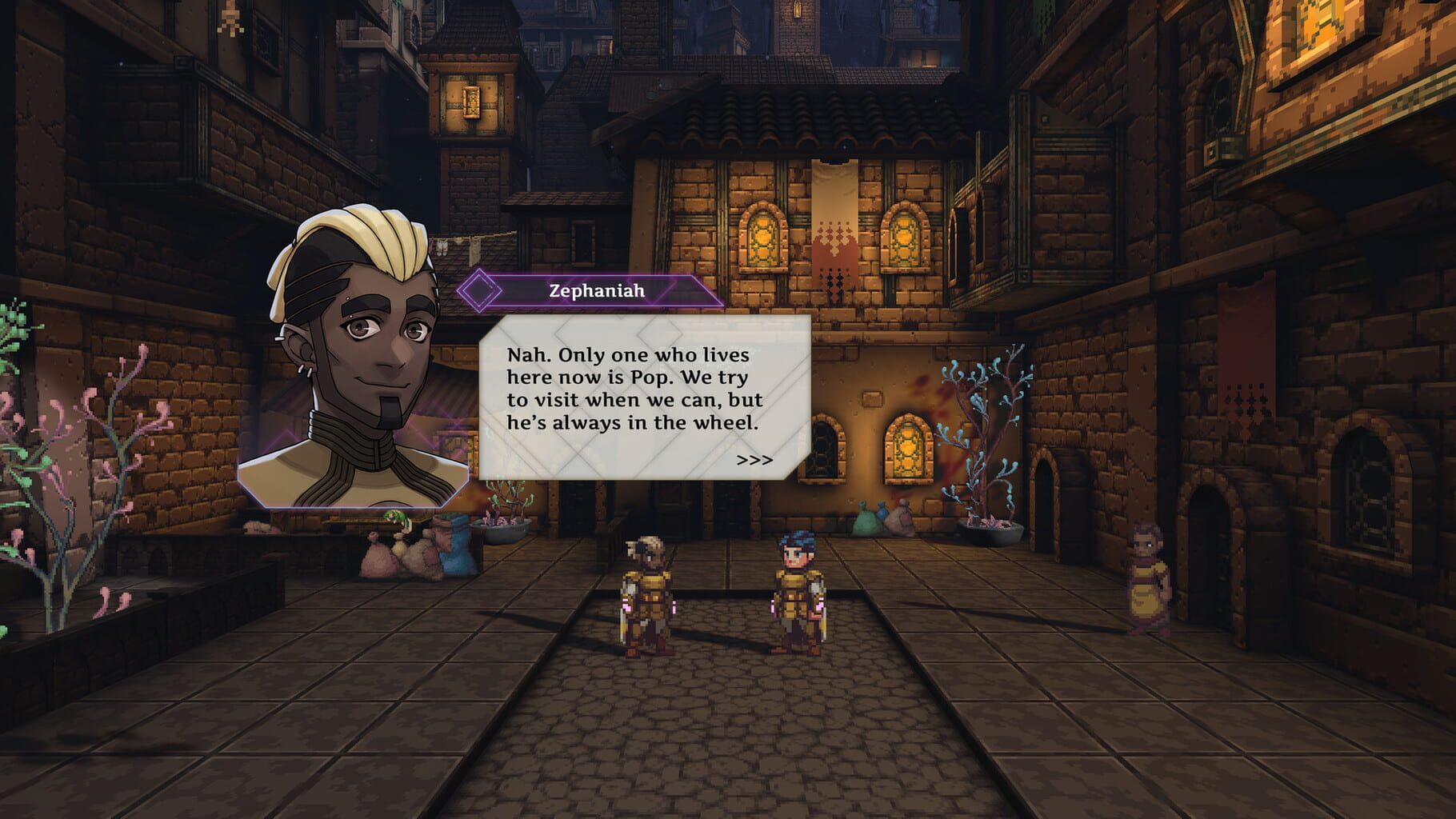
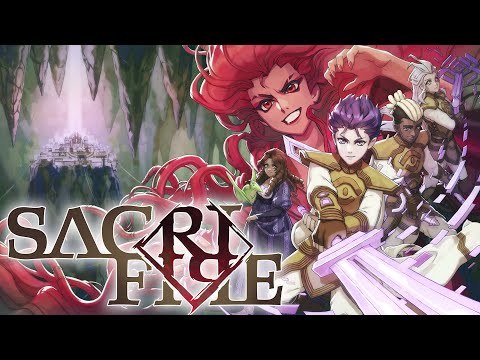
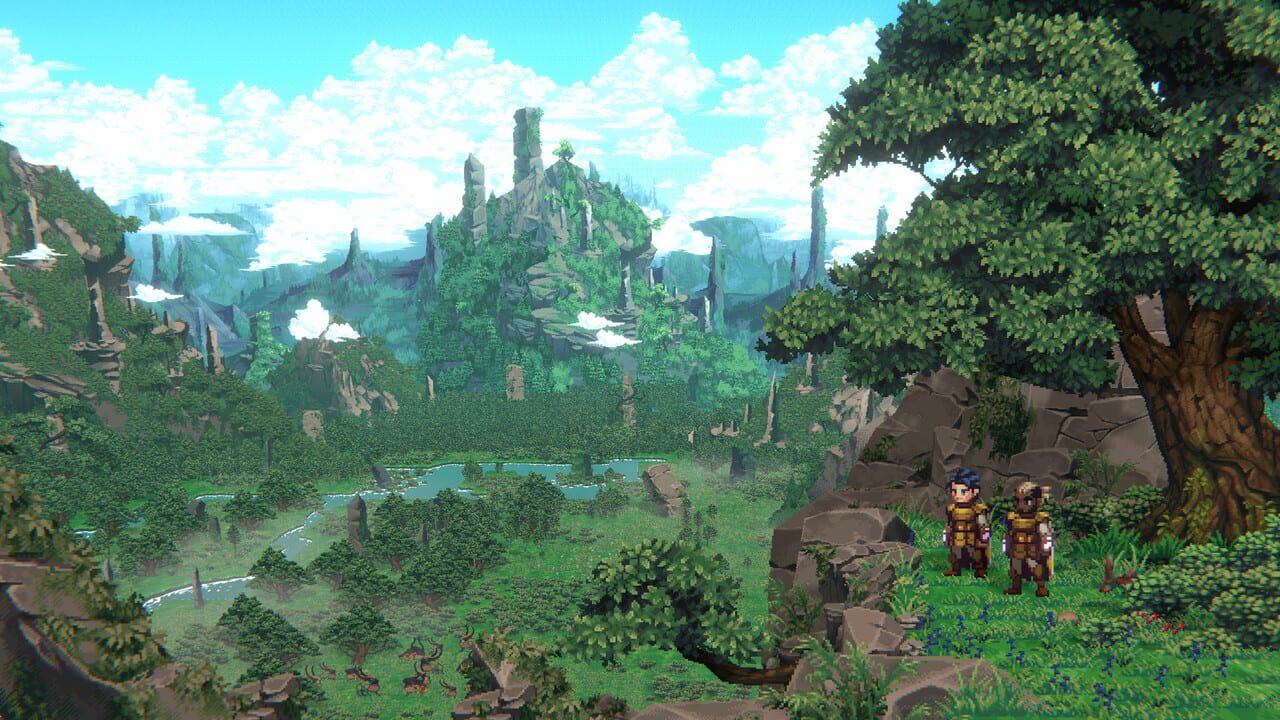
SacriFire, from the Polish studio Pixelated Milk, is a role-playing game in the Japanese tradition with a hybrid battle system and an original score by Sakuraba. This is an image-and-sound reading of what that hire actually buys, because the standard account of it, that a small studio has secured a famous composer, describes a marketing fact rather than a musical one.
Start with the brief, because the brief is extraordinary and nobody outside game audio writes to it.
A film composer writes a cue that will be heard once, or twice by an attentive viewer, in a fixed context, at a fixed length, in a fixed position relative to the picture. A songwriter writes something that might be heard many times, but by a listener who has chosen to hear it, in full, at a moment of their selection, and who can stop at any point.
A battle theme is heard several hundred times by the same person. It begins at an unpredictable moment, plays for a duration determined by how long the fight takes, which the composer cannot know, and is cut off, mid-phrase, at whatever point the last enemy falls. It loops, seamlessly, as many times as required. And it is frequently playing while the listener is mildly irritated, because a substantial share of the encounters in any long role-playing game arrive when the player wanted to be somewhere else.
Nothing else in music is written to those conditions. The nearest analogue is a hold-music loop, and the comparison is instructive, because hold music is the case where the problem has been solved badly and everyone knows what that sounds like.
So what does survive four hundred hearings.
The intuitive answer is simplicity, on the theory that a complicated thing wears out faster. The intuitive answer is wrong, and the reason it is wrong is the most useful thing music psychology has to say about this.
Elizabeth Hellmuth Margulis, in On Repeat, published in 2014, assembled the evidence that repetition does not merely make a listener familiar with a piece. It changes the kind of attention they bring to it. On first hearing, attention runs at the level of the phrase: where is this going, what is the tune. On the twentieth hearing, the large-scale question is settled, and attention descends to smaller units. The listener starts hearing the inner voice, the specific articulation of a note, the small hesitation before a chord change. Margulis's central claim is that repeated listening shifts the listener from following the music to participating in it, anticipating each event fractionally before it arrives, which is a materially different and more physical experience than first-time listening.
That gives the composer a clear instruction. Music that rewards descending attention is music with things at the smaller scales for attention to descend into. Music with a strong melodic shape and very little underneath it has one level, and once the listener has learned it, there is nowhere further to go, and the piece becomes furniture and then becomes an irritant.
Robert Zajonc's 1968 work on mere exposure established the other half, and it comes with a limit that is usually left out of the popular version. Repeated exposure does increase liking. It does so most reliably for stimuli of moderate complexity, and the effect degrades or reverses for stimuli that are too simple, which are experienced as tedious well before they are experienced as familiar.
Put those together and the design brief becomes legible: a battle theme should be denser than it needs to be on first hearing, because the first hearing is not the one that matters.
Which is what Sakuraba writes, and the reason he writes it that way is biographical rather than theoretical. He came out of progressive rock, playing keyboards in a band in the late 1980s and recording instrumental music in that idiom before he scored anything. Progressive rock is a genre organised around exactly the properties described above: fast keyboard figures, harmonic restlessness, irregular metre, sections that refuse to resolve where a pop song would. It is also a genre whose listeners characteristically play the same records for decades, which is not a coincidence.
Sakuraba did not adapt that vocabulary to games. He brought it over intact, and it happened to be the correct tool for a job nobody had described in those terms.
The evidence is in what the music declines to do. A Sakuraba battle theme generally has no climax, and this is the most counter-intuitive property of the whole approach. A piece with a climax has a correct length, and being cut off before the climax is a small disappointment, repeated several hundred times. A piece that runs at constant intensity, with its interest distributed evenly across its length rather than concentrated at a peak, can be stopped anywhere without loss. The player who wins a fight in eleven seconds and the player who wins in ninety have both heard a complete thing.
The loop point works the same way. Music built from a continuous stream of activity can return to its beginning without the seam announcing itself, because there is no structural arrival for the return to contradict.
None of this is accidental, and the proof that Sakuraba knows precisely which register he is in is Dark Souls, where he wrote almost none of it. That score is slow, choral, largely orchestral, and organised around exactly the long approaches and single peaks his role-playing work avoids. The difference is a difference in brief. FromSoftware's boss themes are heard by a player who will hear them many times and be paying complete attention every time, in fights that end decisively. That is a different problem and he solved it differently.
It is worth being concrete about how the loop is actually built, because the mechanics of it constrain the writing more than most listeners realise.
A game music track of this era is typically authored as two pieces: an introduction, played once, and a body, which repeats from a defined loop point until the game stops asking for it. The loop point has to be sample-accurate, and the material either side of it has to join without a click, a gap, or an audible reset of the reverb tail. Composers write to this constantly and it shapes the music: a piece that ends on a held chord cannot loop cleanly, so it does not end on a held chord.
What has changed in the last fifteen years is that the loop is no longer the only tool. Middleware now allows vertical layering, in which several stems play simultaneously and are faded in and out by game state, and horizontal resequencing, in which the music switches between authored segments at musically safe transition points. That technology solves the interruption problem differently and better: a fight that ends can be given a written ending rather than a fade.
The consequence for a composer of Sakuraba's generation is that the constraint he solved by density can now be solved by architecture, and a studio that adopts the modern approach is buying a solution to a problem it may have already engineered away. The two approaches are not incompatible, but they are not the same craft, and a score written as a set of self-sufficient loops behaves differently inside a layered system than one designed for it.
What a small studio is really purchasing, then, is a specific and unfashionable competence: music that does not need the middleware to be tolerable.
So the judgment about SacriFire is narrower than it first appears, and it is not really about the composer.
A small Polish studio has bought a specific and well-tested solution to the repetition problem. Whether it gets any value from that depends entirely on whether its game has the problem. The announced material describes a hybrid battle system, and the modern trend across the genre has been away from frequent random encounters and toward fewer, longer, more deliberate fights, often with enemies visible on the field and avoidable. That is a better design by most measures and it substantially reduces the number of times any given piece of battle music is heard.
A game with sixty battles rather than six hundred has bought a Ferrari to drive to the shops. The score will be excellent and the specific property that makes it excellent, its survivability under repetition, will never be tested.
The counter-reading is the one any honest reader will already be forming, and it needs answering rather than deflecting.
The objection is that the affection for this music is nostalgia. People love these themes because they were sixteen and it was summer and the game was the most important thing that had ever happened to them, and any music attached to that experience would have acquired the same charge. On this account the compositional analysis above is a rationalisation of an attachment formed by circumstance.
There is real force in this, and the concession worth making is specific. Sakuraba's music does not travel well. Played to somebody with no history with these games, a battle theme frequently lands as busy, thin, and relentless, and the complaint is not unreasonable, because every property that makes the music survive the fortieth hour is a liability in the first minute. Density that rewards descending attention is, to a listener who has no reason to descend, simply a lot of notes.
That is the honest position, and it is not a defeat for the argument. It is a statement of what the music is for. This is functional composition, written to a brief, and judging it by whether it works as an album is like judging a hymn tune by whether it works as a single. The correct test is not whether a stranger enjoys it once. It is whether a player who has heard it three hundred times is still finding things in it, and on that test the record is unusually strong, which is why a composer who is now sixty years old is still being hired by studios whose founders were children when Tales of Phantasia shipped in 1995.
There is a version of the nostalgia objection that survives all of this, and it is the sharper one. It says that the descending attention Margulis describes is available in any sufficiently dense music, that a great many composers write densely, and that Sakuraba's particular prominence is an accident of which franchises he happened to be attached to in the 1990s. That is probably partly true. Careers are made that way.
What it does not explain is the durability of the specific approach across four decades, three console generations and a dozen studios that could have hired anyone. Something in that vocabulary keeps being selected for, and the studios doing the selecting are not sentimental about their own childhoods; they are trying to fill sixty hours of playing time with music that will not become unbearable in hour twelve.
There is a second reason density survives repetition, and it is worth separating from the attentional one because it operates on a different timescale.
Music that is harmonically restless is difficult to memorise completely. A listener can learn a simple tune to the point of exhaustion in a dozen hearings, after which every note is fully predicted and nothing remains to attend to. A piece that keeps modulating resists that: the listener acquires it in pieces, holds the shape without holding the detail, and continues to be caught out in small ways for far longer. What feels like richness is partly just an extended learning curve.
The practical consequence is that these pieces have a much longer useful life than their surface would suggest, and it explains a specific and often-reported experience. Players describe the moment, usually somewhere past the twentieth hour, when a battle theme they had registered as noise becomes something they actively enjoy. That is not the music improving. It is the listener arriving at the level of detail the music was written for, which is a threshold a simpler piece would have offered on the third hearing and then had nothing beyond.
One last thing is worth registering, because it is where the essay's subject and its occasion actually meet.
SacriFire is a Japanese-tradition role-playing game made in Poland. That category, the JRPG made outside Japan, has existed for about fifteen years and has produced a reasonable body of work, and it has a characteristic difficulty: the form's conventions were developed under specific production conditions, in a specific market, by teams who inherited them rather than chose them, and a studio adopting them from outside has to decide which conventions the form actually needs and which are merely traditional.
Hiring Sakuraba is a statement about where the studio thinks the weight sits. It is not the pixel art, or the party structure, or the menu conventions, or the towns with an inn in them. It is the sound, and specifically a kind of sound engineered for duration.
That is a defensible reading of the tradition and possibly the correct one. The Japanese role-playing game's most durable contribution to the medium is not its narrative habits, which are various and often poor, but the discovery that a sixty-hour game needs music written on entirely different principles from a six-hour one. A Polish studio that has understood this has understood something a great many larger productions have not.
There is a fair objection that a studio cannot know in advance how many times its music will be heard, since encounter frequency is settled late and often changes in balancing. That is true and it argues for the density approach rather than against it. Music written to survive repetition loses nothing by being heard rarely. Music written for a single memorable hearing has no answer if the fight count doubles.
The loop is the thing to listen for. Somewhere in SacriFire there will be a battle theme of perhaps a hundred and ten seconds, and it will return to its opening without a break in the activity, and it will do so several thousand times over the life of the game across all of its players. The listener will not hear the join. They will hear a keyboard figure they now know slightly before it arrives, and their hand will already be moving.