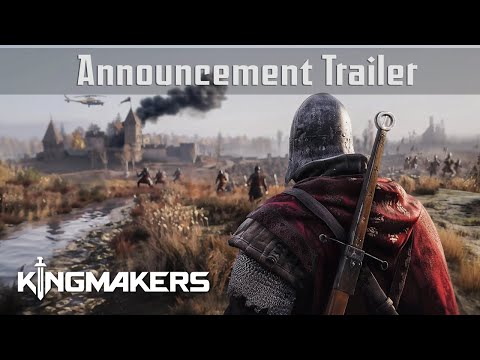
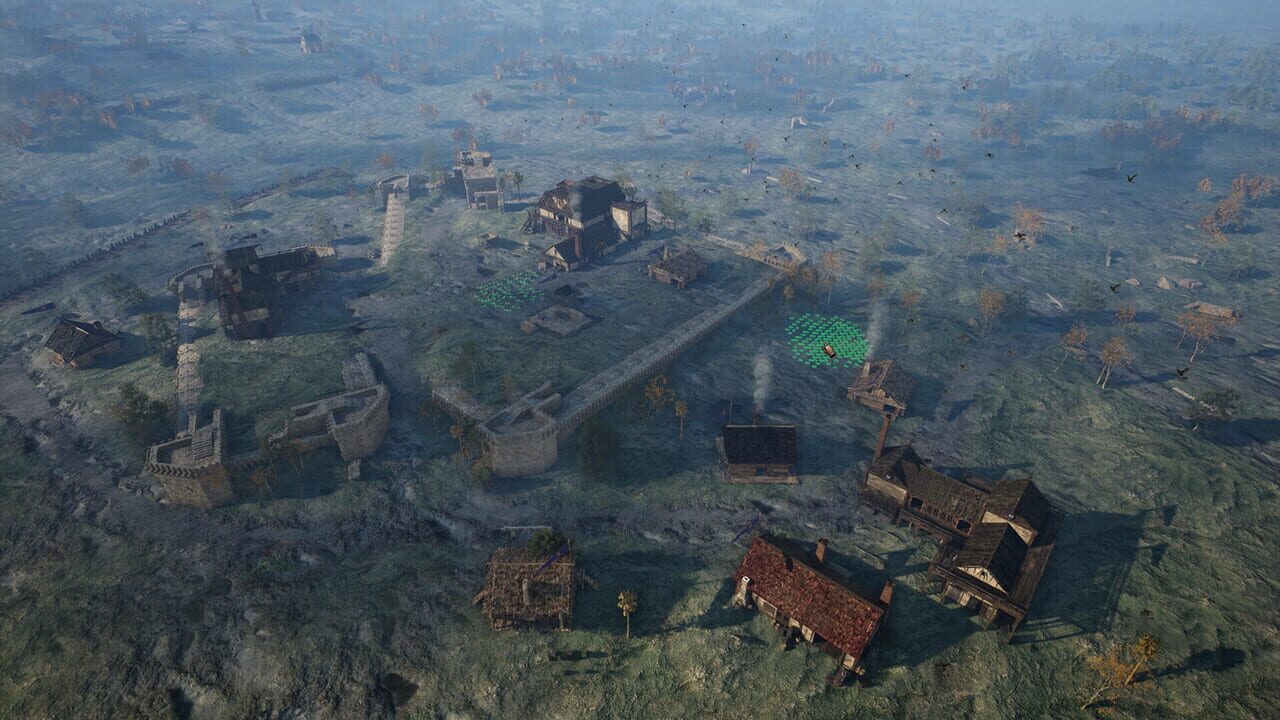
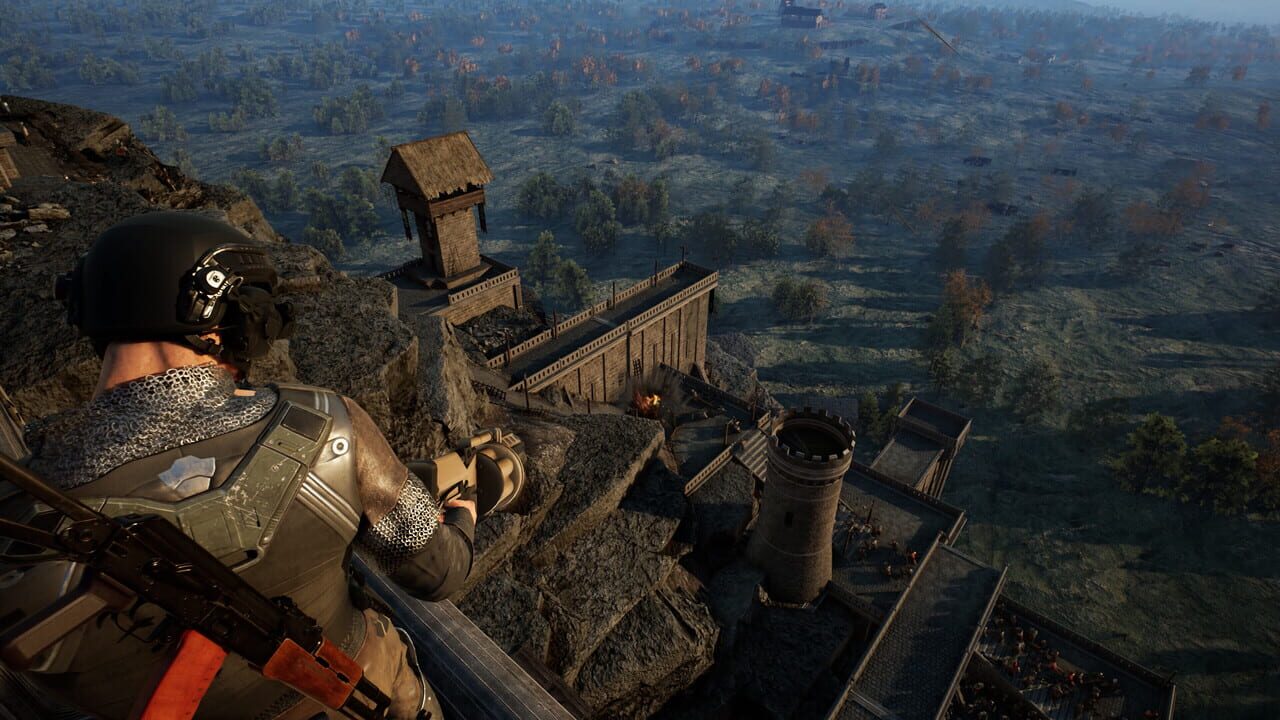
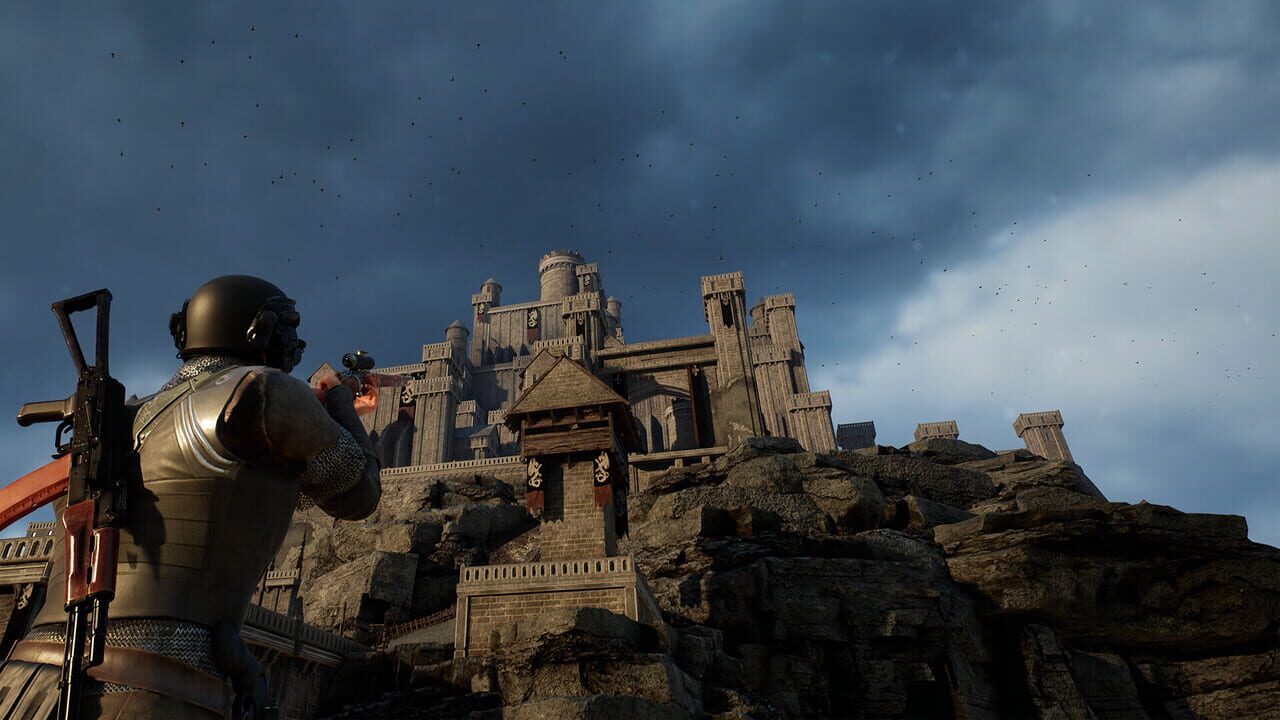
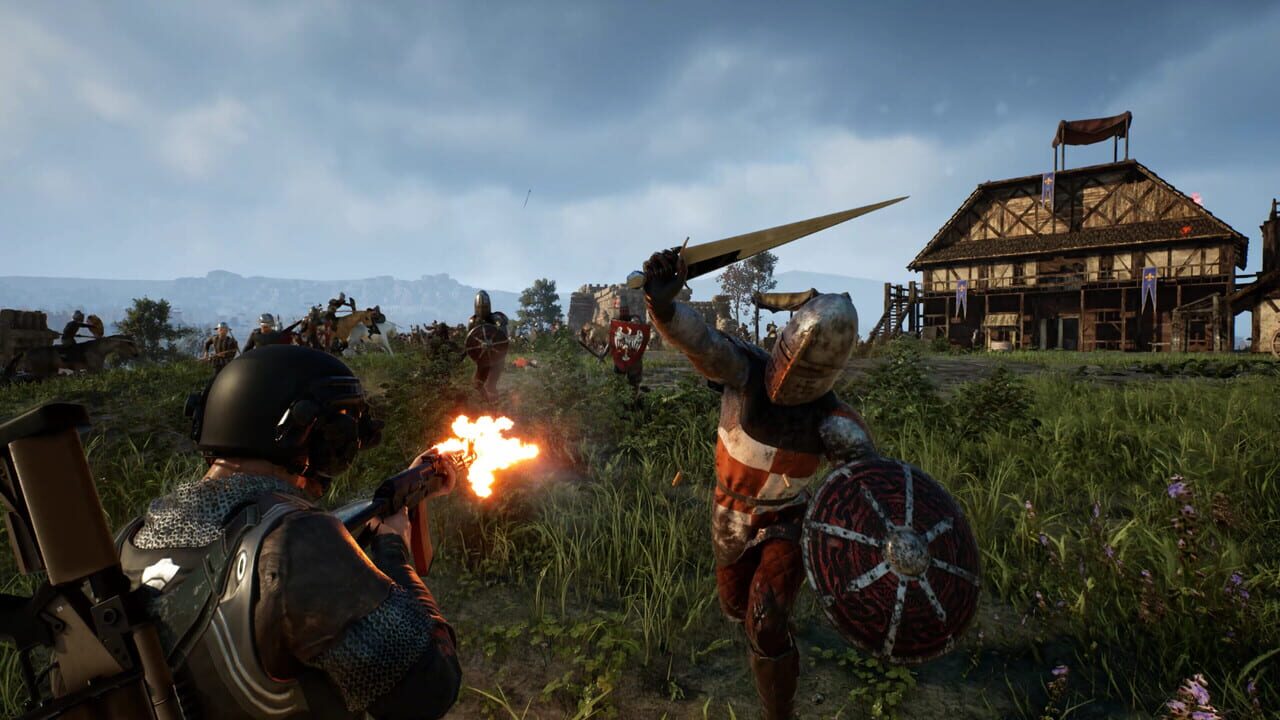
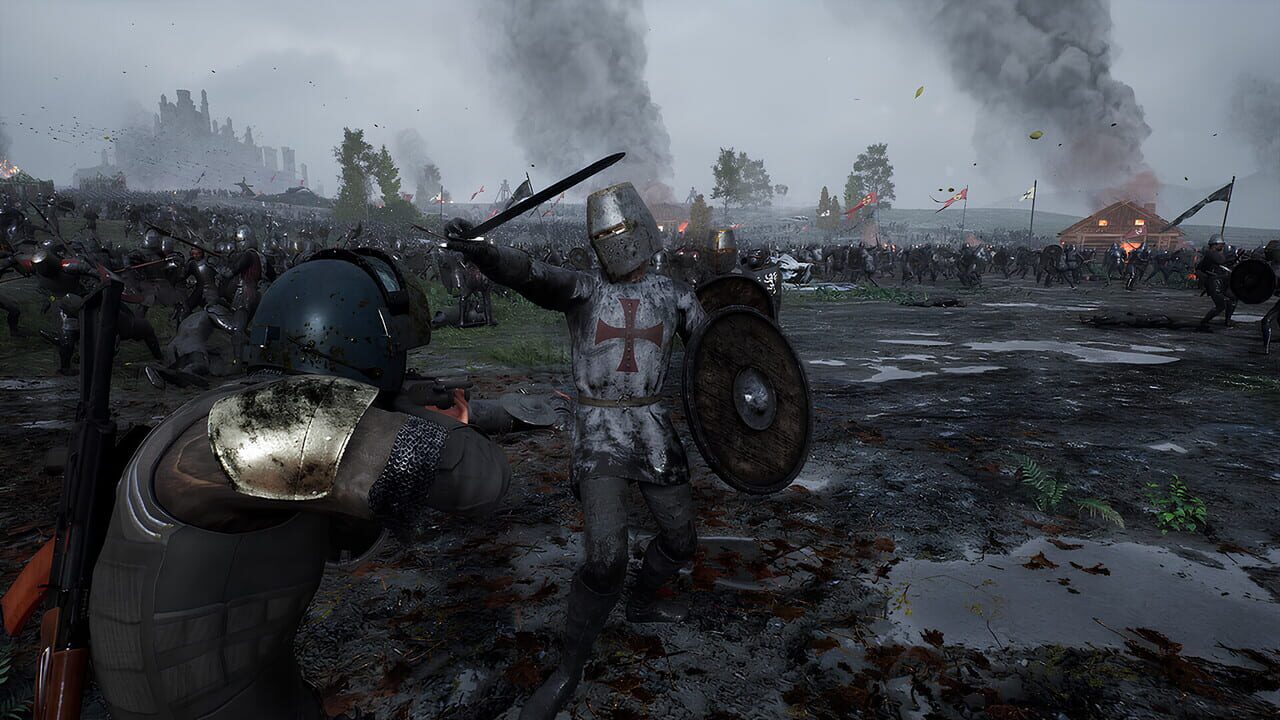
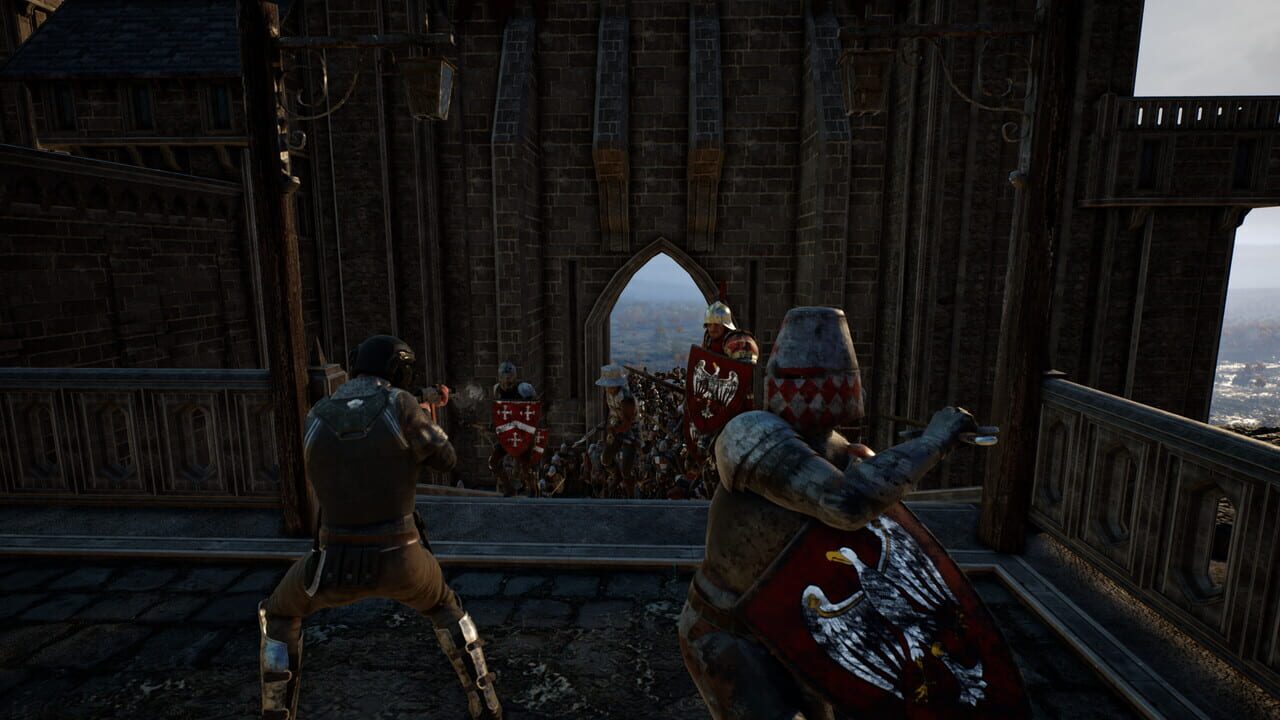
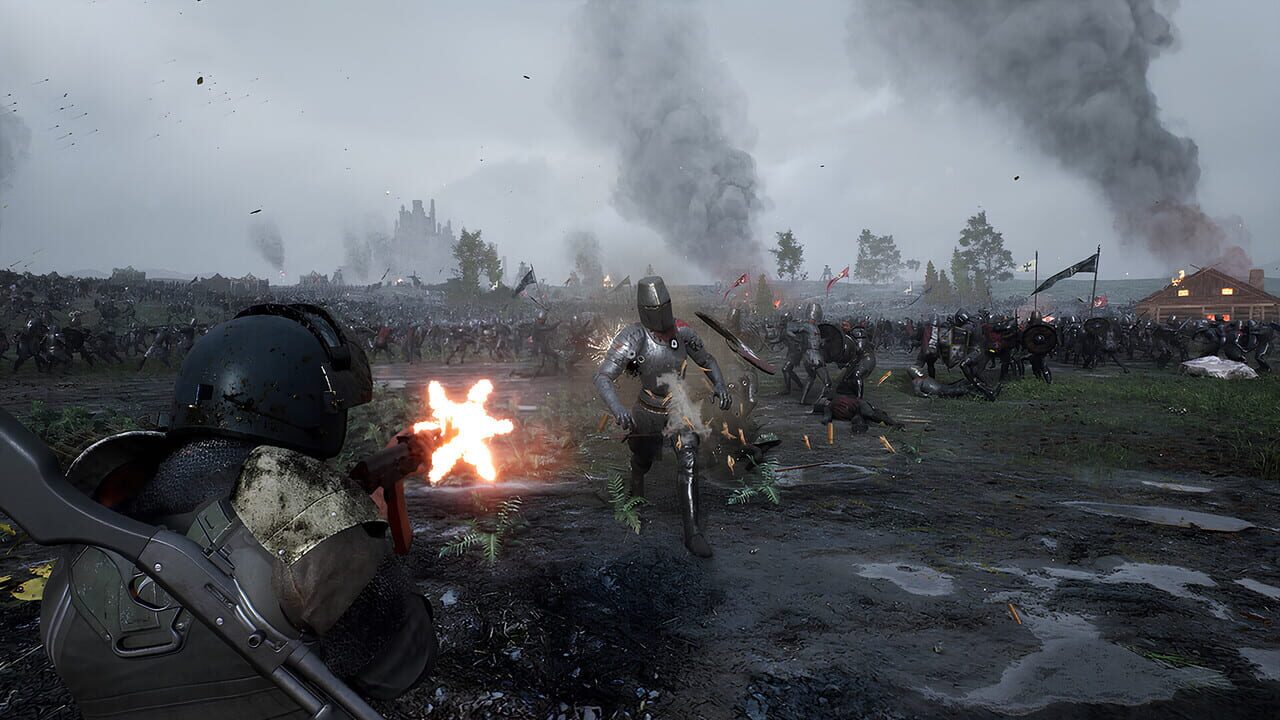
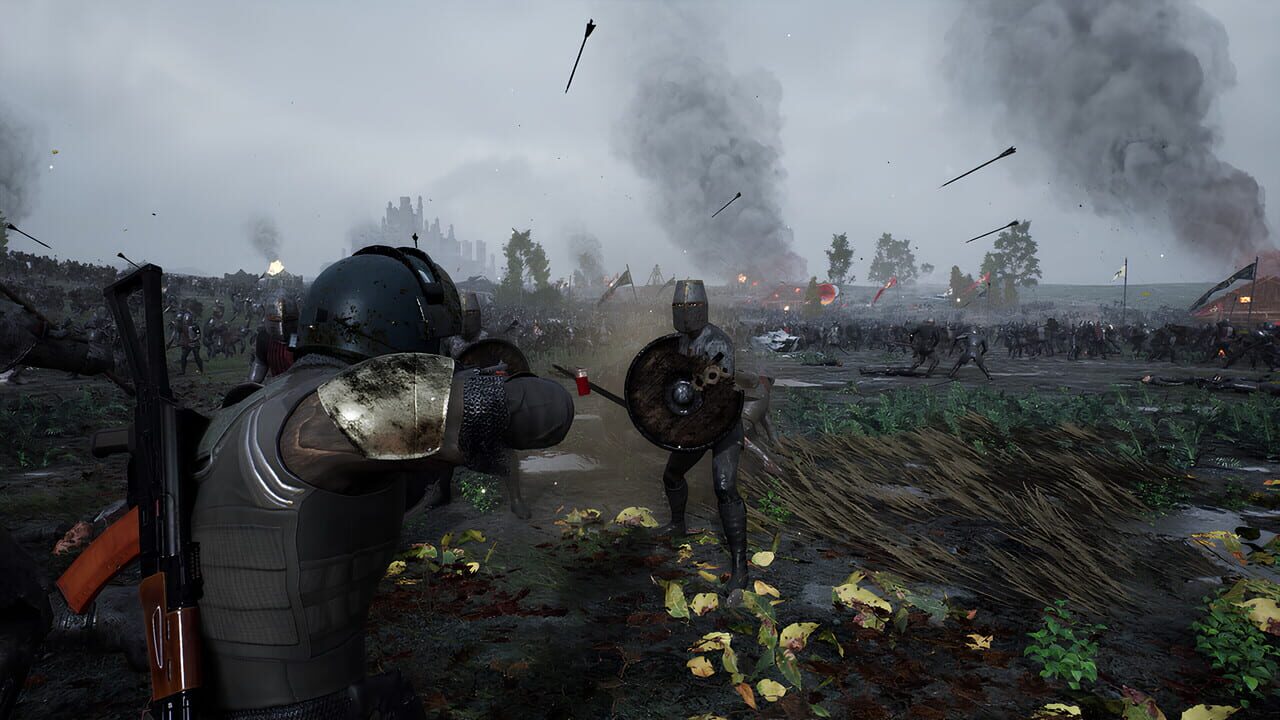
The trailer holds on a longbowman for exactly as long as it takes him to nock, draw, and release. Then the frame he is standing in erupts, not from an arrow but from a rifle round fired by a man in modern tactical gear standing where no man in modern tactical gear has any business standing, in a muddy field in the year 1400. The bowman goes down. The line behind him does not know what just happened to him, only that it happened very fast and from a distance no bow could reach. Cut to a pickup truck fording a river next to a formation of billmen. Cut to a helicopter over a castle that has never seen a flying object bigger than a trebuchet stone. Cut to the title. This is Kingmakers, from Redemption Road Games, and the premise is stated so directly it barely needs restating: a modern special-forces operative is thrown five hundred years into the past, into a fractured medieval Britain, with an armory the fourteenth century has no name for and no defense against. He can fight from behind a rifle sight or step back to a top-down view and command his own medieval army, cavalry and archers and men-at-arms, against forces the game intends to be large. The lens here is History & Memory, because the question Kingmakers keeps asking, whether it means to or not, is what happens to the past when the present is allowed to walk into it carrying a weapon. That question has a real name. It is counterfactual history, sometimes called virtual history or alternate history, and it is a stranger discipline than its pulp reputation suggests. It is also a genuinely contested one. Historians have spent the better part of a century arguing about whether asking "what if" is a serious method of inquiry or an indulgence dressed up as one, and Kingmakers, without citing a single one of them, has built its entire premise on one side of that argument taken to its most literal extreme. Most alternate histories ask what would have happened if a single variable had gone differently: if the Persians had won at Marathon, if Sarajevo in 1914 had gone. Kingmakers doesn't tinker with a variable. It drops an assault rifle directly into the equation and asks the same question with the subtlety filed off. What happens to the medieval battlefield when the one thing every actor on it agrees is true, that a sword's reach and a bow's range describe the outer limit of danger, simply stops being true. The case for taking this question seriously starts, unhelpfully, with the case against taking it seriously at all. E. H. Carr, in his 1961 lectures published as What Is History?, dismissed the entire enterprise in one line that has followed the field around ever since: "one can always play a parlour game with the might-have-beens of history. But they have nothing to do with history." Carr's objection wasn't that counterfactuals are fun, which he conceded, but that they are unfalsifiable. History happened once. Nobody can run the Battle of Agincourt again with the wind from the other direction and check the result. Any claim about what would have happened is a claim about a world that does not exist and never will, dressed in the evidentiary language of a world that does. Niall Ferguson's answer, in the 1999 essay collection Virtual History, is the fullest defense the discipline has, and it is worth taking on its own terms rather than as a punchline. Ferguson's argument is not that counterfactuals are true. It is that historians rely on them constantly whether they admit it or not, every time they use a word like "caused," "necessary," or "inevitable," because each of those words is a comparison against an alternative that didn't happen. To say the assassination in Sarajevo caused the war is to imply a counterfactual: that without it, in that specific configuration of alliances and mobilization schedules, no war, or at least not that war. Ferguson's discipline for doing this responsibly is that a counterfactual only counts if it stays within what contemporaries themselves considered plausible. Not any story you can imagine. Only the branches that were actually visible, as live possibilities, to the people standing at the fork. Ferguson's own contributors take the discipline seriously enough to make it dull in exactly the way good historical argument is supposed to be dull. One essay in the collection asks what would have happened had Britain stayed out of the First World War in August 1914, a question grounded in cabinet papers showing the decision to intervene was genuinely contested at the time, not a foregone conclusion dressed up afterward as one. The counterfactual there does real work precisely because it stays inside the room where the actual decision was made, with the actual information the actual people had. Nobody in that cabinet was choosing between war and an assault rifle. Kingmakers fails that discipline instantly and says so with its own trailer. No one standing on a medieval battlefield in 1400 considered an assault rifle a live possibility, because gunpowder small arms of any kind were roughly a century away from that field and effective ones the better part of two. This is not Ferguson's counterfactual. It is the other kind, the kind historians have a much less patient name for: presentism, the fantasy of dropping the present into the past to see it win. And this is exactly why Kingmakers is a more interesting object than either its trailer or its detractors are likely to give it credit for, because presentism has its own honest use, and the use is diagnostic. If you want to know what a system was actually made of, put a small, extreme force into it that the system was never built to withstand, and watch which parts of the old order buckle first and which parts hold anyway. The assault rifle in Kingmakers is not a fantasy. It is a measuring instrument, and what it measures is how much of medieval battle was never about individual lethality in the first place. Here the popular picture of medieval warfare needs correcting, because the trailer is trading directly on that popular picture and the correction is the most useful thing this essay has to offer a reader who has never had reason to think about any of this before. The image most people carry of a medieval battle, courtesy of film and, yes, of games, is a heaving brawl: two great crowds of armored men colliding and hacking at one another until one side runs out of bodies. On that image, a modern rifle is simply a faster sword, mowing down a line of men who would otherwise have died the same way, just more slowly and with more grunting. That image is close to entirely wrong, and the correction runs through three things historians actually know about how these battles worked: how many people died, how battles were actually decided, and how large they actually were. Start with the deaths. The chronicle sources for battles like Towton, fought on Palm Sunday in 1461 during the Wars of the Roses and remembered as the bloodiest battle fought on English soil, are notoriously unreliable on numbers. Medieval chroniclers were not statisticians; a body count in a chronicle was a rhetorical device meant to convey magnitude and moral weight to God and to posterity, not a field tally, and modern historians treat those figures as inflated by a wide margin as a matter of course. What has actually been counted are bones. In 1996 a mass grave near the Towton battlefield was excavated and its remains studied by an interdisciplinary team, published as Blood Red Roses in 2000 and again in an expanded 2007 edition. The skeletons tell a story chronicles cannot: men with old healed wounds from previous fights, men killed by catastrophic blows to the head and face rather than the tidy sword-thrusts of illustration, and a striking number of wounds inflicted after the victim was already down or already dead, consistent with a rout being run to ground rather than a stand-up fight being fought to its conclusion. Historians working from comparable evidence across medieval Europe generally put battle casualty rates for the winning side in the low single digits to perhaps ten or fifteen percent, with the losing side taking dramatically more, sometimes catastrophically more, but concentrated overwhelmingly in the collapse, not the clash. The armor itself supports the same conclusion from a different angle. Plate harness by the fifteenth century was expensive, well-fitted, and, against the weapons it was designed to defeat, genuinely effective; the archaeological study of the Towton dead found that a disproportionate number of the fatal wounds were to the head and face, the parts a fully armored man could not fully protect and the parts an enemy went looking for once a fight had stopped being a formation contest and become a hunt. That detail alone undercuts the tidy image of sword blades finding their mark through plate at a stately, one-on-one pace. Most of the men in that grave were not out-fought by better swordsmen. They were caught after their line had already come apart, which returns the argument to the same place: the line coming apart, not the swordplay, was the event that decided who lived. That asymmetry, low losses while the lines hold and catastrophic losses once they don't, is the second correction, and it is the one that actually explains why the winning side's casualties stay low. Medieval battle was not, primarily, a contest of individual killing power. Philippe Contamine's War in the Middle Ages, still the standard synthesis of the field, describes the medieval engagement as a test of collective nerve conducted at close range: two armed masses pressing against each other, each man's willingness to keep his place propped up by the men beside him, until one side's formation loses its shape, and the moment it does, the killing that follows bears almost no resemblance to the killing that came before. John Keegan's The Face of Battle, published in 1976 and still the founding text of what became known as "history from below" in military history, makes essentially the same argument about Agincourt in 1415: the men on that field were rarely fighting for their lives against a stranger's blade for very long. Mostly they were straining to keep formation against pressure, watching the men immediately around them for the first sign of buckling, because a formation is not a wall, it is an agreement, and agreements can be broken by fear faster than they can be broken by force. The nineteenth-century French officer Ardant du Picq, writing after his own experience of Napoleonic-era combat, coined a version of the same idea that later military sociology, particularly S. L. A. Marshall's postwar interviews with combat veterans, would formalize: men fight, when they fight at all, mostly for the four or five men standing closest to them, and units break not when their weapons fail but when that small social bond fails first. This holds up remarkably well across a stretch of history that runs from the pike square to the trench, and there is no obvious reason to think it stops applying at the treeline of a fifteenth-century battlefield. If cohesion, not lethality, decided most medieval battles, then Kingmakers' rifle is doing something more specific than the trailer's shock cut implies. It is not simply killing faster. It is attacking the thing medieval combat actually depended on, which is the ordinary soldier's working assumption about what danger looks like and where it comes from. A man in a shield wall in 1400 has a stable mental model of the fight he is in: the enemy is in front of him, roughly arm's length to spear's length away, and the danger scales with how close that enemy gets. A rifle collapses that model instantly, because the man who kills you can be a hundred meters away and invisible, and the physical courage that got you into the line in the first place, the courage to stand at arm's length against another man's blade, offers no protection at all against a threat with no arm's length to speak of. This is presentism doing real diagnostic work almost by accident. The trailer wants a spectacle. What it has actually built, whether the studio intended the essay-length version of the argument or not, is a demonstration that medieval battle's real vulnerability was never armor thickness. It was the fragility of a shared, local, face-to-face model of where danger comes from, a model gunpowder would go on to dismantle for real, just on a timeline measured in generations rather than in a single afternoon. The scale question is the third correction, and it is where the game's other half, the strategy layer commanding cavalry and archers and men-at-arms against forces the studio has described as large-scale, runs into a genuinely different problem, one that has nothing to do with history and everything to do with the architecture of human attention. Medieval chroniclers routinely inflated army sizes for the same rhetorical reasons they inflated casualty figures, and Clifford Rogers' work on the military transformations of the Hundred Years' War has done much of the patient work of deflating those figures back toward what late-medieval logistics could actually support: armies that mustered, moved, and were fed as a coordinated force, which capped practical field strength well below the tens of thousands that chronicle prose liked to claim. A "massive, real-time simulated battle" in a game, by contrast, is under no such constraint. It can put a thousand individually modeled combatants on a field, because a modern engine can compute a thousand positions and a thousand animation states without much strain. The player cannot compute them at all. This is not a metaphor. It is a hard limit on human visual attention, and it has a name in the cognitive-science literature: the psychologist Zenon Pylyshyn's work on multiple-object tracking found that people can maintain focused, individuated attention on roughly three to four moving objects at once before tracking accuracy collapses. Related work on numerosity, summarized by Lisa Feigenson, Stanislas Dehaene, and Elizabeth Spelke, draws a similar line around the same number: below about four items, the visual system knows exactly how many things it's looking at, instantly and without counting. Above that number, it stops counting and starts estimating, trading precision for a rough impression of "many" or "very many." A battlefield of a thousand simultaneous combatants is not a scene a human being can perceive as a thousand individuals. It is a scene a human being perceives as a texture, a crowd, a mass with a rough shape and a rough direction, the same way a beach is not perceived grain by grain. Every game that stages a mass battle, Kingmakers included, is therefore solving a problem its own engine doesn't have: not how to simulate a thousand soldiers, which is comparatively easy, but how to represent a thousand soldiers as something a single pair of human eyes can actually read as a battle rather than as noise. The formations, the banners, the color-coded unit blocks, the deliberately legible silhouettes, all of that apparatus exists to translate a swarm the computer can track perfectly into a shape the player's visual system, capped at four objects of real attention, can hold onto at all. The rifle scope, notably, solves the opposite problem: it takes the unmanageable crowd and hands the player back exactly one target at a time, which is very likely why the power fantasy of dropping a modern weapon into that crowd feels so immediately, viscerally legible in a way that commanding the crowd itself does not. There is an obvious objection to reading this much into a game whose marketing leads with a truck fording a river next to a column of billmen, and it deserves a straight answer rather than a shrug. The obvious objection is that nobody involved in making Kingmakers was thinking about Ferguson, Carr, or the disposition of skeletons at Towton. That is almost certainly true, and it does not weaken the argument, because the argument was never that the studio built a historiography seminar by design. It is that the fantasy they did build, deliberately and for spectacle, cannot help but stage the same structural questions the historiography argues about, because both are answering the same prompt: given the actual conditions of a fifteenth-century battlefield, what would break it. A blockbuster trailer and a peer-reviewed journal article can arrive at the same diagnostic question from opposite motives, one chasing a cool shot, the other chasing a defensible claim, and the question is no less real for having been reached by accident. The game's own strategy layer, which asks the player to choose a side among England, Scotland, and Wales and then hold a fractured, contingent political map together with cavalry and archers before the rifle ever enters the frame, is itself a small, unglamorous acknowledgment that the medieval world it is about to blow up was not a monolith waiting for a foreign army with better guns. It was already a contest of loyalties, terrain, and supply, the ordinary stuff of Rogers' infantry-and-artillery thesis, being decided the ordinary way right up until the trailer's one extraordinary interruption. Put the two halves of the game back together and the joke in the title of this essay stops being only a joke. Kingmakers is built on a chronological violation that real historiography has spent a century deciding how seriously to take, and it lands, without much apparent interest in the argument, on the side that treats the past as a weaker draft of the present: a fifteenth-century army as a problem the twenty-first century simply outguns. That is presentism's oldest and least flattering habit, the "we would have won" fantasy that Carr's parlour-game line was aimed at in the first place, the idea that our tools are what the past was really missing rather than one part of a longer argument about contingency, logistics, and collective nerve. But presentism, taken seriously as a diagnostic rather than a boast, also does something a straight historical simulation could not: it isolates the variable. Give a fifteenth-century battlefield a weapon a fifteenth-century mind has no model for, and the parts of the old order that break first tell you, more precisely than any chronicle, what the old order actually was. Not armor. Not swordsmanship. A shared, local, trusting sense of where danger lives, propped up by the four or five men standing closest to you, and legible enough for an ordinary soldier's eyes to read as a battle rather than a blur. That, and not the rifle, was always the real subject. Somewhere in that muddy field the trailer keeps returning to, the line behind the fallen bowman still doesn't know what killed him. In a week, if the drills that built that line meant anything at all, they will have a name for it, a story, a rumor passed down the ranks about the man with the thundering stick who came out of nowhere. That rumor, not the gun itself, is the part a fifteenth-century army actually knew how to survive.
Tuesday analysis
A Game Whose Entire Joke Is Being in the Wrong Century
- Writer
- J. A. Marsh
- Lens
- History & Memory
- Published
- APR 24, 2026
- Length
- 3,221 words / 14 min
- Notes
- 12 sources
The assault rifle is not a fantasy. It is a measuring instrument, and what it measures is how much of medieval battle was never about individual lethality in the first place.