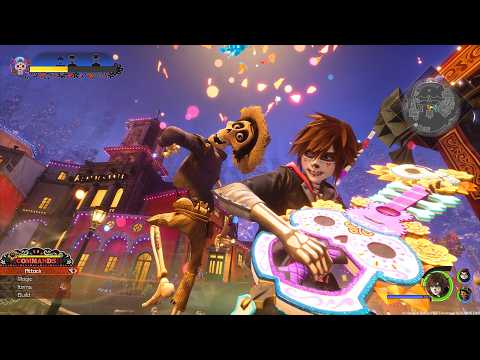


In the trailer that announced Kingdom Hearts IV in April 2022, Sora wakes in a city that looks nothing like the twenty years of Kingdom Hearts that preceded it. The place is called Quadratum, and it is rendered in a flat, photographic realism: real skyscrapers, real traffic lights, rain on real asphalt, a skyline that could be Tokyo or Yokohama on an overcast afternoon. For a series whose entire visual grammar had been the collision of cartoon worlds, worlds drawn in the house style of one animation studio after another, the shift to a city that looks like a photograph reads as a thesis. Sora, the spiky-haired boy who has spent two decades walking through hand-drawn kingdoms, has washed up somewhere that is trying very hard to look like the actual world. And then a familiar shadow moves across the actual-looking sky, and the boy summons the Keyblade, and the myth resumes.
Kingdom Hearts is the strangest object in mainstream video games, and its strangeness is easy to miss because the series has been around long enough to feel ordinary. Consider what it actually is. It is a sincere, decades-long, emotionally unembarrassed mythology, a story about light and darkness and the hearts that hold both, about memory and its loss, about friendship as the one force that survives the dark, and it is assembled entirely out of characters that belong to corporations. Donald Duck and Goofy walk beside Sora because the Walt Disney Company permitted it. Cloud and Sephiroth pass through because Square owned them. The worlds Sora visits are the intellectual property of a film library: Agrabah, Halloween Town, the coliseum where Hercules trained, and in later entries the toy room from Toy Story and the mountain from Frozen. Nothing in the mythology is in the public domain. Every figure in this pantheon has a rights-holder.
For a large cohort of players, most of them children when they first met it, this licensed crossover was not a curiosity. It was a genuine formative mythology, possibly the first one they had. It furnished the categories: this is what good looks like, this is what evil looks like, this is what it costs to lose a friend to the dark and what it means to go after them anyway. This essay takes that seriously, because it is true and because mocking it is lazy. The frame it wants to offer is this: Kingdom Hearts is a folk mythology produced by a culture that no longer has a folk, only rights-holders. It is what the oldest human activity, the communal telling and retelling of shared stories, looks like after the shared stories have all been bought.
It is worth being specific about how well the mythology works, because the argument depends on conceding its sincerity. The story a child receives from the early Kingdom Hearts games is not thin. Its cosmology is legible and strange: hearts are real objects, darkness is a place as much as a condition, and a weapon shaped like a key can lock and unlock the passages between worlds. Its emotional center holds. Sora, Riku, and Kairi are three children on an island who want to leave it, and the wanting scatters them across the dark, and the rest of the series is the long work of finding each other again. The later games complicate this to the edge of incoherence, folding in duplicated selves, rearranged memories, a villain who is also a mentor who is also several people. But the core furniture, the light, the dark, the heart, the friend worth crossing the dark for, is durable, and it lodged. A generation learned an early grammar of loss from a game in which Donald Duck is a court magician.
Roland Barthes, in Mythologies (1957), gave the mechanism its clearest description, though he was writing about detergent advertisements and the face of Greta Garbo rather than about a Japanese role-playing game. Myth, for Barthes, is a second language laid over a first one. It takes a thing that already means something, a rose, a photograph, a wrestler, and empties that first meaning out, keeping only the form, then fills the form with a second meaning that presents itself as natural and eternal. The trick of myth, its quiet politics, is that it turns history into nature. It makes something manufactured and specific and datable appear timeless and given. Barthes's word for what myth does to its raw material is that it drains it: the object arrives with a history and leaves as an essence.
Kingdom Hearts performs this operation on the corporate catalog with a thoroughness Barthes could not have imagined. Mickey Mouse, whose first-order meaning is a trademark, the corporate signature of a media conglomerate, one of the most reproduced images ever made, arrives in Kingdom Hearts drained of that meaning and refilled as King Mickey, a small robed figure of wisdom and light. The commercial history is emptied out; the mythic essence is poured in. The child playing does not experience a portfolio of licensed assets. The child experiences a pantheon. And this is exactly Barthes's point: the work of myth is to make the maker vanish, to make you forget that someone drew the thing, and owns it, and sells it. Myth hides the copyright notice. Kingdom Hearts is not a cynical instance of this; it is a sincere one, which is what makes it the purest instance. Its makers plainly believe in the pantheon. Sincerity is what makes the copyright notice disappear.
There is an older name for the impulse Kingdom Hearts satisfies. Before it was a franchise it was a thing children do with whatever figures they have. The child who lines up the action figures from unrelated stories and makes them share a single adventure, the one where the space soldier and the dinosaur and the borrowed doll fight the same enemy and become friends, is performing the native gesture of folk mythology. Folklore has always worked by collision and recombination: the traveling motif, the borrowed god, the local saint who is an older deity in new clothes, the fairy tale that exists in four hundred versions because everyone who told it changed it. The crossover is not a debased modern form. It is the oldest form. What a generation of children wanted, the meeting of every beloved figure in one story about good and evil, is what people have always wanted from myth.
The difficulty is that the figures a recent generation of children love are no longer in the commons. The space soldier is owned. The dinosaur is owned. The princess is a specific rendering owned by a specific studio, not the freely retold Cinderella of the folk but the 1950 Cinderella of a company that will litigate. So the crossover that folklore performed for free, by simply retelling, cannot be performed at all without permission. Kingdom Hearts is the exception that shows the shape of the rule. It is the childhood crossover play, the mashing together of every owned figure into one myth, executed at the only level where it is legal: the level of the licensing agreement between two corporations. It is fan fiction that obtained clearance. It is the folk process routed through a contract.
Henry Jenkins, in Convergence Culture (2006), mapped the participatory hunger this speaks to. Jenkins described a media environment in which audiences no longer sit still, in which fans pursue their stories across every platform and, given any opening, produce their own extensions, crossovers, and retellings. The impulse he documented, the fan's desire to see the beloved characters meet and to have a hand in the meeting, is the same impulse folklore ran on. But Jenkins was optimistic in a way the intervening decades have complicated. The largest crossovers, the ones a whole culture shares, cannot be made from below. A fan can write the meeting of two owned characters and post it, and be tolerated or served a takedown, but the fan cannot make it canonical, cannot make it the version. Only the rights-holders can do that. Kingdom Hearts is what the participatory impulse looks like once it has been captured and returned to its audience as a finished product. It gives the fans the crossover they craved, on the condition that they receive it rather than make it.
And the number of hands that can grant the permission keeps shrinking. In the years Kingdom Hearts has existed, the ownership of the culture's shared characters has consolidated at a pace that would have seemed like satire a generation earlier. The Walt Disney Company bought Pixar in 2006, Marvel in 2009, Lucasfilm in 2012, and the entertainment assets of 21st Century Fox in 2019. A single corporation came to own the mouse, the superheroes, the space saga, and a great deal else, and Kingdom Hearts III duly added the Pixar worlds to its pantheon, because the pantheon and the portfolio had become the same list. The industry even has a word for the memory-control this ownership permits. The vault: the practice of withdrawing a title from circulation, locking it away, releasing it only in engineered windows, deciding on the culture's behalf what it is allowed to remember and when.
Lewis Hyde, in Common as Air (2010), wrote the history this belongs to. Hyde's subject is the cultural commons, the shared stock of stories and images and ideas that older societies understood as belonging to everyone and no one, and its steady enclosure by an ever-lengthening reach of ownership. He is fond of Jefferson's image: to receive an idea from another is to light your taper at their flame, taking the light without darkening them. Ideas, in that older understanding, were the one kind of property that could be given without being lost. The enclosure Hyde describes is the reversal of that understanding, the fencing of the flame. And the deep irony he traces is that the companies most protective of their enclosures are often the ones that drew most freely from the commons while it was open: the studio whose empire was built on Grimm and Andersen and Collodi, on Cinderella and Pinocchio and the Snow White of the folk, is the same studio that lobbied to keep its own versions locked for most of a century. Kingdom Hearts is a mythology built entirely inside the enclosure. There is not a single figure in it that a child could lawfully retell.
Walter Benjamin worried, in 1935, that mechanical reproduction would strip art of its aura, the singular presence a thing has when there is only one of it, here, now. The licensed character is the far end of the process he saw beginning: reproduced past counting, stamped on every possible surface, without a here or a now, the same everywhere. And yet Kingdom Hearts does something Benjamin might have found instructive. It takes the most reproduced images on earth and gives them back an aura, embeds them in a single, weighty, unrepeatable story, and the child who meets Mickey inside the myth meets him as if for the first time, as if there were only one. The mass-produced commodity is re-enchanted by being set inside a mythology. This is not nothing. It may be the truest cultural work the series does. It also depends completely on the reproduction it briefly transcends, because there would be no myth to build if the images were not already in every child's eye.
The reason this reaches past one series is that most of the reader's own shared mythology is now in the same condition. The superheroes that furnish the current common story of good and evil are owned. The space saga is owned. The wizard's school is owned. The interlocking film universe that a decade of audiences treated as a modern pantheon is a single company's release schedule. What Kingdom Hearts offers is only the purest, most naked case, because it is the one that admits what it is. The interlinked superhero films maintain the fiction of separate stories that happen to connect; Kingdom Hearts never pretended. It stood up at the start and said, plainly, that its gods were licensed, and then it went ahead and built a sincere religion out of them anyway. Its honesty is the source of its strangeness. It is the only mythology of its scale that never hid the contract.
What it means for a generation to have received its first myth this way is not simple to weigh, and the essay does not want to pretend the weighing is obvious. Something is genuinely gained: the myth is real, the loss it taught was real, the friendship it modeled furnished real interior lives. And something is lost that the child could not have seen: the myth cannot be given onward the way myths were given, cannot be retold and altered and made one's own and handed to the next teller, because it is not the child's to hand. The folk could always add to the story. The audience can only receive it and wait for the next installment, which arrives when the rights-holder decides, in the art style the rights-holder chooses, having spent the intervening years in the vault.
Which returns us to Quadratum, and to the Keyblade the boy raises in that photographic city. The weapon is shaped like a key, and its function across the whole series is to lock and unlock the passages between worlds, to open what is closed and seal what should not be entered. It is difficult, in 2026, not to read the shape as the argument. A generation was handed a myth about a key that opens locked worlds, built from worlds that are locked, owned, held in a vault, openable only by their owners. The boy in the real-looking city lifts the key, and the myth resumes, and it is genuinely moving, and every figure it moves the player with belongs to someone else. That is the condition the game is honest about. The first mythology a generation owned, in the sense of held and loved and carried, was owned, in the other sense, by somebody who licensed it out. Both meanings are true at once. Kingdom Hearts is the rare object that lets a person feel them as the single fact they are.