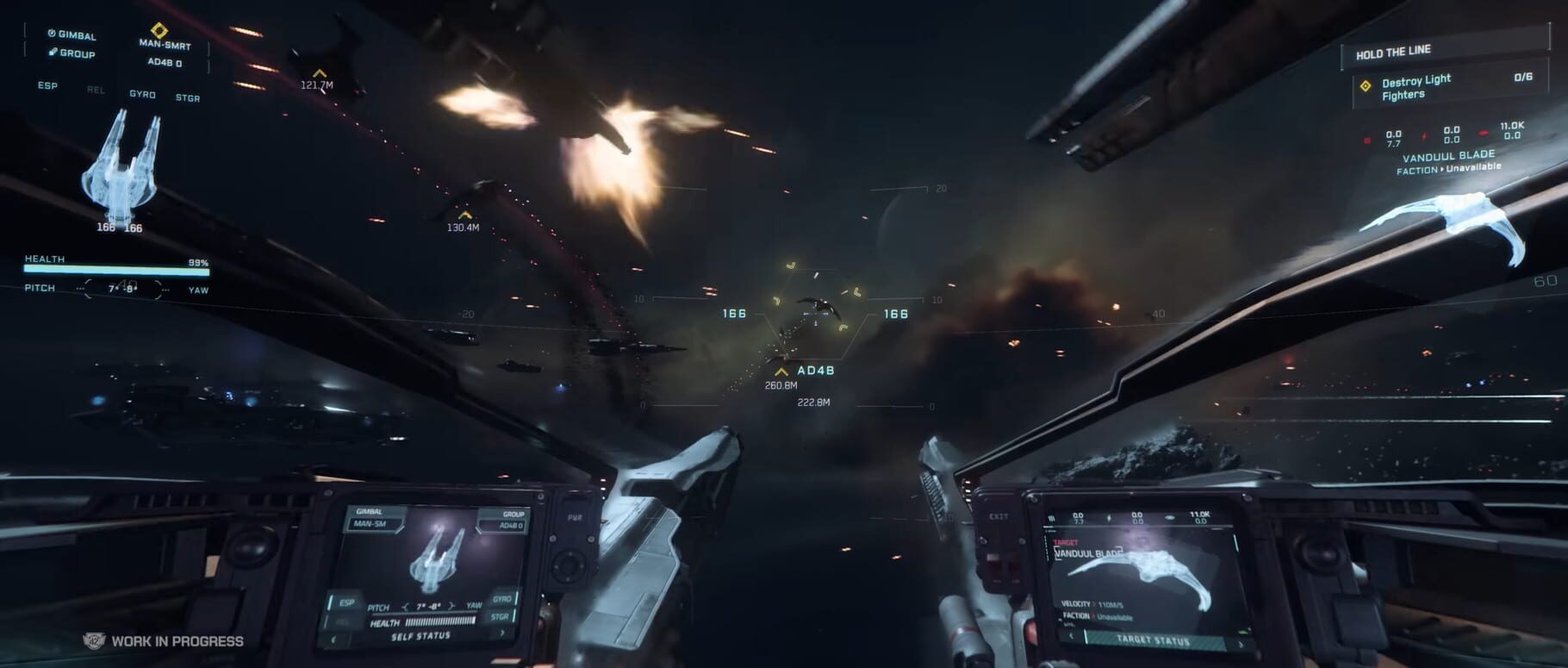

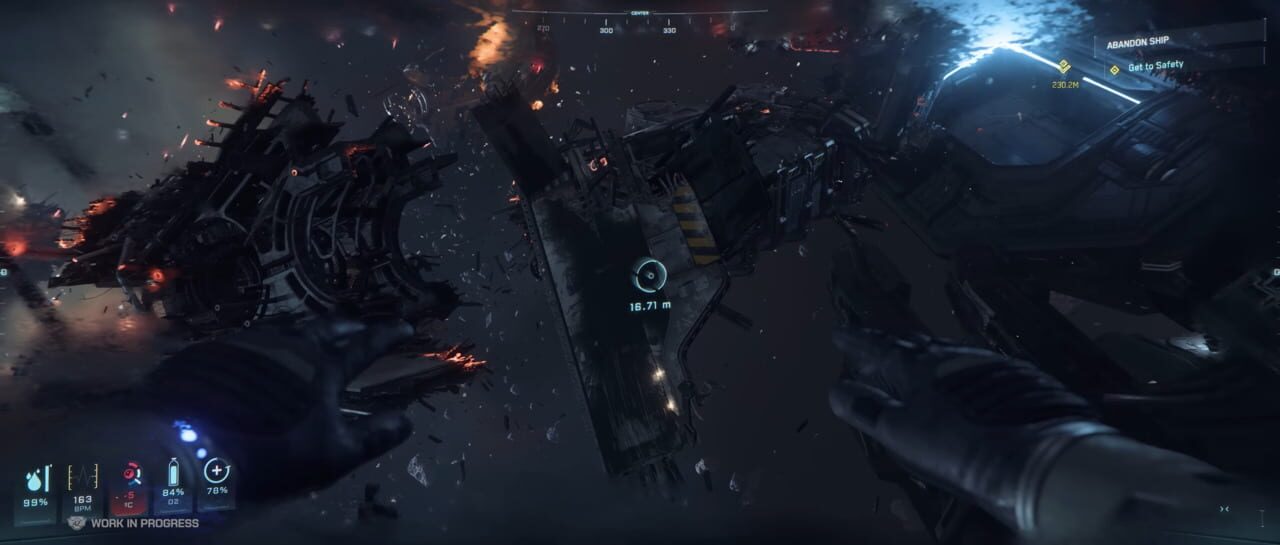



On October 18, 2012, a page went up on Kickstarter asking the public for $500,000. The pitch was for a computer game called Star Citizen, and folded inside that pitch, described almost as a bonus, was a second promise: a single-player campaign called Squadron 42, built as what its creator, Chris Roberts, called a spiritual successor to his own Wing Commander series from the 1990s. Stretch goals attached to the pitch as the total climbed promised a richer story and, eventually, forty-five playable missions. The initial goal was met within a day. Cloud Imperium Games, the studio Roberts had built specifically to make the game, had already been running a second funding drive on its own website since October 10, with a separate target of $2 million. By November 19, when the Kickstarter closed, the combined total across both campaigns had reached $5.5 million, of which the Kickstarter platform itself accounted for a little over $2.1 million, and the production estimate attached to the pitch pointed to a finished game around 2014.
That page is the right place to begin, not because the sum on it was large. Set against what came after, it is almost nothing. It is the right place to begin because everything the transaction would become was already present in miniature: a specific amount of money, a specific promised object, a specific delivery window. What happened to that transaction over the following fourteen years, and what accumulated in its place, is the actual subject here, and it is not a question about what kind of game Squadron 42 will turn out to be. It is a question about what several million people built with a studio that has spent more than a decade not finishing it, which makes it a question about an audience and its money before it is a question about spaceships: the kind of question that belongs to the study of what groups of people do with sustained, voluntary, collective commitment, rather than to the study of software delivery. Anyone who has ever kept paying dues to a club whose purpose had stopped matching what the dues technically bought has already lived a smaller version of the arrangement this essay is describing.
Fourteen years on, the amount is no longer almost nothing. The total did not arrive at once. It passed $170 million by December 2017, $300 million by June 2020, $400 million by November 2021, and $500 million by September 2022, each threshold announced by the company and marked by its backers less like a quarterly earnings call than like a parish reaching a fundraising target for a new roof: publicly, cumulatively, with the running total treated as a shared achievement rather than a private business metric. On May 24, 2026, that same running total, still displayed on Cloud Imperium's own site, crossed $1 billion, raised entirely from individual pledges rather than from a publisher or outside investors, which makes it, by a wide margin, the largest sum of money ever assembled by a single videogame outside a publisher's balance sheet. The company's own figures, checked at the end of December 2025, had put the total at $928,446,689 from more than 6.19 million accounts. Five months later the total had cleared a billion and the account count had passed 6.5 million, though Cloud Imperium has never disclosed how many of those accounts represent people who paid for anything at all, as opposed to a free registration made once and never returned to. The figure the company advertises has always measured accounts, not customers, and the company has never claimed otherwise.
The mechanism behind that final push past the billion mark rewards a closer look, because it happened on the same day the counter passed a billion. Cloud Imperium opened sales that day of a new ship called the Anvil Odin, a battlecruiser seven hundred and fifty-two meters long, priced at $5,000, with a variant at $5,900. The Odin does not exist in the game. Anyone who buys one receives a smaller ship on loan until the real one is built. Access to the sale was not simply a matter of having the money: joining the Odin Founders Club required submitting a written account of the applicant's record of coordination and cooperation inside the Star Citizen community, judged against an application deadline that had closed on May 11, with successful applicants receiving paint schemes Cloud Imperium stated would never be offered again through any other promotion. Within its first hour on sale, a battlecruiser that does not exist, sold only to people who had already applied in writing for the privilege of buying it, brought in $6.6 million. More than 1,300 of them sold in that single hour.
The ordinary account of all this treats every dollar in that billion as a preorder: an advance payment against a product, extended across an absurd length of time, made by 6.5 million customers whose order has been badly, chronically late. That account is wrong. What several million people have assembled here, one voluntary payment at a time, for an undertaking whose finish line keeps moving without penalty, is not a backlog of unfulfilled orders. It is a patronage relationship: recurring payment made to sustain an ongoing enterprise's continued existence, rather than to acquire one specific finished object on one specific date. Cloud Imperium's own name for the revenue line supports the distinction more than the company probably intends it to. The billion dollars is not, in the company's own accounting language, sales. It is community funding, a phrase built for a running concern rather than a fixed transaction, sitting in plain view on the company's own site for years before anyone thought to take it literally.
The shape is old, considerably older than software. The institutions that have historically run on this exact mechanism were never selling a finished good on a delivery date. A medieval cathedral chapter collected a rolling tithe toward a spire that nobody currently paying would necessarily live to see capped. A nineteenth-century opera house kept its lights on by selling a patron a box for the coming season and then selling the same patron the next season's box, less because a specific evening's program had been promised than because the house itself needed to keep existing. A learned society charges its fellows annual dues not to purchase a specific paper but to keep a body of inquiry running rather than any single finding. None of these arrangements carried anything resembling a refund clause built around a missed date, because a missed date was never the thing being paid against. What was being paid against, in every case, was the survival of the undertaking itself, which is exactly the currency Cloud Imperium has been trading in since 2012, whether or not anyone drawing a salary at the company would put it that way.
Cloud Imperium's own platform has a structure built for exactly this kind of belonging, and it exists almost entirely apart from anything that ships. Backers can register a player organization, an org, on the company's site: a name, a banner, a charter, a roster of members who have never flown together in a finished game because the game they are organizing around is not finished. Some of these orgs have persisted for more than a decade, complete with recruitment drives, internal ranks, and their own websites, holding elections and arguing about doctrine for a war that has no battlefield yet, which is a strange thing to sustain for a product and an entirely ordinary thing to sustain for an institution. A confraternity attached to a cathedral did the same work eight hundred years earlier: it gave people a title and a role inside an undertaking whose completion neither they nor their children would necessarily see.
The anthropologist Marcel Mauss gave this mechanism its sharpest description in 1925, in an essay usually translated as The Gift, and it earns its place here for one argument only. Mauss was studying exchange systems in Melanesia and the Pacific Northwest, societies that circulated ceremonial goods, canoes, shell ornaments, feast rights, in cycles built from three linked obligations: to give, to receive, and to repay. The claim that travels well past that original evidence, and the only piece of the argument this essay needs, is the third obligation stripped of its ethnographic detail: a gift, unlike a sale, creates an obligation that runs in both directions and does not expire at the point of transfer. A purchase is built to end the relationship between two parties exactly when the object changes hands. Money moves, the good moves, and neither side owes the other anything further. A gift refuses that closure. It binds the receiver to the giver, and less obviously, it binds the giver back to the receiver, because the identity each has taken on, generous patron, grateful beneficiary, has to keep being honored for the exchange to mean what both sides have agreed it means. Neither party gets to walk away clean, which is precisely the feature a commercial contract is engineered to prevent and a patronage relationship is built to require. Buy a copy of an ordinary new release and the relationship between publisher and buyer is fully discharged the moment the download finishes: nobody expects the publisher to keep proving its devotion to the buyer, or the buyer to keep proving worthy of the publisher. That mutual discharge is precisely what fourteen years of Star Citizen pledges have never produced.
This is the mechanism that has kept Cloud Imperium and its backers bound through a delay history that would have voided an ordinary sales contract several times over. The twenty-four-month production estimate from 2012 became, after a new campaign page titled Answer the Call went up in 2015, a suggested 2016 window, publicly abandoned as delayed indefinitely once that year's fan convention arrived. A beta planned for the first quarter of 2020 slipped to the second quarter, then the third, and by December of that year Roberts stopped naming a target altogether. In October 2023, at a presentation titled Squadron 42: I Held the Line, Roberts announced the campaign was feature complete: playable start to finish, its rookie UEE Navy pilot moving between cockpit and battlefield without a loading screen, its cast of film actors, among them Mark Hamill, Gary Oldman, and Gillian Anderson, performed through motion capture rather than the pre-rendered cutscenes the genre once relied on. That was eleven years after a pitch that had promised the whole thing in two. The next year's convention, in 2024, pointed to 2026. The convention after that, in 2025, did not feature Squadron 42 at all, the studio saying publicly that it needed whatever preparation time a showcase would have consumed for the release itself. In May 2026, in an interview with This Week in Videogames, Roberts described the window this way: "The plan is for the end of this year, but there's a certain thing in the industry that we, like everyone else, have to pay attention to, so I can't 100 percent guarantee it." No retailer speaks to a customer base this way about an order twelve years overdue and keeps that customer base intact. A vendor that missed a stated date by a decade would face chargebacks, regulatory complaints, and customers migrating to a functioning competitor. Cloud Imperium has faced none of these at a scale that has slowed it down, because the money backing it was never conditioned on the date. It was conditioned on the ongoing legitimacy of the undertaking, which a missed deadline damages without discharging.
This also explains the emotional register when backers do get angry, because it is not the register of a dissatisfied customer. A customer denied an ordered good complains to the seller and, failing satisfaction, takes the money elsewhere: a chargeback, a public review, a competitor's product bought instead. Cloud Imperium's own refund policy allows exactly this exit for unspent pledge money, and the option does not vanish the moment someone becomes upset. Very few of the loudest, longest running complaints on the studio's own forums end in a refund request. They end in another post. Backers who have stayed angry for years argue about whether a specific line on the public Roadmap constitutes a broken promise or merely a delayed one, the way a family argues about whether a broken promise at dinner was a betrayal or an accident, not the way a customer argues about a late package. The anger is real, often justified on its own terms, and it is the anger of someone who believes they are owed continued good faith by an institution they have already joined, not the anger of someone deciding whether to shop there again.
None of this should be allowed to launder the other half of the picture, which is real and does not dissolve because a framework exists that explains the parts supporting it. The pledge store at Cloud Imperium's own site is, in every visible respect, a store: individual product pages, a price attached to each ship, a cart, sales events with names like Invictus Launch Week and the Intergalactic Aerospace Expo timed, like any retailer's seasonal calendar, to move volume. A great many of the 6.5 million account holders describe themselves, accurately, as customers, and asked directly would say they preordered a video game, not that they patronize an institution, and they are not wrong about their own intention. They bought the cheapest package that has ever included an actual copy of the actual finished game, priced for most of the campaign's life at roughly what one new release costs at retail, and they are waiting for delivery in the plainest sense available: they want the single-player campaign they were promised, and every year it fails to arrive is a year the transaction looks less like an ongoing relationship and more like a broken one. Fourteen years in, the software itself is still formally labeled an alpha build, a status that would be a punchline attached to almost any other commercial product, and for a backer reading the pledge store as a receipt rather than a membership card, that is a legitimate grievance rather than a failure of perspective. Some of them have spent thousands of dollars beyond that starter purchase, enough that Cloud Imperium built a standing loyalty program, Concierge, specifically for its highest spending backers. An entire third-party marketplace, most prominently a site called Star Hangar, exists solely to buy and sell backers' accumulated ship packages for real money, a resale economy that would have nothing to trade if what backers held were simply a claim on a future copy of a game rather than a portfolio of discrete, separately priced goods. A gift relationship does not usually require a loyalty tier or support a resale market. A commercial one does both. Reading every dollar of the billion as an act of Maussian devotion would misdescribe people who, on their own account, are buying goods and would like the one they were promised first, delivered before any of the others.
But the ledger itself does not support the pure commerce reading either, and here the arithmetic matters more than either side's account of its own motives. If the only package that has ever carried an actual copy of the actual game has sold, for most of fourteen years, at roughly the price of one new release, then a billion dollars cannot be explained as the sum of individual people buying that one package once each. Even granting that only a fraction of the 6.5 million accounts ever paid for anything, which is what the company's own reluctance to publish a customer count implies, the amount spent per actual payer has to run well past the price of a single game for the total to reach a billion dollars at all. That gap, between one game's price and a billion dollars, divided among however many people actually opened their wallets, is not preorder money. It is money spent by people who already had access to whatever a preorder would have bought them, spent again, repeatedly, on goods that duplicate a function they already own. That additional spending is justified in the backers' own vocabulary not as an upgrade but as support: keeping the studio funded, staying a founder of something rather than a customer of it. That is the language of patronage arriving from the patrons themselves, years ahead of any essay written about them. It is why Squadron 42's eventual release, whenever it actually arrives, will be a stranger event than a normal launch of a normal overdue game. Cloud Imperium will ship a finished single-player campaign, with a recognizable cast and a story that can be judged the way any story is judged, to an audience that includes several million people who simply want to play it and will be satisfied or disappointed the way anyone is by a finished piece of work. But most of the billion dollars that made the campaign possible was never a claim on that specific delivery. It was rent paid on the continued existence of an idea, and an idea does not have a release date, because an idea was never the kind of thing that ships.
The clearest precedent for this kind of financing predates the videogame industry by a century and a half, and it is worth sitting with because it shows the pattern surviving its own worst case. In 1871, Richard Wagner began selling Patronatscheine, patron certificates, to fund a theater in the small Bavarian town of Bayreuth, built for no purpose other than staging his own operas the way he had decided they had to be staged. The foundation stone went in on May 22, 1872, Wagner's fifty-ninth birthday. The house was supposed to open the following year. By that date Wagner had barely raised enough from his patrons to finish the walls. He spent the next two years touring Europe as a conductor, performing concerts to close the gap, and still fell short. The project was completed only after Ludwig II of Bavaria, the young king who had already settled Wagner's personal debts once before, stepped in with the financing that got a roof on the building. The Festspielhaus finally opened, three years behind its original date, on August 13, 1876, with the first complete staging of the Ring cycle Wagner had been describing to his patrons since before the foundation stone existed. The festival has been run by Wagner's own descendants for most of the century and a half since, funded today by ticket sales and public subsidy rather than patron certificates, which is what a patronage relationship looks like once it has succeeded long enough to stop needing patrons.
The people who bought a Patronatschein in 1871 were not purchasing a ticket with a printed date on it. They were buying into a composer's claim that something ought to exist, years before it existed, on a schedule that turned out to be almost entirely wrong, rescued past the point of its own failure by a party with no stake beyond wanting the thing to happen. Nobody today calls that arrangement a botched preorder. The theater still stands on its hill above the town, still staging the same operas every summer to audiences that now wait years for a ticket, a hundred and fifty years into a commitment nobody involved in 1871 could have priced correctly, and the thing it actually sold was never the festival. It was the standing invitation to keep believing one was coming.