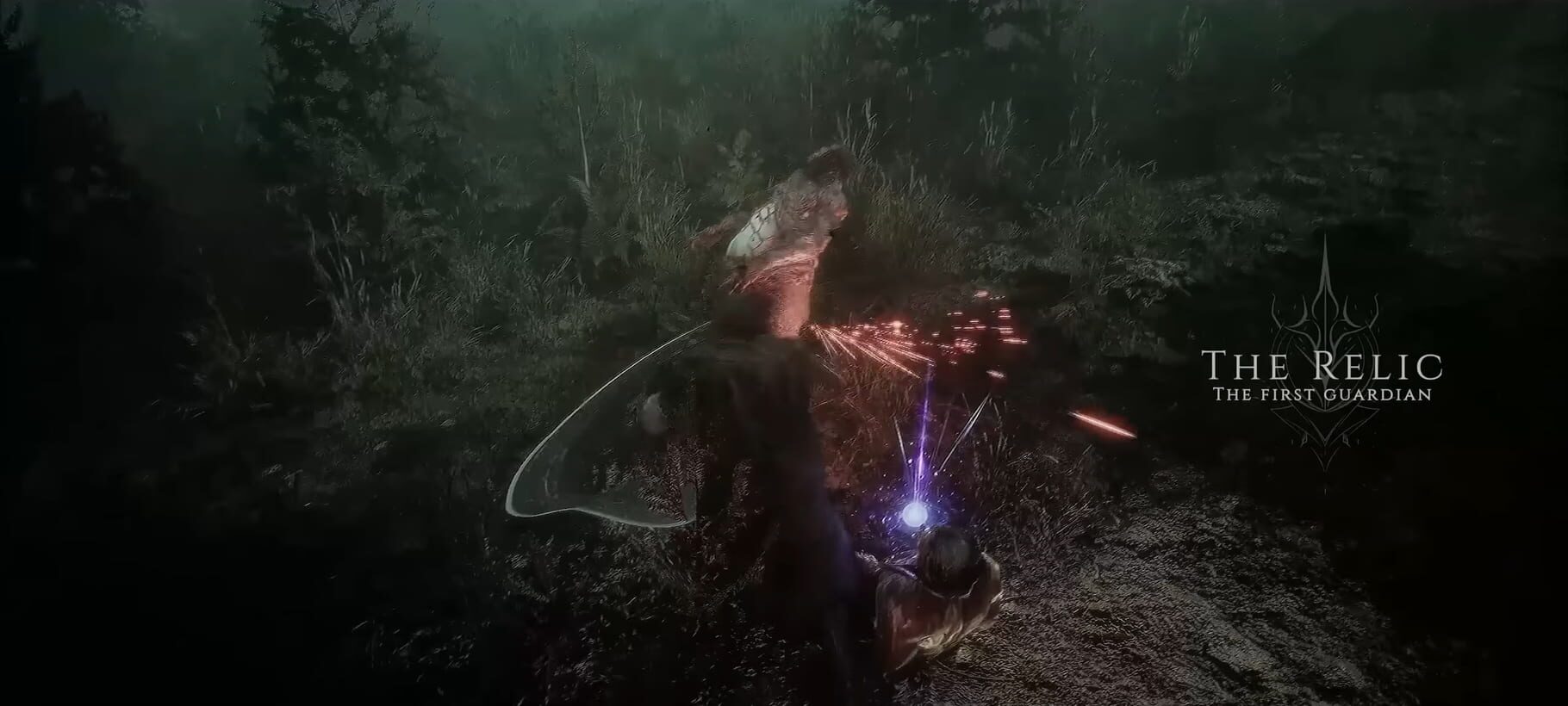

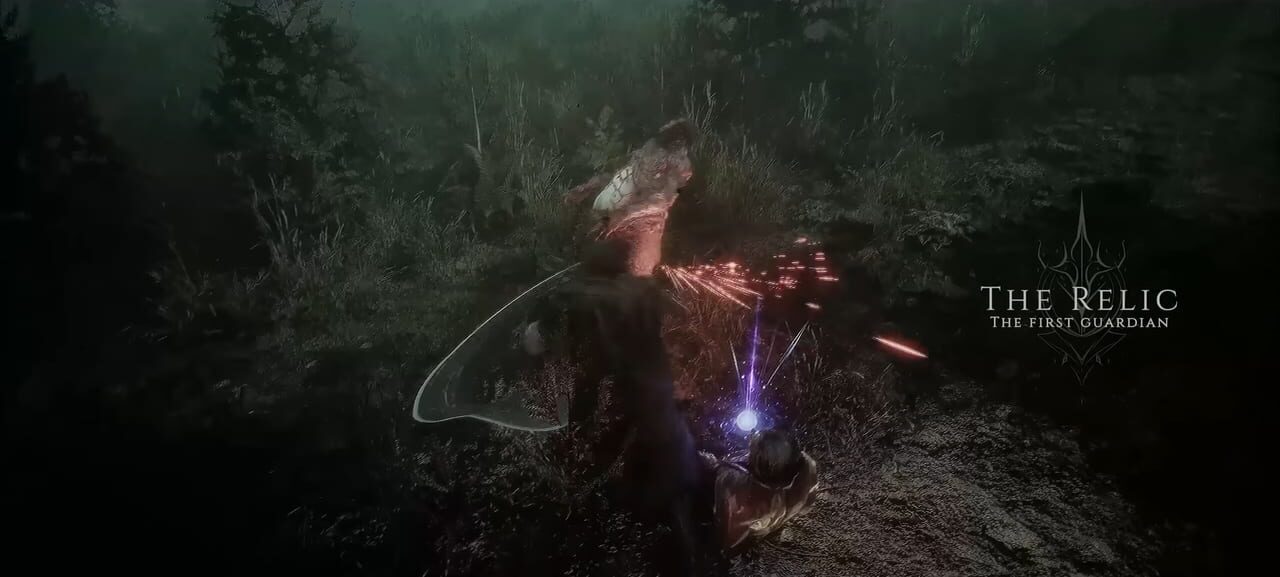
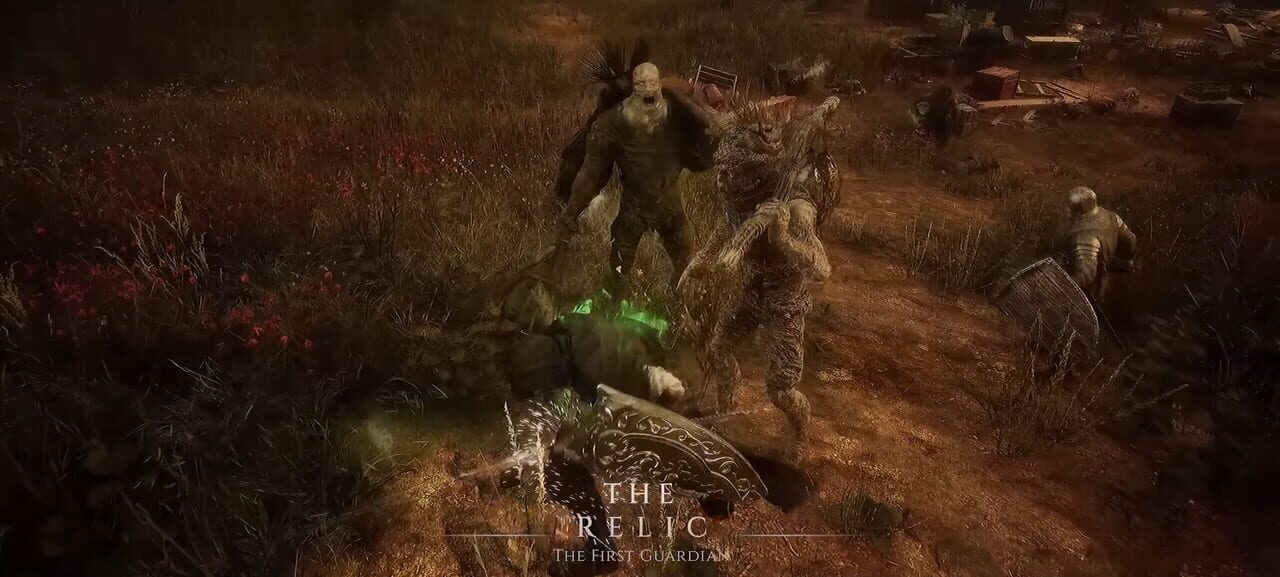
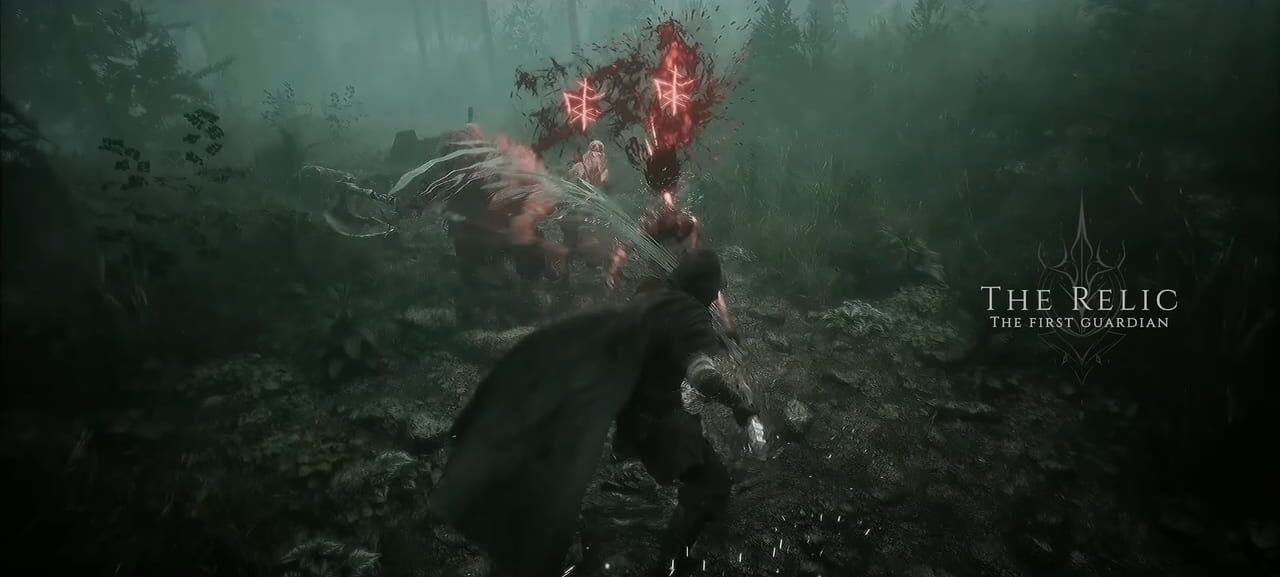
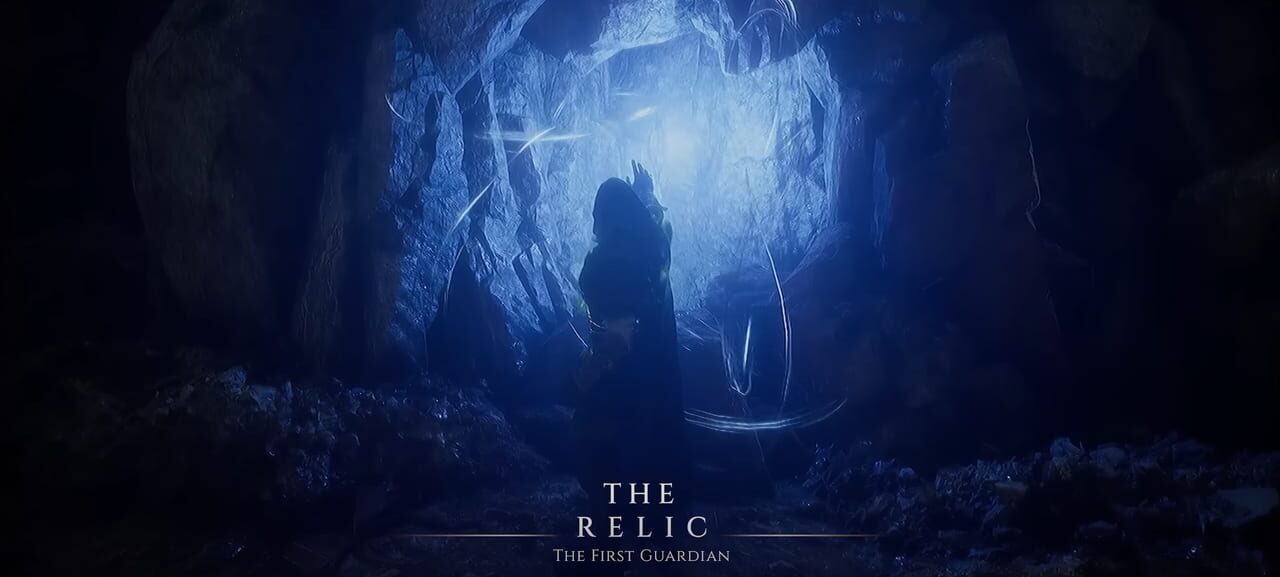
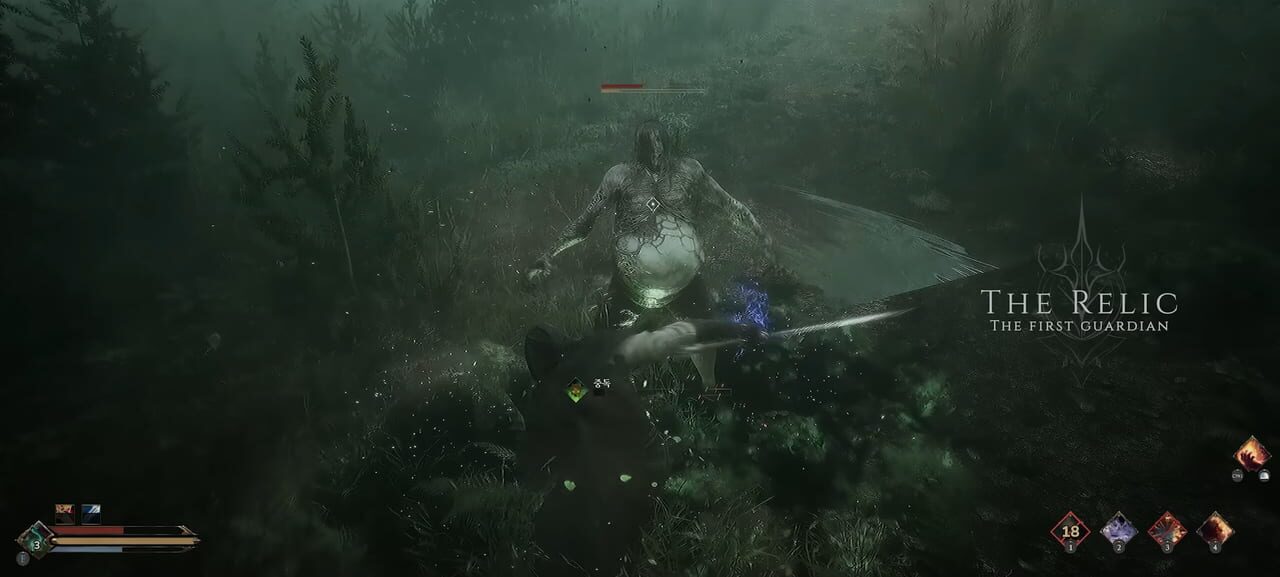
Project Cloud Games, a studio of around nine people in South Korea, has said it wants its first game to feel like an old folktale told by a grandfather to a child: gentle, lingering, and profound. The game in question, The Relic: First Guardian, is a Soulslike, the genre whose whole reputation rests on punishing difficulty and the hard satisfaction of finally putting a monster down. Over the course of it the player will face about seventy bosses. Most of them were once people.
The studio calls these bosses Brutals, and the word carries more than the marketing seems to notice. A Brutal is not a demon imported from outside the world. It is a resident of it: an ordinary inhabitant of the ruined land of Arsiltus who was starved, or cursed, into something monstrous. The catastrophe made them. When the player defeats one, the game does not say the soul is destroyed or the power absorbed. It says the troubled soul is laid to rest. The reward for the fight is not strength. It is the dead person's story, which the player carries forward.
This is a small inversion, and it changes what the genre is for.
The Soulslike took its grammar from Dark Souls, FromSoftware's 2011 game, and that grammar is the grammar of conquest. A boss is an obstacle with a health bar. The player learns its patterns, survives its violence, and is rewarded, on its death, with souls: a literal currency, harvested from the corpse and spent on growing stronger. FromSoftware's worlds are famously melancholy, their bosses often pitiable. The final encounter of Dark Souls is Gwyn, a once-great lord reduced to a hollow husk, scored not with a war drum but with a thin and grieving piano line. The player kills him anyway, and takes his place at the fire. The pathos is genuine. But it is ambient. It hangs in the air of the level while the player does the thing the level is built around, which is killing the boss and taking what the killing provides. Sympathy is the lighting. Extraction is the mechanic.
The Relic keeps the difficulty and the death and the careful, patterned violence. What it removes is the extraction. There is no soul-currency to harvest, because there are no character levels at all. The player does not grow stronger in the familiar arithmetic way. The studio's phrase is that the player grows through memory: progress comes from Relics, fragments the dead leave behind that carry, in the game's own words, the emotions and wishes of those who lived before, the promises, waiting, fear, and love. A boss defeated is not fuel. It is a person settled, and an account taken down. The Relics carry, by the studio's count, more than seventy distinct passive effects, and the player reshapes what the character can do by choosing which of the dead to keep close. Strength, in the only sense the game extends it, becomes a question of whose memory the survivor decides to carry into the next fight. The build, in the genre's jargon, is an act of selective remembrance.
The French sociologist Robert Hertz worked out, more than a century ago, why that distinction lands as hard as it does on human beings. In a 1907 essay on the collective representation of death, drawing on ethnographic reports of the secondary burials practiced among the Dayak of Borneo, Hertz argued that death is not an event but a process, and that the process belongs as much to the living as to the dead. When a person dies, the corpse is not yet finished with the community and the community is not yet finished with it. The soul, in the schemes Hertz studied, enters an intermediary period: homeless, unsettled, hovering near the living and resentful of them, belonging neither here nor in the land of the dead. Only the second funeral, the deliberate ritual labor of the survivors, performed sometimes years after the first burial, settles the soul, ends the danger, and lets mourning close. A death left unfinished does not stay in the ground. It festers, and it turns on the people who failed it.
The image at the center of Hertz's argument is physical and unsparing. In the practices he studied, the first burial was provisional: the body was stored, exposed, or temporarily interred while it decomposed, and only once the flesh was gone and the bones were clean and dry could the second and final burial take place. The decay was understood to track the soul's own unsettled passage, and the mourners were held in a matching limbo, secluded and marked and barred from ordinary life until the work was finished. The dead and the grieving moved through the middle state together, and the second funeral released them both. Settling a soul, in this account, is not a gentler word for feeling better. It is labor, in stages, that someone has to perform.
Hertz was especially interested in what he called the bad death: death by violence, by drowning, in childbirth, by epidemic, by famine. The bad dead are denied the ordinary rites, and so they are stranded in the intermediary period with no way out. They become the restless, malevolent presences that haunt the margins of nearly every culture's imagination, the ones who must be appeased or laid down before they harm anyone further. Read The Relic against that argument and its premise stops looking like ordinary fantasy decoration. The Brutals are the bad dead of Arsiltus. The famine is Hertz's epidemic by another name. The land has become a country of death because nobody completed the work, and the work has fallen to one person, the Last Guardian, whose entire function is to do for a whole nation what a family in Borneo did for a single corpse: finish the death, settle the soul, make the haunting stop.
The genre's verb has always been defeat. This game changes it to lay to rest, and the change runs all the way down.
Consider what the player is left holding when a fight ends. Not a number that climbed. A story. The studio frames the protagonist not as a hero but, in the creative director's words, as the one who restores memory and a keeper of stories, walking a road that follows forgotten voices. This is the older of the two things a funeral does. A funeral disposes of a body, but it also produces an account: the eulogy, the shared remembering, the quiet agreement among the living about who the dead person was and what they are owed. Hertz's second burial was as much about the survivors' memory as the corpse's final address. A game that replaces the experience bar with a gathering of the dead's stories has, perhaps without putting it in these terms, rebuilt the experience bar as a memorial. The grandfather telling the folktale to the child is doing the identical work in miniature: handing the dead down so they are not lost a second time, this time to forgetting.
It is worth noticing what kind of protagonist this produces. Most action heroes are defined by appetite: for territory, for vengeance, for the next tier of power. The Last Guardian is defined by a duty toward other people's endings. Nearly every culture has set someone aside for that duty and treated them as a class apart, necessary and faintly unclean: the gravedigger, the washer of bodies, the keener hired to carry a grief the family cannot manage on its own, the psychopomp who walks the soul to the far bank. The figure is feared a little precisely because the person who tends the dead spends their days in the dangerous middle zone Hertz described, standing closer to the bad death than anyone else will. The Relic casts its player in that exact part. The Last Guardian is not the chosen one of a prophecy. The Last Guardian is the one still willing to handle the bodies.
The refusal reaches further than progression. In most games of this kind, equipment is fungible. A sword is a set of numbers, a better sword is a better set of numbers, and the old one is sold or broken down for parts without a flicker of feeling. The Relic states that every weapon and every piece of armor exists only once in the entire game world, each a singular object with its own history. On its face this is a combat-design choice about scarcity and build variety. It is also a claim about what a thing is worth. An object that exists only once cannot be a commodity, because a commodity is by definition replaceable. It can only be an heirloom, or a relic, which is the word the game keeps returning to and means with precision: an object that matters because of who held it and what it outlived. The loot economy of the modern action game is an economy of abundance, a steady drizzle of marginally better numbers that the player is trained never to grow attached to. The Relic proposes scarcity instead, and scarcity is the precondition for grief. Nobody mourns the loss of a thing that drops again in ten minutes.
Even the smallest systems lean the same direction. In the standard Soulslike, stamina is the meter that governs everything, and attacking spends it, so aggression is rationed and every swing is weighed against its cost. The Relic, the studio says, does not draw on stamina for attacking at all. The bar exists only for defense, for the dodge and the deflection. Offense is free; survival is the only thing that costs. It is a minor adjustment with a tonal result. The game declines to make the player meter their violence, and asks them to meter only their care for staying alive. The hands are left loose to do what the studio called the player's rhythm and style, while the discipline is relocated onto the single task of remaining standing in front of the dead.
None of this is conjured from nothing. East Asian tradition holds a long and specific vocabulary for exactly what The Relic is dramatizing. The hungry ghost, the preta of Buddhist cosmology, familiar across the region and in Korea, is the dead person hollowed by an appetite that can never be filled, often one who died in want or was left unmourned, condemned to wander ravenous at the edges of the living world until the proper offerings release them. The scholar Stephen Teiser, writing on the medieval Chinese Ghost Festival, described an entire annual machinery built around feeding and freeing these unsettled dead, a yearly act of communal repair aimed at the souls the ordinary rites had missed. A population turned monstrous by starvation, who can only be released by a survivor performing what amounts to a rite, is not a marketing conceit bolted onto a Western genre. It is a folk theology that has shaped real funerals and real festivals for many centuries, here loaded into a control scheme and a difficulty curve. The grandfather's folktale once more: the form a culture uses to carry its dead, and its fear of the dead, down to the people who will outlast it.
There is a second context worth naming, because the game half-announces it. A studio of nine people in South Korea has built its first release in the most thoroughly international idiom available to it, and its early audience has assembled from everywhere: the requests for translation on its store page arrive in Turkish, Russian, and Chinese, next to the English skepticism. What the studio has chosen to carry into that shared dialect is something quite local, the conception of the restless and hungry dead that runs through Korean Buddhist practice and the wider grammar of East Asian funeral custom. The genre is the lingua franca; the cargo is one culture's particular sense of what is owed to the people it has lost. That a folk theology of the unsettled dead can travel the world disguised as a difficulty curve is its own quiet argument about what the medium is now able to carry.
The game extends the form into its very structure. Each of the seventy Brutals, the studio says, is written as a standalone folktale, a self-contained small tragedy the player enters, ends, and absorbs. Set out like that, the game is not a string of obstacles. It is an anthology of deaths, a body of ghost stories assembled one funeral at a time, which is a fair description of what a tradition's stock of folktales actually is. Every culture that has feared its dead has also catalogued them, sorted the drowned from the starved from the wronged, and kept the stories partly as warning and partly as the only burial some of them ever got. The Relic proposes to let the player walk through that catalogue and close each entry by hand.
The previews give a face to one of the entries. A boss shown ahead of release, Branka, the Bloody Shield, is fought against a burning village, a figure of violence set against the ordinary disaster that seems to have produced her. The genre likes to crown its bosses with cosmological titles, the Nameless King, the Soul of Cinder, names that announce a mythology. The Bloody Shield is a smaller and sadder kind of epithet. It names a person by the worst thing that ever attached to them, the way a village remembers the man a bad winter changed, and that is far closer to how folktales actually label their dead than to how fantasy games usually brand their demons.
The skeptics deserve their hearing, and on the game's own forums they are not quiet. The most active thread on its Steam page is titled, in flat disbelief, "Unofficial dark souls 4." Another simply asks, "Another souls like slop?" They are not wrong about the landscape. The Soulslike has become one of the most crowded rooms in games, and a debut from a tiny studio, arriving after a slip from its announced May 2026 date to a vaguer summer window, wearing folklore over a thoroughly familiar skeleton, has every reason to be met with a raised eyebrow. There is no honest way past this: the game is not out, this writer has not held the controller, and a graceful design document has buried a great many ordinary games. Whether the encounters land like funerals or like the four-hundredth time a player has rolled through a boss's combo is a question only the finished thing can answer, and it is fully capable of answering it badly.
But the doubt and the argument are aimed at different targets. The complaint is that the game looks like Dark Souls, and it does. The claim here concerns what the design is trying to convert that resemblance into, and on that question the crowded room is the whole point. When a genre's conventions are worn this smooth, they stop reading as a template and start reading as a language, and a studio that speaks it fluently can use it to say something the genre rarely says. The Relic is speaking Soulslike, fluently and unoriginally, in order to make an unusual statement with it: that the figure on the ground at the end of the fight was a person, that beating it was an obligation rather than a triumph, and that what the survivor carries off is a duty to remember rather than a pool of souls to spend. FromSoftware lets the player feel a flicker of sorrow over the king they cut down, then hands them his power. The Relic withholds the soul-reward, deletes the level-up, and hands over a story, which is a way of insisting that the sorrow was the substance and never the seasoning.
A fair worry remains, and it is not the genre-fatigue one. It is whether a feeling can survive being made into a mechanic. Grief automated seventy times is in some danger of becoming a chore with a sad caption, the emotional equivalent of a fetch quest. Rituals work, in Hertz's account, precisely because they are not optional and not infinitely repeated against a stranger; they are performed by the bereaved, for their own dead, once. A game cannot reproduce that. What it can reproduce is the shape of the obligation, the structure of staying with a death until it is finished, and the refusal to convert the dead into a resource. Whether the shape alone is enough to move anyone is the real test the summer will set, and it is a harder test than difficulty tuning. The studio has at least understood what it is attempting, which is more than most games in the tradition can claim, most of which are not attempting anything past the next boss.
There is a version of The Relic that fails outright, and it is easy to picture: stiff combat, a world that reads as a wishlist of borrowed influences, seventy boss-shaped errands dressed in the costume of mourning. The delay and the quiet since April keep that version on the table. But the idea underneath it is neither cynical nor small. It takes the single most repeated act in one of the medium's most repeated genres, the act of killing a monster to become stronger, and asks what is left if the monster is a neighbor the famine took, and becoming stronger is off the table, and the only thing to gain is the dead one's name and the agreement to carry it. That is the labor Hertz watched the living perform for the dead in the secondary burials of Borneo, and that the hungry-ghost festivals still perform across East Asia, and that the grandfather performs when he tells the child the old story one more time so that it does not die when he does. A country full of people who were never properly buried, and one figure walking through it, settling each death the only way a death is ever settled, which is by someone staying long enough to finish it.