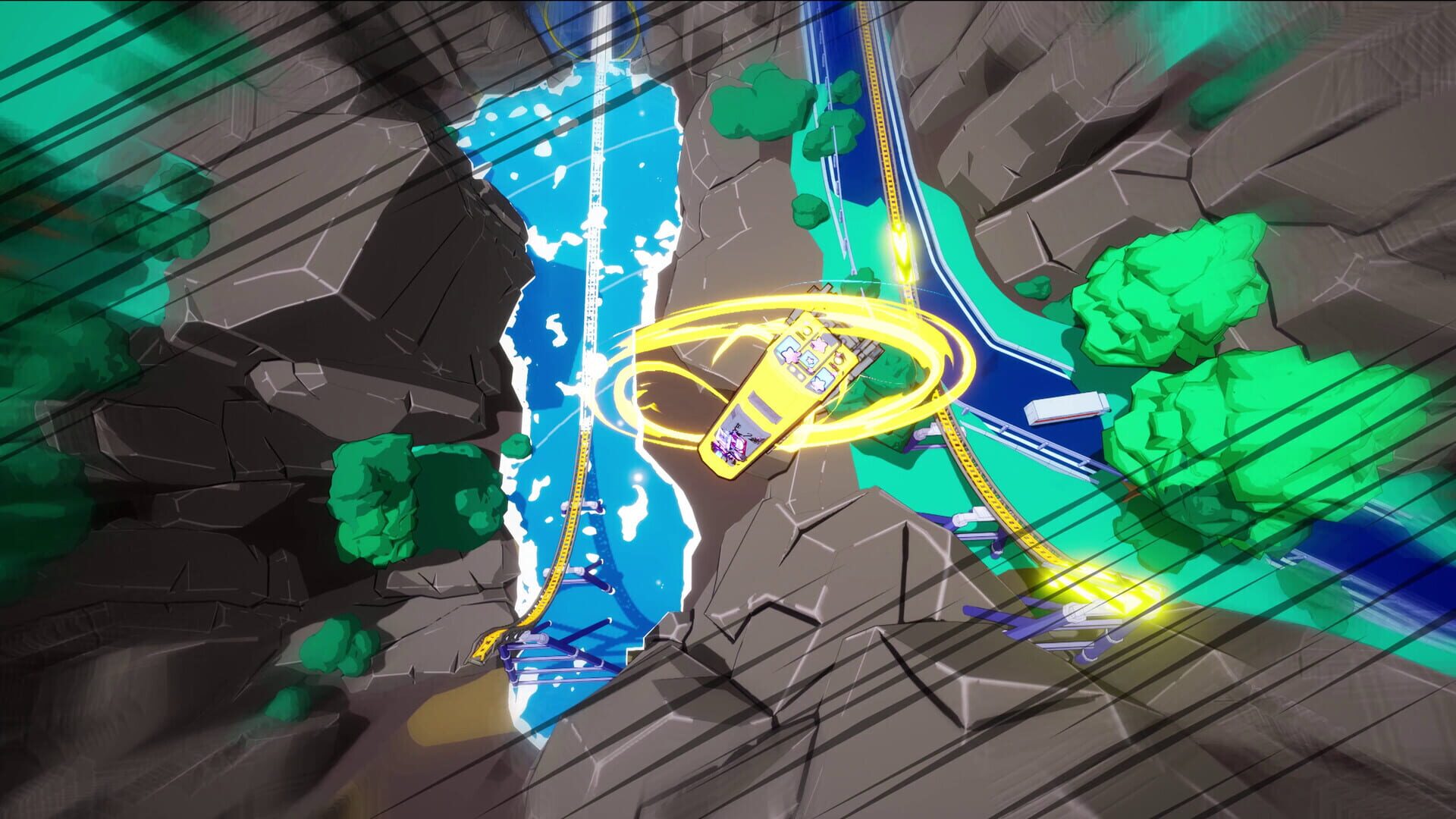



A train the length of a city block lifts itself onto a single rear wheel, rotates a hundred and eighty degrees in the air, and lands on a guardrail above a sealed dome-city. A small noise comes from the controller. Across the room, the player exhales and says, aloud or under their breath, the sentence the game has been waiting for them to say since they pressed start: "I landed that."
The sentence is, on inspection, slightly strange. The player did not land anything. The player pressed two buttons in quick succession on a small piece of plastic. The thing that landed was a digital train the size of a city block, several visual miles away on screen, operating in a physics simulation that exists only inside the box. There is a real cognitive event in the room, but the event has had to perform a small piece of conceptual sleight-of-hand to take the shape the player's sentence is reporting. The player has, for a brief moment, decided that they are the train.
The São Paulo studio Undercoders releases Denshattack! on 17 June 2026. The game's premise is that the player operates a gravity-defying train through the dome-cities of dystopian Japan, performing the moves of a skateboarder while controlling a vehicle whose entire ontological condition is the opposite of a skateboard. The marketing materials describe the game as fast, colourful, anti-corporate, and slightly absurd. They describe it correctly. The argument of this essay is that the most interesting thing about the game is not the premise. The most interesting thing is what the player's brain is doing during the small interval between the button press and the spoken sentence. The brain is, in that interval, performing a measurable neurological operation that has been one of the more durable findings of the past thirty years of cognitive neuroscience, and the game is the absolute limit case of what the operation will agree to do.
This is a Brain & Body essay. Its subject is body-schema extension: the brain's ability to redraw the boundary of the self to include objects the self is operating, the research that has documented this ability, and what the operation of a city-block-sized digital train reveals about how far that boundary will move. The argument the essay wants to commit to is direct. The pleasure of vehicular games, including this one, is not the pleasure of seeing a vehicle do something interesting on the screen. It is the pleasure of the brain agreeing that the vehicle is, for the moment, part of the self. The agreement is real, it is measurable, and Denshattack is the cleanest available demonstration of how absurd the brain is willing to get about it.
The empirical floor for the claim is a body of research that begins, for the modern purposes, with the Japanese neuroscientist Atsushi Iriki and his collaborators at the RIKEN Brain Science Institute. The foundational paper was published in 1996, in the journal NeuroReport, under the title "Coding of modified body schema during tool use by macaque postcentral neurones." The experiment was simple. Iriki and his team trained Japanese macaques to use a small rake to retrieve food pellets from a distance that the monkeys' arms could not reach. The training took several days. The monkeys learned. The interesting result came when the researchers recorded the activity of specific neurons in the macaques' intraparietal cortex while the animals used the tool.
A certain class of cells in this brain region, called visuotactile bimodal neurons, ordinarily respond to two kinds of stimulus together: a touch on a particular part of the hand, and the sight of an object approaching that same part of the hand. The cells map a region of personal space immediately around the body in which approaching things matter to the animal. Before the training, the cells responded to objects approaching the hand. After the training, while the macaque was holding the rake, the same cells responded to objects approaching the tip of the rake. The brain had, in the act of learning to use the tool effectively, expanded the cells' receptive field to include the rake.
The finding is a small one in its lab specifics and an enormous one in its implications. The cells were not metaphorically including the rake. They were literally extending their visual receptive field along the length of the tool. The macaque's brain, at the level of the individual neuron, had agreed that the rake was now part of where the monkey's body ended. Not in some loose sense of "the monkey feels like the rake is hers." In the strictly neurophysiological sense that the receptive fields measured by an electrode in the brain had extended themselves to cover it. Iriki and his collaborator Angelo Maravita laid out the broader research program this opened in a 2004 review article in Trends in Cognitive Sciences. Across the decade after the original macaque study, several research groups confirmed the phenomenon in humans, using non-invasive measures that no electrode could deliver. Tools that the brain has learned to use reliably are incorporated into the body's neural representation. The incorporation is fast. The incorporation is reversible. The incorporation is selective: a tool the brain does not trust to respond to intent will not be incorporated, no matter how long the person holds it. The brain is doing a specific computation, and the computation has an empirical signature.
A parallel research program had, in 1998, produced a more famous demonstration of the same general phenomenon in a setting requiring no special equipment. The cognitive scientists Matthew Botvinick and Jonathan Cohen, working at the University of Pittsburgh, set up an experiment in which a subject sat at a table with one arm hidden from view behind a screen. A rubber hand was placed in front of the subject, in the position the hidden real arm would have been. The experimenter stroked the rubber hand with a soft brush and at exactly the same rhythm stroked the subject's real hidden hand. The subject saw the brush stroking the rubber hand and felt the brush stroking their own. Within about thirty seconds, the subject reported that the rubber hand felt like theirs. Within another minute, if the experimenter then suddenly threatened the rubber hand with a knife or a hammer, the subject would flinch as if their own hand were in danger.
The rubber-hand illusion has been replicated several thousand times in the intervening twenty-eight years, with consistent results and an enormous published literature. Its implication is the same as the macaque study's, delivered through a different methodology. The brain's representation of the body is not a fixed map of the literal flesh. It is a continuously running computation that integrates vision, proprioception, and a model of which objects in the world are responding reliably to the brain's intentions. When those inputs agree, the brain assigns ownership. When they do not, the brain withdraws ownership. Ownership is not metaphorical. The threatened rubber hand produces a real flinch.
The third strand of the research program, and the one that is most directly relevant to the train, comes from the cognitive neuroscience of vehicle operation. A series of studies across the 2000s and 2010s, using driving simulators, brain imaging of car drivers, and behavioural measures with pilots, established that the brain's body-schema extension applies to vehicles at scales much larger than the original macaque-with-rake research had tested. Drivers who have been operating the same car for years show, on the behavioural measures that detect body-schema extension, a representation that includes the car's outer edges as part of where their own body ends. Experienced pilots demonstrate the same phenomenon for the wingtips of an aircraft. The brain has agreed that the wingtip is now where the pilot is.
The folk-language version of this finding has been available for as long as people have been operating large machines. Drivers say their cars feel "part of them" after a few months of ownership. Pilots talk about flying "as" the airplane. Truckers report that they "know where their back end is" in tight turns without thinking about it. Video game players talk about the controller disappearing in their hands, and about being inside the action rather than watching it. The folk descriptions are not loose poetry. They are accurate reports of the neurological event that is happening. The brain is incorporating the vehicle. The vehicle has, for the duration of the operation, become part of where the operator's body ends.
This is the operation Denshattack is performing on the player's brain, and the game is unusual mostly in the extremity of the case. The train the player is operating is enormous. The train's actions are dramatic. The asymmetry between what the player is doing physically (small movements of the thumbs on a controller) and what the train is doing on screen (rotating a hundred and eighty degrees in the air, landing on a guardrail, grinding it for thirty metres) is comically large. The brain does not appear to mind. The body-schema computation has been documented to accept tools at any scale the brain has learned to predict the response of, and the training the demo provides in its first hour is exactly the kind of feedback the computation needs in order to accept the assignment. Press the button. The train responds. Press again. The train responds the same way. Within thirty minutes the player is no longer pressing buttons and watching a train respond. The player is doing the tricks. The "I" in "I landed that" is not a metaphor.
There is an obvious counter-reading and the essay has to engage it. The counter-reading is that the analysis is over-claiming. The player who says "I landed that" is using ordinary first-person speech in a perfectly familiar way; people say "I won that match" of a board game without believing they have physically defeated their opponent, "I built that wall" of a wall a contractor built, "I made it to the airport" of a journey conducted entirely inside a car. The "I" in those sentences is metonymic and grammatical, not neurological. The framework above is, on this reading, importing brain-research jargon to describe a piece of ordinary English that does not need it.
The objection is not nothing and the response has to be specific. The framework is not claiming that every use of "I" in a sentence about an external agent is producing a body-schema event. The framework is claiming something narrower. When the agent in question is an object the speaker is continuously operating, with high-bandwidth sensory feedback and a sustained behavioural commitment to the operation, the brain has been measurably documented to perform a specific computation that does not happen in the contractor or the airport case. The contractor case is metonymic English. The driver-of-this-car case has a flinch in it, a brain-imaging signature, and decades of converging evidence from at least three independent research programs. Operating a video game vehicle for thirty hours is, on the criteria the research has established, closer to the second case than the first. The "I" in "I landed that," delivered after a thirty-minute training session inside the game's input system, is reporting a neurological event the framework can pick out by name.
It is worth being specific about what makes vehicular video games unusually effective at producing this event, because the answer is somewhat surprising. The video game has, on the face of it, none of the affordances the brain ordinarily uses to compute body ownership. The player is not physically connected to the vehicle. The proprioceptive inputs from the player's actual body have nothing to do with the train. The visual feedback is on a screen across the room. The whole arrangement should, on a naive reading, produce no body-schema effect at all. The arrangement reliably produces a strong one. The reason is the input system itself. The controller, in the player's hands, is the actual object the brain is incorporating, and the brain has been doing the rubber-hand-illusion operation on it since the player picked it up. The controller delivers the high-bandwidth, predictable, intent-driven feedback the body-schema computation requires. The train on the screen is not what the brain is incorporating. The controller is. The train is the visual representation the brain is rendering as the place the controller's signals land. The two are bound together because the controller is responding to the player's intent and the train is responding to the controller. The chain is unbroken. The brain reads the chain as one extended object that begins in the hand and ends a hundred metres away on screen.
This is why a game's input system matters out of proportion to its other affordances. A game with a poorly responsive controller will never produce the body-schema event no matter how impressive its visuals, because the chain breaks at the first link. A game with a responsive controller and a relatively simple visual representation will produce the event reliably, because the chain holds. The reason video games have, across forty years of commercial development, converged on increasingly precise input systems, even when the visual representation does not require the precision, is that the input system is what is selling the central cognitive event. The controller is the thing the brain incorporates. The graphics are the destination the incorporation points at. Denshattack's input layer has been built with this in mind. The demo's response time, the trick-input ordering, the way the rail-grind input feels through the controller's haptics: these are not surface polish. They are the thing the game is selling.
The cultural-historical version of the same point is worth pausing on, because it explains why the medium has been able to do this at all. Humans have been performing body-schema extension into tools for at least a million years, on the archaeological record. The hand axe of the Acheulean period is, on the available neurological evidence, exactly the kind of object the brain would have incorporated into its body schema during use. Every refinement in human tool use across the intervening time has been, in part, a refinement of the brain's capacity to fold tools into the self. The car driver and the pilot are recent entries in a very long sequence. The video game player is a recent entry in the same sequence. The medium has, in the past four decades, found a particular cultural form for the operation: an input system delivering high-bandwidth predictable feedback, a visual representation rich enough to anchor the incorporation in a specific destination, a behavioural commitment from the player that holds attention long enough for the bind to set. The form works because the brain has been waiting, for a million years, for exactly the kind of stimulus the form delivers. The medium did not invent the cognitive event. It found a new way to host one.
The closing image is therefore not the train doing the trick. It is the controller in the player's hand thirty seconds after they have picked it up for the first time, before any tricks have been landed. The player is pressing buttons at random. The train on the screen is moving in directions that do not yet correspond to any intention the player has formed. The brain's body-schema computation has not yet kicked in. The chain has not yet bound itself. Nothing is incorporated. The player is, in this brief interval, still purely outside the system, watching a thing on a screen. The brain is sampling the controller's responses, building a small predictive model of what each button does. The model is fast. The model is, on the available evidence, already roughly accurate by the thirty-second mark. The minute that follows is the minute in which the player stops being a person holding a controller and starts being a person inside a digital body. The vehicle is a train. The vehicle is also, for the next ten hours of play, where the player ends. The brain has agreed to the bargain that thirty years of cognitive neuroscience says it would agree to, and the bargain is what every vehicular game in history has been selling without quite knowing it was selling that.