



The girl is nine. The doll's house is on the floor of her bedroom, and she is sitting cross-legged in front of it, moving a small plastic mother across the kitchen toward a small plastic kettle on a small plastic stove. The kitchen is half an inch deep. The girl knows, on whatever level a child knows things, that the kettle is not really boiling and the mother is not really making tea, and she also knows, on a different level, that the kettle is boiling and the mother is making tea, and the holding of both of these at once is not a confusion. It is, on the empirical record of how childhood cognition actually works, one of the most sophisticated mental operations the child has yet learned to perform. The girl will spend several hours doing it, and at no point during the several hours will she be bored.
The girl is now forty. The doll's house is gone. The kettle and the mother and the small plastic stove are gone. The cognitive operation the doll's house was hosting is not gone. The operation is still inside her and is, on a slow afternoon, still available, but the conditions for running it have become much harder to find. The conditions are specific. There has to be a small world. The small world has to be visible all at once. The small world has to contain figures small enough to look down at, doing things small enough to take seriously. Adult life does not normally arrange this. The natural-history museum does. The model-railway hobbyist does. The architecture firm building a massing model for a planning meeting does, briefly. Everyone else makes do without.
The Square Enix action role-playing game The Adventures of Elliot: The Millennium Tales, released by the publisher and the Tokyo studio Claytechworks on 18 June 2026, restores the conditions. The game's visual register, called HD-2D in the publisher's marketing materials and now in its eighth year of refinement across seven titles, places the player in front of a small constructed world rendered at the scale of a doll's house, lit at the scale of a doll's house, populated by figures sized to be looked down at. The player is forty, or thirty-five, or sixty-two, and the player is buying, for the price of a contemporary console game, a thing they last had access to on the bedroom floor when they were nine.
This is a Brain & Body essay. Its subject is the specific cognitive position the doll's house puts the child in, why the position is unusual and powerful, what happens when the position becomes unavailable in adult life, and why a particular thread of contemporary game design has spent the past decade building grown-up versions of the same arrangement. The argument the essay wants to commit to is a direct one. The pleasure of HD-2D, of Octopath Traveler in 2018, of Triangle Strategy in 2022, of the Dragon Quest III HD-2D Remake in 2024, and of Adventures of Elliot in 2026, is not the pleasure of nostalgia for the SNES era. The publicity calls it that, and the publicity is mostly wrong. The pleasure is the doll's-house pleasure, and the doll's-house pleasure is a specific cognitive event that the adult brain has been hungry for since the doll's house went away.
What the doll's house was doing, in the strict cognitive sense, has been one of the more productive research programs in developmental psychology across the past several decades. The Oregon psychologist Marjorie Taylor's 1999 book Imaginary Companions and the Children Who Create Them consolidated several decades of research on what she and her colleagues called the cognitive work of symbolic play. The headline finding is straightforward and slightly counterintuitive. Children engaged in elaborate pretend play, including the kind of doll's-house arrangement the opening of this essay describes, are not doing something simple or unproductive. They are performing, in the loose informal medium of toys and miniature figures, several of the same operations that adult cognition will eventually use for much more abstract work. The child is holding multiple representations at once, switching between them, taking the perspective of a figure they are not, simulating a counterfactual scene, narrating events that have not happened and may not happen, and assigning emotional weight to objects that have no emotional content on their own. Taylor's program documented that children who do more of this kind of play, across a wide range of measures, develop stronger executive function, stronger theory of mind, stronger narrative ability, and stronger counterfactual reasoning than children who do less of it. The doll's house was not entertainment with no cognitive substance. The doll's house was a training apparatus for some of the most important operations the adult mind would eventually need.
The position the child was occupying while she did this had its own specific properties, and the American literary critic Susan Stewart spent the early 1980s identifying what those were. Her 1984 book On Longing, which remains the foundational work on the cultural and perceptual meaning of the miniature, observed that the small constructed world has a particular relationship to the viewer who looks down on it. The viewer sees the whole at once. The viewer is positioned outside the world rather than inside it. The future of the activity occurring inside the world is legible from above in a way it would not be from within. The viewer has, in Stewart's phrase, the "dream of vision unmediated by the body": the position of an observer who can see all of a scene at once without participating in it, without the constraints that being inside the scene imposes on what one can see and know. Stewart was writing about adult engagements with miniatures: the museum diorama, the architect's model, the snow globe, the collector's display. The position she was describing was the position the child in the doll's house occupies as a matter of course. The position is, on Stewart's reading, doing real work on the viewer. The work is the cognitive event of comprehensiveness, of seeing-it-all-at-once, of holding a whole arranged world inside the attention. The work is rare. The work feels good.
What happens to this position across the life course is what makes the games matter. The child has access to the position more or less continuously. The doll's house in the bedroom, the model train layout the father has built in the basement, the toy-soldier formation on the dining room table, the snow globe on the shelf, the dollhouse-scale Christmas village the family unpacks once a year, the action-figure scenarios assembled on the carpet. The position is, in childhood, an ordinary cognitive condition. The young adult loses access to most of the apparatuses. The doll's house is given away. The model trains stay with the father, but the daughter has moved out. The toy soldiers are in a box in the basement. The cognitive position the apparatuses produced was so ordinary inside childhood that the loss of access in adulthood is not, for most adults, registered as a loss. The position is simply gone. The categories of attention the position trained the child to enjoy are, on the available evidence, still inside the adult, but the conditions for running them have evaporated.
The cultural artefacts that survive into adult life as miniature-position hosts are revealing. The natural-history museum's diorama, which Donna Haraway analysed at length in her 1984 essay on the American Museum of Natural History as a constructed ideological vision. The model railway, which has had a continuous hobbyist tradition across the past century and which carries an audience whose median age has continued to climb. The architectural massing model, which is professional infrastructure and not a leisure object. The maquette, the snow globe, the wargaming-miniature tabletop. The list is short. The artefacts are mostly cultural-specialty or professional. The ordinary adult, going through the ordinary adult day, does not routinely encounter the conditions for the doll's-house cognitive event. The brain that grew up running the event has, for most adults across most of the last forty years, lost the place to run it.
This is the part of the analysis that explains why HD-2D landed the way it landed. The Octopath Traveler launch in 2018 did substantially better than the publisher's internal projections for a small-scale role-playing game in a niche genre, and the eight-year refinement program that has followed has been one of the more commercially-resilient experiments in Square Enix's recent output. The publicity around the launch and around the subsequent titles has consistently described the appeal in terms of nostalgia for the 16-bit era. The audience research, where it has surfaced in public, has consistently shown that the buyer base skews older than the buyer base for most contemporary role-playing games. The publicity has interpreted this as evidence for the nostalgia reading. The nostalgia reading is partial. The buyer base skews older not because older players are nostalgic for an aesthetic of their childhood, though some are. The buyer base skews older because older players are the demographic that has lost the most access to the doll's-house cognitive position. The publishers have been selling, without quite naming it, the position back to the people who used to have it for free.
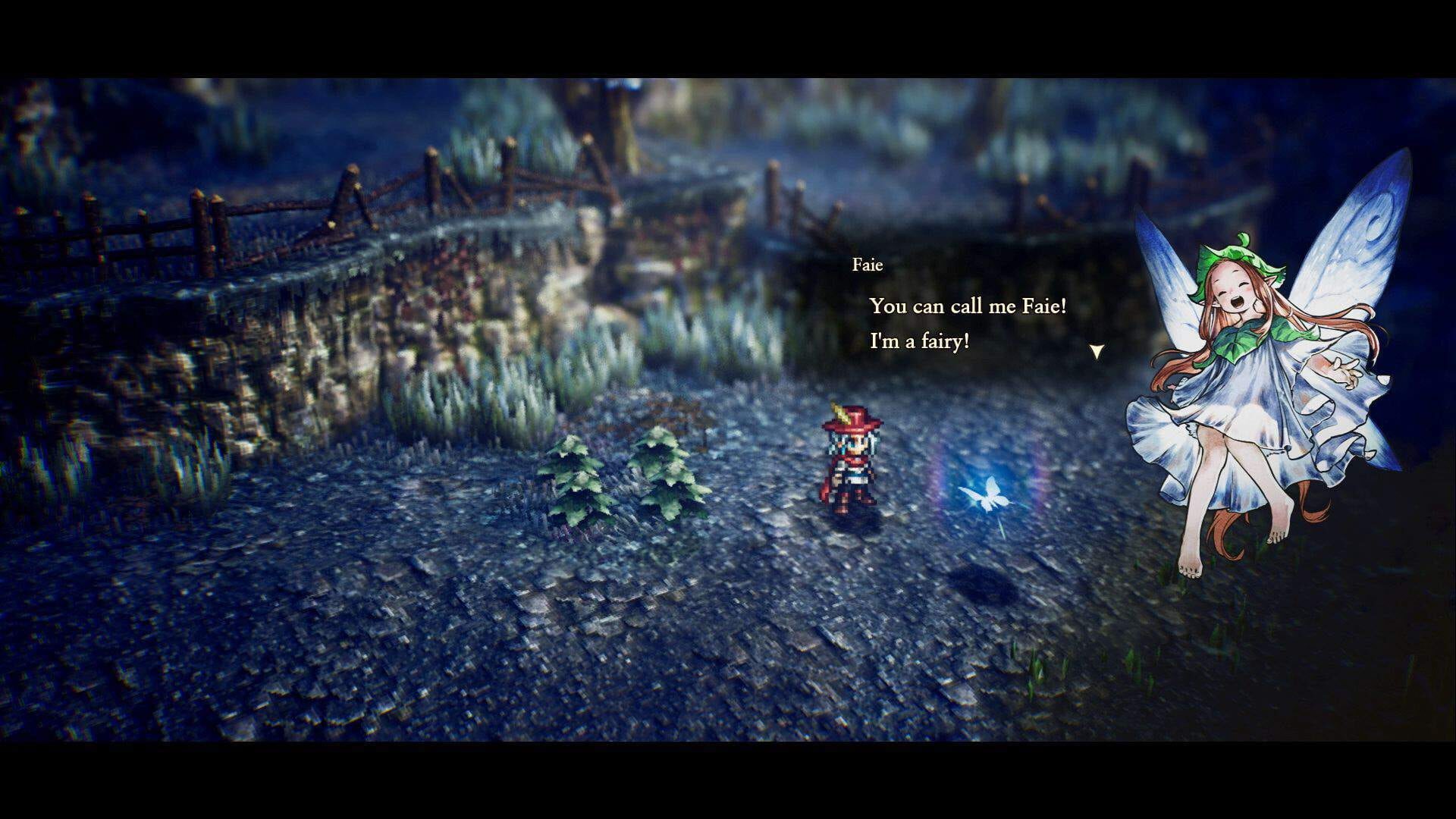
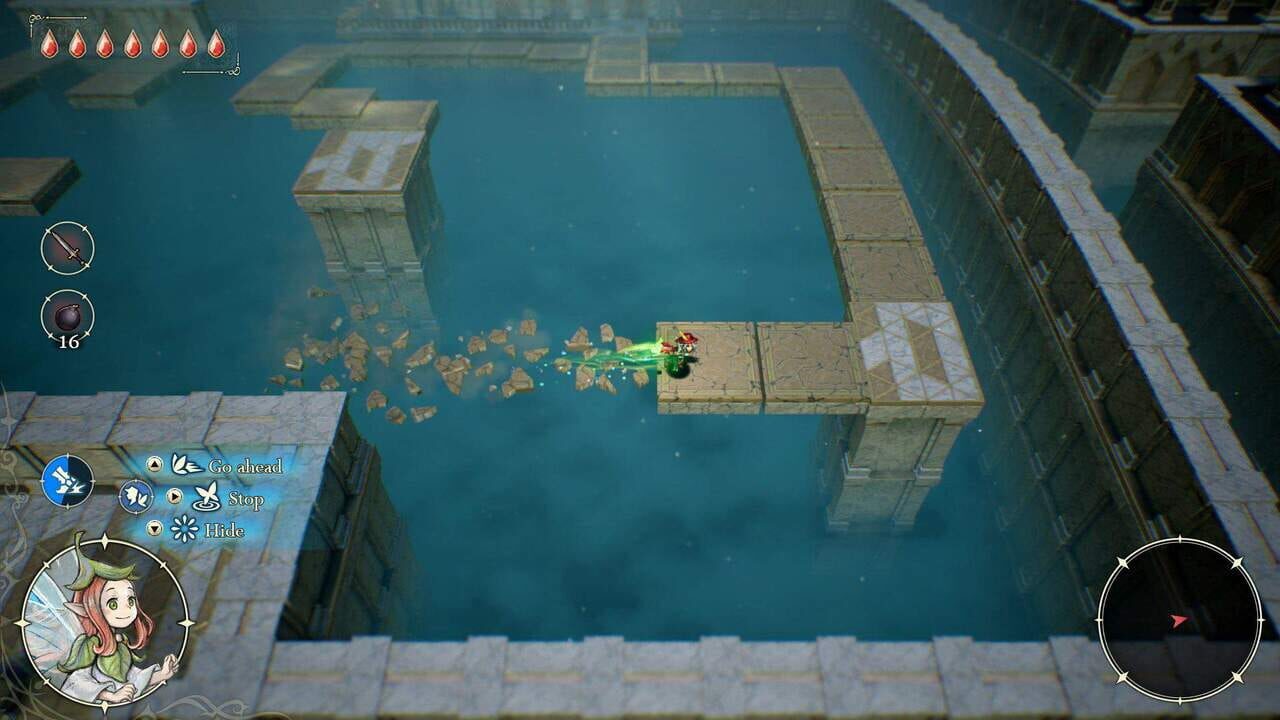
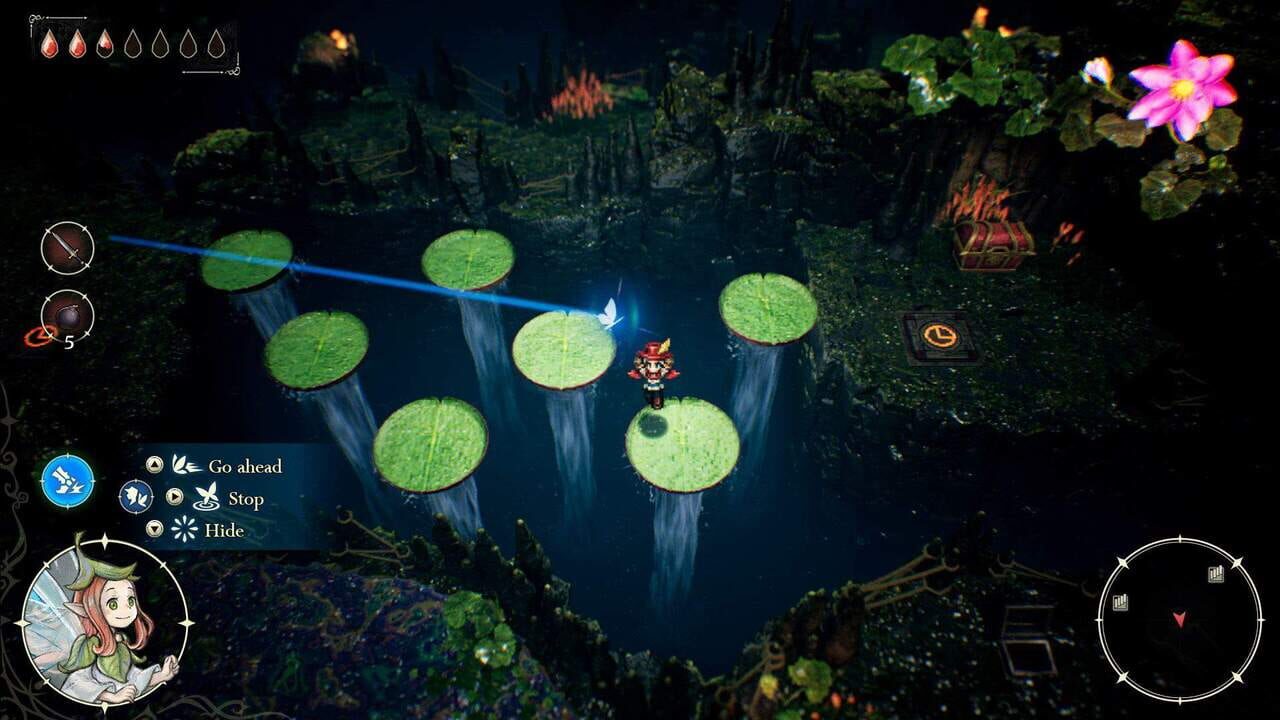
What HD-2D actually arranges, in technical terms, is exactly the conditions Stewart's miniature position requires. The sprite character is small. The world around the sprite is large. The angle of the camera is fixed somewhere between thirty and sixty degrees from horizontal, looking down at the small figure rather than across at it from the figure's own eye-line. The depth-of-field blur applied across the scene is calibrated to the focal length of a real camera held a few inches from a small physical model: the foreground sharp, the middle distance softening, the far distance blurred. The lighting is dramatic in the way the lighting on a theatrically lit diorama is dramatic, with volumetric shafts of light through trees, particulate dust in the air, soft shadows from a real virtual sun. The viewer is in the exact perceptual position the doll's-house owner is in. The technique was not arrived at by accident. It was arrived at by a Japanese studio that has spent eight years iterating on the specific arrangement of camera angle, sprite scale, lighting calibration, and detail density that maximises the position's affective return. The arrangement is, on the available evidence, optimised for the cognitive event the position produces.
Adventures of Elliot is the title in the sequence that has gone hardest at this. The game's narrative premise involves an artefact called the Doorway of Time, which the protagonist activates to move between two historical eras of the same continent. The reviewer at RPGFan, in a hands-on preview published in May 2026, described the gameplay as Square Enix's most refined HD-2D production to date. The mechanic that the preview did not have the room to develop, and that this essay wants to draw attention to, is the relationship between the time-travel-as-redecoration arrangement and the doll's-house position the technique already places the viewer in. The child in the opening of this essay, moving the plastic mother across the doll's-house kitchen, can also pick up a small plastic Christmas tree from a box of seasonal accessories and put it next to the doll's-house living-room window. The same room is now winter. The child has not entered a different game. The child has redecorated the small world. The doll's-house position admits temporal substitution as a natural property of itself, because the gaze has already done the work of converting the represented world into a set of arrangeable objects. The Doorway of Time in Adventures of Elliot is the same operation. The player switches the diorama from one era to another. The viewer's position has not changed. The viewer is still looking down. The viewer is still seeing the whole arrangement at once. The mechanic that the game's marketing calls a time-travel mechanic is, in the cognitive register the technique was already running, a redecoration of the doll's house.
There is an obvious counter-reading and the essay has to engage it. The counter-reading is that the framework is over-extending a piece of developmental psychology to describe what is really a fairly ordinary entertainment product. Adults play HD-2D games for the same reasons adults play any kind of video game: the games are fun, the games kill time, the games offer the small pleasures contemporary entertainment generally offers. The framework above is, on this reading, importing childhood-cognition research into a context where it does not need to be.
The objection is not nothing and the response has to be specific. The framework is not claiming that the player consciously experiences a regression to childhood while playing Octopath Traveler. The framework is claiming something narrower. The cognitive position the doll's house put the child in has specific properties (the bird's-eye view, the whole arrangement visible at once, the comprehensibility of the contained world, the figures sized to be looked down at) that are unusual in adult life and that the brain has been documented to enjoy when it can find them. HD-2D arranges those specific properties. The arrangement is not the only thing the games offer, and it is not the only reason an adult might buy one. It is the specific cognitive feature the games arrange that other contemporary game types do not, and it explains the part of the games' commercial success that the nostalgia reading alone has not been adequate to account for. The buyer base is doing something the buyer base could do nowhere else. The doing has a name. The name is the same one Taylor's research program gave it, and the name is older than the SNES.
It is worth saying something about why the position has felt scarce in adult life specifically, because the answer is partly historical rather than developmental. The doll's house, the model railway, the tin soldier, and the toy theatre were ordinary domestic objects in the middle-class home for most of the nineteenth and early twentieth centuries. The historical record on this is reasonably clear. The miniature was not, then, a specialty hobby. It was a category of leisure object that most households contained some version of, and that adults engaged with as readily as children did. The professionalisation of the miniature as a specialty hobby occurred across the postwar period, alongside several adjacent shifts: the move of leisure into commercial entertainment forms, the contraction of the domestic interior as a site of arranged objects, the rise of the screen as the default location of attention. The miniature did not stop being interesting to adults. The conditions for adults to encounter it stopped being domestic. The HD-2D screen, on a couch in 2026, is the contemporary location where the position has become available again: a small, contained, theatrically-lit arrangement of figures, visible all at once, occupying the focal attention of an adult who has not had a doll's house in thirty-one years.
The closing image is one the previews have not yet covered in detail, because the relevant sequence appears later in the game than the demo grants access to. The Prologue Demo released in May 2026 contains the moment that demonstrates the technique's central work. Elliot and Faie, his fairy companion, are walking through a small grove of pine trees at dusk. The light is coming through the trees in soft volumetric shafts. The pine sprites are small. The figures are small. A small bird, also a sprite, flies through one of the light-shafts and out of frame. The camera is fixed, looking down at a slight angle. The viewer is, in the cognitive arrangement the technique constructs, holding a small fragment of an evening in their hands, looking into it the way the nine-year-old in the opening of this essay looked into the doll's house, watching the small life of the scene proceed inside the arrangement the technology has made for her. The viewer is forty. The scene is on a screen. The cognitive operation is the one Marjorie Taylor's research program identified across decades of work on what children do with plastic figures and small constructed rooms. The operation has been gone, for most adult viewers, since the doll's house went away. The screen has put it back.