



In September 2014, the technology and futures writer Adam Flynn published a short essay on the Project Hieroglyph website under the title Solarpunk: Notes Toward a Manifesto. The essay was approximately 700 words long. It identified, briefly and with no particular ceremony, an aesthetic-political position that Flynn argued was needed in the contemporary cultural moment: a sensibility committed to imagining post-scarcity, post-extraction, ecologically reconciled futures, in deliberate counter-position to the cyberpunk-as-default of late-twentieth-century science fiction. The essay drew on a small body of prior work, most notably a 2008 Brazilian science-fiction anthology titled Solarpunk: Histórias ecológicas e fantásticas em um mundo sustentável, edited by Gerson Lodi-Ribeiro and Daniel Cubas, that had introduced the term in Lusophone SF circles. Flynn's essay crystallized the term in anglophone usage and inaugurated what has, across the intervening twelve years, become a real if quiet aesthetic-political movement with its own anthology series (Sunvault in 2017, Multispecies Cities in 2021), its own literary works (Becky Chambers's Monk and Robot novellas, Kim Stanley Robinson's Ministry for the Future), and now its own video game.
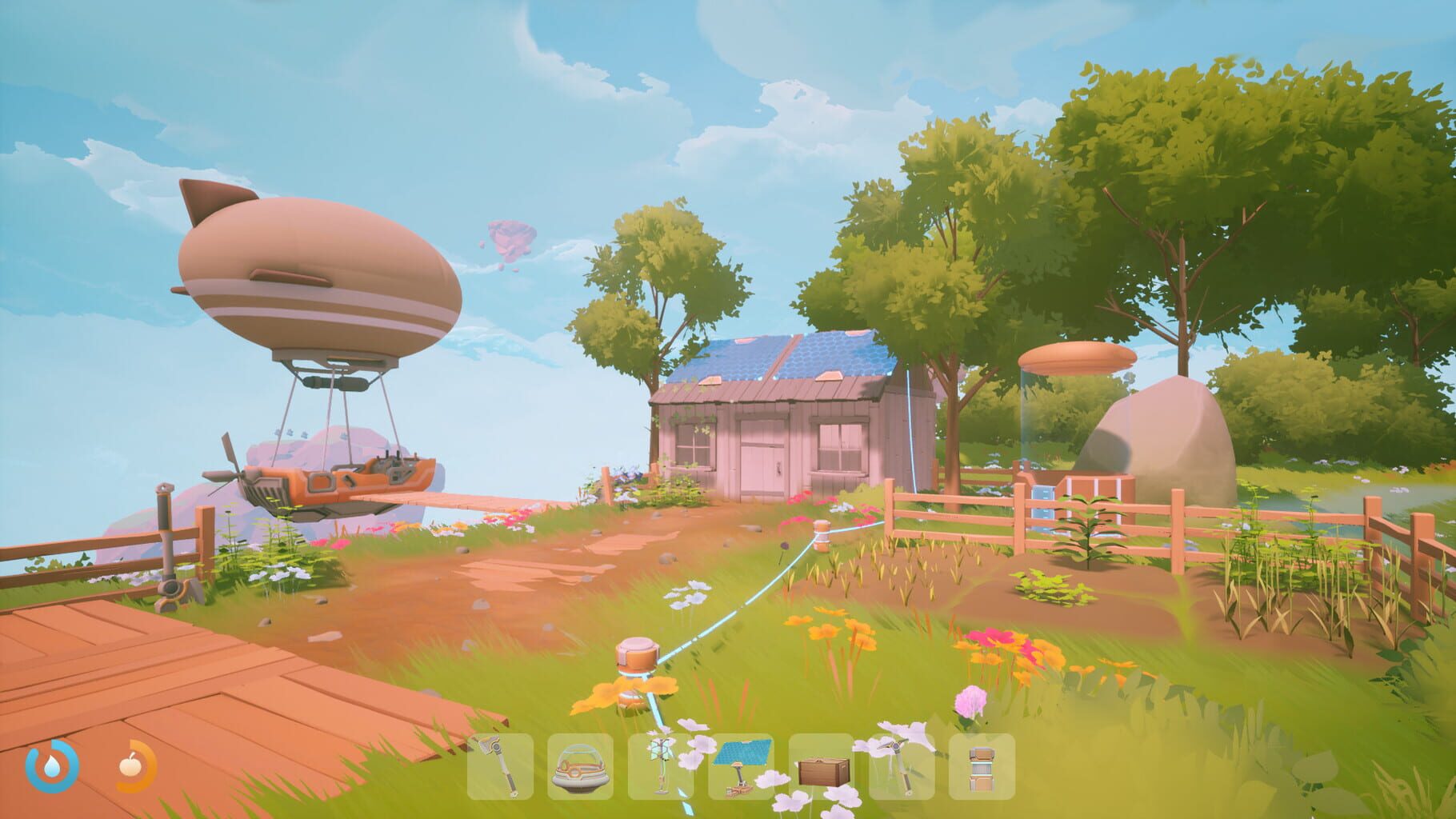
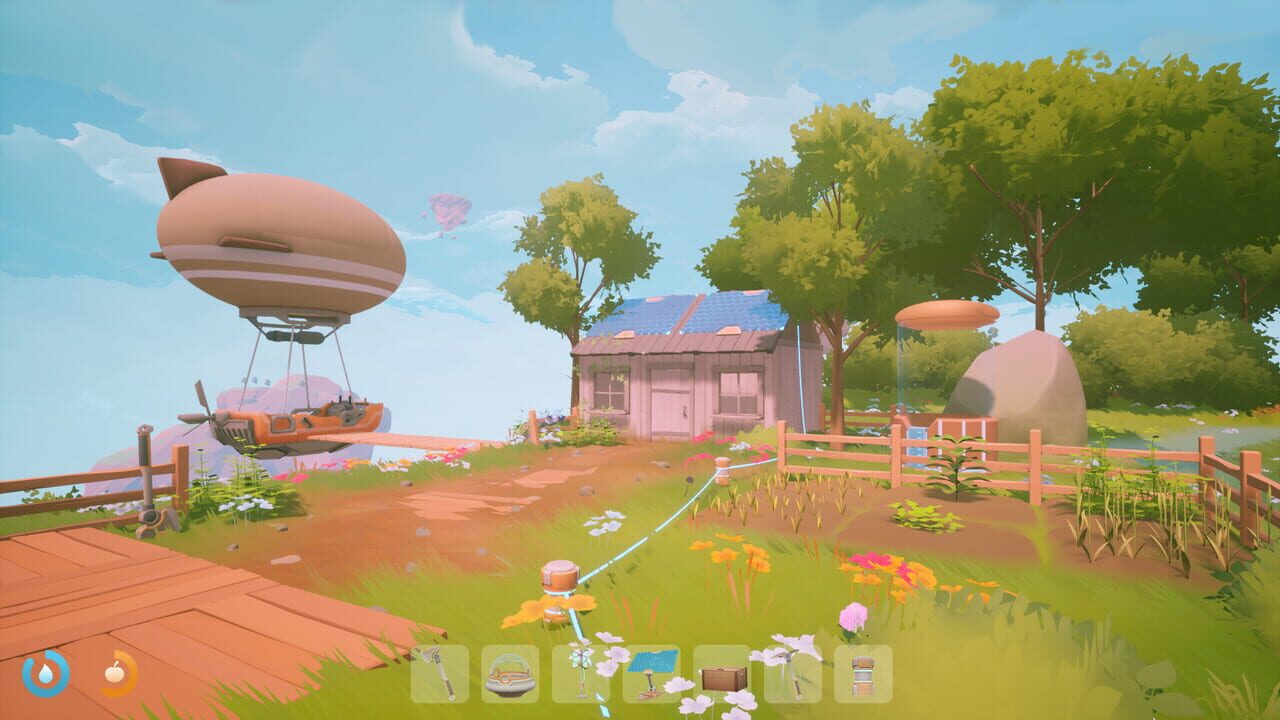
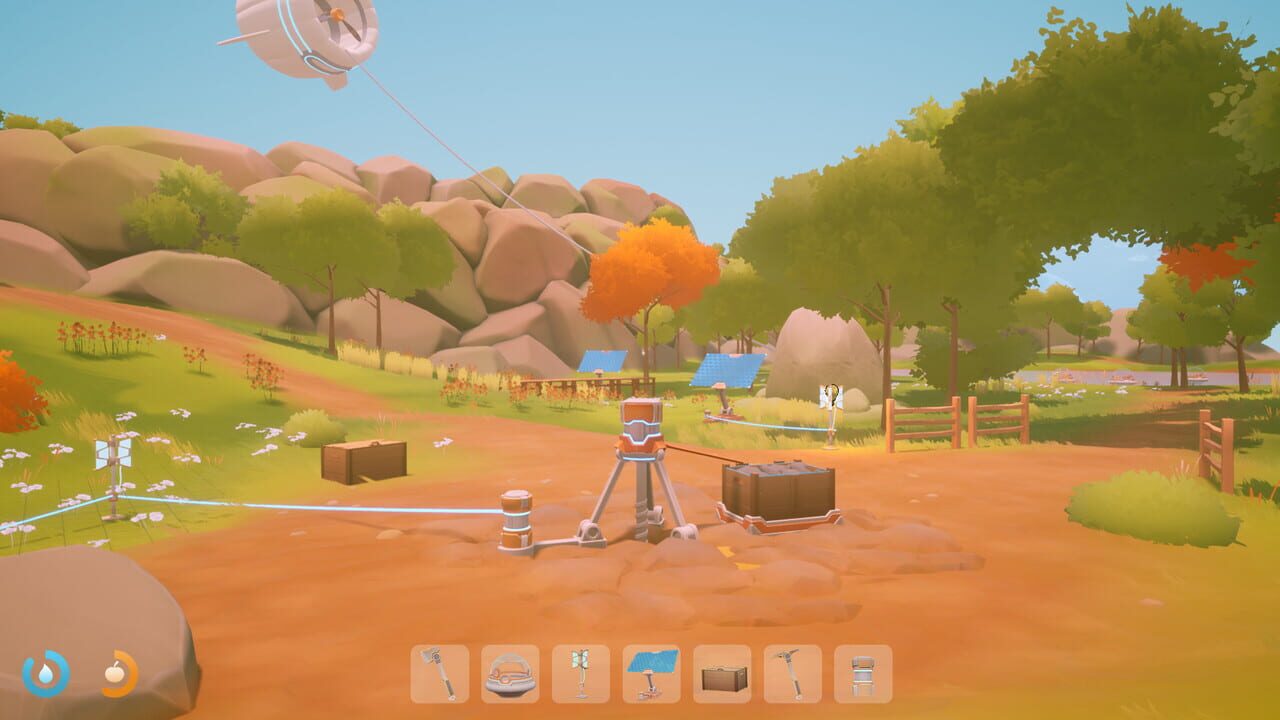
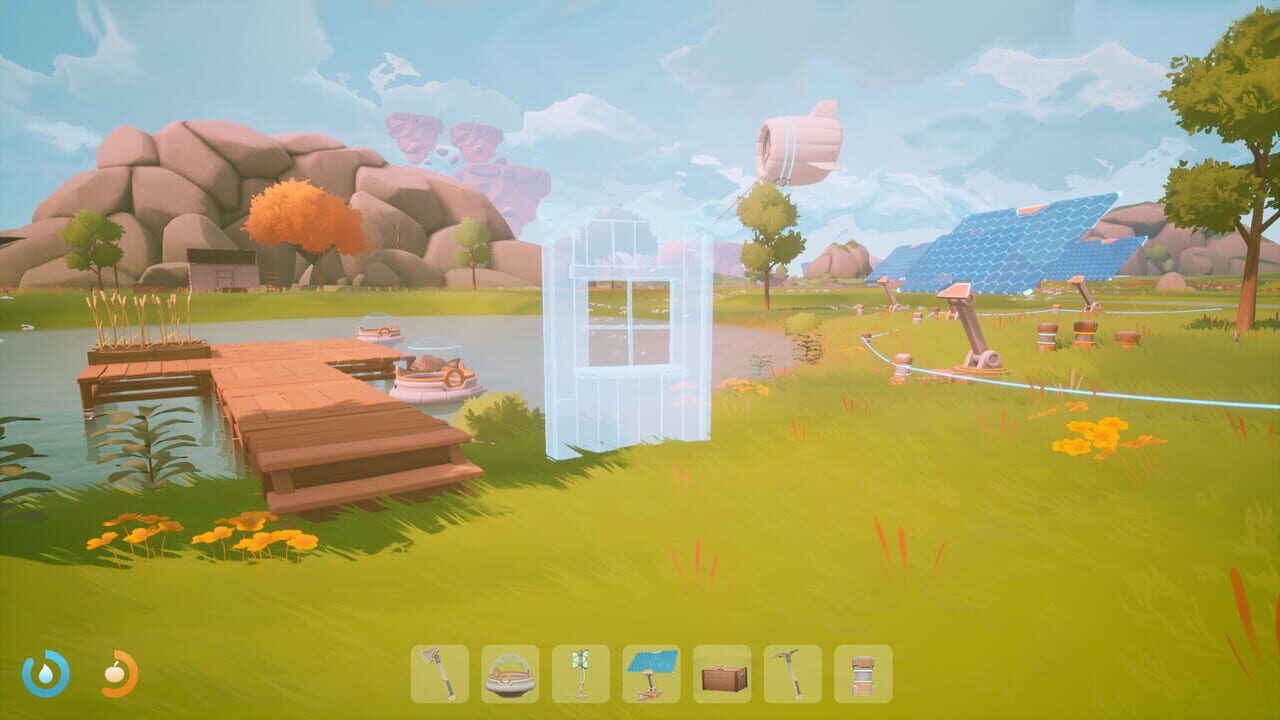
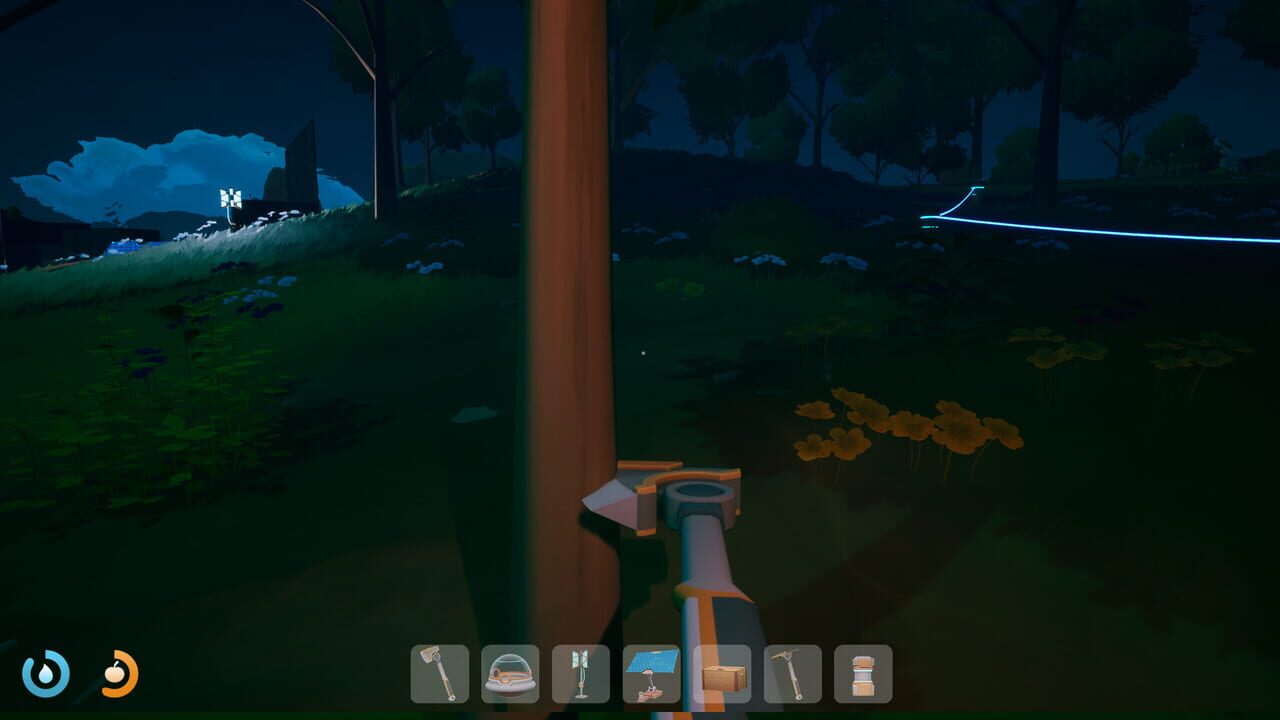
Solarpunk, the cozy-survival game released by Cyberwave in early June 2026, takes the movement's name and aesthetic and translates them into the playable medium. The design is on its surface familiar from the cozy-survival lineage that has been one of the most commercially productive game categories of the past decade: a player character in a small environment with crafting, building, gathering, and gentle progression systems. The differences from the standard cozy-survival template are interesting, and the differences matter for what the game is actually doing.
The frame this essay wants to give the reader is broader than the game and broader than the Solarpunk movement. The central political-cultural concept the movement organizes itself around - the concept of having enough - has been one of the most consistently demonstrated findings of the past forty years of well-being research, and one of the most consistently absent positions in contemporary political-economic life. The gap between what the research has been showing and what the cultural-political conversation has been able to accommodate is one of the more revealing features of the contemporary moment. Solarpunk as a movement, and Solarpunk as a game, are small cultural products whose central design proposition treats enoughness as the system rather than as the dissenting position. The proposition is rarer than it should be, and noticing why it is rare is more useful than the game's surface charm suggests.
The well-being research that supports the enoughness concept is among the more consistently replicated bodies of evidence the social sciences have produced. The foundational paper was published by the University of Pennsylvania economist Richard Easterlin in 1974, titled Does economic growth improve the human lot? Some empirical evidence. Easterlin's analysis assembled the available cross-national happiness-survey data and the available time-series happiness data within countries, and produced what is now known as the Easterlin Paradox. The paradox was that, within any given country at any given time, higher-income individuals reported higher happiness than lower-income individuals, but across time as countries became wealthier overall, the average reported happiness did not increase in proportion to the increased wealth, and in many cases did not increase at all past a certain income threshold. The implications were clear and unwelcome. The unlimited pursuit of increased material consumption that the postwar economic system was organized around did not, on the actual happiness data, produce the increased life satisfaction the system promised. The pursuit produced more consumption. The consumption did not produce more happiness.
The subsequent fifty years of happiness-economics research have refined Easterlin's findings considerably. The contemporary consensus, gathered most accessibly in the British economist Tim Jackson's 2009 Prosperity Without Growth and its 2017 expanded edition, is that there is a threshold income level - varying by country and by historical period, but generally in the range of $20,000 to $40,000 USD per capita in 2020 dollars - below which additional income produces substantial well-being gains and above which the gains taper off sharply. The developed countries crossed this threshold sometime in the mid-twentieth century. The continued economic growth since has produced substantial additional consumption without proportional additional well-being. The threshold is real. The threshold is also the empirical foundation for the political-philosophical concept of enoughness.
The British philosopher Kate Soper, in her 2020 Post-Growth Living, gave the contemporary philosophical articulation of what an enoughness-oriented cultural-political position would actually look like. Soper's argument, developed across several decades of prior work, is that the contemporary cultural-political imagination has been substantially captured by what she calls the consumerist hedonism that the postwar economic system has been actively producing. The captured imagination treats increased consumption as the default form of well-being and treats any reduction in consumption as a sacrifice. The actual happiness data, on Soper's argument, suggests that this framing has the relationship between consumption and well-being backwards past the threshold income. Past the threshold, additional consumption does not produce well-being gains; it produces additional environmental damage, additional time-stress (the work required to fund the consumption), additional social-comparison anxiety (the keeping-up-with-the-Joneses pattern), and additional storage-and-maintenance burdens (the time spent managing what has been acquired). Soper's alternative hedonism is the position that, past the threshold, voluntary reduction in consumption produces well-being gains rather than losses, and that the cultural-political construction of consumption-as-pleasure has been keeping the population from noticing.
The anthropologist Jason Hickel, in his 2020 Less Is More, made the complementary structural-political argument. Hickel's position is that the developed-world consumption levels are not just questionable on well-being grounds but are environmentally impossible to sustain. The biosphere cannot accommodate the contemporary developed-world per-capita consumption levels if extended to the global population, and the contemporary consumption levels cannot continue indefinitely even in the developed world without producing biospheric collapse on a timescale that has become alarmingly visible across the past decade. The position is not new - variations of it have been articulated continuously since the 1972 Limits to Growth report - but the contemporary empirical evidence has been making the position substantially harder to dismiss as alarmist. The implication is that the developed world is going to have to find some path back below its current consumption levels, either through voluntary reduction or through involuntary collapse, and that the voluntary version is substantially less destructive than the alternative.
The political-cultural reception of the Soper-Hickel-Jackson framework has been, on a careful reading, almost entirely confined to a small left-academic readership. The mainstream political-economic conversation in the developed world has continued, across the entire period of the framework's development, to treat continued economic growth as the unquestioned baseline and to treat any deviation from growth as a temporary problem to be solved by returning to growth. The Easterlin Paradox does not appear in mainstream political coverage. The threshold-income finding does not enter the public conversation about economic policy. The structural-environmental argument that the developed-world consumption levels are biospherically impossible is treated, when it appears at all, as a fringe position rather than as the consensus of the relevant empirical literatures.
The reason for the reception gap is, on the available political-economy analysis, structural rather than ideological. The contemporary economic system has substantial built-in constituencies - financial-sector actors who depend on continued asset appreciation, industries whose profitability depends on continued consumption growth, governments whose tax bases depend on the consumption flows, employed workers whose wages depend on continued production - that benefit from the continuation of the growth model and have no incentive to acknowledge the well-being or environmental data that would suggest the model needs to be revised. The data is available. The actors have not been incentivized to act on it. The result has been a continued growth trajectory through and past the point at which the trajectory's beneficiaries became, on the well-being measures, no better off than they had been at lower consumption levels.
This is the cultural-political situation Solarpunk enters. The movement's central proposition - that ecological reconciliation, post-scarcity, and the cultural valuation of enoughness are imaginable futures worth imagining toward - is the kind of imaginative work the contemporary mainstream conversation has been failing to perform. The work is, on the Soper-Hickel-Jackson framework, badly needed. The cultural products that perform the work are doing something the surrounding mainstream cultural environment has been actively making difficult.
The game's design, on the available information about the early-access build, takes the movement's premise seriously enough to organize the game's systems around it. The standard cozy-survival template is built on scarcity as the engine: the player gathers resources because resources are limited, the player crafts items because items are not freely available, the player progresses through a tech tree because the tree's later nodes are gated by accumulated resources. The Solarpunk template removes the scarcity assumption. The game's environment is, in the post-scarcity register the movement's literature has been developing, abundant. The player's activity is not primarily extraction; the player's activity is primarily arrangement, repair, and the small ongoing maintenance of an already-functional ecosystem. The reward economy is different because the underlying resource economy is different.
This is harder to design than it sounds. Most game designers' working knowledge of how to produce satisfying gameplay has been built up against scarcity-engine templates, and the standard intuitions for what makes play satisfying often do not transfer cleanly to post-scarcity premises. The early reports on Solarpunk's early-access build suggest that the studio has handled this design challenge with mixed success - some of the game's systems work well in the abundance register, others feel under-pressured because the standard scarcity-pressure has been removed without sufficient replacement of the cognitive engagement scarcity was providing. The challenge is real and the resolution is design-difficult. The game's continued early-access development will, on the available pattern, refine the design as the studio iterates on what the abundance-register engine actually requires.
There is one specific design dimension worth registering. The Australian permaculture practitioner Bill Mollison, whose 1988 Permaculture: A Designer's Manual gave the contemporary permaculture movement its foundational practical text, developed an approach to agricultural design that took the post-scarcity premise seriously at the level of system construction rather than as ideology. Permaculture, in Mollison's articulation, is the deliberate design of agricultural systems that mimic the functional properties of natural ecosystems - multiple yields from each element, multiple elements supporting each function, deliberate use of mutualism between species, energy-conserving routing of materials between system components. The well-designed permaculture system, on Mollison's argument and on the subsequent forty years of practical application, requires substantially less labor per unit of output than the conventional industrial-agriculture system requires, while producing more diverse outputs, building rather than depleting soil, and improving rather than degrading the surrounding ecosystem. The system's reward economy is not the conventional efficiency-maximization economy of industrial agriculture; the system's reward economy is the multi-yield, mutualistic, energy-conserving economy that the permaculture design principles are oriented toward.
Solarpunk the game, on the available early-access reports, has been working in the permaculture register. The game's design recognizes that the post-scarcity premise requires a different set of underlying systems than the standard scarcity-engine template provides, and the studio has been drawing on the permaculture practical literature for the specific design vocabulary. This is a sensible design choice and, on the available evidence, mostly working. The play sessions that result have a specific affective register few cozy games have produced: the player is not maximizing extraction or accumulation; the player is, in the small interactive way the medium permits, designing for ongoing mutualistic system functioning. The cognitive practice is different from the standard cozy-survival cognitive practice in ways the play actually registers.
What the game's existence and reception will reveal, more interestingly than the game's specific design accomplishments, is whether the cultural appetite for the enoughness frame the movement has been articulating is actually present at the scale that would matter politically. The cozy-survival category has been one of the most commercially productive game genres of the past decade. If Solarpunk produces commercial returns within the category's normal range, the data will suggest that the cultural appetite for the enoughness frame is substantial. If the game underperforms relative to the category baseline, the data will suggest the appetite is narrower than the movement's literature has been hoping. Either result will be informative.
What the reader can take from this, beyond the specific game and the specific movement, is the small recognition that enoughness as a cultural-political concept is rarer in the contemporary mainstream than the underlying empirical evidence would justify, and that the rarity is a function of structural conditions rather than of the concept's intellectual weakness. The well-being research has been clear for fifty years. The threshold income has been identified. The diminishing returns past the threshold have been documented across many decades and many countries. The environmental limits on continued consumption growth have been established by the relevant scientific consensus. The cultural-political conversation has been working around all of this for the entire period in which the evidence has been accumulating, because the structural beneficiaries of the continued growth model have had no incentive to engage with the evidence on its own terms.
The cultural products that take the enoughness frame seriously - the Becky Chambers novellas, the Kim Stanley Robinson novels in his more recent register, the Sunvault and Multispecies Cities anthologies, the smaller body of Solarpunk-coded films and games of which the new Cyberwave game is one - are doing slow cultural work the political-economic conversation has not been doing. The work is the work of making enoughness imaginable as a system rather than as a sacrifice. The imagining is the precondition for the cultural-political shift the empirical evidence has been pointing toward for decades. The shift, on the historical pattern of how cultural-political shifts actually happen, requires the imagining as the cultural substrate from which the political articulation eventually emerges.
This is not, on a fair reading, the small cozy game's responsibility. The game is a game, and the game's contribution to whatever larger cultural-political shift may or may not occur is, on its own scale, modest. But the cumulative effect of many such modest contributions, across the cultural products taking the enoughness frame seriously, is the kind of slow cultural work the historical record suggests does eventually produce political change at the rate the underlying evidence licenses.
The reader who plays Solarpunk in the early-access build will encounter a small playable world organized around the proposition that enough is the system, not the dissenting position. The world is fictional. The empirical evidence underneath the proposition is not fictional. The cultural-political conversation that should have been organized around the empirical evidence forty years ago has not been organized around it, and the cultural products that do the organizing work the political conversation has refused are doing more than the cozy-game surface marketing has been able to admit. Adam Flynn's 700-word manifesto in 2014 was the small inaugural text. The cultural production since has been the slow, distributed, continuing development of what the manifesto pointed toward. The new game is one entry. The next will arrive. The cumulative work continues, on the timescale at which cultural-political shifts actually proceed, regardless of whether the surrounding mainstream conversation has yet noticed the work is happening.