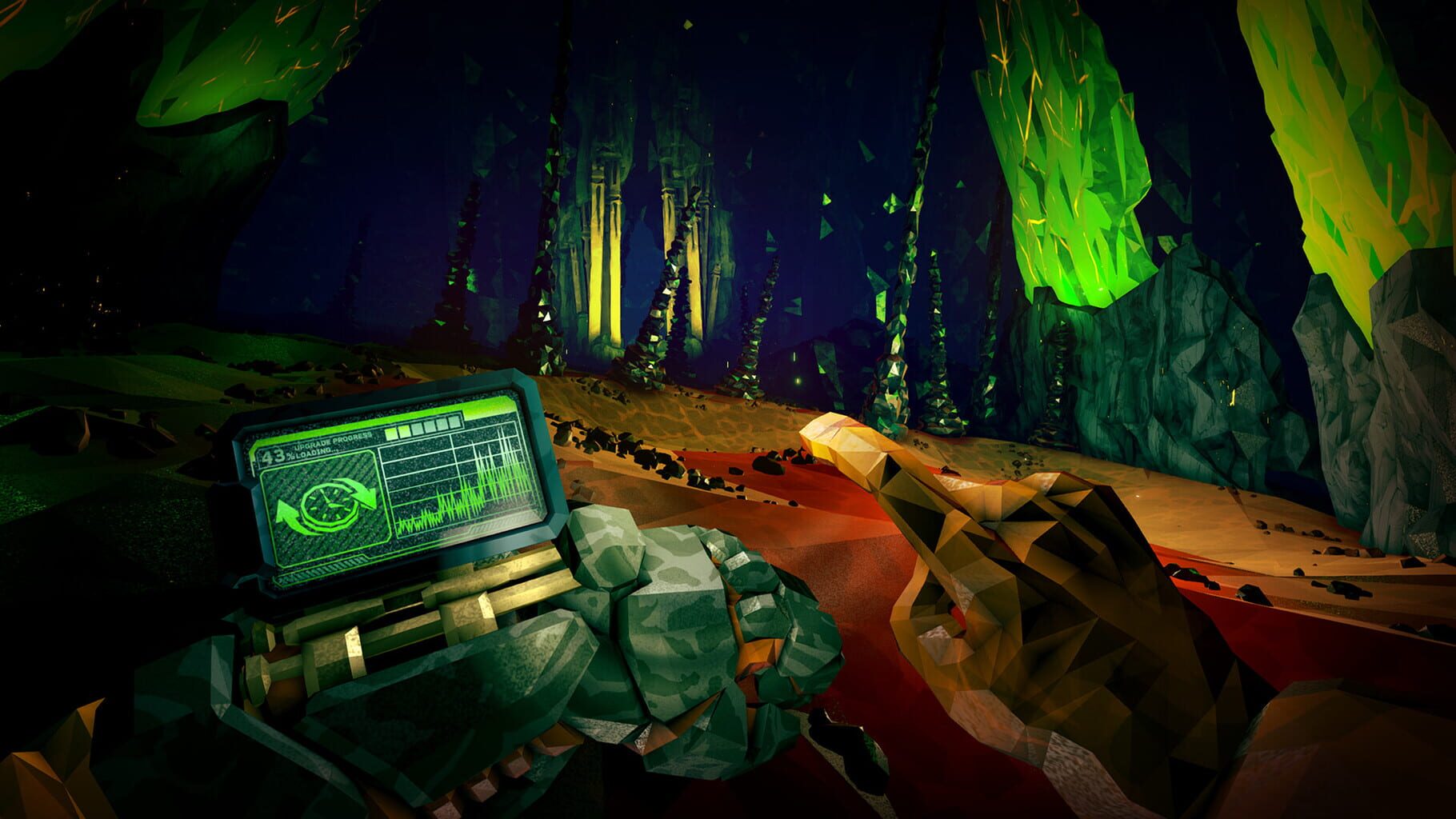



It is roughly two in the morning. The dwarf is down. The other three dwarves on the hill have been holding position against a swarm of insectoid creatures for the past forty seconds, and the fourth - operated by a player whose handle is something like "GreasyHandshake" or "KrellMineCo" - has been reduced to a small kneeling figure on the rocky ground, with a fading red icon above its head indicating that without intervention in the next twenty seconds the run is going to end here. The player operating GreasyHandshake has never spoken in the voice chat. He has not, at any point in the previous thirty-eight minutes of cooperative drilling and shooting and ore-extraction, given any of the other three dwarves any reason to do anything for him beyond the minimum the game's matchmaking required when it placed them on this team.
One of the dwarves turns around. The dwarf in question - the Scout - has been running flares and pickaxing minerals on the far side of the cave, and is currently the only one of the three remaining team members not under direct combat pressure. He could keep doing what he is doing. He could let GreasyHandshake bleed out and continue the mission as a three-stack. He could, more realistically, do what most online cooperative-game players have been documented doing in equivalent situations over the past fifteen years, which is leave the match and re-queue with a new team that has not just lost a member.
The Scout instead rappels across the cavern, takes a small amount of damage from a passing acid-spitter, lands beside GreasyHandshake, holds the revive button for the requisite three seconds, and then turns to engage the next wave. GreasyHandshake stands up. The two of them, plus the other two dwarves still holding the hill, complete the extraction. The Pelican lifts. The mission ends. None of the four players ever speaks. The game's lobby screen returns them to the main menu, where each of them queues for a new mission with three new strangers, and the entire procedure begins again.
This is most sessions of Deep Rock Galactic, the Danish-developed cooperative shooter that Ghost Ship Games released in 2018 and that has, across eight years and several major expansions, sustained an online community that is, by a substantial margin, the kindest large-scale multiplayer community in commercial gaming. The franchise's latest entry, Rogue Core, entered early access in May 2026 as the studio's first roguelite spin-off of the original. The mechanical proposition is new; the community is the old one.
The frame this essay wants to give the reader is broader than this one game. The DRG community is not an accident, and it is not a function of the studio's force of personality or the audience's mysterious good nature. The community works because the game's design happens to implement, almost in full, the specific institutional conditions that political scientist Elinor Ostrom spent her career identifying as the conditions under which cooperation actually sustains itself in the absence of state coercion or market discipline. The conditions are knowable. They have been studied across many domains for fifty years. Once you can see them, you can predict with reasonable accuracy which online communities will work and which will not.
Ostrom won the 2009 Nobel Prize in Economics, the first woman to do so, for her work on what economists had been calling the commons problem: how do groups of people sustainably manage shared resources (fisheries, irrigation systems, grazing lands, forests) without either privatizing them or having a state enforce rules from above? The dominant assumption since Garrett Hardin's 1968 paper The Tragedy of the Commons had been that they could not - that shared resources were always going to be over-exploited by self-interested individuals, and the only solutions were either to put fences around them and assign ownership or to bring in a coercive authority to ration access. Ostrom's career was the patient demonstration that this assumption was empirically wrong. Communities have, across the world and across centuries, sustainably managed shared resources without privatization and without state enforcement, in cases ranging from Swiss alpine pastures to Philippine irrigation systems to Maine lobster fisheries. The cases were not unicorns. They were the historical norm.
What Ostrom's lab at Indiana University spent decades doing was identifying the structural features common to the successful cases and absent in the failed ones. The result was a set of eight design principles for what she called long-enduring, self-organized common-pool resource regimes. The principles are dry; the application is striking. Communities whose institutional arrangements satisfy most of the principles tend to sustain cooperation across generations. Communities that satisfy few of them tend to collapse into the tragedy Hardin had predicted, but for reasons that are about institutional design rather than human nature.
The eight principles, in compressed form: clearly defined boundaries around who is in the community and what the resource is; rules adapted to the local situation rather than imposed from outside; collective-choice arrangements that let the people affected by the rules have a voice in making them; monitoring of rule compliance; graduated sanctions for violations, escalating only when the smaller responses fail; cheap and accessible conflict-resolution mechanisms; recognition by external authorities of the community's right to organize itself; and, for larger systems, nested layers of organization that operate at appropriate scales.
The reader who has never read Ostrom may be surprised at how dry these are. The principles do not sound revolutionary. They sound like the kind of common-sense organizational advice anyone who has run a successful neighborhood watch or amateur sports league could have produced from experience. That is approximately the point. Ostrom's contribution was not invention; it was the empirical demonstration that these specific features, in combination, predict cooperation reliably, while their absence predicts collapse reliably, and the prediction holds across cultures, scales, and resource types. The principles do not require unusual human virtue. They require structural conditions most online communities have not bothered to construct.
Now consider Deep Rock Galactic.
The game's class system creates clearly defined boundaries: four dwarf classes (Driller, Engineer, Gunner, Scout) with non-overlapping capabilities. The Scout can light caves but cannot dig efficiently. The Driller can tunnel anywhere but does not have ranged combat. The Engineer places turrets and platforms but cannot navigate vertical terrain unassisted. The Gunner deploys zip lines and lays down suppressive fire but is mechanically slow. The classes do not overlap because the design intentionally refuses to let them. A four-player team that has only Scouts cannot, in any meaningful sense, complete a difficult mission. The mechanical necessity of the other classes is the structural fact that produces the cooperation. You do not help the other dwarves because you are virtuous. You help them because the cave system you are in is structured around their specific competences, and without those competences you are dead in the next forty seconds.
The game's loss states are graduated sanctions in Ostrom's strict sense. A teammate who goes down can be revived. A teammate who dies entirely can still be respawned at the next iron supply pod. A team that fails the mission entirely loses the mission's rewards but retains their character progression, their equipment, and their place in the community. The penalties for griefing or for poor play are present but recoverable. The penalty for severe griefing - repeatedly killing teammates with friendly fire, intentionally wasting resources - is removal from the lobby, but only after the lower-level responses (warnings, the host's discretion, the community's social pressure) have failed. The system does not jump straight to maximum punishment. It escalates as Ostrom's research predicts effective sanction systems do.
The game's matchmaking system creates recognition of rights to organize: players who want to play together can form persistent groups; players who want to play with strangers can queue solo; the studio has refused, across eight years, to force matchmaking pools that would mix incompatible preferences. The official Discord and subreddit operate as nested enterprises in Ostrom's vocabulary: large-scale community spaces that handle disputes and norm-setting at scales the in-game matchmaking cannot. The studio's policy of releasing community-facing tools (modding support, server browsers, custom-difficulty settings) is a recognition that the community has the right to organize aspects of the experience the studio cannot manage from a central position.
The famous "Rock and Stone" callout - the verbal-and-text ritual every dwarf can perform, eliciting matching callouts from the rest of the team - is the community's cheap and accessible conflict-resolution mechanism, almost in caricature. There is no voice chat required; there is no need to type out a message; there is no opportunity for the callout to escalate into argument. The callout exists. The teammates respond. The brief moment of synchronization re-affirms that the team is a team. This is, structurally, the same function that ritual greetings serve in many traditional commons-managing communities, from the Swiss alpine pasture associations Ostrom documented to the Japanese village irrigation cooperatives later researched by Margaret McKean. The callout is small. The function is exact.
The pattern is not coincidence. Ghost Ship Games did not, on the public record, sit down with Ostrom's 1990 Governing the Commons before designing DRG. The design choices that produced the cooperative community emerged from the studio's intuitions about what makes a co-op shooter feel good, and from years of community management responsive to what was working and what was not. The fact that those choices map almost perfectly onto Ostrom's principles is what cooperation researchers would call convergent design: independent solutions to a structural problem converge on similar features because the structural problem has a limited number of robust solutions.
The implication for the broader medium is more substantial than the casual conversation about online community has been able to articulate. Most online multiplayer games default to toxicity. Their communities are difficult, their first-time-player experience is hostile, their long-term retention skews toward a small core of veterans who tolerate the conditions. The default explanation in industry circles has been that online communities are like that, that players are toxic, that the surrounding internet culture is bleeding into game spaces and there is little a studio can do.
This explanation is convenient and empirically wrong. Online communities are like that when the games they form around fail to implement Ostrom's conditions. Online communities are not like that when the games implement those conditions. The variation is not in the population of players, who overlap heavily across games. The variation is in the institutional design. League of Legends and Deep Rock Galactic share most of their PC players. The communities are nothing alike. The difference is in what the games' designs let, encourage, and punish, not in who is playing them.
Robert Putnam, in his 2000 Bowling Alone, gave the contemporary American sociological version of Ostrom's argument from the other direction. Putnam documented the collapse of American civic associations across the second half of the twentieth century: bowling leagues, lodges, religious congregations, neighborhood associations, parent-teacher organizations, all in measurable decline. His central claim was that this decline mattered because civic associations had been the substrate on which everyday cooperation, social trust, and political functioning were built. Without them, the population had become more anxious, more isolated, and worse at the collective behaviors that democratic societies require. The decline was not a failure of individual virtue. It was the absence of the structural conditions that had previously made the cooperation visible and easy.
Putnam and Ostrom were working on different scales - Ostrom on small commons, Putnam on national civic infrastructure - but their findings were complementary. People are not generally bad at cooperation. People are bad at cooperation when the conditions for cooperation have been allowed to erode. Build the conditions back, and the cooperation returns at predictable rates. This is one of the more important and underappreciated findings of late-twentieth-century social science, and it has not been absorbed by the conversation around online communities at anything like the rate the evidence would support.
What Rogue Core inherits from the original game is the cooperative-design substrate that has been keeping DRG's community kind for eight years. The roguelite structure of the new game changes the run-to-run experience: missions are now persistent across a campaign of attempts, with meta-progression carrying forward, and the team's investment in any given run is higher than the original's mission-by-mission structure permitted. This raises the stakes of cooperation. A team that fails on the eleventh floor of a roguelite run loses substantially more than a team that fails on a one-off mission. The early reports from Rogue Core's player base suggest that the community has, so far, scaled with the new stakes - the helpfulness has intensified rather than fragmented, which is what Ostrom's framework predicts for a community whose institutional design is sound.
The reader who finishes this essay can carry the frame outward into almost every online community they encounter. The next time a multiplayer game's community feels welcoming, the question worth asking is not whether the studio has cultivated a culture (although it usually has). The question worth asking is which of Ostrom's principles the design happens to implement. Are the roles clearly bounded? Are the sanctions graduated? Are there nested layers where conflicts can be resolved at the appropriate scale? Does the community have recognized rights to organize spaces the studio cannot manage centrally?
The same question runs in reverse for the toxic communities. When an online space is hostile, the explanation is rarely that the players are uniquely terrible. The explanation is almost always that the structural conditions have been left in a state that makes hostility cheap and cooperation expensive. The fix, in principle, is not to lecture the players. The fix is to redesign the conditions. Ostrom's career was a fifty-year demonstration that this fix is real and that it works.
The Scout in the cave will rappel back to his side of the cavern. GreasyHandshake will join the regrouping team. The Pelican will lift. The cycle will repeat at two-thirty in the morning on a different planet, with three different strangers, in a community whose structural conditions have been producing this same small act of kindness, over and over, for eight years and counting. The kindness is not virtue. It is design. And the design is reproducible, in this medium and in every other one where strangers are asked to do something together, when the people building the systems are willing to do the work Ostrom showed was always available to be done.