


In 1959, in a Siberian research station outside Novosibirsk, the Russian geneticist Dmitry Belyaev began an experiment that would run, in unbroken sequence, for the rest of the twentieth century and into the twenty-first. The experiment was ostensibly a study of fur farming. Belyaev's actual question was older and stranger: how had wolves become dogs? The Soviet biological establishment of the late 1950s, organized around Lysenko's ideologically enforced rejection of Western genetics, did not give him resources to ask the question in the form he wanted. So he asked it in the form he was permitted to ask: he began selecting silver foxes for tameness, generation after generation, breeding only the kits that approached human handlers without aggression and discarding the ones that did not.
The results, by the tenth generation, were structurally astonishing. The foxes selected for tameness had not just become tame. They had begun developing physical traits the original silver foxes did not have: floppy ears, curly tails, white spots in their fur, shorter muzzles, smaller teeth, the bark-like vocalizations that wolves do not produce. The foxes were, by the twentieth generation, recognizably proto-dogs. By the sixtieth generation, which the experiment reached around 2020 under Belyaev's successor Lyudmila Trut, the foxes were dogs in everything but their species classification: they sought out human attention, they wagged their tails, they whimpered when their handlers left the room, they were sad to be alone. Selecting for tameness had selected for an entire phenotypic constellation that had taken wolves roughly fifteen thousand years to develop into dogs and that the Soviet fox experiment had reproduced in sixty.
This is the underlying biological fact most of the contemporary conversation about human-animal relationships has not been trained to integrate. The relationship between a human and a companion species is not a fixed encounter between two pre-existing kinds. The relationship is the conditions under which both kinds become what they are. The dog is the animal that has been bred, generation by generation, for the relationship the dog has with humans. The human, on the longer evidence of the archaeological and genetic record, has also been changed by the relationship, with measurable consequences for human social behavior, immune function, and possibly cognitive specialization. Wolves and humans did not meet as wolves and humans. They met as something else, and across the millennia they have been making each other into what they are now. The making is the relationship. The relationship is the making.
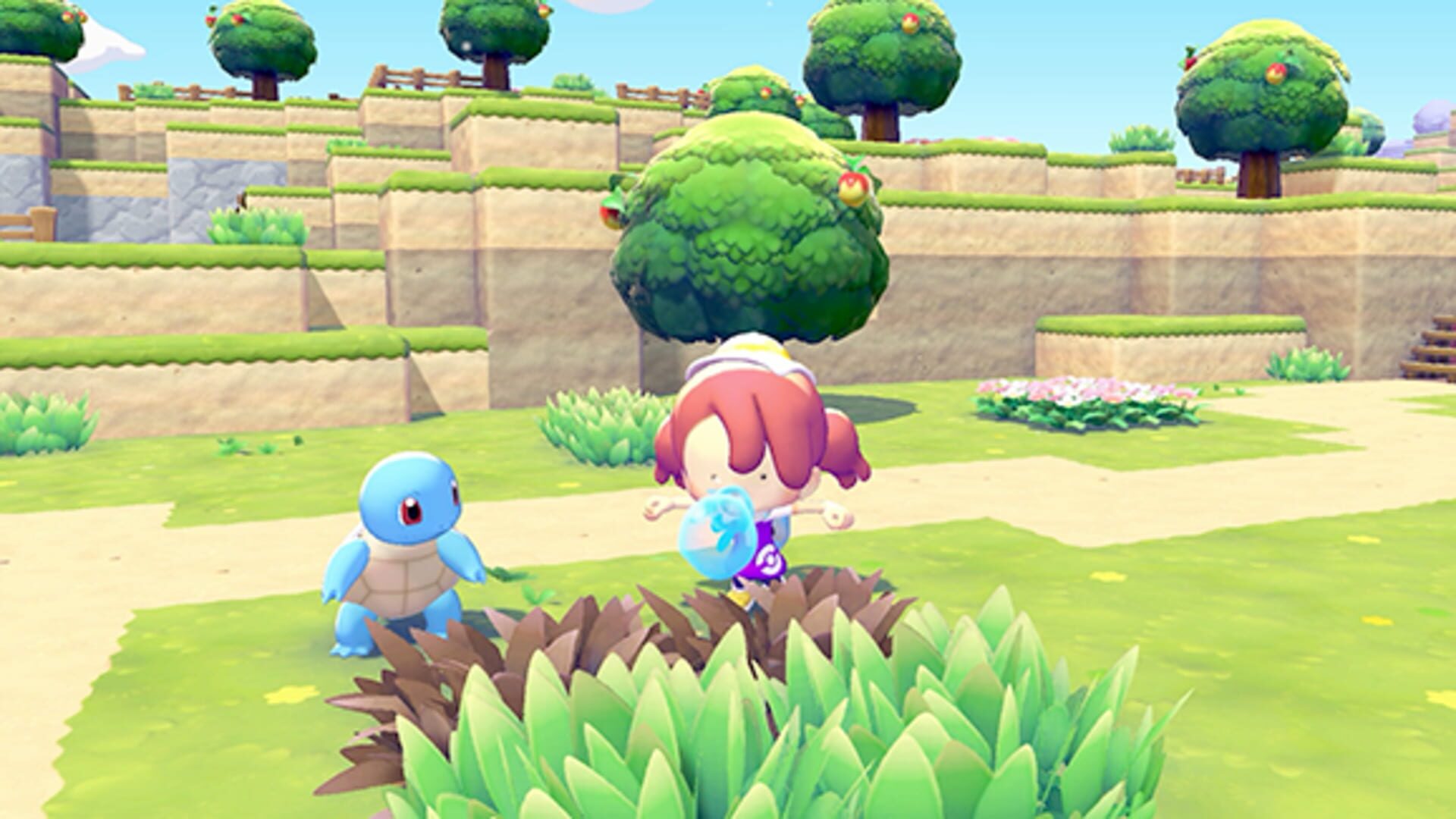
Pokemon Pokopia, the life-simulation spin-off Nintendo released for Switch 2 in March 2026, is the franchise's first commercial commitment to taking this proposition seriously as the design's primary subject rather than as the unstated background of the catching-and-battling structure that has dominated the series since 1996. The game's protagonist is a Ditto - the franchise's mimicry creature, capable of transforming into other Pokemon - who has transformed into a human in order to shape an empty land into a habitable place for other Pokemon. The player is not a human caretaker placed above the creatures. The player is a creature performing humanity in order to make a small social world possible. The shift in framing is small in stated terms and substantial in implication. The game is, in the small commercial way Nintendo sometimes does this, the franchise's most carefully positioned statement on what the human-companion relationship has been from the beginning.
The frame this essay wants to give the reader extends past the game. The frame is this: the surrounding contemporary culture's casual understanding of companion-species relationships has been organized around a one-sided model in which the human is the active party and the companion is the recipient of the human's care. The model is empirically wrong. The biological evidence, going back through Belyaev to the longer archaeological record, is overwhelming that companion-species relationships are co-evolutionary. The companion changes the human as much as the human changes the companion, on a longer time-scale than any individual relationship but with measurable consequences for both parties. The cozy-game category, of which Pokopia is the latest mass-market entry, has been making this proposition available to its players for two decades, mostly without the surrounding cultural conversation noticing what the form is doing.
Donna Haraway, the American historian of science whose 2003 Companion Species Manifesto and 2008 When Species Meet gave the contemporary humanities its most-cited framework for thinking about cross-species kinship, made the central argument the rest of this essay will rely on. Haraway's claim, developed against the dominant late-twentieth-century cultural model that treated animals as the inarticulate other of human culture, was that human-animal relationships are real social relationships and that the social relationship cannot be reduced to either party's pre-existing nature. The dog is not just the human's companion; the dog is one of the parties producing the relationship, with its own history, its own developmental specificities, its own forms of cognition and feeling that the human has had to learn to read. The relationship is built, in Haraway's vocabulary, in the contact zone where the two species are negotiating what they are in relation to each other. The contact zone is not the natural meeting of two pre-formed things. The contact zone is the place where both things continue to become themselves through their relation.
What Haraway's framework makes available, for thinking about Pokemon Pokopia, is the recognition that the game's premise is not, in any reductive sense, anthropomorphism. The Ditto-as-human is not a creature pretending to be something else. The Ditto-as-human is the franchise's design metaphor for what every actual companion-species relationship requires: the willingness to perform partial cross-species translation in order for the relationship to be possible at all. The human who lives with dogs has, over the years, learned to read the dog's signals, to time activities to the dog's needs, to modify the household's spatial arrangements to the dog's competences, to develop the small vocabulary of vocal cues and body language that the relationship operates through. The human is not just being human; the human is also, in some real way, being the kind of human a dog can live with. The Ditto in Pokopia makes this explicit. The Ditto is, in the game's fiction, the kind of creature that has chosen to perform humanity in order to make a place where other creatures can live.
This is one of the franchise's most thoughtful design statements in years, and it has been mostly underread by the surrounding critical conversation because the surface of the game is so consistent with the Pokemon house style that the conceptual shift is easy to miss. The bright colors, the cheerful music, the small chibi proportions, the friendly Pokemon character designs, all read as the franchise's standard visual register. Underneath, the design is making an argument the franchise has not made before. The argument is that the relationship between trainer and Pokemon was always, on a longer read, the relationship between human and companion species. The catching, the battling, the team-building of the older games were specific cultural-mechanical articulations of the underlying relationship. They were not the relationship itself. The relationship can be articulated differently. Pokopia is the franchise's attempt to articulate it as dwelling, repair, and small-scale accommodation rather than as acquisition and competitive deployment.
Vinciane Despret, the Belgian philosopher and anthropologist of science whose 2012 What Would Animals Say If We Asked the Right Questions? developed one of the more useful contemporary frameworks for thinking about how humans interpret animal subjectivity, gave the second part of the analysis the game's premise requires. Despret's central project was to develop an alternative to two failed traditions in the study of animal behavior. The first tradition, behaviorism, treated animals as input-output machines whose interior life was either inaccessible or nonexistent. The second tradition, naive anthropomorphism, treated animals as having interior lives identical to human ones. Despret's argument, drawn from her decades of fieldwork with biologists, ethologists, and animal-keepers, was that the productive position lies between these two failures. The skilled animal-handler does not deny the animal's interiority and does not project a human interiority onto it. The skilled handler develops, through patient repeated observation and small interactive experiments, a working interpretive vocabulary for what this specific animal, in this specific context, is doing. The vocabulary is partial. The vocabulary is provisional. The vocabulary is also, on the empirical record, more accurate than either of the failed traditions had been.
Despret's framework is what cozy companion-care games have been training their players in for two decades. The Animal Crossing player who learns the specific small signs that indicate a neighbor wants a particular gift, the Stardew Valley player who learns the specific schedule the chickens prefer for feeding, the Pokemon player in the older games who learns the specific food preferences of a partnered Pokemon, are all developing, in small commercial-mediated form, the interpretive skill Despret was describing. The skill is partial; the skill is provisional; the skill is the skill the actual companion-species relationship operates on. Pokopia, with its design commitment to repeated daily-life encounter rather than to one-time capture, is the franchise's clearest commitment to this skill as the game's actual content.
Yi-Fu Tuan, in his 1984 Dominance and Affection: The Making of Pets, made an argument that deserves to be in this conversation despite its harder-edged framing. Tuan's claim was that the companion-pet relationship, while undeniably affectionate, also contains a dimension of domination that the surrounding culture has been reluctant to name. The pet is the creature that has been selected, bred, trained, and housed for the human's pleasure. The pet's preferences are accommodated; the pet's existence is structured by the human's choices. The affection is real. The asymmetry is also real. Tuan's argument was not against pet-keeping but for clarity about what the practice actually is: a particular mixed form in which care and control coexist, and in which the care depends on the control without being reducible to it.
The Pokemon franchise has, historically, been mostly silent on this dimension of its central relationship. The training, the battling, the use of small animal-shaped beings as tools of competitive deployment, are all in the dominance register Tuan was describing, even when the affection register is strongly present alongside them. The franchise's surrounding culture has been mostly comfortable with this, partly because the Pokemon are fictional and partly because the franchise's surface tone is cheerful enough to discourage too-careful reading. Pokopia, on a fair look, is the franchise's first commercial entry to acknowledge the dominance dimension by partially backing away from it. The player in Pokopia is not training, not battling, not deploying. The player is building a place, in cooperation with Pokemon who are, in the game's fiction, choosing to be there. The asymmetry has been softened. It has not been eliminated - the player still arranges the place, names the residents, designs the conditions - but the harder edges have been smoothed.
This is, on a careful read, what the cozy-game category is doing across most of its successful examples. The category is not, in the dismissive cultural-criticism reading, escapism. The category is a commercial form for engaging in care relationships without the harder dominance dimensions that older game forms had been more comfortable with. Stardew Valley, Animal Crossing, A Short Hike, Spiritfarer, the broader contemporary cozy-game library, are all entries in this softening. The softening is doing real cognitive work for its players: it is making available a kind of small-scale care relationship that the surrounding culture has been progressively withdrawing alternatives for. The relationship is fictional. The cognitive practice the relationship engages is real.
Anna Tsing's The Mushroom at the End of the World (2015) is worth registering briefly because it gives the broader ecological-philosophical frame the analysis depends on. Tsing's project, developed across fieldwork with matsutake mushroom foragers in Oregon, Yunnan, and Finland, was to argue that survival under contemporary conditions is mostly a matter of collaborative survival: humans, fungi, trees, animals, soil microbiomes, and the small specific interspecies arrangements that make any given biome livable are all, in Tsing's account, participants in the survival of any given place. The single-species story - humans as the lone protagonists, nature as the inert background - is, on Tsing's evidence, an inaccurate model of how survival actually works. The accurate model is multispecies entanglement.
Pokopia's design, on this Tsing-shaped reading, is the franchise's most direct commitment to the multispecies survival proposition. The place the player is building is not a place where humans live and Pokemon exist alongside as ornaments. The place is a multi-species arrangement in which the human (or human-shaped Ditto) and the various Pokemon residents are all contributing to the conditions that make the place livable. The Pokemon's abilities - the watering Pokemon, the growing Pokemon, the gathering Pokemon, the shelter-building Pokemon - are, in the game's design, infrastructure-contributions rather than tools the player deploys. The infrastructure is what the place is. The infrastructure depends on the multispecies cooperation. The multispecies cooperation is the design's argument about what habitation actually is.
The frame the reader should walk away with: companion-species relationships are co-evolutionary, partial, interpretively demanding, and structured by the contact-zone work both parties are doing. The cozy-game category has been making this proposition available to its players in commercial form for two decades, mostly without the surrounding cultural conversation recognizing what the form is doing. Pokopia, by inverting the franchise's longstanding catching frame into a dwelling frame, makes the proposition unusually visible. Notice, when the next companion-care game arrives, whether the design is treating the companion as a tool to be deployed or as a participant in the conditions of habitation. The choice is in the design. The choice is rarely advertised in the marketing.
The Ditto is, in the game's first hour, learning what shape the humans the Ditto is performing usually take. The other Pokemon are, in the same hour, beginning to arrive at the small empty land that will, by the campaign's eventual end, have become the kind of place where Pokemon stay. The performing is part of how the place becomes possible. The arriving is part of what the place becomes for. Neither party is the place's author. The place is what the parties make together, with patience, across a number of days the franchise has, for the first time, decided to count rather than to skip past.