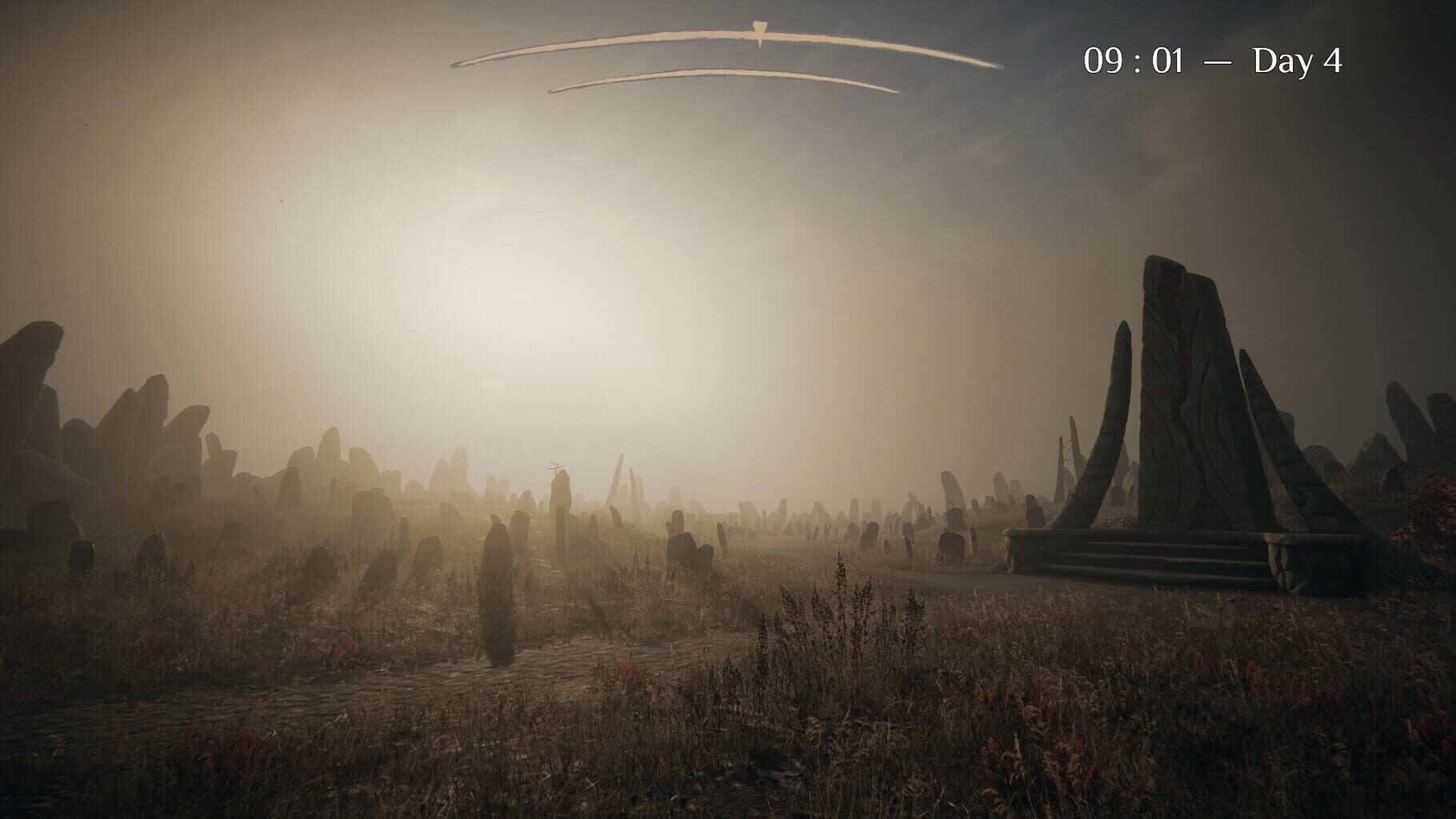




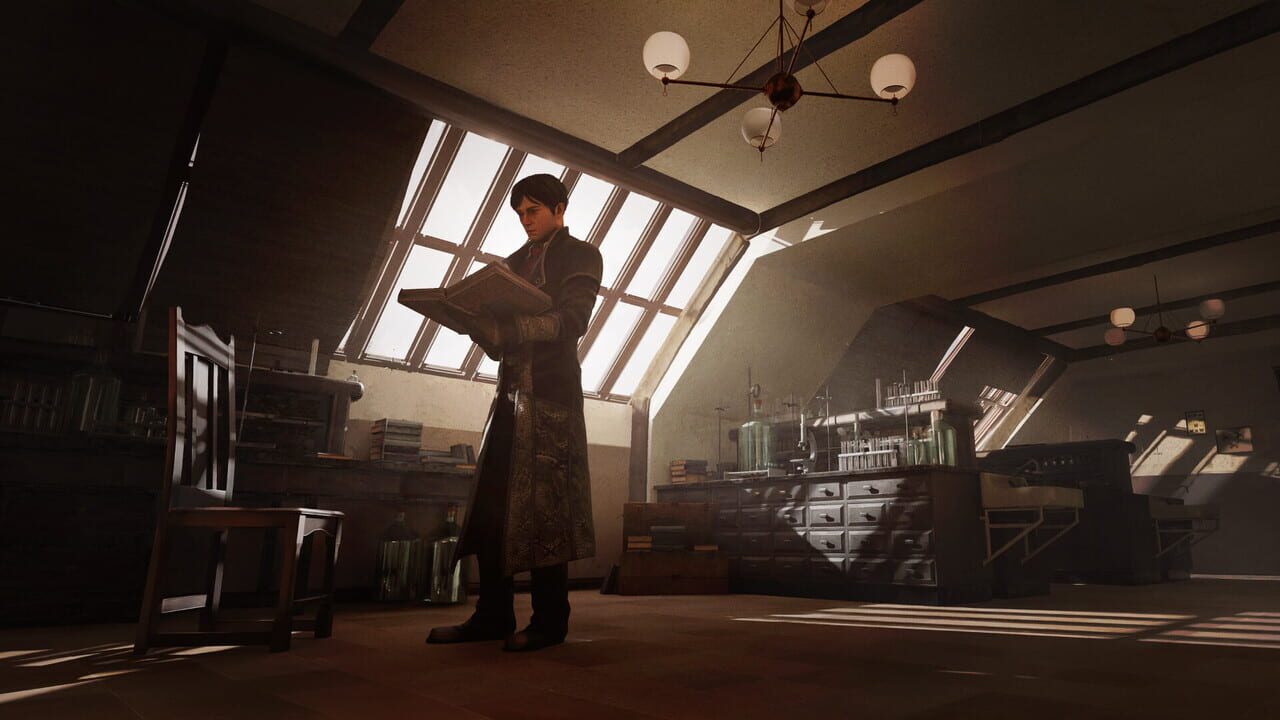
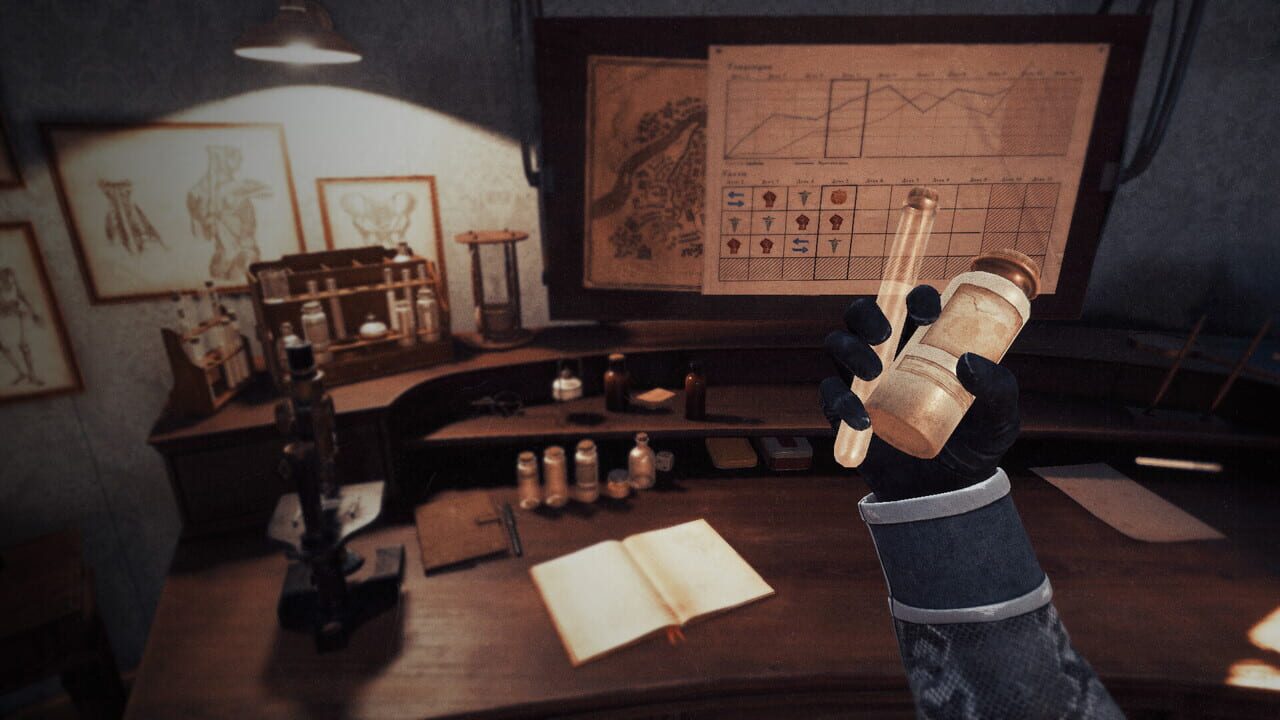


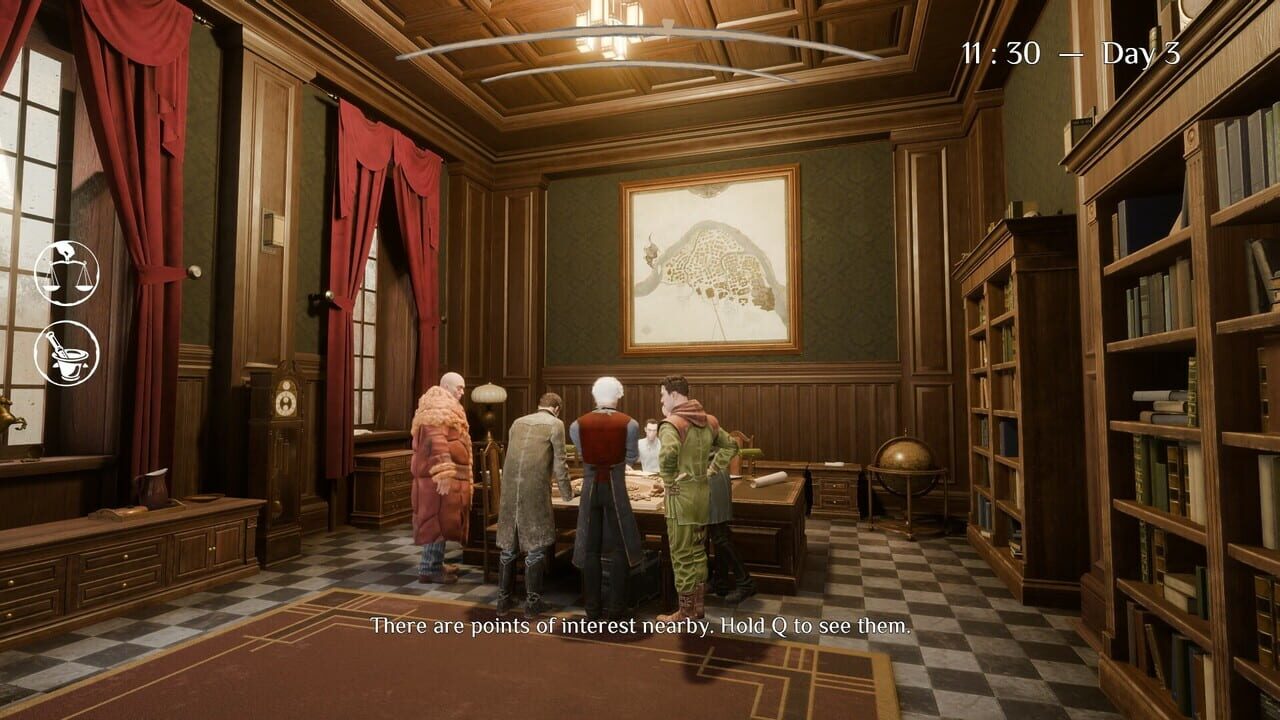
The clock on the wall is a real clock. It is half past four in the afternoon of the third day. The doctor is named Dankovsky. He is standing in the consulting room of a house at the western edge of a small town on a steppe in the Russian-empire-shaped fictional country the Ice-Pick Lodge games have been inventing for twenty-one years. The patient is dying. The cure the doctor has been working toward for the better part of three days is ready, in a vial in the doctor's bag, and will not save the patient: there is a procedural reason, a logistical reason, and a social reason, and on the available evidence all three are operating at once. The clock ticks toward five. The patient dies. The doctor will leave the house. The day will continue. The day will, at the appointed hour, end. And then the day will begin again, with the same patient in the same bed in the same house, ready to die, the cure ready to fail to arrive in time, the clock ready to tick.
Pathologic 3, released by Ice-Pick Lodge in January 2026 and the studio's first major entry since the 2019 narrative remake, is a first-person medical-detective game whose central premise is a twelve-day clock with a time loop wrapped around it. The doctor has twelve days to do something with the plague that has settled into the town. The doctor's first attempts will fail. The doctor will learn what each failure cost. The doctor will be returned to the start of the campaign with what he has learned but without the lives he failed to save. The structure is unusual in mainstream commercial games and unusually well-suited to the argument the franchise has been making since 2005.
The argument is this: plague stories in fiction have to decide what kind of problem the plague is. Almost every plague story in mass culture, especially American mass culture, decides it is a knowledge problem. The doctor or the scientist needs to find the cure, identify the vector, sequence the pathogen, develop the vaccine. The narrative shape is the shape of an investigation that culminates in the right answer being found, after which the social order resumes. Twenty-eight Days Later, Outbreak, World War Z, Contagion, Resident Evil, The Last of Us - each is, beneath its specific genre furniture, a knowledge-problem narrative. The plague is a puzzle. The puzzle can be solved. The solving is the work.
Pathologic 3 refuses this. The plague is not, in any operationally meaningful sense, a puzzle that the doctor can solve. The cure is partly available. The cure does not save everyone. The plague is, instead, a social fact passing through skin: a condition under which a community has to figure out what kinds of obligations are still binding, what kinds of authority are still recognized, what counts as a death the survivors will mourn and what counts as a death they will attribute to someone's prior bad behavior. The doctor's job, in this register, is not to find the cure. The cure was never going to be the answer. The doctor's job is to do whatever he can with twelve days, in conditions that include the cure being insufficient, and to recognize that what he is doing is not medicine but a small form of triage in a town that is going to have to bury its dead anyway.
The frame this essay wants to give the reader is not specifically about Pathologic 3. It is about how to read any plague narrative, including the next one, when it arrives. Plague stories carry a fork. The fork is whether the story commits to the knowledge problem or the social-organization problem. Most stories commit to the first because the first has a satisfying ending. The second has, structurally, no ending. The town buries the dead. The town does what it can. The town continues, with the survivors carrying what the dead used to carry, in arrangements that are improvised, imperfect, and recognizably human. This is what disaster sociology has been documenting empirically for sixty years. It is also, mostly, what mass-cultural plague fiction has been refusing to render.
Susan Sontag, in Illness as Metaphor (1978) and the later AIDS and Its Metaphors (1989), made the foundational argument about why this matters. Sontag, who had been treated for breast cancer in the early 1970s and had spent the experience watching her doctors and the people around her load the disease with moral content, wrote the first book against the habit of turning illness into metaphor. Her claim was that diseases without clear biological understanding are particularly prone to being colonized by metaphor: tuberculosis became, in the nineteenth century, the disease of the sensitive and the artistic; cancer became, in the twentieth, the disease of the repressed and the angry; AIDS became, in the 1980s, the disease of the morally suspect. The metaphors are not innocent. They harm the sick by suggesting the disease is a confession. They also harm the response by suggesting the disease is the patient's fault, which is much more comfortable for the surrounding society than the alternative, which is that disease is a thing that happens to bodies whose biology is shared by everyone.
Sontag's argument has aged with disturbing relevance. The COVID experience between 2020 and 2024 produced, in real time, the same metaphor-loading she had described. The disease was, depending on who was speaking, the consequence of insufficient personal discipline, of failed individual responsibility, of poor lifestyle choices, of belonging to the wrong political coalition. The metaphors arrived faster than the science. The metaphors have outlasted the science. Most people who think about COVID today are thinking about it through the metaphor-residue, not through the epidemiology.
Pathologic 3 understands what Sontag was warning about. The town in the game does the metaphor-loading on a compressed timeline. By the third day, the disease has acquired a moral shape in the town's collective interpretation. The infected family in one quarter is suspected of having brought it on themselves. The clean district holds clean meetings about how the contamination is and is not their problem. The merchant guild has a different theory about origins than the priests, who have a different theory than the mystics, who have a different theory than the rationalist faction the doctor nominally represents. None of these theories is going to be correct, and most of them are going to be roughly equally useful for the people clinging to them. The plague is a fact. The interpretations are what people produce because the fact is intolerable without one.
What Pathologic 3 does that most plague fiction does not is take the interpretations seriously as a primary phenomenon. The town's competing explanations of the plague are not noise that the rational doctor has to brush past on his way to the cure. The competing explanations are the substance of the situation. They are what is actually animating the town's response. The merchant who refuses to admit an infected neighbor across the threshold is doing so because of an interpretive framework - about purity, about contagion, about whose suffering counts - that has nothing to do with the biological vector of the disease. The interpretive framework is what is determining who dies and who does not.
Mary Douglas, in Purity and Danger (1966), gave the foundational anthropological account of why this happens. Douglas's claim was that human societies organize themselves through categories of clean and unclean, ordered and disordered, in-place and out-of-place. The categories are not innocent reflections of empirical reality; they are constitutive of how the society makes sense of itself. Dirt, in Douglas's famous formulation, is not a natural category but a relational one: dirt is matter out of place. A piece of bread is food on a plate and dirt on the floor; the same molecules, two different categorical positions. When a society is functioning, its dirt categories are stable enough to allow daily life to proceed without constant interpretive work. When a society is under stress - and especially when the source of the stress is biological contamination that crosses ordinary categorical boundaries - the dirt categories collapse and have to be rebuilt under pressure. The rebuilding is rarely orderly. It produces, among other things, the scapegoating, the witch-hunting, and the suspicion of outsiders that historical plague responses have so reliably generated.
The town in Pathologic 3 is doing this categorical rebuilding in fast-forward. Twelve days is not long enough to develop new stable dirt categories. Twelve days is long enough for the existing categories to fail, the suspicions to harden, the small communities to seal themselves against the larger one, and the doctor - who is, by training and temperament, attached to the older rationalist categories the larger society had been using - to be progressively less able to operate inside the social space the categorical breakdown is producing. The doctor's medicine cannot get to the patient because the patient lives in a quarter the doctor cannot enter without first negotiating with three competing interpretive authorities, each of whom believes it is doing the work of public health by limiting the doctor's access.
This is the part of the game's design that the reviews have had the hardest time naming. PC Gamer's January review, like most of the critical coverage, framed the game as a difficult, cruel, and ethically intricate experience and left the framing there. The framing is correct as far as it goes. It does not name what is producing the difficulty. The difficulty is not, primarily, mechanical. The doctor's tools are adequate. The cure is, in some form, in the bag. The difficulty is that the social space the doctor is trying to operate in has stopped cooperating with the rationalist medical framework the doctor brought with him. The categories the doctor needs to assume - patient and physician, sick and well, infectious and clean, urgent and routine - are not the categories the town is now using. The doctor's competence is structurally insufficient to a situation in which the social agreements his competence had been resting on have dissolved.
Paul Farmer, the American physician and anthropologist whose 1999 Infections and Inequalities consolidated two decades of fieldwork in Haiti, Peru, and Rwanda, made the contemporary clinical-anthropological version of this argument. Farmer's claim, developed against the dominant late-twentieth-century public-health framework of his profession, was that infectious diseases do not distribute themselves randomly across populations. They distribute themselves according to the social arrangements the populations are living inside. Poverty, housing density, political neglect, uneven access to clean water, uneven access to medical care, the historical violence that produced the current distribution of any of those resources - all of these structure who gets sick and who recovers. The infection is biological. The infection's distribution is social. The treatment, if it is going to work, has to address both.
Farmer's framework reads as obvious in 2026 in the way ideas read as obvious after they have won. It was not obvious in 1999. It was a minority position, against a dominant view in his profession that held infectious diseases to be primarily biological problems with biological solutions. The dominant view had a comforting implication: the doctor's job was technical, the treatment was the cure, and the cure could be developed, manufactured, and distributed without much engagement with the patient's larger social conditions. Farmer's view had the uncomfortable implication that the doctor who treats only the biology is treating only part of the problem, and the part he is treating is the part that is, on the empirical record, often the smaller part.
Pathologic 3 is, in this Farmer-shaped reading, a long interactive argument for the larger part. The doctor's medical knowledge is, in the game's world, a real and useful thing. The doctor's medical knowledge is also, on the available evidence, insufficient to the situation he has been called into. The situation is not primarily a medical problem; it is a social problem with a medical symptom. The doctor can save some patients by being a better physician. The doctor can save more by being a partly competent diplomat and a partly competent ethnographer and a partly competent local-history-of-the-town person, in addition to being a physician. The game's design enforces this. The doctor who treats the campaign as a series of medical puzzles will fail. The doctor who treats the campaign as a series of social negotiations in which the medical work is one component among several will do somewhat less badly, on a scale of failure that has, structurally, no success state.
The time loop is the formal innovation that makes this argument legible. Without the loop, the campaign would resolve in one of the two standard plague-narrative shapes: either the doctor saves the day (knowledge-problem ending) or the doctor tragically fails (the heroic-tragedy ending that lets the audience experience the loss as catharsis). The loop refuses both. The first day repeats. The same patient dies. The doctor is returned, with what he has learned, to a situation in which what he has learned is partially useful and partially irrelevant, because the social conditions that allowed the patient to be in the position to die have not changed. The repetition is not, in the usual time-loop sense, an opportunity for mastery. The repetition is a clarification of what the situation actually is. The doctor's accumulating knowledge does not solve the situation. The doctor's accumulating knowledge reveals that the situation was never going to be solved at the level the doctor was working at.
This is the moment in any analysis of Pathologic 3 where the temptation is to call the game depressing or punishing and to wonder whether the experience is worth it. The temptation is, on a careful reading, the wrong move. The game is not depressing. The game is honest about a kind of situation that the medium has rarely been honest about, and the honesty is what produces the difficulty. The plague is the framing case. The frame is generalizable. Many of the situations the contemporary adult is actually called into - the chronic illness in the family, the institutional failure at work, the political-social emergency on the news, the small-scale local crisis that the larger systems have stopped being able to address - are not knowledge problems with clean solutions. They are social-organization problems in which the available competence is partial, the available time is bounded, and the question is not how to make the problem go away but how to behave well inside it.
The medium has, until recently, not had many forms for rendering these situations. The action-game framework defaults to the knowledge problem because the action-game framework needs a problem to solve. The narrative-game framework defaults to the heroic-tragedy structure because the narrative-game framework needs a recognizable emotional arc. Pathologic 3 has built a third framework. The framework is bounded time, accumulated partial knowledge, no success state, and a long careful attention to what the social space inside the bounded time actually contains. The framework reads, on first encounter, as cruelty. The framework is, on second encounter, an unusually accurate model of the situation the contemporary adult is actually being asked to function inside.
There is a small sardonic observation worth making here, because the surrounding critical conversation has been mostly solemn about Pathologic and the solemnity is itself part of the game's reception problem. The Ice-Pick Lodge studio has been, for twenty-one years, the medium's most articulate practitioner of a particular kind of game that is hard, miserable, frequently unsatisfying, and intellectually superior to almost everything the larger commercial industry is producing. The studio has spent twenty-one years being praised for these qualities by people who would not, in any practical sense, want to live next door to them. Ice-Pick has built a small global audience of admirers who own the games, recommend the games to others, and, in a substantial fraction of cases, have not actually finished any of them. This is not a criticism. It is an observation about what kind of cultural object the franchise has become: an object whose existence does more cultural work than its consumption does. The objects are precious because they are there. The not-finishing is, in a small way, part of the project. The town continues whether or not you, the doctor, manage to do anything useful during the twelve days. The town will continue if you put the game down on day six.
What Pathologic 3 offers, beyond its surface as a brutal time-loop medical detective story, is a working model of what it looks like to take a non-solvable social-organization problem seriously, in the interactive medium, without flinching into the knowledge-problem framework that the medium's economic logic prefers. The model is rare. The model is, in the empirical record of how disasters actually unfold, more accurate than the alternatives the medium has been producing. The reader who walks away from this essay with one frame should walk away with the fork: every plague story commits to either the knowledge problem or the social-organization problem. Notice which one the next plague story you encounter has committed to. The commitment is not usually announced in the marketing. The commitment is in the design of what failure looks like.
The doctor is in the consulting room on the morning of the third day for the second time. The patient is in the same bed. The cure is in the same bag. The doctor knows, this time, that the cure will not arrive in time, and knows roughly why. The doctor goes to the patient anyway. The patient is going to die in the same forty minutes. What the doctor is doing in those forty minutes is not, on any rationalist medical accounting, useful. The doctor is doing it because what the situation requires, given that the cure is not going to work, is for someone to be in the room while the patient dies. This is also a kind of work. It is the kind of work the rationalist medical framework had assigned to the chaplain, in better-organized situations. The chaplain is, today, somewhere in the town, in a quarter the doctor cannot easily enter. The doctor is, in his place, doing what he can.