

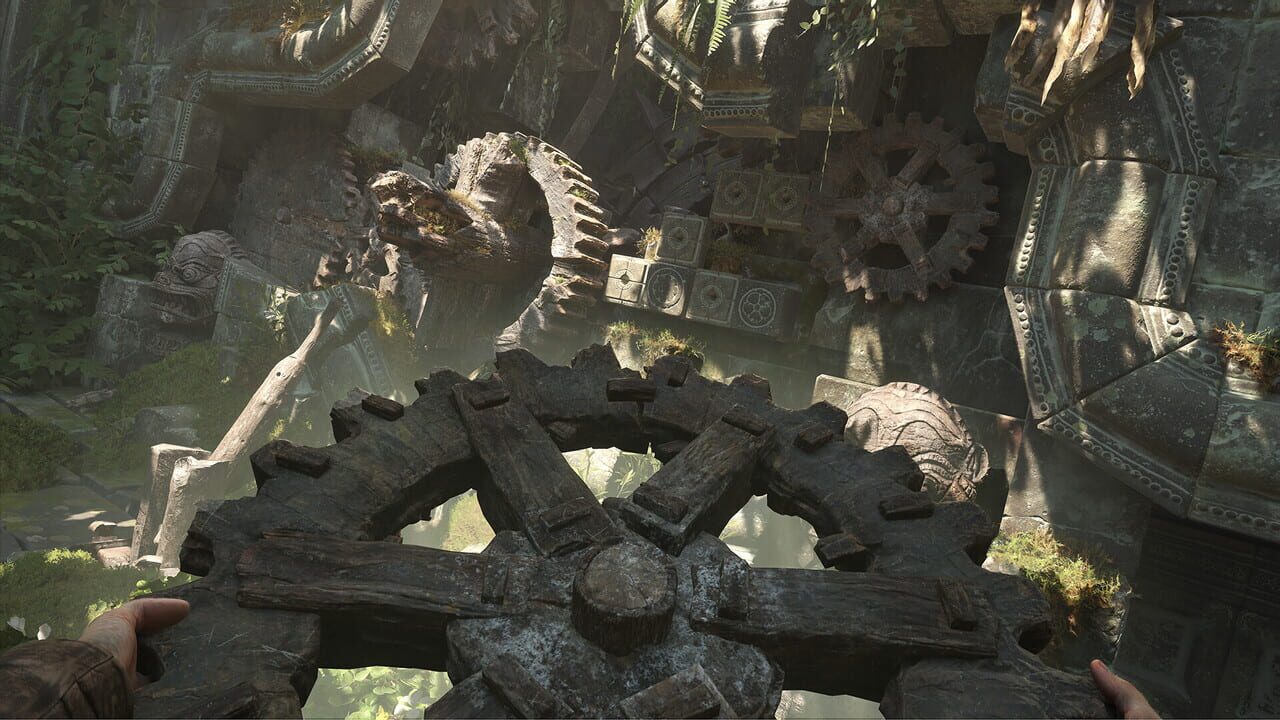
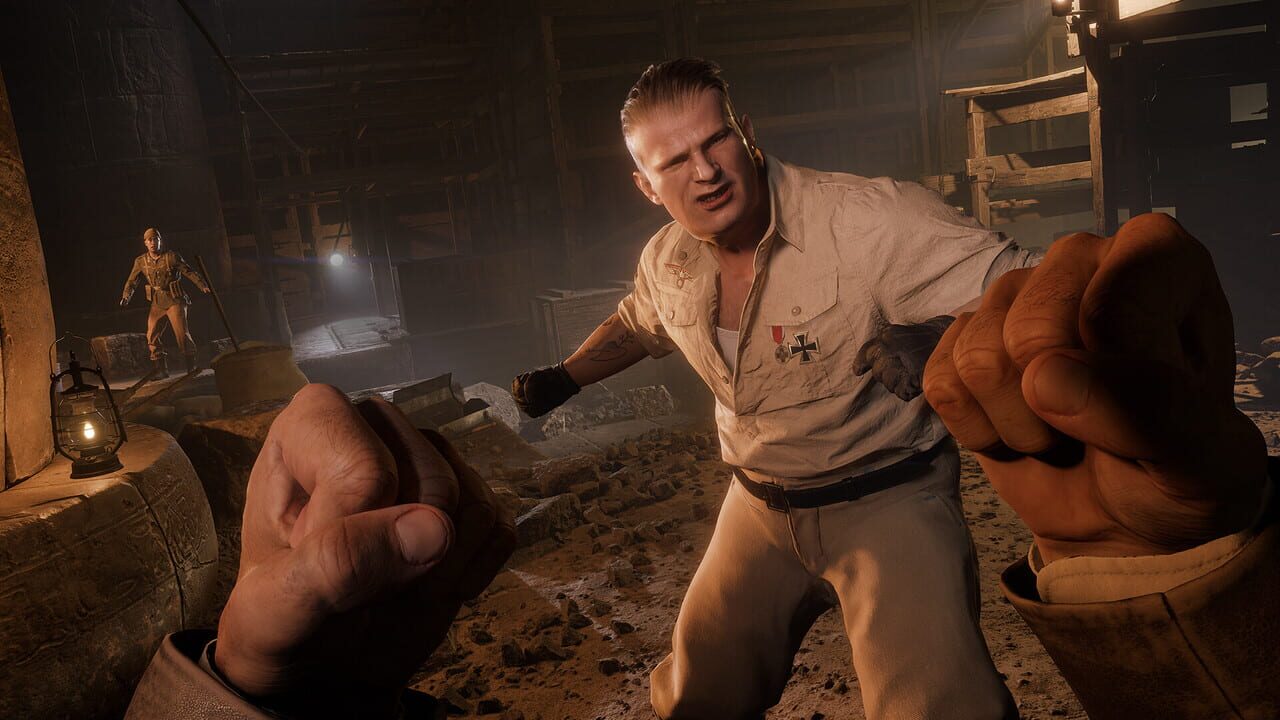
Indiana Jones, in the four films, shoots almost nobody who matters. The character carries a revolver, the revolver appears in many scenes, and across roughly nine hours of total screen time the character uses the revolver in maybe a dozen consequential moments. The character's primary verb across the franchise is something else. The character punches Nazis. The character runs from boulders. The character whips a sword out of a man's hand. The character traps another man in a ceiling fan. The character climbs out of submarines. The character escapes from collapsing tombs. The character solves puzzles in ancient mechanisms. The character, in the franchise's best scenes, talks his way through situations that would have killed a less verbally-resourced protagonist. The shooting is, on a careful count of the films, almost never the part of the scene that matters.
This is the obvious fact about the Indiana Jones character that the previous several decades of video-game adaptations have failed to honor. The previous Indiana Jones games have been, in their majority, shooters. The character has been given a gun the films treat as a side accessory and a tactical-shooter level structure the films were structurally not built around. The character has been forced, by the conventions of the medium's dominant action-game genre, to do most of his work in the verb the films had specifically declined to use as the character's primary verb. The adaptations have been competent in many cases. They have not, in any of the cases, felt like Indiana Jones.
The claim that the previous games have been shooters "in their majority" needs a name attached to its exception, since a generalization stated that flatly invites the reader to go looking for the counter-case, and the counter-case exists. Indiana Jones and the Fate of Atlantis, the LucasArts point-and-click adventure Hal Barwood and Noah Falstein designed in 1992, solved this problem three decades before Great Circle solved it again. Partway into the story, Fate of Atlantis lets the player choose among three paths: a Wits path built entirely from puzzle-solving, a Fists path built around fistfights resolved through a simple mouse-or-keyboard combat mode, and a Team path that splits the difference and adds Sophia Hapgood as a companion. None of the three paths puts a gun in the player's hand. The choice on offer is between two of the verbs the films had actually calibrated, thinking and punching, with a hybrid available for the player who wants both. A design team working in 1992, on a genre built for dialogue trees and inventory puzzles rather than for combat, arrived at the character's real verb economy without needing three more decades of hindsight to find it.
What happened to that discovery between 1992 and 2024 is not a mystery specific to Indiana Jones. The graphic adventure, the genre Fate of Atlantis belonged to, was a commercially dying format within the decade. LucasArts released Grim Fandango in 1998 to some of the best reviews the studio ever earned and, by PC Data's count, fewer than sixty thousand copies sold in the United States in its first year. Indiana Jones and the Infernal Machine, the next Indy game after Fate of Atlantis, arrived the following November as a third-person action-adventure with platforming, environmental puzzles, and, for the first time in the series, firearms fired at Soviet soldiers. Reviewers noticed immediately what the new template had cost the character. Tom Chick, reviewing Infernal Machine for Computer Games Strategy Plus, called it "a tedious, frustrating, flat-chested, wisecracking Tomb Raider who's nothing like the Indiana Jones that you know and love" - the same complaint this essay has been making, filed twenty-five years earlier by a critic who never needed the phrase verb economy to feel the mismatch. LucasArts shipped one further adventure game, Escape from Monkey Island, in 2000, then left the genre, citing a PC market that had moved on from graphic adventures. The pivot was not one designer's failure of nerve. It was a format dying across an entire cohort of publishers at once, adventure design abandoned for the 3D action template Tomb Raider had made the era's default, and Indiana Jones carried along inside a shape built for a different kind of character.
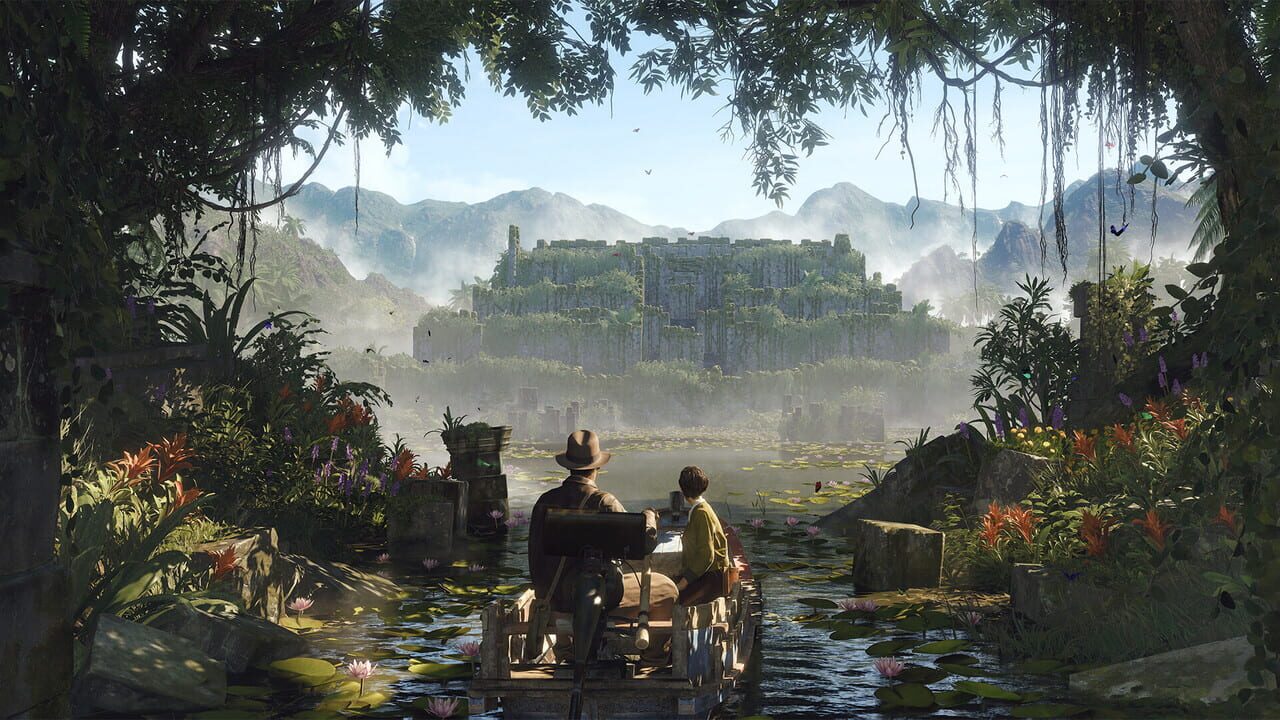
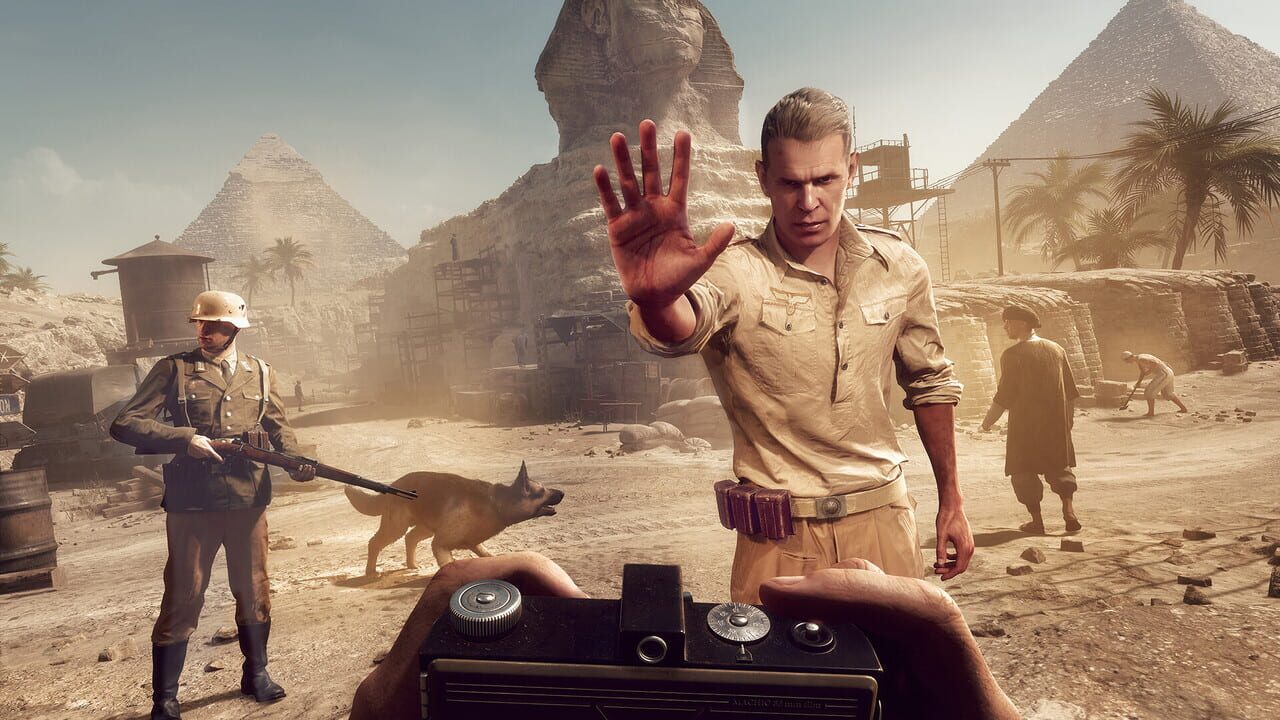
Indiana Jones and the Great Circle, released by MachineGames in December 2024, is the first major commercial Indiana Jones game in three decades to ask the obvious question the surrounding adaptations had been avoiding. The question is: what would an Indiana Jones game whose verb economy actually matched the films' verb economy be? The answer the studio arrived at is: a first-person adventure game with substantial puzzle-solving, traversal, environmental interaction, social negotiation, and short brutal moments of close combat that resolve with the same punching-and-improvising rhythm the films had calibrated. The studio has, in effect, built the game the films would have produced if the films had been games. The game has, in commercial reception, become one of the most-praised licensed-IP video games of the past decade.
The frame this essay wants to give the reader: when a cinematic source is adapted into a video game, the studio has to make a choice about which verbs the player will perform. The choice is rarely the verb the source actually uses. The choice is, in most cases, whatever verb the medium's dominant genre conventions at the moment of adaptation make easiest to ship. The mismatch between the source's verb economy and the adaptation's verb economy is the single most common reason cinematic-IP video games feel wrong even when the visual fidelity and the cast and the writing are competent. The Great Circle has done what the surrounding tradition has been failing to do, and the demonstration changes what the medium can ask of itself in future cinematic adaptations.
This is a frame that travels. Once the reader has it, almost every cinematic-IP video game becomes evaluable on a single useful question. What verb does the source actually privilege? What verb has the adaptation chosen? Do the two match? The answer, in most cases, is no. The James Bond games have made Bond a shooter, when the films treat shooting as one verb among many. The Star Wars games have, with varying success, made the protagonist a swordfighter or a shooter, when the films distribute the protagonist's verb economy across many activities. The Marvel games have, in most cases, made the hero a beat-em-up combatant, when the films have specific verb economies for each character that the games rarely honor. The Harry Potter games have varied wildly in which verbs they emphasized, with the better entries (the Lego adaptations, in their best moments, and Hogwarts Legacy in some of its design choices) matching the source's specific blend of exploration, spell-casting, and small social interactions more carefully than the worse entries did.
The reader can apply this frame retroactively to almost every cinematic-IP game in their own history and arrive at a more interesting evaluation than the marketing-driven reception had delivered. The games that felt wrong probably felt wrong because the verb economy was wrong. The games that felt right probably felt right because the verb economy was right. The visual fidelity, the music, the cast, the writing, are real factors and they matter. They are also, on the available reception evidence, secondary to whether the player's actual moment-to-moment activity matches what the source had been training the audience to expect.
The Bond example deserves a harder look than the paragraph above gave it, because a reader who knows the films will object immediately: Bond shoots people constantly, more often and more coldly than Indiana Jones does, and the single most decorated licensed adaptation in the medium's history is a shooter built around him. GoldenEye 007, the 1997 Rare game for the Nintendo 64, is still, by most critical and commercial accounts, the best Bond game ever made and one of the best licensed games of any franchise, having sold more than eight million copies on one console alone. If shooting is the wrong verb for a cinematic secret agent, GoldenEye should not exist as a counterexample. It plainly does.
The objection has real force, and the honest concession is that Bond's relationship to guns is not Indiana Jones's. Bond carries and fires a weapon in nearly every film, often with the cold precision the character is defined by, and the earlier claim in this essay that the films treat shooting as one verb among many understates how central marksmanship is to the character's identity. What GoldenEye actually matched was texture rather than category: the specific rhythm of Bond's shooting, economical and precise, rather than the generic fact of shooting itself. Bond's on-screen gunplay favors a silenced PP7, a single clean shot, a guard dropped before he can radio for help, a mission built around planting a bomb or photographing a folder of documents rather than clearing a corridor of bodies. GoldenEye built its levels and its difficulty settings around exactly that rhythm, with hit locations that mattered, silenced stealth routes through the game's opening dam and facility levels, and objectives that were rarely reducible to killing the room. 007: Quantum of Solace, the 2008 video-game tie-in Treyarch built on the Call of Duty 4 engine, tested the same distinction and failed it: same verb, same franchise, a cover-based firefight structure borrowed wholesale from a different genre, and a critical reception that called it short, repetitive, and unoriginal despite being, mechanically, a competent shooter. Both games hand Bond a gun. Only one hands him the specific way the films taught an audience to watch him use it: economical, cold, rarely sustained. A verb carries a texture along with its category, a rhythm and a set of stakes borrowed from the source, and matching the category while missing the texture is how Quantum of Solace ended up playing like Call of Duty in a tuxedo. Great Circle's whip and its fists have to clear the same bar. Being present in the game world is the easy half. The harder half, the one MachineGames actually earns, is the rhythm of a punch or a climb matching what four films spent a combined nine hours teaching an audience to expect.
Henry Jenkins, the American media theorist whose 2006 Convergence Culture developed the contemporary framework for thinking about how intellectual property moves between media, gave the analysis the cultural-theory grounding it needs. Jenkins's central observation was that the most successful cross-media adaptations are the ones in which the receiving medium's specific affordances have been carefully calibrated to the source's specific properties. Adaptation is not, on Jenkins's argument, the reproduction of a source for a new medium. Adaptation is the careful construction of a new artifact that takes the source's specific properties and renders them in ways the new medium can deliver. The new artifact has to be honest about what the new medium can and cannot do. The new artifact also has to be honest about what the source's specific properties actually are.
Most cinematic-IP video-game adaptations have failed on the second of these. The studios have, in many cases, treated the source as if its specific properties were the visual surface (the costumes, the actors, the music) rather than the deeper structural properties (the verb economy, the pacing of consequences, the specific relationship between protagonist and antagonist that the source had calibrated). The visual surface has been faithfully reproduced. The structural properties have been substituted with whatever the receiving medium's dominant genre conventions made convenient. The result has been many adaptations that look like the source and play like a different source's adaptation.
MachineGames is the studio that has, on the available evidence, been working on this problem more carefully than most of the cinematic-IP-adaptation field. The studio's previous decade was substantially devoted to the Wolfenstein series, where the same problem applied: William J. Blazkowicz, the protagonist, is a specific cinematic-action-hero figure with a specific verb economy, and the studio's adaptations have been distinguished by their commitment to honoring that verb economy even when the medium's broader conventions would have pushed in different directions. The studio came to the Indiana Jones project with substantial practice at the specific design problem the project required. The practice was visible in the early footage and is now visible in the finished game.
Brendan Keogh, in A Play of Bodies (2018), gave the contemporary game-studies vocabulary for what is at stake here. Keogh's central argument was that video games produce specific bodily experiences in their players, and that the experiences are determined more by the games' verb economies than by their visual or narrative content. The player's body, in the small interactive way the medium permits, is doing what the game's verb economy asks the body to do. The shooter's body is different from the platformer's body, which is different from the puzzle-solver's body, which is different from the racing-game body, which is different from the adventure-game body. The body the player has been operating for forty hours is the body the player will remember the game by, more than any of the surface features the marketing apparatus has been emphasizing.
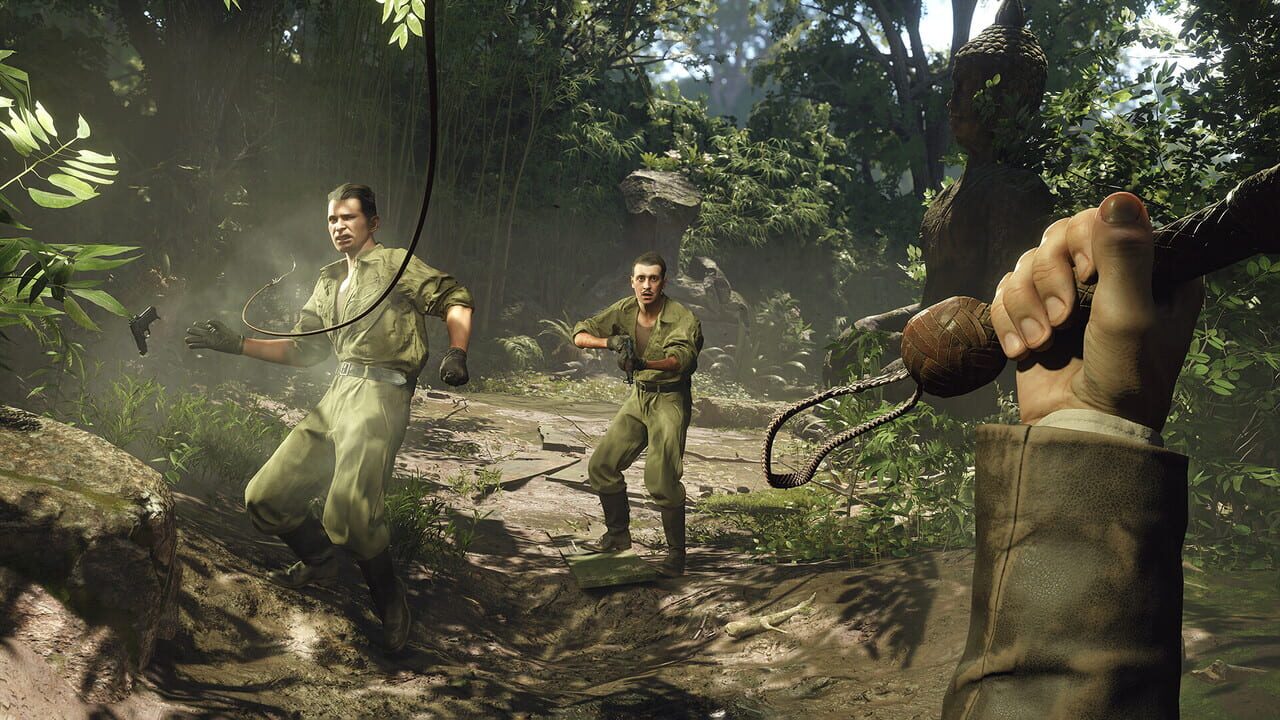
This is what The Great Circle has gotten right that the surrounding tradition had been getting wrong. The body Indiana Jones operates in the game is the body the films had calibrated. The body climbs into and out of crawlspaces. The body uses the whip as a tool the films had calibrated the whip to be (transit aid, disarming weapon, retrieval tool, occasional combat verb). The body solves environmental puzzles that have the specific architectural-mechanical character the films' set-pieces had calibrated. The body punches Nazis the way the films' Indiana Jones punches Nazis, which is to say with the specific blend of practiced competence and visible cost that the films' Indiana Jones had been calibrated to. The body talks its way through situations when the situations permit. The body, in the rare moments combat is the right verb, performs combat in a register that matches the films' calibrations of combat: short, brutal, improvised, often resolved through environmental interaction rather than through pure damage exchange.
MachineGames has explained the mechanism for enforcing this preference in terms closer to a design document than to film criticism. Axel Torvenius, the game's creative director, told Edge magazine in September 2024 that guns sit in the world in real numbers but that the systems around them were not built to reward their use. "We do not encourage gunplay," he said. "It's not being pushed as the primary way forward. We have a game where plenty of guns are in there, but you choose not to use them because it's too loud and dangerous." A gunshot in the game does more than kill one guard. It summons every other guard within earshot, turns a stealth encounter into a firefight the player is not equipped to win, and spends ammunition the game does not restock generously. The design pushes further than withholding reward: a gun can be picked up and swung as a club instead of fired, which Torvenius described as a fittingly in-character use of a gun for a man who would rather not use one. Punching, throwing, and hiding stay the rational choices for most of the campaign because the systems punish the alternative, not because a cutscene insists that Indiana Jones is a scholar first. The films never had to explain why their hero preferred his fists to his revolver. The game had to build an economy that makes the fists the smarter bet and then let the player learn the preference by getting shot at twice. The irony reaches the engine itself: id Tech 7, the technology id Software built for Doom Eternal and the line MachineGames has used for every game it has made, spends this campaign talking the player out of the one verb it was built to deliver.
The result is a game whose forty hours of campaign produce, in the player's bodily memory, the specific Indiana Jones body the films had built. The game, in this register, accomplishes what cinematic-IP adaptation has been failing to do for decades. The game is also, on commercial measure, demonstrating that the audience for the well-built adaptation is larger than the publishing arithmetic has been assuming, because the audience can tell when the verb economy has been honored and when it has not.
The implication for the medium extends past Indiana Jones. The next decade of cinematic-IP adaptations will be made by studios whose design teams have, in some cases, internalized what The Great Circle and a few other recent successes have demonstrated, and in other cases will continue to make the same verb-economy substitution errors that the previous tradition has been making. The reader who has the frame can predict, with reasonable accuracy, which announcements will produce strong adaptations and which will produce weak ones. The signal is in which studio has actually put in that effort, what design vocabulary they have demonstrated competence in, and whether the studio's previous projects show evidence of careful attention to verb economies.
The reader can also apply the frame retroactively, with practical results. The adaptation in the reader's life that felt right despite being technically modest probably got the verb economy right. The adaptation in the reader's life that felt wrong despite being technically impressive probably got the verb economy wrong. The pattern holds across many specific cases. Recognizing the pattern changes what the reader values in future announcements and what the reader chooses to commit time to.
The deeper continuity in this argument is that the medium has spent thirty years assuming that cinematic-IP games should default to shooter mechanics because shooter mechanics were the medium's most-refined verb economy at any given moment. The assumption was a function of the medium's specific commercial history, not a function of what cinematic-IP adaptations actually require. The Great Circle has demonstrated that the assumption can be set aside when the studio has the institutional confidence and the design vocabulary to set it aside. The demonstration is the part of the game that travels past the franchise. Other studios working on other cinematic adaptations can, if they pay attention, do the same thing the studio did here.
There is a smaller closing observation worth registering, because MachineGames as a studio has a specific cultural-political character that the surrounding conversation has been mostly polite about. The studio has spent the past decade making games whose central moral content is that the Nazi must be killed. The Wolfenstein series has been one of the contemporary medium's clearest sustained commitments to this proposition. The Indiana Jones films, the source the new game is adapting, were also produced under the same general moral proposition: Indiana Jones punches Nazis. The Nazi falls. The form remembers. The cultural maintenance of the anti-fascist pulp imagination is, on the longer historical record, one of the small useful things mass culture has done for the cultures that produced it. The form is healthier when it continues to do this work. The studio is healthier when the studio commits to the doing. The game is, in this register, one of the small entries in the cultural-historical tradition that has, in many specific moments, helped the surrounding population remember that some things, when they appear, must be opposed by force. The frame the reader can carry: the cultural products that maintain the anti-fascist imagination are doing small useful work the surrounding culture continues to need.
The reader who finishes the essay can, from this point forward, evaluate every cinematic-IP video-game adaptation with the simple question: does the game's verb economy match the source's? The answer is more often available than the marketing copy lets on. The studios that get it right deserve recognition for the specific craft skill the getting-right requires. The studios that get it wrong are usually getting it wrong for predictable commercial reasons that the reader can name. The pattern, once visible, becomes one of the more useful tools the reader has for navigating the steady stream of adaptation announcements the contemporary entertainment-industry pipeline produces.